In Illinois, a driver turning left frequently bears fault because 625 ILCS 5/11-902 requires the turning driver to yield to oncoming traffic close enough to constitute an “immediate hazard.” But fault is not automatic. The signal phase, each vehicle’s speed and position, and the available evidence determine whether the yielding duty was violated and whether either driver contributed.
The assumption that the turning driver is responsible comes from a real legal duty: a left turn crosses the path of opposing traffic. But Illinois law does not require yielding to every oncoming vehicle regardless of distance or timing.
That distinction can matter in Chicago car accident claims where the drivers disagree about the signal phase, speed, or when the turn began.
Key Takeaways:
- Illinois requires a left-turning driver to yield to oncoming traffic that is so close as to constitute an immediate hazard under 625 ILCS 5/11-902.
- Fault is not automatic. Distance, speed, timing, signal phase, and each driver’s conduct may affect the analysis.
- A green arrow and a circular green signal are different under 625 ILCS 5/11-306, and each carries different yielding requirements.
- A traffic citation does not decide civil fault. A statutory violation may be prima facie evidence of negligence, but causation still must be proven.
- Both drivers may share fault under 735 ILCS 5/2-1116, which reduces recovery proportionally and bars it when the plaintiff’s fault is more than 50%.
- Most Illinois personal injury claims have a two-year filing period, but shorter deadlines may apply to public-entity claims.
- A driver with the right-of-way still owes a duty of ordinary care; right-of-way does not automatically resolve fault.

Who Is Usually at Fault in an Illinois Left-Turn Accident?
There is no automatic rule that makes the left-turning driver liable for every Illinois left-turn crash. Illinois instead requires the turning driver to yield to an oncoming vehicle that is “so close as to constitute an immediate hazard.” That makes the surrounding facts, especially distance, speed, signal phase, and timing, central to the fault analysis.
The assumption that the turning driver is responsible comes from the structure of the maneuver itself. A left turn crosses the path of opposing traffic, so Illinois law places a specific yielding duty on the driver making the turn. Once that driver has yielded, however, § 11-902 says the turn may proceed when a safe interval occurs.
That means the legal question is not simply who was turning. It is what each driver was doing when their paths crossed.
Illinois places duties on both drivers approaching a left turn, and fault depends on what the evidence shows about each.
What Illinois Law Requires of Drivers in a Left-Turn Crash
Illinois law places duties on both drivers in a left-turn collision, so the table below summarizes the key requirements that may affect the fault analysis.
Key Duties in an Illinois Left-Turn Collision
| Driver or Road User | What Illinois Law Generally Requires | Authority |
|---|---|---|
| Driver Turning Left | Yield to opposing traffic that is close enough to constitute an immediate hazard, make the turn only when it can be made with reasonable safety, signal the movement, and obey the traffic signal governing the turn | 625 ILCS 5/11-902; 625 ILCS 5/11-804; 625 ILCS 5/11-306 |
| Oncoming Driver | Obey the signal controlling the movement and operate consistently with the traffic laws governing the approach to the intersection; the driver’s own conduct may also be relevant to negligence and comparative fault | 625 ILCS 5/11-306 and other applicable Illinois Vehicle Code provisions |
| Driver Turning Near Pedestrians or Bicyclists | Yield where required to pedestrians and bicyclists lawfully within the intersection or adjacent crosswalk under the applicable signal rules | 625 ILCS 5/11-306 |
| Person Riding a Bicycle on the Roadway | Generally has the rights and is subject to the duties applicable to drivers, except provisions that by their nature do not apply to bicycles | 625 ILCS 5/11-1502 |
This table summarizes general Illinois traffic duties and does not determine fault in any individual collision.
A turning driver can therefore violate Illinois law by beginning a left turn when an oncoming vehicle presents an immediate hazard. But the presence of a left turn alone does not establish negligence, and the conduct of the oncoming driver may also become relevant depending on the evidence.
What Illinois Law Requires of a Driver Turning Left
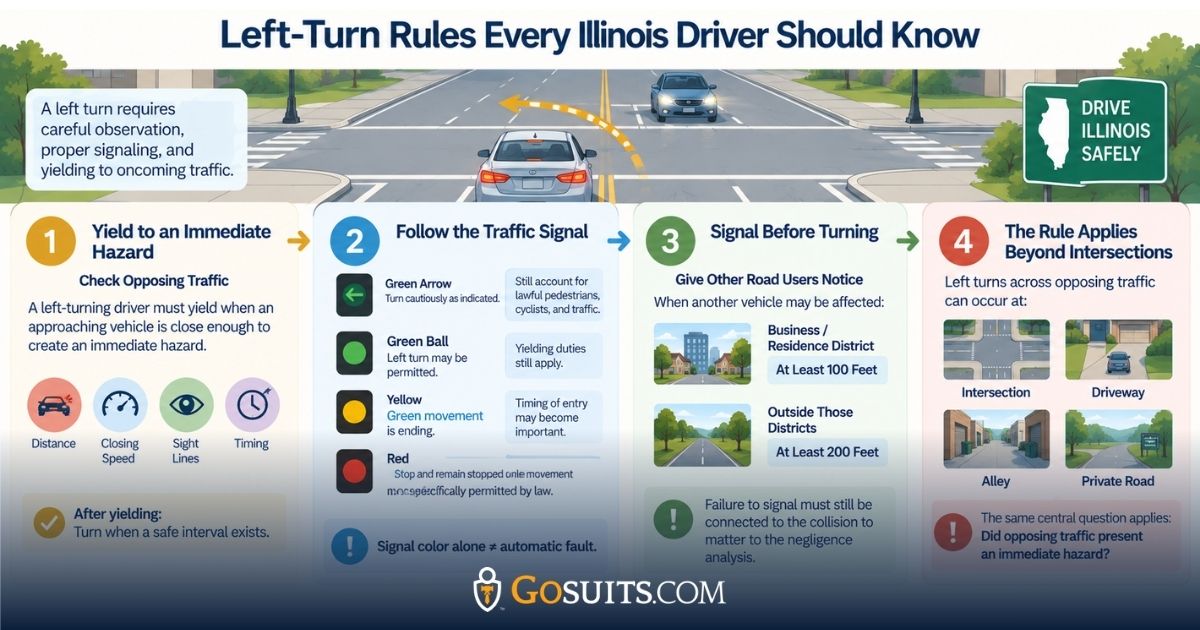
Illinois requires a driver making a left turn to yield when opposing traffic is close enough to constitute an immediate hazard, signal the intended movement, and follow the traffic signal controlling the turn. These duties apply based on the circumstances of the movement rather than creating automatic fault whenever a left-turn collision occurs.
The “Immediate Hazard” Standard
Under 625 ILCS 5/11-902, a driver intending to turn left within an intersection must yield to a vehicle approaching from the opposite direction when it is “so close as to constitute an immediate hazard.”
The phrase matters because the statute does not require a driver to wait until every opposing vehicle has passed. After yielding as required, the statute permits the driver to make the left turn when a safe interval exists.
Determining whether an approaching vehicle presented an immediate hazard may therefore require evidence about distance, closing speed, sight lines, and timing. Where each vehicle was when the turn began can be particularly important. An oncoming vehicle that was farther away when the movement started presents a different factual question from one that was already approaching the intersection closely.
These facts do not produce an automatic answer. They help determine whether the yielding obligation under § 11-902 applied under the circumstances and whether either driver’s conduct contributed to the collision.
Green Arrow, Green Ball, and Yellow
The signal displayed when a left turn begins can materially affect the analysis. Under 625 ILCS 5/11-306, Illinois distinguishes between a green arrow, a steady circular green, and a yellow indication.
A green arrow permits the indicated movement to enter cautiously, but the driver must still yield to pedestrians, bicyclists, and other traffic lawfully using the intersection.
A steady circular green may permit a left turn, but the driver remains subject to applicable yielding duties, including the immediate-hazard rule in § 11-902 for opposing traffic.
A yellow indication warns that the related green movement is ending. If the drivers dispute which signal governed the turn, signal timing records may help reconstruct the sequence. The signal phase is important, but it must be considered with § 11-902 and the rest of the evidence.
How the Signal Indication Changes the Left-Turn Analysis
The signal governing the vehicles can materially affect which yielding and signal-compliance duties apply.
How Traffic Signals Affect Left-Turn Fault in Illinois
| Signal Indication | What It Generally Permits | How It May Affect the Analysis |
|---|---|---|
| Green Arrow | The driver may cautiously enter to make the movement indicated by the arrow | The arrow authorizes the indicated movement, but the driver must still account for pedestrians, bicyclists, and other traffic lawfully using the intersection |
| Steady Circular Green | A driver may proceed straight or make a permitted turn | A driver turning left remains subject to applicable yielding duties, including the immediate-hazard rule for opposing traffic under § 11-902 |
| Steady Yellow | Warns that the related green movement is ending and a red indication will follow | The timing of entry may become important when the drivers disagree about which indication governed their movements |
| Steady Red | Requires traffic to stop and remain stopped subject to turns or other movements specifically permitted by Illinois law | Evidence that a vehicle entered contrary to the applicable red-signal rule may be relevant to negligence and comparative-fault analysis |
This table provides a general summary of 625 ILCS 5/11-306 and 625 ILCS 5/11-902. The signal indication alone does not determine civil liability.
Signaling the Turn
Illinois also requires a driver to signal before making a turn when another vehicle may be affected by the movement. Under 625 ILCS 5/11-804, the signal must be given continuously for at least 100 feet in a business or residence district and 200 feet outside such a district before the turn.
A failure to signal does not automatically establish liability for a left-turn crash. Even when a statutory violation is established, Illinois negligence law still requires a connection between that conduct and the injury. If the presence or absence of a turn signal had no bearing on how the collision occurred, the violation may have a different significance than when another driver relied on the vehicle’s apparent direction of travel.
Turns Into Driveways, Alleys, and Private Roads
Illinois’ left-turn yielding rule is not limited to intersections. Section 11-902 expressly applies when a driver intends to turn left “into an alley, private road, or driveway” as well as when turning within an intersection.
That means the same immediate-hazard question may arise when a driver crosses opposing traffic to enter a parking lot, business driveway, residential driveway, or private road. The location of the turn changes the factual setting, but it does not remove the yielding duty established by § 11-902.
When Is the Oncoming Driver at Fault?
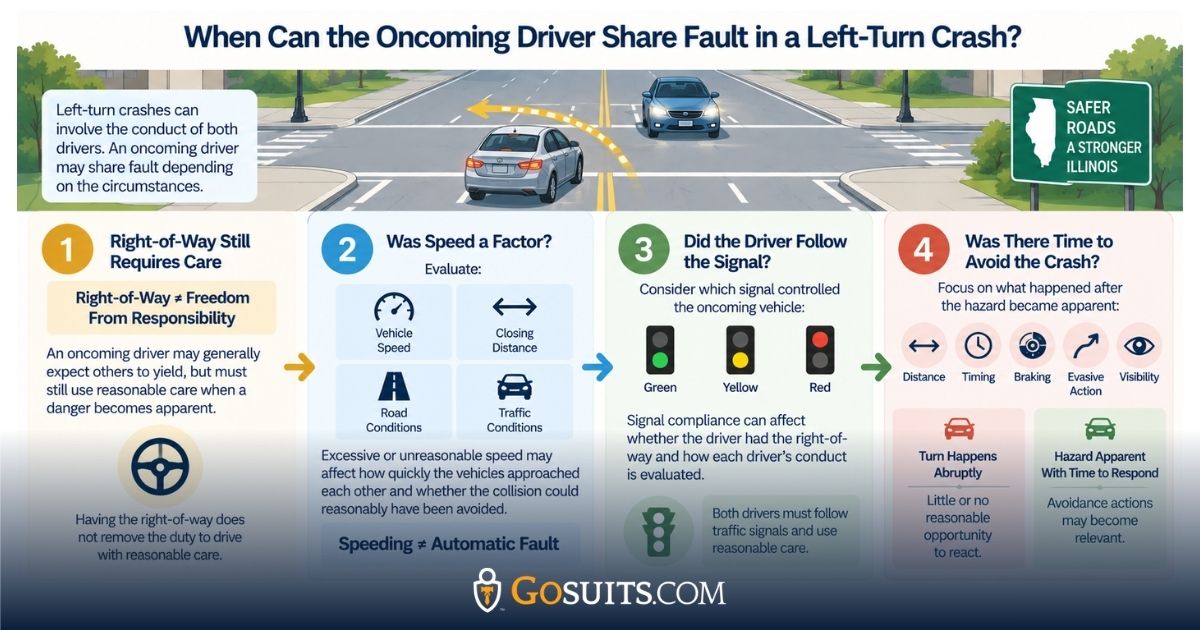
An oncoming driver may bear some or all of the fault when their own conduct contributes to a left-turn collision. Having the right-of-way does not eliminate the duty to exercise ordinary care, and factors such as speed, signal compliance, visibility, and the opportunity to avoid the crash may matter.
Right-of-Way Does Not Eliminate Ordinary Care
Illinois courts recognize that a driver with the right-of-way must still exercise ordinary care. A preferential driver generally may expect another motorist to obey applicable traffic controls or yielding duties, but the right-of-way is not absolute, and the driver must still keep a proper lookout and use reasonable care to avoid a collision when danger becomes apparent or reasonably should have become apparent.
In a left-turn crash, this means the turning driver’s duty under 625 ILCS 5/11-902 and the oncoming driver’s own conduct may both be relevant to negligence and comparative fault.
Speed Can Matter
The oncoming vehicle’s speed may affect both the immediate-hazard analysis and the evaluation of that driver’s conduct.
Under 625 ILCS 5/11-601, drivers must operate at a speed that is reasonable and proper for traffic and roadway conditions. Similar principles can become important when examining how Illinois assigns fault when road conditions contribute. Evidence of speed may help show how quickly the vehicles were closing distance and where the oncoming vehicle was when the turn began.
Speeding does not automatically shift fault. Its significance depends on whether it contributed to the collision.
Signal Compliance Can Change the Analysis
An oncoming driver’s right-of-way also depends on the signal governing that movement. Evidence that a driver entered contrary to the applicable red-signal rule may affect the fault analysis, while a driver proceeding lawfully may generally expect others to follow applicable yielding duties.
This is why a statement such as “the other driver had the right-of-way” does not always resolve a disputed left-turn crash.
What If the Oncoming Driver Could Have Avoided the Crash?
The ability to avoid a collision can be relevant, but Illinois law does not require a driver with the right-of-way to anticipate every unlawful movement by another motorist.
Illinois appellate decisions distinguish between a hazard that gives a driver a reasonable opportunity to respond and a vehicle that moves into the driver’s path so abruptly that a collision cannot reasonably be avoided. The relevant question depends on what the driver observed or reasonably should have observed and what opportunity existed to respond.
As a result, evidence that the oncoming driver saw a left-turning vehicle does not by itself establish fault. The timing of the turn, distance between the vehicles, speed, braking, evasive action, and other circumstances may determine whether additional action was reasonably possible.
Does a Ticket or a Police Report Decide Fault?
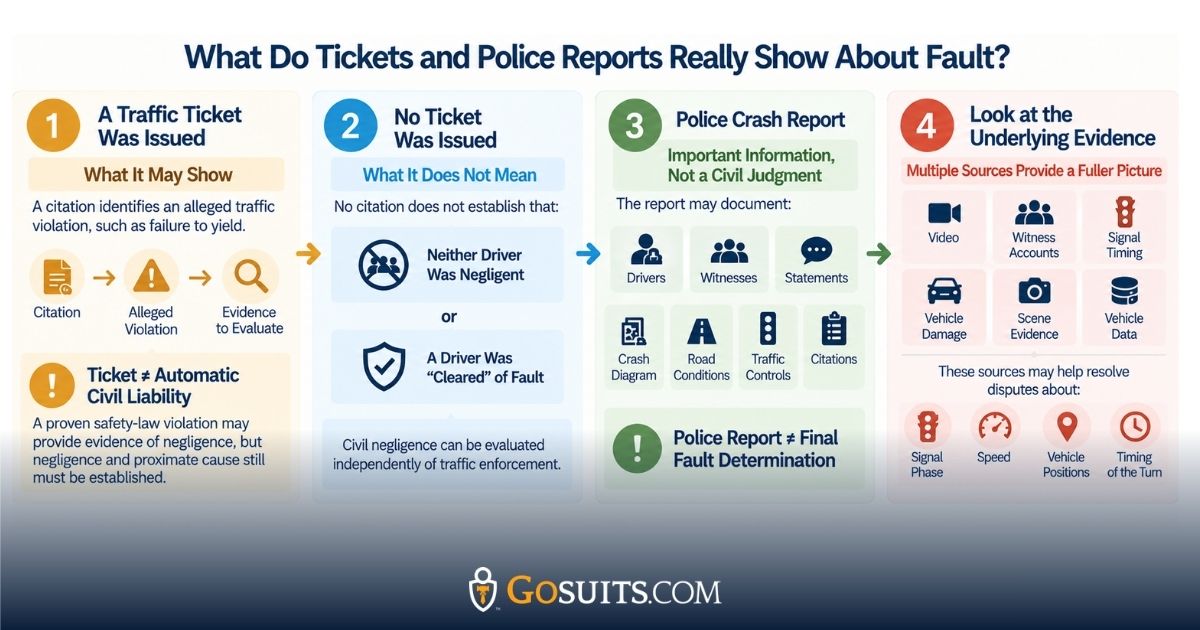
No. A traffic citation or Illinois Traffic Crash Report does not by itself determine civil fault for a left-turn accident. A citation may identify an alleged traffic violation, and a crash report may document observations and statements, but liability still depends on the evidence supporting negligence and proximate cause.
What Does a Failure-to-Yield Citation Mean?
A left-turning driver may be cited for an alleged failure to yield under 625 ILCS 5/11-902, but receiving the citation does not automatically establish liability in a personal injury claim.
Illinois follows a broader rule for violations of safety statutes and ordinances. Under Kalata v. Anheuser-Busch Cos., a violation of a statute or ordinance designed to protect human life or property may constitute prima facie evidence of negligence, rather than negligence per se. The plaintiff must also fall within the class the law was intended to protect, suffer the type of injury the law was designed to prevent, and establish that the violation proximately caused the injury.
Because the rule creates prima facie evidence rather than automatic negligence, evidence may also be offered concerning whether the person’s conduct was reasonable under the circumstances.
The distinction is especially important with a citation. Being cited for an alleged violation and proving that the statutory violation occurred are separate questions. A citation records an accusation or enforcement action. It does not, standing alone, establish every element of a civil negligence claim.
What If No Ticket Was Issued?
The absence of a traffic citation does not establish that neither driver was negligent.
Civil liability can be evaluated using evidence beyond traffic enforcement, which is why how negligence is proven in a Chicago crash may depend on witness accounts, video, traffic-signal information, vehicle damage, scene evidence, and vehicle data where available.
A negligence claim also does not necessarily depend on proving that a traffic statute was violated. Conduct may be evaluated under the ordinary-care standard applicable to drivers.
For the same reason, a driver who was not cited should not be described as having been legally “cleared” of fault solely because no ticket was issued.
What Does the Police Report Establish?
An Illinois Traffic Crash Report can be an important source of information. However, how a police report affects an injury claim should not be confused with the report serving as a civil judgment assigning liability.
Depending on what was documented, the report may identify the drivers and witnesses, describe the reported sequence of events, record roadway or traffic-control information, contain a diagram, and identify citations associated with the crash.
The report should therefore be considered alongside the underlying evidence. If the drivers disagree about whether the turn began on a green arrow or circular green, how fast the oncoming vehicle was traveling, or where the vehicles were when the turn began, video, signal information, physical evidence, and other records may become important to the liability analysis.
Ultimately, the question in a disputed left-turn claim is not simply who received the ticket or what one document says happened. It is what the admissible evidence establishes about each driver’s conduct and whether that conduct proximately caused the collision and resulting injuries.
Can Both Drivers Be at Fault in Illinois?
Yes. Illinois law allows fault to be divided between drivers when both contributed to a left-turn collision. Under 735 ILCS 5/2-1116, a plaintiff’s damages are reduced in proportion to that plaintiff’s contributory fault, and recovery is barred if the plaintiff’s fault is more than 50% of the proximate cause of the injury or damage.
That means being partially at fault for a crash in Illinois does not necessarily prevent recovery, and a left-turn collision does not always have to be treated as a case with one completely responsible driver and one completely blameless driver.
The turning driver’s conduct may be relevant under the yielding rule in 625 ILCS 5/11-902, while the oncoming driver’s speed, signal compliance, lookout, or other conduct may also be considered if the evidence shows that it contributed to the collision.
Illinois uses a modified comparative-fault rule:
-
If the plaintiff is 50% or less at fault, recovery is not barred, but any damages allowed are reduced in proportion to the plaintiff’s fault.
-
If the plaintiff is more than 50% at fault, the plaintiff is barred from recovering damages under § 2-1116.
The statute applies to negligence actions involving bodily injury, death, or physical damage to property. It focuses on each party’s contribution to the proximate cause of the injury or damage rather than simply counting traffic violations.
In a disputed left-turn crash, the evidence may address how close the oncoming vehicle was when the turn began, the speed of each vehicle, which traffic signal governed each movement, what each driver could observe, and whether either driver had time to brake or take evasive action. A statutory violation may also be relevant, but it does not mechanically determine a percentage of fault.
For that reason, saying that one driver “had the right-of-way” or that the other driver “was turning left” may be only part of the analysis. Illinois comparative-fault law permits both drivers’ conduct to be considered when the evidence supports it.
What Evidence Determines Fault in a Left-Turn Crash?
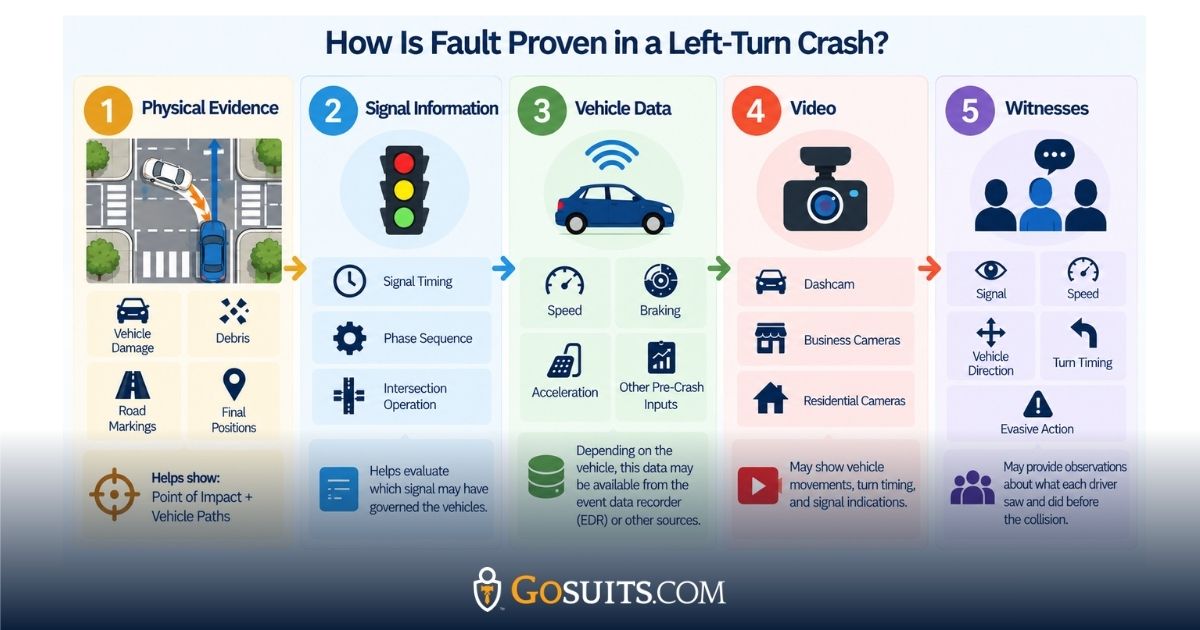
Fault in a disputed left-turn crash may depend on physical evidence, traffic-signal information, video, vehicle data, and witness accounts rather than either driver’s description alone.
These records can help establish where the vehicles were, how they were moving, and what signal governed the intersection when the turn began.
Why the Point of Impact Matters
Vehicle damage can help reconstruct how the vehicles came together. The location and angle of damage may provide information about each vehicle’s path and where the collision occurred relative to the turn.
Other physical evidence may include:
-
scene photographs
-
debris location
-
roadway markings
-
final rest positions
-
damage to each vehicle
-
repair photographs taken before work begins
No single damage pattern automatically establishes fault. Physical evidence is most useful when considered together with the drivers’ movements, signal information, video, and other available records.
Signal Information Can Help Establish the Sequence
When drivers disagree about whether the turn occurred on a green arrow, circular green, yellow, or another indication, records concerning the traffic signal may become particularly important.
Depending on the intersection and agency, available records may provide information about how the signal was programmed or operated. Those records can then be compared with video, witness accounts, vehicle movements, and other evidence to reconstruct the sequence.
Signal records should not be described as automatically proving what color each driver faced at a particular second. What they establish depends on the type of records available and how the intersection was operating at the time.
Vehicle Data May Provide Information About Speed and Braking
Some vehicles record data that may assist in reconstructing events immediately before a collision. Depending on the vehicle and system, available information may bear on:
-
vehicle speed
-
braking
-
throttle or acceleration inputs
-
other recorded pre-crash vehicle activity
That information can be relevant when the dispute centers on how quickly the oncoming vehicle was approaching or whether either driver attempted to slow down.
The existence, contents, accessibility, and interpretation of vehicle data vary. It should not be assumed that every vehicle contains useful crash data or that such information can always be obtained informally.
Federal law also restricts access to event data recorder information. Under the Driver Privacy Act of 2015, EDR data generally belongs to the vehicle owner or lessee, and access by another person ordinarily requires consent, judicial authorization, or another statutory exception. This is one reason obtaining vehicle data in a disputed crash may require formal legal process.
Video and Witnesses Can Help Resolve Conflicting Accounts
Dashcam footage, nearby surveillance video, or other recordings may show the vehicles approaching the intersection, the signal sequence, or when the left turn began.
Independent witnesses may also provide information about:
-
which direction each vehicle was traveling
-
what the traffic signal displayed
-
the apparent speed of the vehicles
-
when the left turn began
-
braking or evasive movements before impact
Video availability varies by location and recording system. A business, public agency, or other third party should not be assumed to possess footage of a particular collision.
Evidence Commonly Used to Evaluate Fault in a Left-Turn Crash
These records may help reconstruct a left-turn collision, although what exists and how it can be obtained varies from case to case.
Evidence That May Help Determine Fault in a Left-Turn Crash
| Evidence | What It May Show | Practical Considerations |
|---|---|---|
| Illinois Traffic Crash Report, Narrative, and Diagram | Reported sequence, involved parties, roadway conditions, observations, and citations recorded in connection with the crash | The report is an investigative record and does not itself determine civil liability |
| Traffic-Signal Records | Information about the programming, sequence, or operation of the signal | Availability and type of records depend on the agency responsible for the intersection |
| Vehicle or Event Data | Depending on the vehicle and system, information potentially bearing on speed, braking, or other pre-crash inputs | Not every vehicle records the same information, and obtaining or interpreting data may require additional process |
| Dashcam or Other Video | Vehicle approaches, movements, signal indications, or the timing of the turn | Availability and retention vary by recording system |
| Business or Residential Surveillance Video | The intersection, vehicle movements, or surrounding events if the camera captured the relevant area | Footage may not exist or may not capture the necessary angle |
| Commercial Vehicle Telematics | Depending on the system, vehicle location, speed, or operating information | Relevant records may be held by an employer, carrier, or other third party |
| Scene Photographs and Physical Evidence | Vehicle positions, debris, roadway markings, sight lines, and surrounding conditions | Conditions can change after the scene is cleared |
| Vehicle Damage and Repair Documentation | Location and angle of impact and the nature of vehicle damage | Photographs taken before repair may preserve useful physical details |
| Independent Witnesses | Observations about the signal, speed, vehicle movements, or sequence | The value of a witness account depends on what the person was actually able to observe |
| Medical Records and Itemized Bills | Injuries, treatment, and medical expenses documented after the collision | These records primarily address injury and damages rather than independently establishing which driver caused the crash |
This table provides a general overview of records that may be relevant to a left-turn collision. The existence or significance of any particular record depends on the circumstances.
What If a Pedestrian or Cyclist Was Hit During a Left Turn?
A driver making a left turn may also have to yield to a pedestrian or bicyclist who is lawfully within the intersection or crosswalk. The exact duty depends on the traffic signal, the person’s location, and how the intersection is controlled.
At a signalized intersection, 625 ILCS 5/11-306 requires a driver turning on a circular green or green arrow to yield to pedestrians and bicyclists lawfully within the intersection or an adjacent crosswalk. A green arrow therefore does not create an unrestricted right to turn.
Pedestrian-control signals also matter. Under 625 ILCS 5/11-307, a pedestrian or bicyclist proceeding under a WALK or walking-person signal generally has the right-of-way against vehicles, subject to the statute’s crossing rules.
When traffic-control signals are not in place or operating, 625 ILCS 5/11-1002 governs crosswalk yielding. It requires drivers to stop and yield in specified circumstances, while also prohibiting pedestrians from suddenly entering the path of a vehicle that is already too close to stop safely.
Illinois also generally gives bicyclists riding on highways the rights and duties applicable to vehicle drivers under 625 ILCS 5/11-1502, subject to bicycle-specific rules. To read more about duties owed to people riding bicycles, see our article on bicycle dooring accidents and fault in Illinois.
Fault still depends on the evidence. Signal indications, vehicle speed, visibility, the pedestrian’s or cyclist’s location, video, and witness accounts may all affect the analysis. A turning driver is not automatically liable simply because a pedestrian or cyclist was struck.
What If a Rideshare, Commercial Vehicle, or CTA Bus Was Involved?
A left-turn crash involving a rideshare driver, commercial vehicle, or CTA bus can raise additional questions about insurance, employment status, responsible parties, and filing deadlines. The traffic rules still matter, but the type of vehicle and the driver’s status can change the claim analysis.
Rideshare vehicles: Under 625 ILCS 57/10, insurance requirements can change depending on the driver’s app status, including whether the driver was logged in and waiting for a request or had already accepted a ride. Records showing that status may therefore be important when a Chicago rideshare accident attorney evaluates which coverage and parties may be involved. To learn more about rideshare coverage when the driver has no insurance, read our related article.
Commercial vehicles: A claim may involve questions about who employed or contracted with the driver, who owned the vehicle, whether the driver was acting within the scope of employment, and what insurance or company records may apply. An employer is not automatically liable simply because its driver was involved in the crash. A Chicago truck accident attorney can also evaluate whether company records, vehicle data, or additional parties may be relevant to the investigation.
CTA buses: Claims involving a CTA bus or L train require separate attention because CTA liability and filing rules differ from many ordinary motor vehicle claims. Under 70 ILCS 3605/41, a personal injury action against the CTA generally must be commenced within one year from the date the cause of action accrued. Current Illinois law also excludes entities organized under or subject to the Chicago Transit Authority Act from the ordinary Tort Immunity Act framework under 745 ILCS 10/2-101.
Identifying the driver, vehicle owner, employer or company relationship, rideshare app status, and any public-entity involvement can affect available coverage, potentially responsible parties, evidence, and deadlines.
For these reasons, a left-turn collision involving a rideshare, commercial, or CTA vehicle may require a broader investigation than a typical two-driver crash.
What Damages Are Recognized in an Illinois Left-Turn Claim?
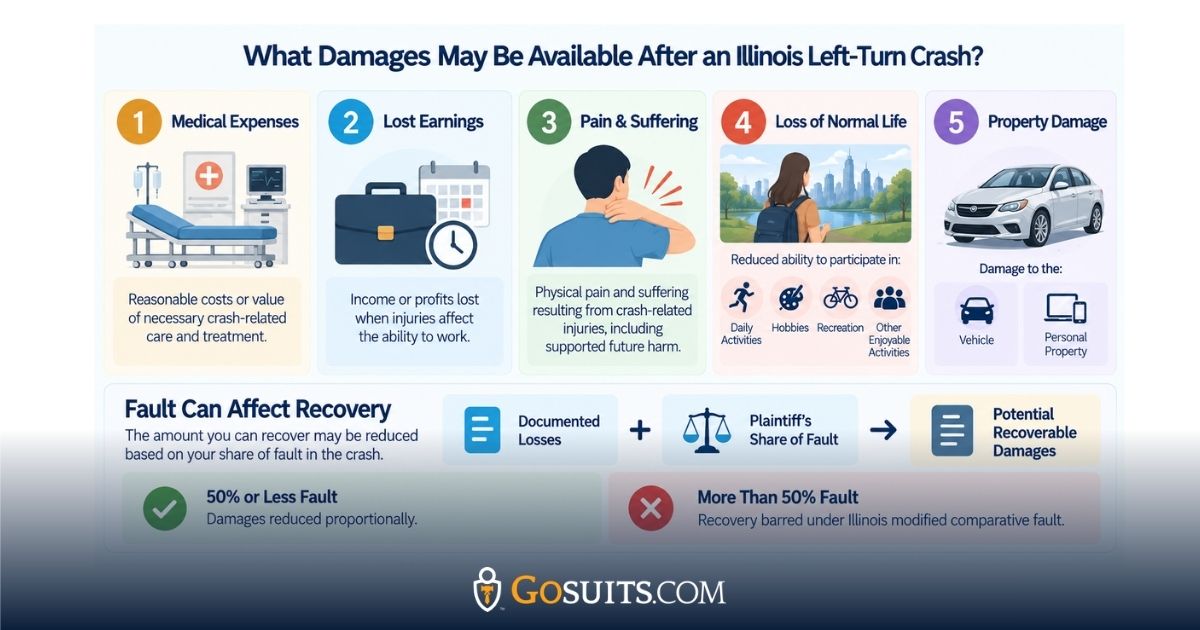
An injured person may seek compensation for losses caused by an Illinois left-turn collision when those losses are supported by the evidence. Common categories include:
-
Medical expenses for the reasonable expense or reasonable value of necessary medical care and treatment related to the crash. Questions can become more complicated in claims where treatment did not begin immediately.
-
Lost earnings or profits when injuries prevent or limit the ability to work
-
Pain and suffering resulting from the injuries, including qualifying future pain when properly supported
-
Loss of normal life for a temporary or permanent diminished ability to enjoy everyday activities and pleasurable aspects of life
-
Property damage involving the vehicle or other personal property damaged in the collision
Establishing damages is only one part of how injury claims are evaluated in Illinois. As discussed above, Illinois modified comparative-fault law can reduce a plaintiff’s recoverable damages in proportion to the plaintiff’s contributory fault.
If the plaintiff’s contributory fault is more than 50% of the proximate cause of the injury or damage, § 2-1116 bars recovery.
For that reason, the amount of documented loss and the allocation of fault are separate issues that can both affect the final recovery in a left-turn accident claim.

What Can Reduce What You Keep From a Settlement?
The gross settlement amount is not always the amount an injured person ultimately receives. Depending on the claim, attorney fees and case expenses, health-care provider liens, and certain insurance or government reimbursement interests may need to be resolved before the remaining proceeds are distributed.
Under Illinois’ Health Care Services Lien Act, qualifying health-care professionals and providers may assert liens for reasonable charges related to treatment. The combined amount of liens governed by the Act generally cannot exceed 40% of the injured person’s recovery, but that figure is a statutory ceiling, not an automatic deduction from every settlement.
Other reimbursement interests, including certain health-insurance, government, or benefit-plan claims, may be governed by different state or federal rules. Attorney fees and case expenses can also reduce the net amount received when they are payable under the representation agreement.
For that reason, how liens affect a settlement depends on the particular provider liens, reimbursement obligations, fees, and expenses connected to the claim rather than the gross settlement figure alone.
How Long Do You Have to File a Left-Turn Accident Claim in Illinois?
For many Illinois personal injury claims arising from a left-turn crash, the general deadline is two years from the date the cause of action accrued. Shorter deadlines may apply when certain public entities or public employees are involved.
Key timing rules include:
General personal injury claims: Under 735 ILCS 5/13-202, actions for injury to the person generally must be filed within two years after the cause of action accrued.
Local public entities or employees: Under 745 ILCS 10/8-101, covered injury actions generally must be filed within one year, subject to statutory exceptions.
Chicago Transit Authority claims: Under 70 ILCS 3605/41, personal injury actions against the CTA generally must be filed within one year from accrual.
Minors and certain persons under legal disability: 735 ILCS 5/13-211 may toll the limitations period in qualifying circumstances.
The filing deadline is separate from insurance negotiations, medical treatment, or evidence preservation. Video, vehicle data, witness information, and other records may become unavailable long before the lawsuit deadline expires. The filing deadline is also separate from how long an Illinois injury lawsuit takes, since the statute of limitations governs when an action must be commenced rather than how long the case may take to resolve.
Because the applicable period can change based on the defendant and the facts, the general two-year rule should not be treated as universal. Our Chicago personal injury attorneys can evaluate which filing period may apply to a particular claim.
Sources
-
Illinois General Assembly: 625 ILCS 5/11-902, Vehicle Turning Left
-
Illinois General Assembly: 625 ILCS 5/11-804, When Signal Required
-
Kalata v. Anheuser-Busch Companies, Inc., 144 Ill. 2d 425 (1991)
-
Illinois General Assembly: 625 ILCS 5/11-306, Traffic-Control Signal Legend
-
Illinois General Assembly: 625 ILCS 5/11-601, General Speed Restrictions
-
Illinois General Assembly: 735 ILCS 5/2-1116, Limitation on Recovery in Tort Actions
-
Illinois Department of Transportation: Law Enforcement Crash Reporting
-
-
Illinois General Assembly: 625 ILCS 5/11-307, Pedestrian-Control Signals
-
Illinois General Assembly: 625 ILCS 5/11-1002, Pedestrians’ Right-of-Way at Crosswalks
-
Illinois General Assembly: 625 ILCS 57/10, Transportation Network Providers Act: Insurance
-
Illinois General Assembly: 70 ILCS 3605/41, CTA Personal Injury Limitation
-
Illinois General Assembly: 770 ILCS 23/10, Health Care Services Lien Act
-
Illinois General Assembly: 770 ILCS 23/50, Subrogation Claims
-
Illinois General Assembly: 735 ILCS 5/13-202, Personal Injury Limitation
-
Illinois General Assembly: 745 ILCS 10/8-101, Local Public Entity Limitation
-
Illinois General Assembly: 735 ILCS 5/13-211, Legal Disability
-
Illinois General Assembly: 625 ILCS 5/11-1502, Traffic Laws Apply to Persons Riding Bicycles
-
Illinois General Assembly: 745 ILCS 10/2-101, Tort Immunity Act Applicability and CTA Exclusion
-
-
Frequently Asked Questions
Is the driver turning left always at fault in an Illinois accident?
No. Under 625 ILCS 5/11-902, a left-turning driver must yield to opposing traffic that is close enough to constitute an immediate hazard. Fault still depends on speed, distance, signals, and other evidence.
What if the oncoming driver was speeding?
Speed can affect fault. Excessive or unreasonable speed may affect the immediate-hazard analysis and comparative fault, but it does not automatically eliminate the turning driver’s duty to yield.
Does a green arrow change who is at fault?
Yes, it can. A driver facing a green arrow may cautiously make the indicated turn, but must still yield to pedestrians, bicyclists, and other traffic lawfully using the intersection.
What if the left-turning driver received a failure-to-yield ticket?
A ticket does not automatically establish civil liability. A proven statutory violation may be prima facie evidence of negligence, but negligence, causation, and comparative fault still must be established.
Does the police report determine who was at fault?
No. A crash report may document statements, observations, diagrams, and citations, but it is not a civil judgment assigning liability.
Can both drivers be at fault for a left-turn accident?
Yes. Illinois follows modified comparative fault. A plaintiff who is 50% or less at fault may recover reduced damages, while fault above 50% bars recovery.
What if the left turn was into a driveway or private road?
Section 11-902 expressly applies to left turns into alleys, private roads, and driveways. A maneuver entirely within a private parking lot may require a different analysis.
Can you obtain data showing how fast the other vehicle was traveling?
Possibly. Some vehicles record data related to speed, braking, or other pre-crash inputs, but availability and access vary by vehicle and system.
What changes if the other vehicle was a rideshare car, commercial vehicle, or CTA bus?
Vehicle status can affect insurance, responsible parties, available records, and deadlines. CTA personal injury claims generally have a one-year filing period under 70 ILCS 3605/41.
How long do I have to file a left-turn accident lawsuit in Illinois?
Many Illinois personal injury claims generally have a two-year limitations period. Certain public-entity and CTA claims may have shorter one-year deadlines, and exceptions can apply.