





























What types of brain injury cases do we handle in Irvine and Orange County?
No two brain injuries play out the same way, which means the legal strategy never really plays out the same way either. It shifts based on what you’re actually dealing with. The CDC reports that TBIs are tied to about 30 percent of all injury-related deaths in the country. Pause on that for a second. We’ve worked with people across Irvine and the rest of Orange County through closed head injuries, skull fractures, anoxic events, and penetrating trauma cases. What follows is a look at the cases we see most often and how we tend to work through each one.
Concussions and mild traumatic brain injury
Concussions get called “mild.” That word does a lot of damage. What’s really happening is a closed head injury: your brain gets jolted hard enough that normal function goes sideways, and the symptoms can hang around for months. Sometimes years. Headaches, dizziness, sensitivity to light, sleep that won’t reset, trouble holding a thought long enough to finish it. We loop in neurologists, neuropsychologists, and vestibular therapists to actually document what you’re going through, and then we go after compensation for the ongoing care, the work you’ve missed, and the cognitive changes that quietly reshape how you get through the day.
Moderate to severe traumatic brain injuries
Severe TBIs leave a footprint. You’ll typically see loss of consciousness, abnormal imaging, or a Glasgow Coma Scale score below 13, and those cases pretty much always start with an ICU admission, often at Hoag Memorial in Newport Beach or UCI Medical Center. From there, it’s months of inpatient rehabilitation. Speech therapy, occupational therapy, assistive devices. The works. Our job is to make sure the math is honest. We bring in medical economists to build a lifetime care plan, because the real cost of recovery isn’t what shows up on the hospital bill. It’s everything that comes after.
Diffuse axonal injuries
Diffuse axonal injuries happen when the brain shifts inside the skull during rapid acceleration or deceleration, tearing nerve fibers across wide regions. These are common in high-speed crashes on the I-405 and I-5, and they often produce coma or long-term cognitive disability. We work with neuroradiologists who use diffusion tensor imaging and other advanced studies to document damage that a standard CT scan will simply miss.
Anoxic and hypoxic brain injuries
When the brain is deprived of oxygen, even briefly, the consequences can be permanent. Near-drownings in residential pools, choking incidents, cardiac events after a crash, surgical complications. We investigate the chain of events, identify negligent parties, and pursue compensation for the cognitive and motor deficits that follow. These cases often involve premises liability at the pool level or medical negligence, and the evidence window is short.
Penetrating head injuries
These cases arise from defective machinery, falling debris on a job site, or intentional acts. The legal strategy may involve product liability, premises liability, or third-party claims depending on what happened. We secure the device or object early, coordinate with engineers, and build cases that account for surgery, infection risk, seizure management, and long-term medical monitoring.
Where do Irvine brain injuries most often happen?
Most of the brain injury cases we see in Orange County trace back to a handful of recurring locations and scenarios. The I-405 through Irvine backs up hard at the SR-133 interchange, and rear-end collisions there are common, even at moderate speeds. The I-5 corridor sees a steady volume of commercial truck crashes because of the freight traffic moving through. Jamboree Road and MacArthur Boulevard, both high-speed arterials, produce T-bone and rear-end collisions at intersections that result in closed head injuries. Falls in retail centers near the Irvine Spectrum, poorly lit apartment stairwells, and workplace incidents on construction sites around the Irvine Business Complex round out the picture. The SR-73 toll road and SR-133 also generate motorcycle crashes at interchange ramps where riders have limited visibility and little margin for error.
Commercial truck crashes deserve their own mention. An 80,000-pound tractor-trailer versus a passenger car is just unforgiving physics, and the head injuries that result tend to be severe. The Federal Motor Carrier Safety Administration has documented that a significant share of fatal large-truck crashes result in injuries to the people in the smaller vehicle. On the I-5 through Irvine and the SR-133, these wrecks aren’t rare. Strong claims require getting the evidence before it disappears: hours-of-service logs, electronic control module data, post-crash drug and alcohol screens, and maintenance records, all of it preserved through a spoliation letter sent early.
Who can be held responsible for a brain injury in California?
This question matters more than most people realize going into a case. California follows a pure comparative negligence rule, which means responsibility can be split across multiple parties and each pays their share. A TBI from a freeway crash might involve the at-fault driver, the driver’s employer if they were on the job, a vehicle manufacturer if a defective component contributed, and a government agency if a poorly designed interchange played a role. None of those claims are mutually exclusive.
In commercial truck cases, the liable parties can include the driver, the motor carrier, the freight broker, the company that loaded the cargo, and whoever was responsible for the truck’s maintenance. Each of those parties has its own insurer and its own defense strategy. That’s part of why truck accident brain injury cases require investigation that starts immediately, before records are overwritten or vehicles are repaired.
In premises cases, the property owner’s duty under California Civil Code section 1714 is to maintain reasonably safe conditions for foreseeable users. If a fall in a retail center parking structure caused your TBI, the question of whether the owner had actual or constructive notice of the hazard is usually the center of the liability analysis. Product liability cases follow a different track entirely, under the strict liability framework recognized in Greenman v. Yuba Power Products, you don’t have to prove negligence, just that the product was defective and caused the injury.
California also recognizes the eggshell-skull rule: a defendant takes the victim as they find them. A prior concussion, a history of migraines, or any pre-existing vulnerability doesn’t reduce what a defendant owes you for making things worse.
How is a brain injury claim valued?
Brain injury claims are among the highest-value personal injury matters in California, and for a real reason: the costs are often lifelong. California allows recovery for both economic and noneconomic harm, and in cases involving egregious conduct like drunk driving or a corporate decision that knowingly put a defective product on the market, punitive damages under California Civil Code section 3294 may also be available.
Economic damages cover the measurable financial impact. Emergency care, neurosurgery, ICU stays, inpatient rehabilitation, outpatient cognitive therapy, prescriptions, assistive devices, home modifications, transportation to appointments, and lost wages. For severe TBIs, the future medical costs projected by a life-care planner can run into the millions before lost earning capacity is even added to the calculation.
Noneconomic damages cover the human side: pain and suffering, emotional distress, loss of enjoyment of life, and the personality and cognitive changes that strain marriages and reshape families. California has no statutory cap on noneconomic damages for standard personal injury cases, and juries in Orange County Superior Court can award substantial sums when the harm is clearly documented. A spouse may also pursue a separate loss of consortium claim for the loss of companionship and intimacy the TBI caused.
One part of the process that often surprises clients: at the end of your case, we don’t just deliver a settlement figure. We negotiate with hospitals, ER groups, health insurers, and medical lien holders to reduce what you owe out of that recovery. The gross number on the settlement agreement and what actually lands in your pocket are two different figures, and closing that gap is part of our job.
How insurers approach TBI claims and what to expect
Insurance companies handle brain injury claims differently than they handle straightforward fracture or property damage cases, and the reason is the invisibility of the injury. A broken bone shows up cleanly on imaging. Cognitive deficits after a concussion often don’t, at least not on a standard CT. Adjusters know this, and some will use it.
Common tactics include requesting an early recorded statement before you’ve had time to understand the full scope of your symptoms, offering a quick settlement before your medical picture has stabilized, and retaining their own neuropsychologist to argue that your cognitive deficits predate the incident or would have resolved on their own. None of those moves are coincidental. They’re strategies designed to reduce the payout.
We handle all communication with insurers from the moment you retain us, so adjusters can’t use casual statements to minimize the claim. We also send legal hold demands early to preserve vehicle event data, surveillance footage, and any records the carrier or property owner might otherwise let disappear. When a policy-limits demand is warranted, we send a formal time-limited demand under California Insurance Code section 11580.075, which protects your right to the full limits and puts the insurer on notice of bad-faith exposure if they lowball. For an overview of how TBI symptoms and recovery timelines interact with these claims, our TBI and CTE awareness guide covers the medical side in plain terms.
What should you do in the first days after a head injury in Irvine?
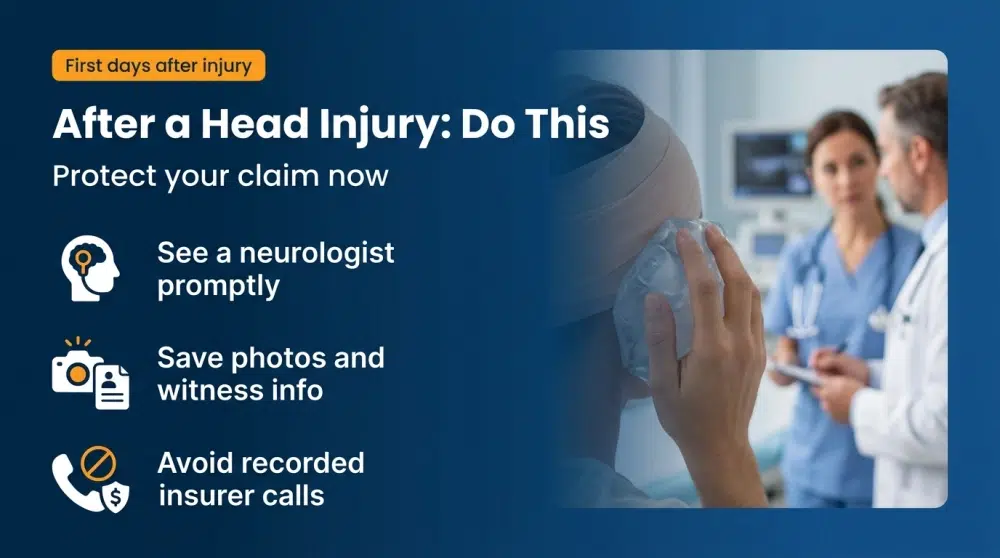
Get medical care first. That sounds obvious, but TBI symptoms can be delayed, and a lot of people walk away from a crash or a fall feeling okay, only to develop headaches, dizziness, and cognitive fog in the days that follow. If you haven’t seen a neurologist yet, that’s the first call after the ER.
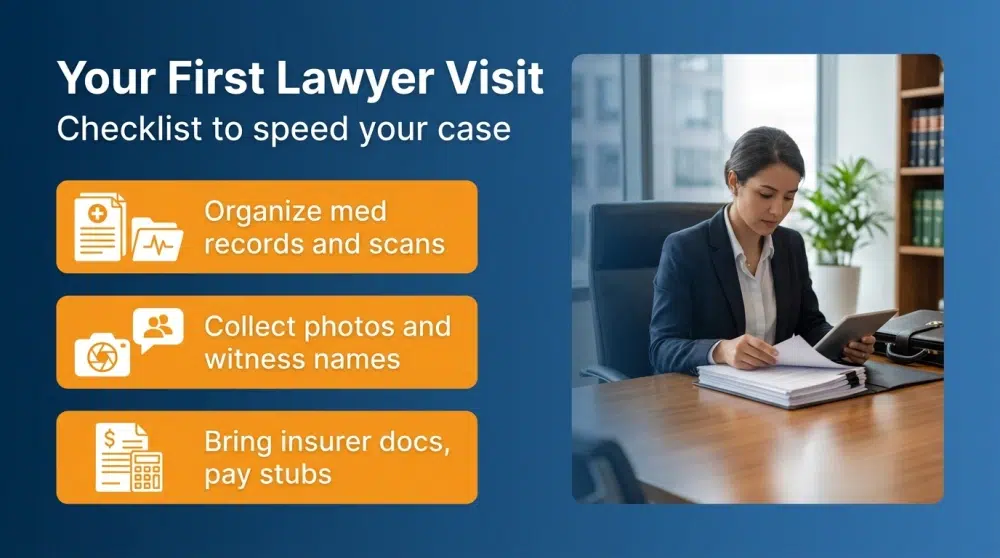
Then preserve what you can. Photograph the scene if you haven’t already. Get the names and contact information of anyone who saw what happened. If there’s any possibility of surveillance footage at the location, note the business name and address so it can be subpoenaed before the footage is overwritten. Most commercial systems hold footage for 30 days or less.
Don’t give a recorded statement to the at-fault driver’s insurer. Adjusters are trained to ask open-ended questions that can produce statements minimizing your injury, and you have no obligation to provide one before speaking with an attorney. California law doesn’t require it. Reaching out to our team early costs you nothing and puts experienced people in place before critical evidence is gone.
How long do you have to file a brain injury claim in California?
Under California Code of Civil Procedure section 335.1, most personal injury claims must be filed within two years of the date of injury. That’s the standard window, but there are exceptions that can shorten it significantly. If a government entity is involved, such as a crash with a city-operated bus on Culver Drive or a fall on public property near a city park, the California Government Claims Act requires a written claim within six months. Missing that six-month deadline can permanently bar a lawsuit against the public entity, even if the two-year statute hasn’t run.
For TBI survivors who lack capacity to manage their own affairs, California Code of Civil Procedure section 352 may toll the deadline during incapacity, but establishing that tolling requires medical evidence and often a conservatorship or guardian ad litem filing. For minors, the statute is generally tolled until age 18. These rules interact in ways that make early legal consultation important: the two-year window feels long until it isn’t.
End-to-end support, from the first call to the final check
Healing from a brain injury is a lot. The legal piece is honestly just one slice of it. Our Irvine team handles the rental car after your crash, connects you with local neurologists, neuropsychologists, and rehab specialists who treat on a medical lien with no upfront cost, and at the end of the case, we negotiate those same liens down so the money you recover actually ends up in your pocket, not in a medical bill. First call to final check, we manage the moving parts. Your only job is getting better.