






























What areas in Los Angeles County do construction accident lawyers serve?
If you were hurt on a jobsite anywhere in Los Angeles County, GoSuits is ready to help. While our practice covers the entire region, we know the construction patterns of each part of the county well, from downtown high-rise projects to single-family remodels in the foothill neighborhoods. Our legal team serves injured workers and their families from the coastal South Bay to the busy commercial corridors of the San Fernando Valley.
Construction injuries happen everywhere in this county: on tower crane sites near downtown, on freeway widening projects along the I-405 and I-110, on residential remodels in Pasadena and Manhattan Beach, and on warehouse builds in the high desert near Lancaster. No matter where the incident occurred, we bring local knowledge and legal experience to protect your rights and pursue the compensation you deserve.
Los Angeles County is home to over 9.7 million people and has one of the largest active construction footprints in the country. According to California Department of Industrial Relations data, construction consistently has one of the highest fatal injury rates of any industry in the state. We know the unique risks across different parts of the county, and we tailor our approach accordingly.
Areas we commonly serve
- Central LA and Downtown: Downtown LA, Koreatown, Hollywood, Mid-City, Echo Park, Silver Lake
- Westside: Santa Monica, Venice, Culver City, Brentwood, West LA, Manhattan Beach
- San Fernando Valley: Van Nuys, Sherman Oaks, Burbank, Glendale, North Hollywood, Northridge
- San Gabriel Valley: Pasadena, El Monte, Alhambra, Arcadia, Monrovia, Glendora
- South Bay and Harbor: Long Beach, Torrance, Carson, San Pedro, Wilmington
- Antelope Valley and North County: Lancaster, Palmdale, Santa Clarita, Norwalk
Wherever your jobsite was in Los Angeles County, we’re just a call away and ready to step in when you need legal guidance after a construction injury.
What types of construction accident cases does GoSuits handle in Los Angeles?
Construction work is one of the most physically demanding and hazardous occupations in California. According to the U.S. Bureau of Labor Statistics, the construction industry accounted for roughly one in five worker fatalities nationally in recent years, and the “Fatal Four” hazards (falls, struck-by, electrocutions, and caught-in/between) cause the majority of those deaths. At GoSuits, we handle the full range of construction-related injury claims, with a sharp focus on third-party civil liability beyond the workers’ compensation system.
How are falls from height handled on Los Angeles jobsites?
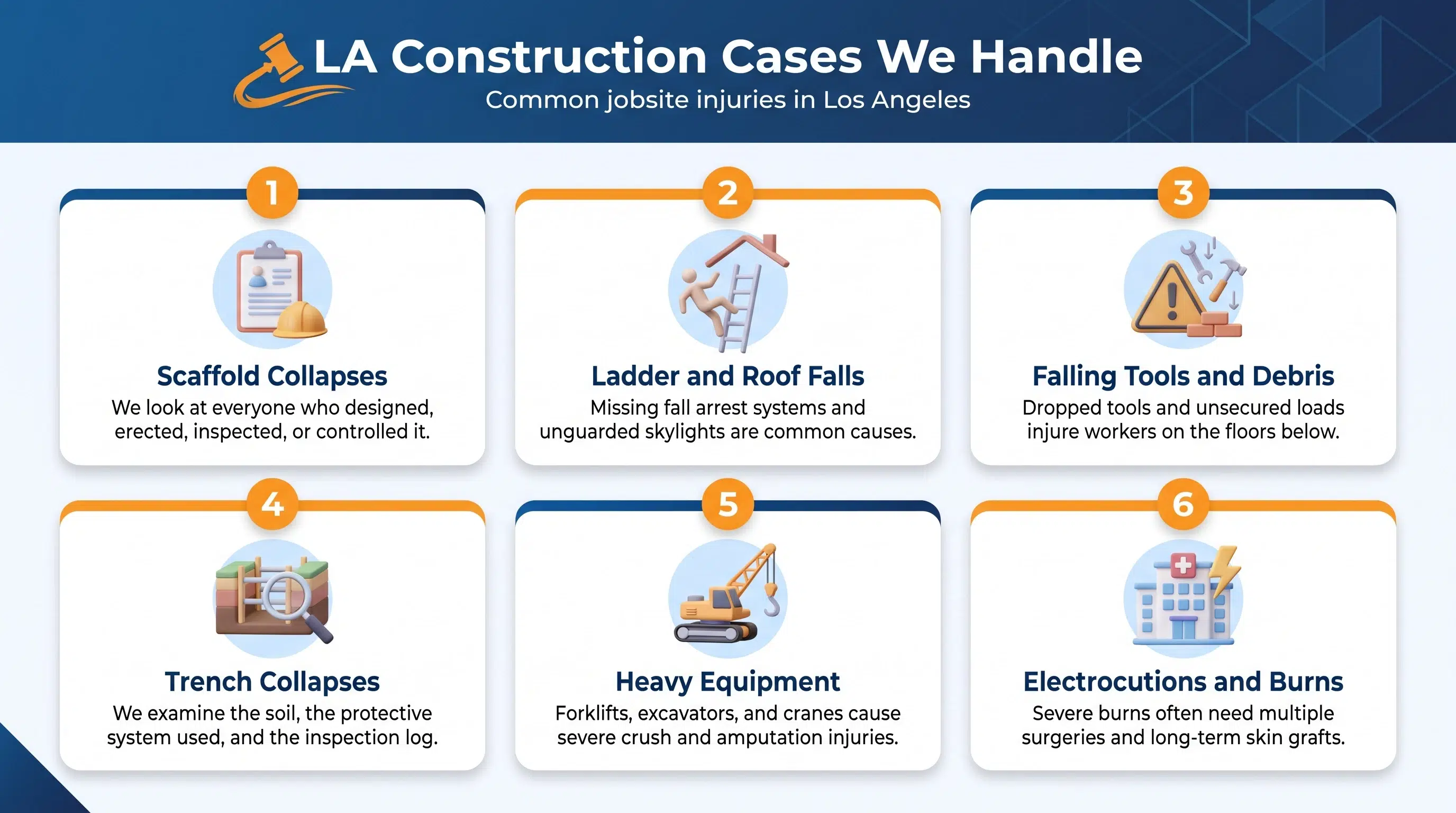
Scaffolding collapses and unsafe scaffold conditions. Cal/OSHA Title 8, Article 21 (Scaffolds, beginning at section 1637 and continuing through sections 1644 and beyond) sets detailed requirements for scaffold construction, planking, guardrails, and access. When a scaffold collapses, sways, or lacks required toe boards and midrails, we look at every party who designed, erected, inspected, or controlled it. Liability often extends past the worker’s direct employer to the general contractor, the scaffold subcontractor, and the equipment supplier.
Ladder and roof falls. Falls remain the leading cause of death in construction. We pursue claims tied to defective ladders, missing fall arrest systems, unguarded skylights, and improperly anchored harness lines. California Code of Regulations Title 8, section 1670, requires personal fall protection at heights specified by trade and task; documenting that gap is often central to the third-party case.
Falls through floor and skylight openings. Open floor holes, uncovered shafts, and unprotected skylights cause some of the most catastrophic falls on LA high-rise sites. We work with safety professionals to reconstruct what controls were missing and which contractor controlled the area.
What happens after a struck-by or caught-in accident?
Falling tools, materials, and debris. Workers below scaffolds and on lower floors are routinely hit by dropped hammers, rebar, concrete forms, and unsecured loads. Liability may rest with the crew above, the rigging contractor, or the general contractor responsible for overhead protection.
Trench and excavation collapses. Cal/OSHA Title 8, Article 6, requires shoring, sloping, or shielding for excavations of certain depths, along with daily competent-person inspections. When a trench collapses on a worker, we examine the soil classification, the protective system used, and the inspection log.
Heavy equipment and crane incidents. Forklifts, excavators, skid steers, and tower cranes cause severe crush and amputation injuries. We coordinate with reconstruction professionals, equipment manufacturers, and operators to identify whether the injury came from operator error, mechanical failure, or a planning failure on the part of the controlling contractor.
How are electrocutions and burns investigated?
Contact with energized power lines, ungrounded tools, and arc-flash incidents cause some of the most serious injuries on LA construction sites. Cal/OSHA Title 8, section 2946, sets minimum approach distances and lockout/tagout requirements. We work with electrical safety professionals to determine whether the utility, the general contractor, or an electrical sub failed to follow these rules. Severe burns frequently require multiple surgeries and long-term skin grafts, and we build damages models that account for the full lifetime cost of care.
What about construction zone vehicle crashes?
Workers in road construction zones along the I-10, I-405, and I-110 face constant exposure to passing traffic. When a driver strikes a flagger, pavement worker, or surveyor, the case often combines auto liability, contractor traffic-control duties, and Caltrans project specifications. These cases sit at the overlap of construction injury law and motor vehicle litigation, and we handle them as integrated claims.
What if a loved one died on a Los Angeles construction site?
California Code of Civil Procedure section 377.60 lists the family members who may bring a wrongful death claim after a fatal jobsite incident. These claims can recover the value of lost financial support, lost household services, and the loss of love, companionship, and guidance. We approach every fatal-injury case with care and a commitment to accountability, supporting families through a difficult time while we hold negligent parties responsible.
How does third-party liability work beyond workers’ compensation?
For most injured workers in California, workers’ compensation is the exclusive remedy against the direct employer under Labor Code section 3602. That system pays a defined schedule of medical care and disability benefits, but it does not pay for pain and suffering, full lost earnings, or the loss of future earning capacity. For a serious construction injury, those uncompensated losses are usually where most of the real harm sits.
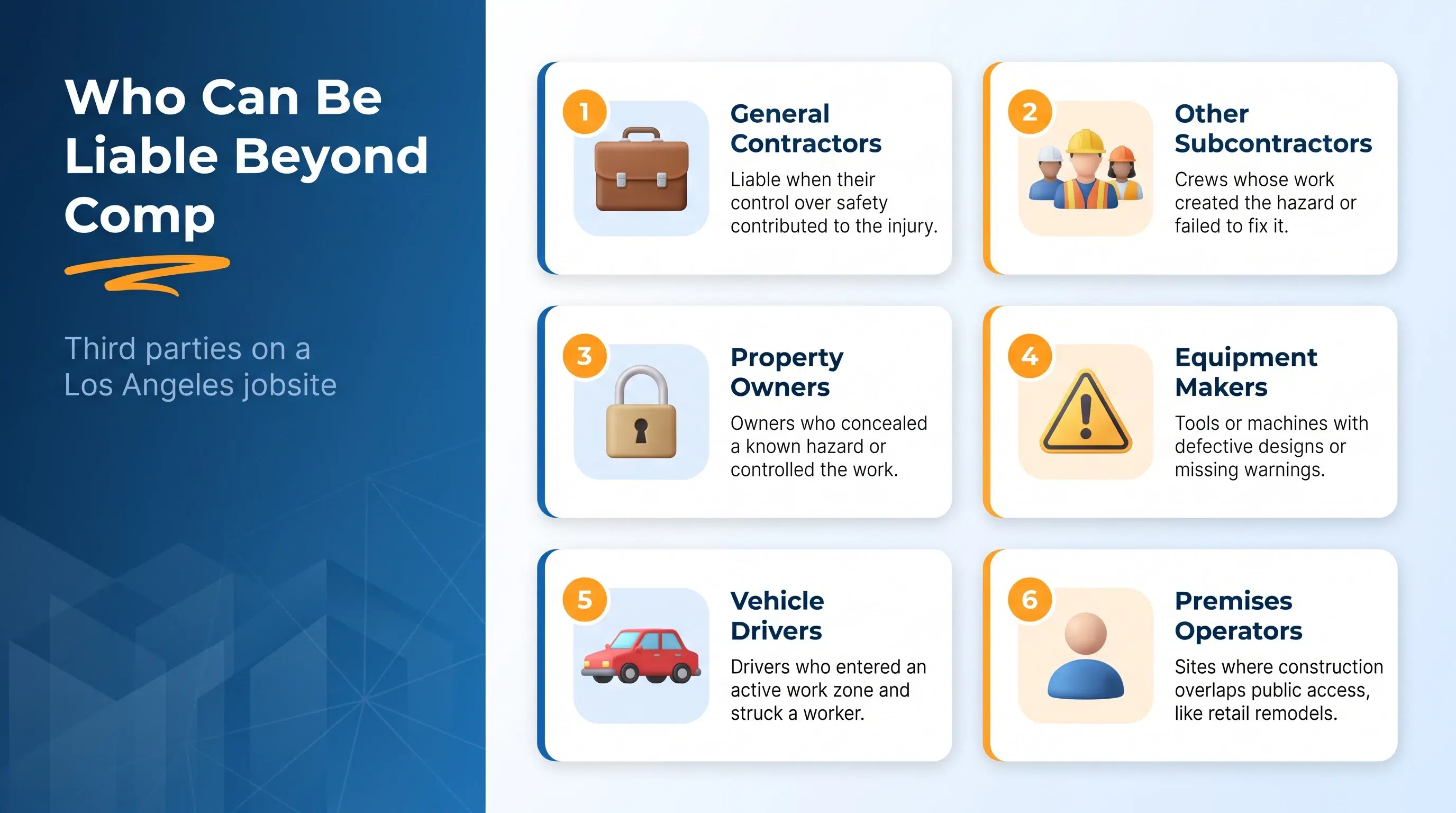
The good news is that California law preserves your right to sue any non-employer party whose negligence contributed to the injury. That third-party doorway is where construction cases often produce a meaningful recovery, and where civil counsel matters most. Common third-party defendants on a Los Angeles jobsite include:
- General contractors who retained control over jobsite safety. Under Hooker v. Department of Transportation (2002) 27 Cal.4th 198 and the related Privette, Toland, and Kinsman line of cases, a general contractor can be liable when it actively controlled safety and that control affirmatively contributed to the injury.
- Other subcontractors on the same site whose work created or failed to fix the hazard.
- Property owners who concealed a known hazard or retained meaningful control over the work.
- Equipment manufacturers when a tool, machine, or component was defectively designed or lacked adequate warnings.
- Vehicle drivers who entered an active work zone and struck a worker.
- Premises operators at sites where construction work overlaps with public access, like retail remodels and tenant improvements.
Pursuing these claims at the same time as a workers’ compensation claim is allowed and often expected. The two systems coordinate through liens (the workers’ compensation carrier may assert a lien on a portion of the third-party recovery), and part of our job is negotiating those liens at the end of the case so the net recovery to you is as large as possible.
What does California law say about construction injury claims?
California follows a pure comparative negligence system. If you are found partially responsible for an incident, your compensation is reduced by the percentage of fault assigned to you, but it is not eliminated. For example, if your damages total $400,000 but you are deemed 25% at fault, your recovery would be reduced to $300,000. This rule comes from Li v. Yellow Cab Co. (1975) 13 Cal.3d 804 and is applied by California courts in personal injury cases.
Timing is critical. Under California Code of Civil Procedure section 335.1, most personal injury claims must be filed within two years of the incident. If a public entity is involved, such as a city, county, or Caltrans project, you must serve a written government claim within six months under Government Code sections 910 and 911.2. Missing that six-month window can permanently bar a claim, which is why early consultation matters on any project tied to a public agency.
Workers’ compensation deadlines run on a separate clock. You generally must report a workplace injury to your employer within 30 days under Labor Code section 5400 and file a workers’ compensation claim within one year. The civil third-party lawsuit and the workers’ compensation claim move on parallel tracks, and missing either deadline can cost you compensation you would otherwise be owed.
Cal/OSHA standards (California Code of Regulations Title 8) define the safety baseline for every jobsite in the state. While a Cal/OSHA violation does not automatically equal civil liability, it is powerful evidence of negligence and it shapes how the case is framed. Common standards we cite include:
- Title 8, Article 21 (beginning at section 1637) for scaffolds, including the section 1644 series on metal scaffolds
- Title 8, section 1670, for personal fall protection systems
- Title 8, Article 6, for excavation and trench protection
- Title 8, section 2946, for electrical safety
- Title 8, section 1509, requiring an Injury and Illness Prevention Program at every construction site
How do you choose the right Los Angeles construction injury legal representation?
Finding a construction accident lawyer in Los Angeles after a serious jobsite injury can feel like trying to merge onto the I-405 at rush hour. It is overwhelming and full of options, but making the right choice early can shape your entire recovery. Construction cases are a different animal than ordinary personal injury cases, and the lawyer you pick should reflect that.
You need more than a lawyer who occasionally handles workplace claims. Look for a firm that knows the difference between a workers’ compensation claim and a third-party civil lawsuit, and that handles both at the same time. Ask how often they go to trial, how they calculate long-term medical costs, and how they plan to keep you informed. A clear legal strategy and plain-English communication are signs you are in good hands.
Local experience is also key. A construction injury attorney in Los Angeles who knows the LA County Superior Court system, local judges, area hospitals, and the contracting community can spot delays and move your case forward faster. Most trusted firms, including GoSuits, offer free consultations and take cases on a contingency basis. That means no attorney fee unless we recover. Case costs and medical bills may still be owed.
Why does focused construction injury representation matter?
If you needed spinal surgery, you would not choose a general practitioner. You would seek out a board-certified spine surgeon. The same logic applies after a serious construction accident.
Focused construction injury attorneys understand jobsite hierarchies, multi-employer worksite rules, prime contractor relationships, union benefit interactions, and the way that workers’ compensation liens get negotiated against a civil recovery. They understand how to preserve crash data, equipment evidence, and project records before they disappear. They know how to read a Cal/OSHA citation and use it correctly in civil litigation.
Generalist attorneys may not recognize critical deadlines or know how to calculate the full value of a long-term disability. They often lack working relationships with safety professionals, accident reconstruction firms, vocational economists, and life-care planners who help prove damages in catastrophic cases.
When you choose a firm that concentrates on serious injury work, you gain a deeper level of strategy and support. That can translate into stronger negotiation power and better compensation. Your future deserves a legal team that treats injury law not as an option, but as their full-time focus.
How GoSuits Los Angeles construction accident lawyers can help you
Recovery after a construction injury is hard enough on its own. From the moment you call the GoSuits Los Angeles personal injury firm, we step in early to manage the legal side so your attention stays on your health and your family. We start by gathering Cal/OSHA reports, project safety plans, daily logs, and any photos or video of the scene. We send preservation letters to general contractors and equipment owners so that scaffolds, ladders, trench boxes, and machinery are not quietly altered or scrapped before our investigators see them.
We then walk the same client journey for every case, told as a single connected path from your first call through the day your settlement clears. If you cannot drive, we help arrange transportation to medical appointments. If your treating doctor wants to refer you to a specialist, we connect you with surgeons, neurologists, and pain management physicians who treat on a medical lien, meaning no upfront cost to you. We monitor your treatment so the medical record actually reflects how the injury affects your work, your sleep, and your daily life. When the third-party claim resolves, we negotiate down those medical liens and the workers’ compensation lien so the dollars that actually reach your pocket are as large as we can make them. That last step alone often adds tens of thousands of dollars to a client’s net recovery.
On the legal side, we work with vocational economists, life-care planners, accident reconstruction professionals, and Cal/OSHA-knowledgeable safety consultants to build damages and liability models that hold up at trial. If the insurance company will not negotiate fairly, we are fully prepared to file in Los Angeles County Superior Court at the Stanley Mosk Courthouse or the appropriate branch courthouse and try the case to verdict.
What makes our approach different is our deep knowledge of the Los Angeles legal community. We know how Cal/OSHA inspections move, how local courts schedule construction cases, and how to anticipate the delays that defense carriers rely on. You will receive regular case updates, secure online access to your file, and a prompt response when you reach out.
We work on a contingency fee basis, which means you do not pay anything up front. You only owe a fee if we recover compensation on your behalf. To talk through your situation with a real attorney, you can schedule a free consultation at any time, day or night.
For more resources, explore our Knowledge Base, including our guide to how much most personal injury cases settle for.