- What we know about the Angeles Crest Highway crash
- Angeles Crest Highway context and conditions that often matter in investigations
- Official determinations released so far
- Which official records to request and where to call
- Civil pathways after a fatal crash in California
- Preserving evidence after a high performance vehicle crash
- Insurance considerations when a crash turns fatal
- Supporting an investigation without adding risk
- Local community notes about SR 2 and nearby landmarks
- Next steps and why timing matters
- Commentary from Gosuits Los Angeles, California Personal Injury Attorney
- References
What we know about the Angeles Crest Highway crash
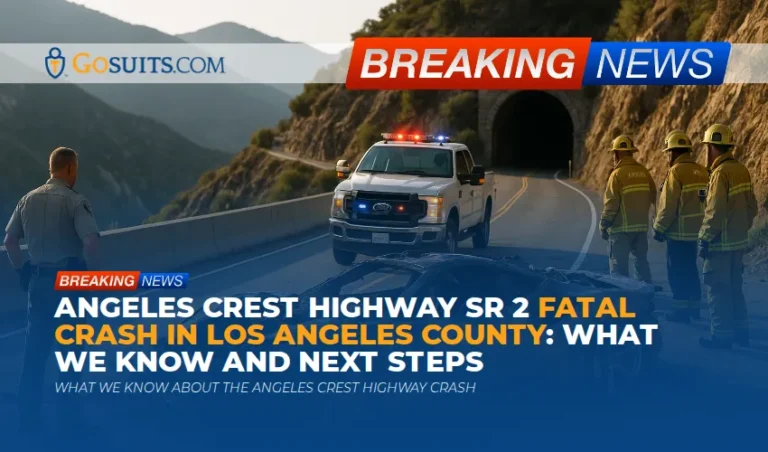
Vince Zampella, known worldwide for shaping modern video games, died following a fiery single vehicle crash on Angeles Crest Highway in Los Angeles County in December. The Los Angeles County Department of Medical Examiner later released the cause of death as thermal injuries and inhalation of products of combustion, with blunt trauma noted, and the manner of death listed as accident [1]. Public reporting has described the vehicle as a Ferrari 296 GTS and indicated the crash occurred shortly after the vehicle exited a tunnel on State Route 2, a stretch that winds through the Angeles National Forest above La Cañada Flintridge and Pasadena. A passenger was also fatally injured.
Angeles Crest Highway is not an ordinary city surface street. It is a mountain corridor with sudden curves, changing light conditions at tunnel exits, narrow shoulders in spots, and dramatic elevation changes. For people who live in La Cañada Flintridge, Altadena, Pasadena, Glendale, and the foothill communities, SR 2 is as much a gateway to the San Gabriel Mountains as it is a challenging drive. Crashes in this corridor often require detailed scene analysis and, when possible, data from the vehicle’s imaging or event data recorder to understand what happened in the seconds before impact.
Angeles Crest Highway context and conditions that often matter in investigations
If you have driven SR 2 on a bright afternoon, you know how the light changes abruptly as you exit one of the tunnels. Your eyes adjust. Temperatures shift with elevation. Winds pick up at canyon mouths, and debris or rockfall can appear around a blind bend. Those who recreate near Switzer Falls or pull off by Red Box frequently see traffic move from stretches with comfortable sight lines to sections where a concrete barrier crowds the right edge. Investigators commonly evaluate factors like:
- Transition zones such as tunnel exits where the change in lighting can briefly affect depth perception.
- Edge protection and barriers, including impact locations on concrete barriers and whether tire marks suggest steering or braking immediately before impact.
- Roadway conditions like debris, moisture from recent weather systems, or gravel brought onto the asphalt from pullouts and driveways.
- Elevation and grade, which can influence braking distance and cooling performance when vehicles have been driven aggressively uphill or downhill.
- Traffic mix, from commuters to cyclists and motorcyclists who frequent the route for recreation, each affecting speed patterns in different ways.
These are general points. They do not assign fault. They do show why a thorough crash reconstruction on SR 2 usually includes scene re-creation, daylight and night visibility checks, and retrieval of any available electronic data.
Official determinations released so far
The Los Angeles County Department of Medical Examiner’s public case listing indicates the death was the result of thermal injuries, smoke inhalation, and blunt trauma, with the manner classified as accident [1]. A Medical Examiner’s finding does not decide civil liability. It documents medical cause and manner of death. Collision causation, including whether any party or factor bears civil responsibility, is typically the subject of a separate traffic collision investigation.
On state highways in Los Angeles County, the California Highway Patrol generally has primary jurisdiction for traffic collision investigations. Requests for collision reports are routed through CHP using a standard process and form, often CHP 190 [2]. In multi agency responses, such as those involving LA County Fire or local sheriffs, there can be additional incident documentation in separate agency systems. Families seeking clarity usually need to combine records from multiple offices, which takes time.
Which official records to request and where to call
After a fatal crash, obtaining the right records helps families understand what happened, supports insurance claims, and preserves options for any civil action. In Los Angeles County, the following are the core record sets and offices to contact. Each agency has its own timelines and eligibility rules.
California Highway Patrol traffic collision report
For state highway crashes, CHP typically handles the primary collision report. Requestors use CHP 190, Application for Release of Information, to obtain the Traffic Collision Report and any attachments, diagrams, or photographs, if available [2]. The report is usually released to involved parties and next of kin. When requesting:
- Provide exact details such as date, approximate time, highway name and milepost if known, and any available incident number.
- Verify the correct Area office that investigated, since SR 2 is patrolled by different CHP offices depending on the segment.
- Ask about supplemental materials including diagrams, statements, and photographs, which may be stored separately or released after the main report.

Los Angeles County Department of Medical Examiner documentation
The Medical Examiner maintains official records of cause and manner of death, as well as autopsy and toxicology reports when performed. Families can locate a case via the online case search and follow the department’s instructions for requesting copies of reports [1]. The department’s main website provides general information about official records and family assistance [3].
- Confirm identity and relationship so staff can advise on eligibility and available documents.
- Track timelines because toxicology results and final reports may take weeks or months.
Vital records, including death certificates
Certified copies of death certificates for events within Los Angeles County are issued by the Los Angeles County Registrar Recorder County Clerk. The agency’s website explains how authorized individuals can request certified copies, required identification, and fees [4]. The death certificate is frequently required by insurers and financial institutions.
Fire and rescue incident documentation
When LA County Fire responds, there may be an incident log or patient care report. Public records requests are routed through the department’s records or public information office. Processing times vary. If a medevac occurred or a patient was transported by a non county provider, that agency may hold separate run sheets or records.
Roadway or infrastructure records
If questions arise about signage, barrier maintenance, lighting, or prior incidents at the location, public records requests may be directed to Caltrans for State Route 2 corridor information. Requests are typically handled under the California Public Records Act, which the California Department of Justice describes in general guidance for the public [5].
For a step by step overview of documentation families often gather during the first few weeks, see this practical guide: Los Angeles wrongful death checklist.
Civil pathways after a fatal crash in California
California recognizes two related, but distinct, civil claims that can follow a fatal crash. Understanding the difference helps families and representatives stay organized when they review insurance or consider legal action.

Wrongful death claims
A wrongful death claim compensates certain surviving family members for their losses caused by the death, such as loss of financial support and companionship. Standing to bring a wrongful death claim is defined by statute in California Code of Civil Procedure section 377.60 [6]. The filing window for wrongful death is generally two years from the date of death under California Code of Civil Procedure section 335.1 [7].
Because deadlines can vary if a public entity is involved or if other special rules apply, families often seek guidance before they approach insurers. Courts expect claimants to meet notice and filing requirements precisely.
Survival actions
A survival action is brought by the decedent’s personal representative or successor in interest to recover damages the decedent could have claimed had they survived, for example property damage or medical expenses incurred before death. Survival actions are authorized by California Code of Civil Procedure section 377.30 [8]. The claim belongs to the estate and is different from the wrongful death claim that belongs to the heirs.
Who might bear civil responsibility
Every collision is unique, and it is not appropriate to guess at fault. In general, civil investigations may consider the conduct of the driver, road conditions, potential vehicle component failures, and third party conduct that contributed to risk. On a state highway in the mountains, questions sometimes arise about barrier impacts, sight distance at tunnel exits, and whether any vehicle system warnings or fault codes were triggered shortly before impact. The presence of a fire can complicate evidence recovery, which is why early preservation is critical.
Families sometimes search for fatal accident lawyers to help coordinate the parallel tracks of records gathering, evidence preservation, and insurance communication while the official reports are still pending. Having a clear plan at the start helps minimize missteps.
Preserving evidence after a high performance vehicle crash
Modern vehicles often store crucial crash related information in an event data recorder. That data can include vehicle speed, throttle, braking, steering inputs, seat belt use, and fault codes logged in the moments before impact. The National Highway Traffic Safety Administration provides guidance about event data recorders and their role in crash analysis [9]. In a fire, preservation is challenging, but not always impossible. Key steps families and representatives often consider include:
- Locate and preserve the vehicle by identifying the tow yard or storage facility and placing it on a litigation hold so components are not altered, scrapped, or downloaded without notice.
- Secure chain of custody documentation for any downloads, photographs, or parts removed, to ensure authenticity is clear later.
- Request nearby digital evidence including traffic camera archives when available, business CCTV from tunnel portals or pullouts, and first responder body worn camera footage if released by policy.
- Document the scene as soon as it is safe with daytime and nighttime photographs that capture sight lines at the tunnel exit, barrier markings, skid marks if present, and debris fields.
- Obtain electronic data with an appropriate protocol. High end vehicles may require manufacturer specific equipment or a specialist to safely access data modules, especially after fire damage.
Event data, when combined with physical evidence and witness accounts, can clarify the sequence of events in a way that simple photographs cannot. Los Angeles fatal accident lawyers are often engaged early to coordinate these technical steps while families focus on immediate needs.
Insurance considerations when a crash turns fatal
Insurance coverage analysis after a fatal crash can involve multiple policies and several categories of benefits. Even in a single vehicle crash, coverage questions can be complex.
- Liability coverage may apply to claims from a passenger’s heirs in a wrongful death case, subject to policy limits and exclusions.
- Uninsured or underinsured motorist coverage may come into play for a passenger, depending on the passenger’s own auto policy and whether it extends to this crash scenario.
- Medical payments benefits sometimes provide limited no fault coverage for certain expenses, depending on the policy.
- Property damage coverage may address towing, storage, and total loss valuation of the vehicle, which can be complicated with specialty or exotic cars.
Insurers routinely request recorded statements early. It is common for families to consult counsel before responding, since statements can be used later to limit or dispute claims. If a potential product issue or component failure is suspected, immediate vehicle preservation becomes even more important so that any third party evaluation is based on the same evidence.
Supporting an investigation without adding risk
Families often want to help, but there is a balance between cooperation and protecting future options. Consider these practical steps:
- Centralize documents in a shared folder with date labeled subfolders for police reports, medical examiner communications, towing invoices, and photographs.
- Limit public statements on social media and decline interviews while facts are still developing.
- Designate a point of contact for agency questions so messages are not missed and responses remain consistent.
- Use written requests for records under the California Public Records Act when appropriate, keeping copies and date stamps [5].
- Calendar statutory dates for potential claims, including the two year window many wrongful death claims follow under California law [7].
Local community notes about SR 2 and nearby landmarks
Residents of the foothills know this corridor well. Heading north from La Cañada Flintridge, the first tunnel comes quickly, followed by bends that are scenic and unforgiving. On weekends, the turnout near the Red Box junction can be busy with hikers bound for Mount Wilson or Switzer Falls. Traffic patterns can shift without warning, especially as cyclists descend or when a group of vehicles alternates between slow scenic driving and bursts of speed to pass. Seasonal weather changes also matter. Early winter mornings can bring patches of moisture and cold air pooling in canyons, while summer afternoons raise pavement temperatures and stress high performance braking systems after repeated hard use.
None of this commentary assigns blame to anyone in this tragedy. It is a recognition of what countless local drivers already know about the character of SR 2. When tragedy strikes on this road, the analysis has to match the environment, from lighting near tunnel exits to barrier geometry where impacts occur.
Next steps and why timing matters
There are several time sensitive steps that typically follow a fatal highway crash in Los Angeles County. These actions are not directed at any one person, but are shared to explain why timing matters and what outcome they support.
- Secure official records quickly. Collision reports, medical examiner documents, and death certificates are foundational for insurance and estate matters. Requesting them early reduces delays when insurers ask for proof later [1] [2] [4].
- Preserve the vehicle and data. Tow yards and storage facilities move fast. A written preservation request can prevent alteration or disposal while decisions are made about downloads and inspections [9].
- Organize insurance communications. Multiple insurers may be involved. Clear documentation and a single point of contact prevent inconsistent statements and improve claim processing.
- Mark statutory calendars. California has filing deadlines that can cut off claims if missed, including the general two year wrongful death window [7]. Government claim deadlines can be much shorter when public entities are involved.
- Seek qualified guidance before insurer statements. It is routine for insurers to request a recorded interview. Knowing legal rights and the scope of coverage first helps avoid statements that may be used to narrow or deny claims later.
These are ordinary, practical steps that support clarity, reduce avoidable risk, and keep all options open while the official record develops.

Commentary from Gosuits Los Angeles, California Personal Injury Attorney
We are deeply sorry for the loss of life in this crash on Angeles Crest Highway. Our thoughts are with everyone who cared about those involved. This article is meant to share public information and general guidance for families facing the aftermath of a fatal crash in our community.
From a civil injury perspective, a single vehicle impact with a barrier near a tunnel exit raises familiar questions. Investigators will look for objective answers in the physical evidence and any available vehicle data. On SR 2, sight lines, surface conditions, and the light transition out of a tunnel often come under the microscope. When a fire occurs, preservation of what remains becomes time critical because heat can destroy or alter crucial components and complicate any event data download.
Insurance carriers and large corporations know how overwhelming the first weeks can be. They move quickly to collect statements, frame coverage issues, and position defenses while families are still gathering records. That early asymmetry can lead to low information decisions, such as giving a broad recorded statement or agreeing to a limited authorization that allows a carrier to comb through unrelated records. The result is often a narrowed claim or avoidable disputes months later.
A free consultation helps people understand timelines, records to request, and strategies for preserving evidence. It also clarifies how wrongful death and survival actions differ and what insurers can reasonably ask at the start. Even when families are still waiting for final reports, a structured plan reduces stress and protects options going forward.
References
- Case Detail 2025 19864 – Los Angeles County Department of Medical Examiner
- CHP 190 Application for Release of Information – California Highway Patrol
- Los Angeles County Department of Medical Examiner – Official Site
- Los Angeles County Registrar-Recorder/County Clerk – Official Site
- California Public Records Act – California Department of Justice
- California Code of Civil Procedure § 377.60 – Wrongful Death
- California Code of Civil Procedure § 335.1 – Statute of Limitations for Wrongful Death
- California Code of Civil Procedure § 377.30 – Survival Actions
- Event Data Recorders – National Highway Traffic Safety Administration