









































What makes a Plano injury claim different?
Plano is mostly in Collin County, and its civil lawsuits are filed in the county’s district courts at the Russell A. Steindam Courts Building on Bloomdale Road in McKinney. A small piece of Plano lies in Denton County, so an injury there can belong to a different court.
The people involved are different too. Plano has many corporate campuses along Legacy Drive between Preston Road and the Dallas North Tollway, and employers, building owners, contractors and delivery services all turn up in claims. Commuters travel to and from the city on the tollways, US 75 and the Bush Turnpike, so the other driver is often from Dallas, Frisco or farther away. Insurance is usually in the picture on every side.
Because Plano straddles a county line, the address of the injury is worth pinning down early. A fall at a business near the Denton County edge of the city can sit in a different courthouse than a crash on Preston Road, and a defendant who lives in Dallas County adds one more option. We map those choices before filing so that the case does not start with a fight over venue.
None of that changes your rights. It does mean the first question in a Plano case is who all the potentially responsible parties are, and the second is what policies stand behind them.
Where do Plano injuries happen?
On the roads, mostly. Preston Road is a major thoroughfare that runs through the city, with signals and driveway traffic at close intervals. US 75 along the east side carries heavy commuter traffic, and the single-point interchange at Parker Road concentrates turning and merging movements in one place. The Dallas North Tollway runs along the west side, and the Bush Turnpike and the Sam Rayburn Tollway mark the south and north.
Around Legacy West, shops, restaurants and parking garages sit close together, so cars, rideshare pickups and people on foot share the same space, and a fall in a garage or on a walkway is as possible as a collision. The Shops at Willow Bend raise the same issues. Downtown Plano and Parker Road have DART Red Line stations, and the walk to the platform means pedestrians crossing in front of cars.
Away from the roads, claims arise from apartment stairwells, office buildings, restaurants, day cares and homes with dogs. Our approach is similar in each: find out who controlled the place or the thing that hurt you, and what they knew.
What is personal injury protection, and should you have it?
Personal injury protection, or PIP, is part of many Texas auto policies. It pays medical bills and some lost income after a crash regardless of who caused it. Insurers must provide the coverage unless the named insured rejects it in writing, so many drivers have it without remembering.
PIP matters because it pays quickly. You do not have to prove fault or wait for the other driver’s insurer to accept liability, and it can pay for early treatment while the bigger claim develops. Using it does not usually give up your claim against the at-fault driver, though the insurer that paid PIP may have a right to be repaid from a settlement, which is a point we deal with. Our guide to personal injury protection in Texas explains how that coverage works.
Hurt at work or on a corporate campus in Plano?
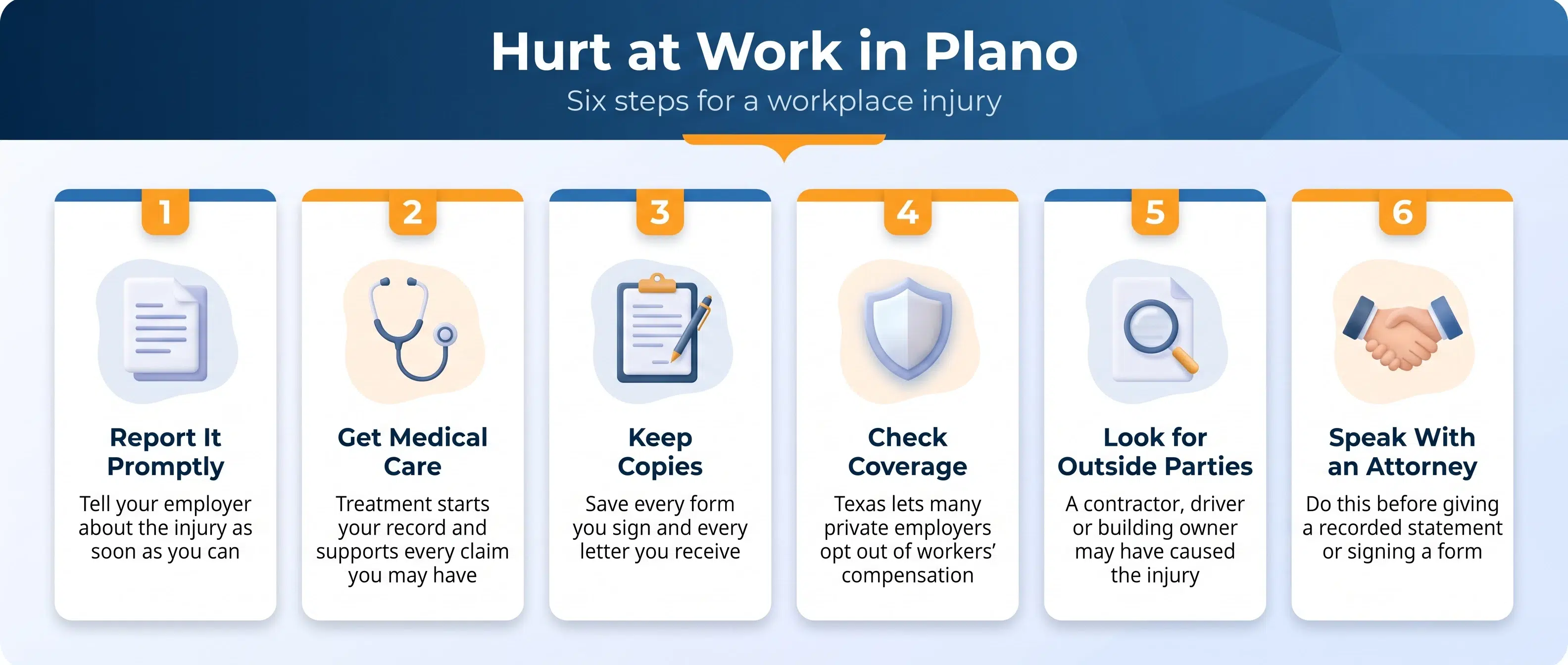
Workplace injuries follow a separate track. If your employer carries workers’ compensation, it pays medical care and part of lost wages without a fault fight, and it limits what you can claim from the employer. If an outside company caused the injury, such as a contractor, a delivery driver or the owner of a building you were visiting, you may also have a separate injury claim against that party.
Texas lets many private employers opt out of workers’ compensation, which changes the picture again. Report the injury promptly, get medical care, and keep copies of everything you sign. Then speak to an attorney before you give a recorded statement or sign a form, because the order of those steps can affect both claims.
What if a child was hurt at a daycare or school?
These cases need careful handling. A child’s limitations period generally does not start to run until the child turns 18 under Civil Practice and Remedies Code section 16.001, though a parent’s claim for the child’s medical bills is treated differently and usually follows the two-year rule. Because the rules differ for each claim, it is safer not to rely on the longer period.
We look at supervision ratios, staff training, equipment inspections, incident reports and prior complaints. Take photographs of the injury and the area, ask for the written incident report, and write down what the child says in their own words soon after, before it is changed by retelling.
Which hospitals and bills come into a Plano claim?
Medical City Plano and Texas Health Presbyterian Hospital Plano are two of the hospitals that treat injured Plano residents. The hospital that treats you may file a lien against your recovery, and your health insurer may seek repayment.
Texas also limits recovery of medical expenses to the amount actually paid or incurred under Civil Practice and Remedies Code section 41.0105. That means billing records and insurance adjustments are read closely, and the number on the first bill is not always the number a jury hears. At settlement, GoSuits negotiates with hospitals, ER groups and lien holders to reduce what comes out of the award, so more of it reaches you.
What evidence matters, and how fast does it go?
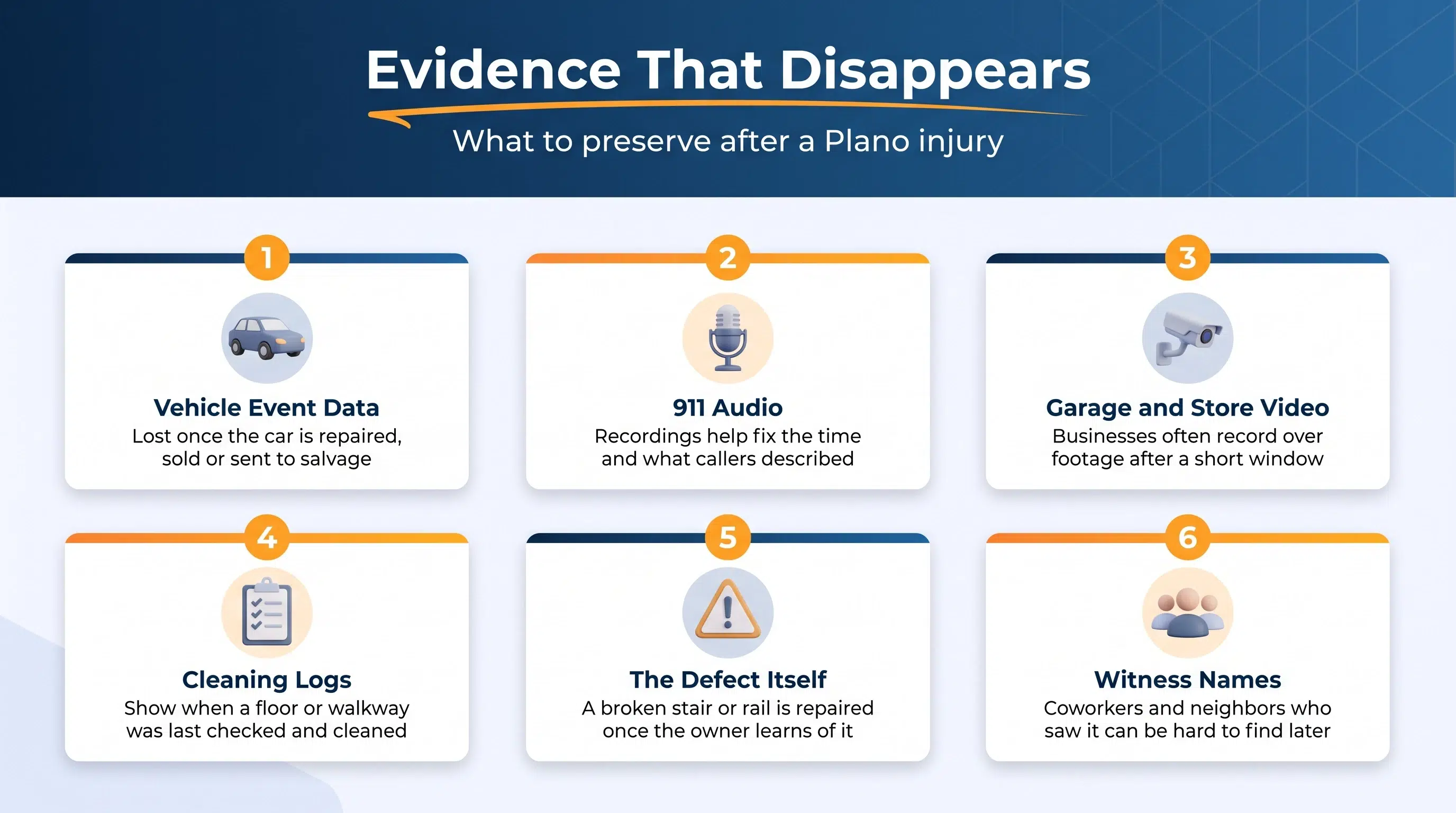
It depends on where you were hurt. After a crash on a tollway, the evidence is the vehicles, their event data, 911 audio and the roadway itself, which gets cleaned up within hours. After a fall in a Plano office building or parking structure, it is video, cleaning and inspection logs, and the physical defect, which gets repaired as soon as the owner learns of the injury.
Businesses often keep video for a short window and then record over it. A written preservation demand sent quickly can stop that. A message sent after the footage is gone proves nothing except that it was lost. We also ask clients to keep their own proof: shoes, clothing, a damaged phone, screenshots of messages with a property manager, and the names of coworkers or neighbors who saw the incident.
How will the insurer treat your claim?
With courtesy, at first. An adjuster calls, asks about your recovery and offers to take a recorded statement. You are not required to give one to the other side’s insurer. An adjuster will also ask for a broad medical authorization, and you can limit it to the records connected to the injury.
Then the file takes shape. A gap in treatment suggests you got better. A prior injury suggests your pain is old. A low early offer is framed as generous. These are ordinary moves, and a lawyer’s job is to answer each with records and, if needed, a petition filed in McKinney.
What can a Plano injury claim include?
Medical care, past and future, is usually the largest piece, followed by lost income and any reduction in your ability to earn. Physical pain and mental anguish count as well, and for lasting harm, so do impairment and disfigurement. Where a defendant’s conduct amounts to gross negligence, Texas allows exemplary damages, subject to statutory limits.
For serious injuries, the numbers rest on documentation: treating physicians’ opinions on future surgery, a vocational assessment of what work you can still do, and a life care plan when care will be lifelong. A young professional with a spinal injury and a retiree with the same injury have very different earning-capacity claims, and the evidence has to speak to each person’s life.
What if you share some blame?
Texas uses proportionate responsibility. A jury assigns each party a percentage of fault, and if you are more than 50 percent responsible you recover nothing. At 50 percent or below, your damages are reduced by your share (Civil Practice and Remedies Code sections 33.001 and 33.012). A fight over ten points of fault can change a result, so we work to build the evidence on both sides of that line.
How long do you have?
Two years from the date of injury for most claims, under Civil Practice and Remedies Code section 16.003. Claims against a city, county or transit agency can require notice within six months, and some charters set shorter periods. If you want a clear reading of your own deadline, schedule a free consultation and bring the date and place of the injury.
Which Plano cases do we take?
Most of the Plano cases we see start on the road. Crashes on US 75, the Dallas North Tollway, the Bush Turnpike and Preston Road are handled by our Dallas-area car accident lawyers. Tractor-trailers and delivery trucks run the same corridors, and a crash with one brings in a carrier, its insurer and federal safety rules, which our Dallas-area truck accident team works from the first week.
When someone is killed, Texas allows the surviving spouse, children and parents to bring a wrongful death claim, and the estate may bring a separate survival claim. Our Dallas-area wrongful death lawyers handle those cases. We also take workplace, premises, daycare and product injury cases from Plano.