























How serious is the drunk driving problem in California and Orange County?
Start with the number. 1,055 Californians killed in alcohol-impaired crashes in 2021, according to the California Office of Traffic Safety. And the death toll, honestly, is the cleaner half of this. CHP’s SWITRS database logs thousands of additional DUI injury collisions every year on top of the fatalities: the spinal cord injuries, the brain trauma, the recoveries that stretch on for years and quietly drain a family’s savings to nothing. The thing I keep getting stuck on is that none of it had to happen. Every crash on those reports traces back to one person, one decision, one drink past the line before they turned the key.
At the federal level, NHTSA reported 13,524 people killed in alcohol-impaired driving crashes nationwide in 2022, an average of one death every 39 minutes. Orange County contributes its share of those numbers. The CHP Santa Ana Area office runs DUI enforcement operations and sobriety checkpoints throughout the region, but enforcement alone does not undo the harm already done to the people sitting across from us.
For victims, the practical point is this: a DUI crash is not a random accident. It is a foreseeable, preventable event caused by a driver’s deliberate choice, and California law treats it that way, both in criminal court and in the civil claim you may bring for your injuries.
Who can be held responsible after a drunk driving crash in Orange County?
The impaired driver is the obvious starting point. But DUI civil cases frequently have more than one responsible party, and identifying every source of liability is part of what changes the number at the end of a case.
Under California Vehicle Code section 23152, driving under the influence is unlawful. A DUI arrest or conviction supports a negligence per se claim under Evidence Code section 669, which shifts the burden and streamlines the liability proof in your civil case considerably. If the driver had prior DUI convictions, the punitive damages case gets stronger, because the prior record shows the driver understood the risk and chose to disregard it anyway.
Third-party liability is worth investigating in every case. California’s dram shop rules are narrower than many states: under Business and Professions Code section 25602.1, a licensed seller of alcohol can be held civilly liable for serving an obviously intoxicated minor who then causes harm. Civil Code section 1714(c) and (d) extend limited liability to adults who furnish alcohol to a minor at a private residence. If the impaired driver was working when the crash happened, the employer may be liable under respondeat superior. Commercial drivers are also held to a stricter blood-alcohol standard of 0.04 percent under federal regulations and California Vehicle Code section 23152(d), well below the civilian limit of 0.08 percent.
We investigate every potential source of alcohol the at-fault driver consumed and every relationship between the driver and an employer or institution before settling on the full picture of liability.
After a DUI crash in Irvine, what should you do first?
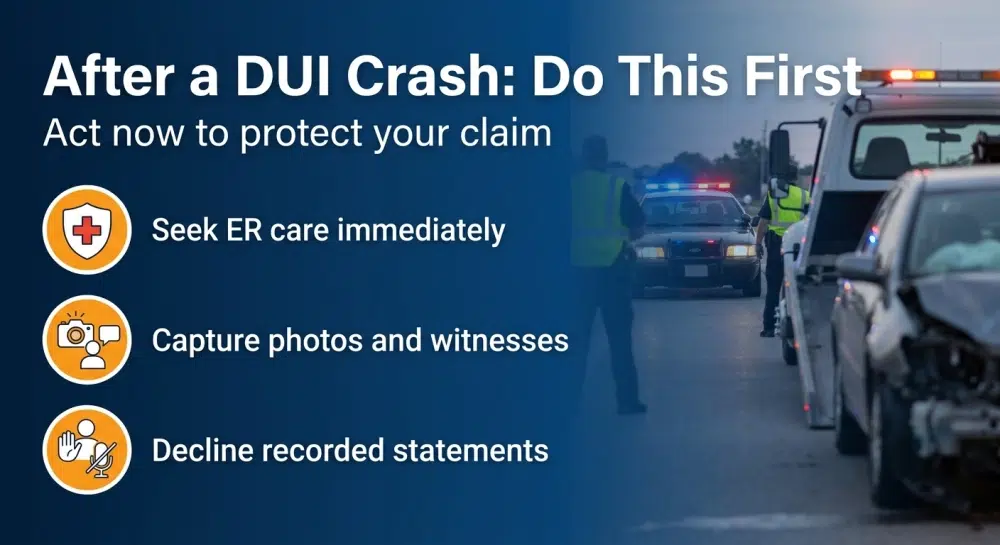
Get medical care. That is first, always. Some injuries, including traumatic brain injury and internal bleeding, do not announce themselves immediately. An ER record from the day of the crash is also the single most useful document in a DUI injury claim, because it ties the injuries to the incident before any gap in treatment can be used against you.
After that, preserve what you can. Photograph the scene, the vehicles, the road conditions, and your injuries before anything is moved or cleaned up. Get the names of witnesses before they leave. Do not give a recorded statement to the at-fault driver’s insurance company before speaking with an attorney.
The evidence window is short. Surveillance footage from businesses near the crash, signal timing data from the city’s traffic engineering office, and 911 audio are all routinely overwritten within days to weeks. Body-camera footage from the responding officers needs to be formally requested before it cycles off. We send preservation letters fast because that window does not wait.
One more thing: the criminal DUI case against the driver runs on a separate track from your civil claim. You do not have to wait for it to finish before filing your lawsuit. A criminal conviction, if one comes, can later be used as evidence of negligence per se in your civil case. Early action on both tracks almost always produces a better outcome than waiting.
What does a drunk driving accident case in Irvine actually look like?
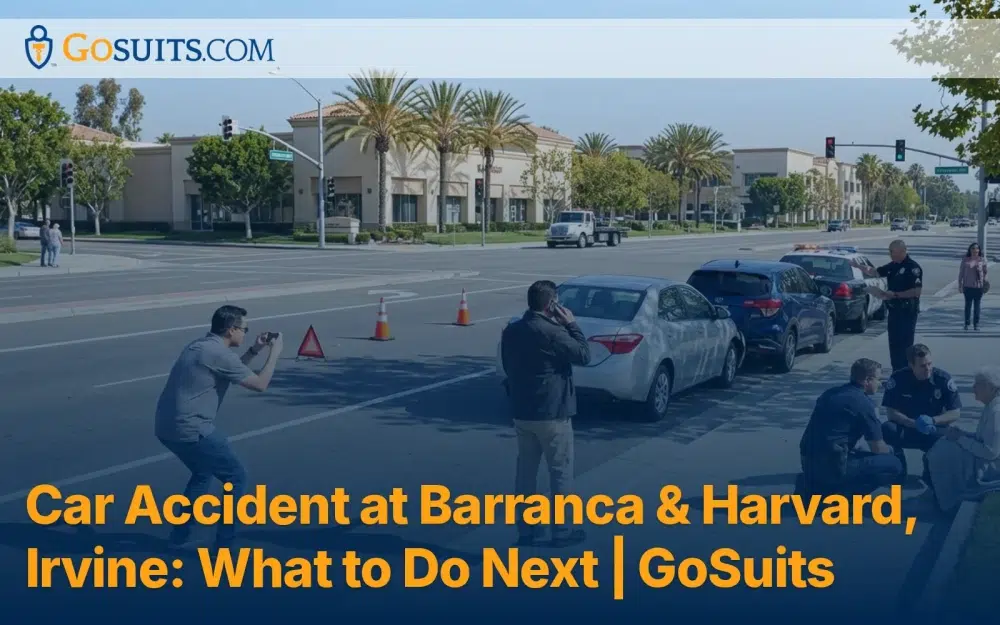
Give it long enough and DUI cases hit every road in this part of OC. We have worked them outside the Spectrum at last call, on the I-405 and the I-5 in the dead of night, on SR-133 winding down toward Laguna. The residential streets are the ones that stick with me. Somebody three blocks from their own driveway, and an impaired driver wanders across the centerline like the lanes do not apply to them.
Wrong-way freeway crashes follow almost the same script every time. Late-night DUI. Driver enters an off-ramp by mistake. Goes a mile or two the wrong direction before a head-on. Usually the I-5, the I-405, or the SR-261 toll lanes. The injuries are brutal, basically without exception. Spinal cord damage. Severe TBI. Wrongful death cases. On these, we work with accident reconstruction professionals on the physical evidence, and we pull CHP’s Multidisciplinary Accident Investigation Team report whenever one has been opened, because the entire case turns on proving the path that put that driver into live oncoming traffic.
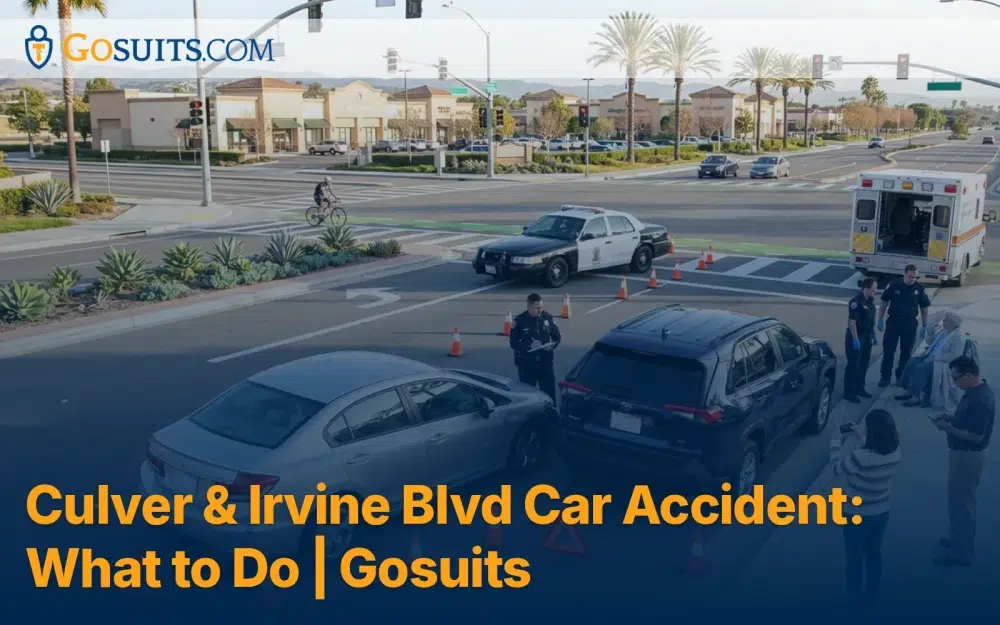
T-bone crashes at signalized intersections are a different animal. An impaired driver running a red light at MacArthur Boulevard, Alton Parkway, or Sand Canyon Avenue hits the side of a car with little warning. Intersection camera footage and nearby business surveillance video are often available but routinely overwritten if no one secures them quickly. We request that footage on day one.
Pedestrian and bicycle cases near the Irvine Spectrum, the Diamond Jamboree corridor, and UCI involve late-night foot traffic in areas that were not designed for the volume they now see. Crosswalk signal cycle records from the city’s traffic engineering office, walk-phase timing, and any camera feeds from adjacent parking structures help establish where the pedestrian was and what the signal showed. These cases frequently draw on every available coverage source: the at-fault driver’s auto policy, any commercial policy if the driver was on the clock, and uninsured and underinsured motorist coverage when the rest does not reach far enough.
Wherever yours happened, we will handle it. We know these roads, we know the courts that hear these claims, and we know how insurance carriers actually behave on a DUI file, which is honestly most of the work right there.
What compensation can a drunk driving victim pursue in California?
California is a pure comparative negligence state. If a fact-finder assigns you any percentage of fault, your recovery is reduced by that percentage but not eliminated. In practice, DUI crash victims are rarely assigned meaningful fault because the impaired driver’s conduct is so far outside the standard of care.
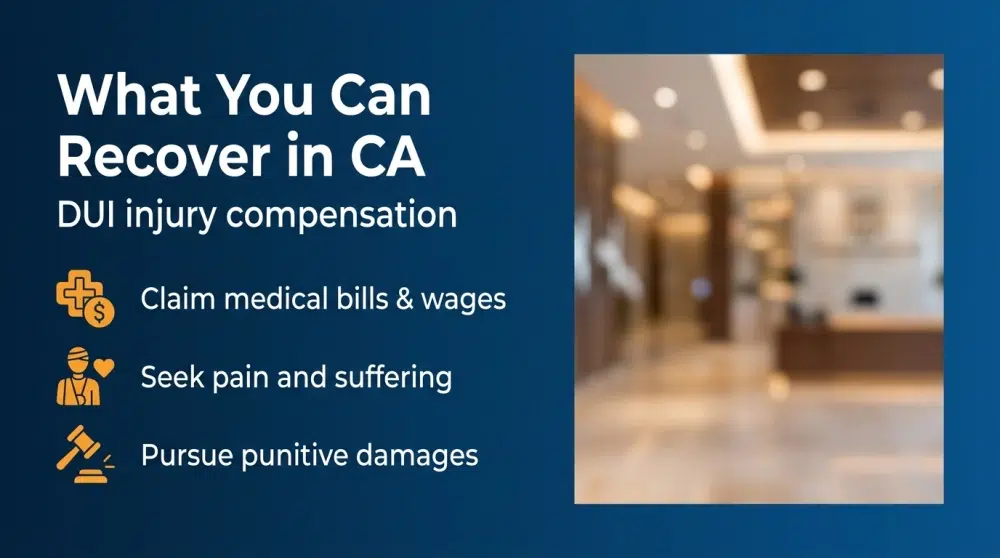
Compensatory damages fall into two categories. Economic damages cover past and future medical bills, lost wages, lost earning capacity, property damage, and out-of-pocket expenses. Noneconomic damages cover pain, suffering, emotional distress, loss of enjoyment of life, and, in fatal cases, the loss of love and companionship that surviving family members can no longer have.
In drunk driving cases, a third category often comes into play. California Civil Code section 3294 allows punitive damages where a defendant has acted with malice, and the California Supreme Court in Taylor v. Superior Court (1979) 24 Cal.3d 890 expressly held that driving while intoxicated can support a punitive damages claim. Punitive damages are meant to punish and deter, and they are a real reason DUI civil cases often settle for more than ordinary negligence cases with similar injuries. They are also typically not covered by the at-fault driver’s auto insurance under California public policy, which means the driver may be personally on the hook for that portion of any judgment.
Beyond pursuing the gross recovery from the at-fault insurer, our team works with treating physicians, life-care planners, and qualified economists to project the long-term cost of your injuries: future surgeries, ongoing therapy, lost career trajectory. And at the end of the case, we go back to the hospitals, ER groups, and medical-lien holders and negotiate those balances down, because the headline settlement number and the check you actually deposit are two very different figures.
How long do you have to file a claim after a DUI crash in California?
Most personal injury claims must be filed within two years of the incident date under Code of Civil Procedure section 335.1. Wrongful death claims follow the same two-year limit from the date of death, with separate rules in section 377.60 governing who may sue. Two years sounds like a long time. It is not, because evidence fades, witnesses move, and the early period of a case is when the most important groundwork gets laid.
There is one deadline that catches people off guard. If a government vehicle or a government-employed driver was involved, you may have only six months to file a written claim under the Government Claims Act, Government Code section 911.2. Missing that deadline can bar an otherwise valid claim entirely. It is one of the strongest reasons to speak with an attorney before the situation feels urgent, not after.
How GoSuits handles a drunk driving case from first call to final check
From your first call to the day the settlement check clears, our job is to absorb the legal complexity so yours can be healing. The early work is unglamorous but it matters a lot. We pull the CHP or Irvine Police Department crash report, request 911 audio, chase down body-camera and dash-camera footage, and canvass nearby businesses for any camera that might have caught the wreck or the impaired driver’s path leading up to it. Because the criminal case is running on its own track at the same time, we coordinate with the prosecutor’s office, because anything they develop against the driver tends to strengthen your civil claim too.
The case moves in the background. Your life still has to keep going while it does. If your car is totaled, we set up a rental. If you do not have health insurance, or your plan will not cover this, we connect you with doctors and imaging centers in Irvine, Newport Beach, and Tustin who treat on a medical lien with no upfront cost. At the end of the case, we negotiate those liens down hard. The gross settlement and the net amount you actually deposit are honestly two different numbers, and closing that gap is part of the job.
If the insurer will not pay fairly, we are ready to file in Orange County Superior Court and present your case to a jury. Drunk driving facts do not play well for defense lawyers, and our job is to lay the evidence out cleanly enough that a jury sees both halves at once: the harm done to you, and the deliberate choice that caused it.
You will receive regular case updates, secure access to your file, and a fast response when you reach out. We work on a contingency fee basis, which means you pay nothing up front and owe a fee only if we recover for you. Ready to talk? Schedule a free consultation with our Irvine team.
Choosing the right drunk driving accident lawyer in Irvine
After a DUI crash, you need more than a generalist who occasionally takes accident cases. Look for a firm that focuses on personal injury, regularly handles drunk driving cases, and is comfortable taking matters to verdict in Orange County Superior Court. Ask how they pursue punitive damages under Taylor v. Superior Court, how they coordinate with the criminal prosecution, and how they will keep you informed between milestones.
Familiarity with the local pieces matters more than people think. A lawyer who already knows the Central Justice Center in Santa Ana, the Harbor Justice Center in Newport Beach, the relevant CHP area office, and the hospitals that typically treat DUI victims is going to move faster and catch the small problems before they become delays. The good news on cost: most reputable firms run free consultations and work on contingency. We do too. Getting actual legal advice on your situation costs you nothing up front.
Local knowledge is also practical knowledge. The I-405 through Irvine backs up hard near the SR-133 interchange, and rear-end collisions in stop-and-go traffic there are common. The SR-55 corridor into Newport Beach sees its share of late-night impaired drivers heading south after closing time. Knowing how those roads behave and how the local courts approach these cases is not a marketing claim, it is how cases get built right.