





































What actually causes work injuries in Irvine, and who pays?
Irvine’s economy spans a lot of different industries, and the injury types reflect that range. The Irvine Spectrum area and surrounding corridors along I-405 host distribution centers, light manufacturing, technology campuses, and construction projects at various stages. Jamboree Road and the Irvine Business Complex see commercial and office construction. The SR-73 and SR-55 corridors move heavy equipment and materials into active job sites. Each of those environments produces specific injury patterns.
Falls from elevation account for a significant share of the serious work injuries we handle: workers falling from scaffolding, ladders, or elevated platforms at construction sites. Forklift and heavy equipment accidents are common in warehouse and distribution settings. Chemical exposures, electrical accidents, and falling object injuries show up across multiple industries. Repetitive stress injuries develop over time but can be just as disabling as acute trauma. And traffic-related incidents, including accidents that happen while a worker is driving as part of their job, are a distinct category with their own legal framework.
In most workplace injury situations in California, workers’ compensation is the starting point. California law requires almost all employers to carry workers’ compensation insurance, and it provides medical treatment and partial wage replacement regardless of who was at fault. But workers’ comp has limits, and those limits matter for people with serious injuries. It does not cover pain and suffering. It does not allow full wage replacement in most cases. And it does not address the conduct of third parties whose negligence contributed to the injury.
When can you go beyond workers’ compensation?
California law allows injured workers to pursue civil claims against parties other than their direct employer. These third-party claims run alongside the workers’ comp process and can recover damages that workers’ comp does not pay, including compensation for pain and suffering, loss of enjoyment of life, and the full economic impact of a permanent injury.
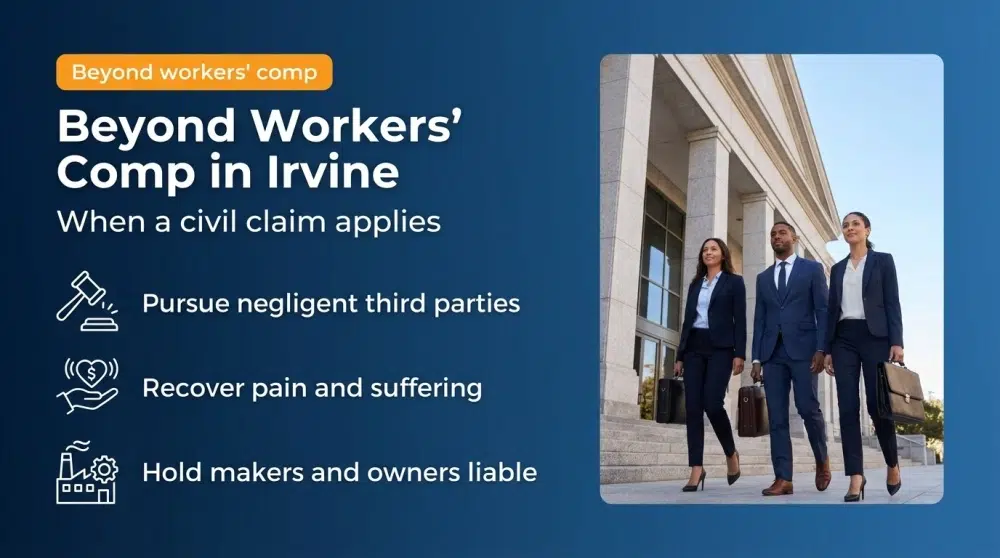
The categories of third-party defendants in Irvine work injury cases include: general contractors and subcontractors on construction sites where the injured worker’s direct employer was a different company; manufacturers of defective equipment that caused the injury; property owners who failed to maintain safe conditions; staffing agencies whose negligent placement or supervision contributed to the accident; and commercial drivers or vehicle operators who caused injuries on the road.
In cases involving employer intentional torts or serious and willful misconduct under California Labor Code section 4553, an injured worker may have additional claims directly against an employer beyond the standard workers’ compensation framework. These are fact-specific and require close legal analysis, but they are a real avenue in cases where employer conduct was egregious.
The analysis of who can be held responsible, and on what legal theory, is the first thing our attorneys work through. That analysis determines the strategy for the entire case.
What evidence makes or breaks an on-the-job injury claim?
The evidence that matters most depends on what caused the injury. A construction site fall case requires a different evidentiary record than a forklift accident in a warehouse or a chemical exposure at a manufacturing facility. But some categories of evidence are valuable across most serious work injury cases.
Incident reports filed with the employer should be obtained and preserved early, before they can be modified. Surveillance footage from job sites, warehouses, or nearby businesses needs to be formally preserved through a legal hold demand within days of the incident, because that footage is typically overwritten on a rolling basis. Equipment involved in the accident should be photographed, documented, and, in serious cases, physically preserved for inspection by qualified professionals. OSHA inspection records and any prior citations against the employer or the job site are discoverable and often highly relevant. Medical records documenting the injury and treatment are the foundation of any damages claim.
Witness statements taken close in time to the incident are significantly more reliable than ones gathered months later. If coworkers saw what happened, or if contractors on the same site observed the conditions that led to the accident, getting their accounts documented early matters.
Our attorneys move quickly on evidence preservation in serious cases. When equipment failure may have contributed to the injury, we bring in qualified professionals to inspect the equipment before it is repaired, removed, or replaced. A physical examination of the machinery, conducted while the evidence is still intact, can establish whether required maintenance was performed and whether visible defects existed before the incident.
How work injury claims in California are valued
Workers’ compensation benefits in California are calculated according to a statutory formula that covers temporary and permanent disability, medical treatment, and supplemental job displacement where applicable. Those formulas do not capture the full economic and personal cost of a serious work injury, which is part of why third-party claims matter.
In a civil third-party claim, the damages a plaintiff can pursue include: past and future medical expenses, including surgery, hospitalization, rehabilitation, and long-term care; past and future lost earnings and lost earning capacity; pain and suffering and emotional distress; and, in cases involving particularly egregious conduct, punitive damages.
What drives the value of a specific case up or down depends on several factors: the severity and permanence of the injury, the strength of the liability case against the defendant, whether the defendant has adequate insurance coverage, the credibility of the injured worker’s account, the clarity of the medical record connecting the injury to the incident, and the skill of the attorneys on both sides.
Beyond the gross recovery from the at-fault insurer, the net amount a client actually receives depends heavily on what happens to medical liens and hospital billing at settlement. GoSuits negotiates directly with hospitals, emergency room groups, and lien holders at the close of a case to reduce what our clients owe out of the award. That negotiation can make a substantial difference in how much of a settlement actually reaches the client’s hands.
For a detailed picture of what your own case might be worth, a free consultation with our team is the only reliable starting point. Every case is different, and general valuations without the facts of your specific situation are not meaningful.
After a workplace accident in Irvine, the first days matter
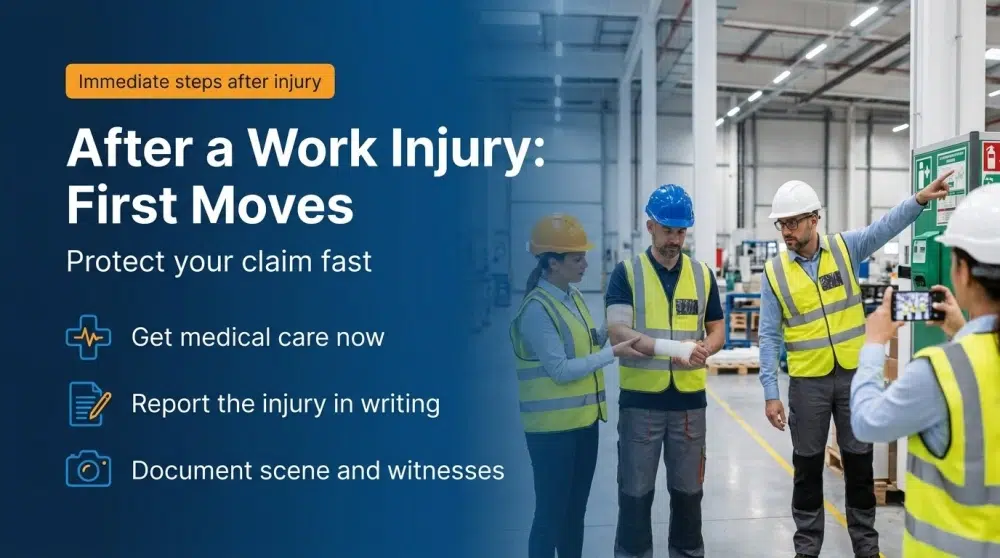
The sequence of steps you take after being injured at work affects both your workers’ compensation claim and any civil claim you may have. A few things matter most in the immediate aftermath.
Get medical attention, and be thorough and accurate when describing your symptoms to treating physicians. An incomplete or inaccurate medical record from the first visits can create problems later. Report the injury to your employer in writing, and keep a copy. Notify them promptly, because California workers’ compensation rules have reporting deadlines that can affect your ability to recover benefits.
Document the scene if you are able to do so safely: photographs of the condition that caused the injury, the equipment involved, the area where the accident occurred. If there were witnesses, note their names and contact information. Do not give recorded statements to your employer’s insurance company without speaking to an attorney first. Insurers for both employers and third parties have interests that are adverse to yours, and recorded statements taken before you understand your legal position can be used to limit your recovery.
Then call a work injury attorney. California’s general two-year statute of limitations for personal injury claims, found in California Code of Civil Procedure section 335.1, creates real pressure to act. But the practical pressure from evidence loss arrives much sooner.
Common injuries and what they mean for your claim
Traumatic brain injuries from falls or falling object strikes can affect cognition, memory, behavior, and the ability to work in ways that are not immediately apparent. TBIs frequently require long-term care and can permanently reduce earning capacity, which means future damages play a large role in valuing these cases.
Spinal cord injuries from falls, heavy equipment accidents, or vehicle collisions can result in partial or complete paralysis. These cases involve extensive long-term medical needs, home modification costs, and permanent loss of function, and their valuation requires detailed life care planning.
Severe crush injuries, amputations, and burns require repeated surgeries, prolonged rehabilitation, and often result in permanent functional limitations. The psychological impact of disfiguring injuries adds a dimension of non-economic damages that is real and compensable.
Repetitive stress injuries, including carpal tunnel syndrome, rotator cuff damage, and lumbar degeneration from sustained heavy lifting, develop over time. Proving the causal connection to work conditions requires careful medical documentation and, in some cases, qualified occupational medicine analysis.
Our Irvine personal injury team handles the full range of serious work injuries, from acute trauma cases that require immediate investigation to long-developing occupational injuries that require building a record over time. The legal strategy differs by case type, and we explain how we would approach your situation at the consultation stage.
If you want to understand more about your rights as an injured California worker, the knowledge base article on employee rights after a workplace injury in California walks through the framework in plain terms.