










































What areas in Dallas County do brain injury lawyers serve?
If you or a loved one suffered a traumatic brain injury anywhere in Dallas County or the broader DFW Metroplex, GoSuits is ready to help. While our attorneys are based in Dallas, we serve clients throughout the region, from the high-rise medical corridor near Baylor University Medical Center to the suburban neighborhoods of Plano, Carrollton, and McKinney.
We understand that brain injuries happen in many different settings: a rear-end crash on Central Expressway, a fall on a poorly maintained staircase, a struck-by-object incident at a construction site near Deep Ellum, or an assault at an under-secured apartment complex. No matter where your injury occurred, we bring local knowledge and trial readiness to protect your rights.
TBI is way more common than the headlines suggest. The CDC counted about 214,110 TBI-related hospitalizations in 2020 and 68,663 TBI-related deaths in 2023, the most recent years it reports. Texas, going by the Department of State Health Services, sees tens of thousands of these hospitalizations annually, with crashes, falls, and assaults driving most of them. Dallas County, somewhere over 2.6 million people per the Census Bureau, carries a real share of that statewide load.
Areas we commonly serve
- Central Dallas: Downtown, Uptown, Deep Ellum, Oak Lawn, Bishop Arts, Oak Cliff
- North Dallas and suburbs: Plano, Frisco, McKinney, Carrollton, Richardson, Addison, Allen
- East and South Dallas: Mesquite, Garland, Rowlett, Lancaster, DeSoto, Duncanville
- West and Mid-Cities: Irving, Las Colinas, Grand Prairie, Arlington, Grapevine
- Outlying communities: Greenville, Rockwall, Wylie, Murphy, Sachse
Wherever you are in the DFW area, we’re a phone call away and ready to step in when you need legal guidance after a serious head injury.
What types of brain injury cases do we handle in Dallas?
Brain injuries are not all alike. They range from a single concussion that resolves within weeks to severe diffuse axonal injuries that change a person’s life forever. At GoSuits, we have helped clients across Dallas pursue compensation for the full range of head trauma, no matter how the injury occurred.
How a TBI happens
Motor vehicle crashes
Per the CDC, motor vehicle crashes are the second-leading cause of TBI-related hospitalizations in the United States, behind falls, accounting for 23.8 percent of nonfatal TBI hospitalizations in 2018. From a rear-end on the Dallas North Tollway to a side-impact on I-30, the violence of a crash can rattle the brain against the inside of the skull even when there’s no direct hit to the head. Sudden acceleration, sudden stop, that’s all it takes. Our attorneys build the file from the ground up, police crash reports out of the Texas DOT CRIS system, dashcam clips, surveillance video, and the treating-physician records that catch both the day-of diagnosis and the cognitive issues that creep up later.
Commercial truck collisions
Truck crashes produce some of the worst brain injuries we see. The mass and speed of an 80,000-pound vehicle can cause skull fractures, hemorrhages, and severe diffuse axonal injuries even at moderate highway speeds. When a tractor-trailer or delivery truck causes a wreck on I-20, I-45, or I-635, we move quickly to preserve electronic logging device data, dispatch records, and maintenance files before they are lost or overwritten.
Falls
The CDC identifies unintentional falls as the leading cause of TBI-related hospitalizations, accounting for 51 percent of nonfatal TBI hospitalizations in 2018. A fall down poorly lit stairs at an apartment complex, a slip on an unmarked wet floor at a grocery store, or a tumble on a broken sidewalk can produce a subdural hematoma or contusion that does not show symptoms for hours. We document the property condition, pull maintenance and inspection records, and identify the responsible owner or property manager.
Construction and workplace incidents
A study by the CDC’s National Institute for Occupational Safety and Health (NIOSH) found that the construction industry had the highest number of fatal work-related traumatic brain injuries of any U.S. industry. A struck-by-object incident, a scaffold fall, or a crane accident on a Dallas job site can produce permanent cognitive impairment. Our team coordinates with workers’ compensation insurers and pursues third-party negligence claims when general contractors, subcontractors, or equipment manufacturers contributed to the incident.
Assaults and inadequate-security incidents
Property owners in Texas have a duty to keep premises reasonably safe. When poor lighting, broken locks, or absent security at an apartment complex, parking lot, or nightclub leads to an assault and a head injury, the property owner can be held responsible under premises liability law.
Common categories of brain injury
Concussion and post-concussion syndrome
A concussion is a mild TBI, but mild does not mean minor. Symptoms can include headaches, light sensitivity, sleep disturbance, mood changes, and difficulty concentrating that lasts weeks or months. We work with neurologists and neuropsychologists to document the cognitive effects and pursue compensation for ongoing care.
Contusions and hemorrhages
A contusion is a bruise on the brain itself. Hemorrhages, including subdural and epidural hematomas, involve bleeding inside the skull and often require emergency surgery. Imaging from CT and MRI scans, combined with treating-neurosurgeon records, anchors these cases.
Diffuse axonal injury (DAI)
DAI is one of the most severe forms of TBI, caused by the brain twisting inside the skull during rapid rotation. Recovery is often incomplete and can include long-term coma, persistent vegetative state, or permanent cognitive disability. Life-care planners and economists help us project decades of future medical costs.
Penetrating brain injuries
When an object pierces the skull, whether a piece of debris in a crash or a projectile in an assault, the resulting injuries are often catastrophic. These cases require careful evidence preservation and detailed expert analysis.
Common symptoms families notice first
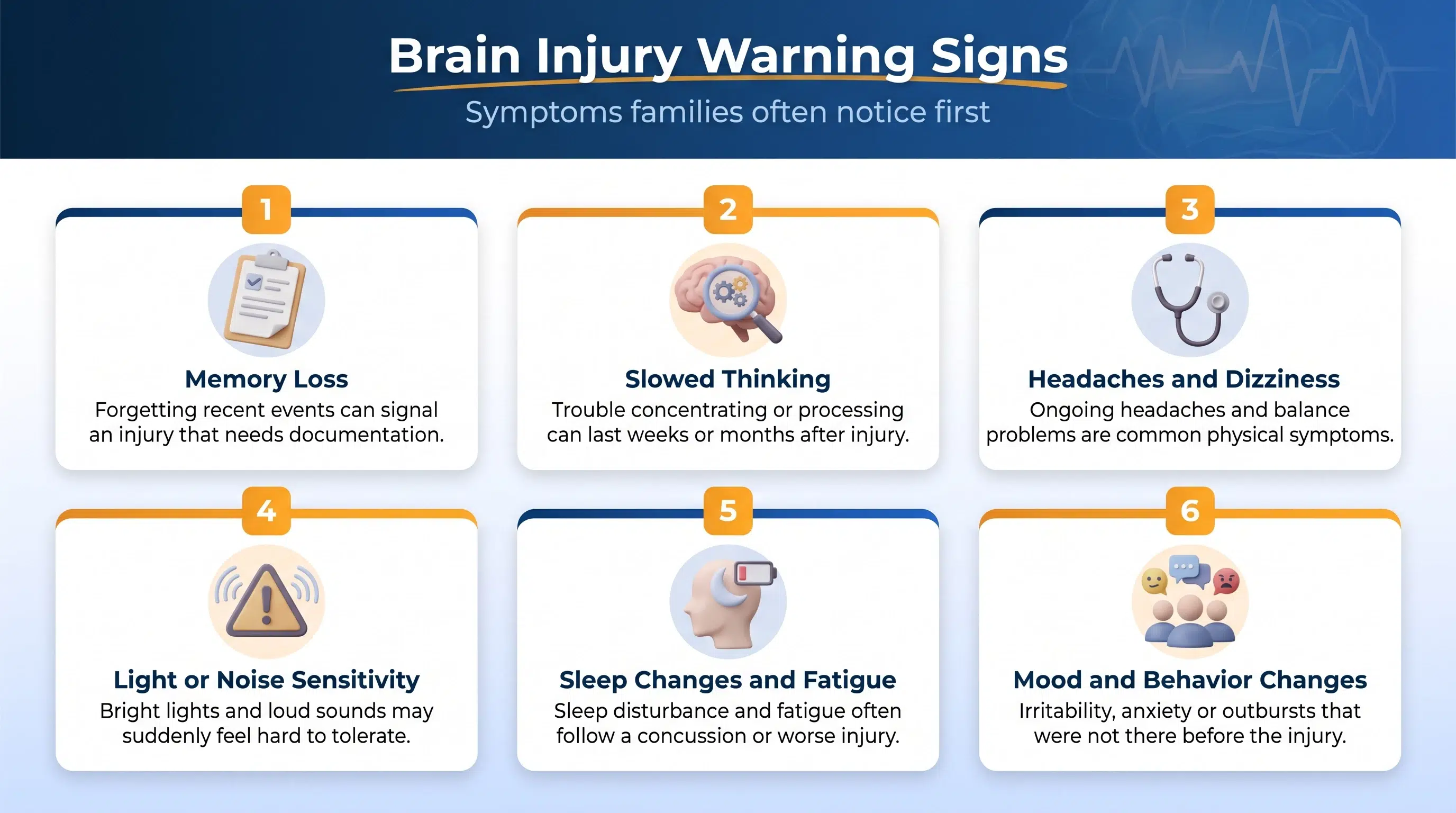
Cognitive symptoms: memory loss, slowed thinking, trouble concentrating, confusion about familiar tasks.
Physical symptoms: headaches, dizziness, balance problems, light or noise sensitivity, fatigue, sleep changes.
Emotional and behavioral symptoms: irritability, depression, anxiety, personality changes, and emotional outbursts that were not present before the injury.
If you or a family member is experiencing any of these symptoms after a crash, fall, or other incident in Dallas, the time to begin documenting the injury is now. Symptoms that seem minor in the first few days can become disabling weeks later.
Choosing the right brain injury legal representation in Dallas
Finding a brain injury lawyer in Dallas after a serious head trauma can feel overwhelming, especially when the injured person is still struggling with memory and processing problems. The choice you make early on can shape the entire recovery.
You need more than a lawyer who occasionally handles accident claims. Look for a firm that regularly handles TBI cases, works directly with neurologists and neuropsychologists, and understands how to project lifetime care costs for cognitive injuries. Ask how often they take cases to trial, how they document long-term losses, and how they keep families informed when the client cannot.
Local experience also matters. A brain injury attorney in Dallas who knows the Dallas County District Courts, the local judges, and the major medical centers (Parkland, Baylor Scott and White, UT Southwestern, Methodist Dallas) can move your case forward faster. Most trusted firms, including GoSuits, offer free consultations and take cases on a contingency basis. That means no attorney fee unless we recover. Case costs and medical bills may still be owed.
Top-rated brain injury lawyers vs. generalists: why it matters
If you needed brain surgery, you would not pick a general practitioner. You would seek out a board-certified neurosurgeon. The same logic applies when picking a lawyer after a head injury.
Top-rated brain injury attorneys focus their practice on serious injury and wrongful death cases. They understand how to preserve crash data, work with treating neurologists, build life-care plans with qualified planners, and present complex medical evidence to a jury. At GoSuits, our team focuses on personal injury and catastrophic injury law, and our trial attorneys carry recognition from organizations including TopVerdict, the National Trial Lawyers, Super Lawyers, and Best Lawyers.
Generalist attorneys may not recognize important deadlines or know how to calculate the full value of a long-term cognitive disability. They often lack working relationships with neuropsychologists, vocational rehabilitation professionals, and economists who help prove damages.
When you choose a firm that concentrates on serious-injury work, you gain a deeper level of strategy and support. That can translate into stronger negotiation power and better compensation for the years of care a brain injury often requires.
Understanding Texas brain injury laws
Texas follows a modified comparative fault rule under Texas Civil Practice and Remedies Code Chapter 33. If you are found 51% or more at fault for the incident, you cannot recover damages. If you are 50% or less at fault, your recovery is reduced by your percentage of responsibility. For example, if your damages total $1,000,000 but you are deemed 20% at fault, your recovery is reduced to $800,000.
Timing matters. Under Texas Civil Practice and Remedies Code Section 16.003, most personal injury claims in Texas must be filed within two years from the date of the incident. This is the statute of limitations. Claims against governmental units (a city bus, a county vehicle, a public hospital) can require formal notice within six months under the Texas Tort Claims Act.
Damages in a Texas brain injury case are typically split into economic and noneconomic categories. Economic damages cover medical expenses, future medical care, lost wages, and lost earning capacity. Noneconomic damages cover pain, mental anguish, disfigurement, and loss of enjoyment of life. In rare situations involving gross negligence, punitive (exemplary) damages may apply, capped under Texas Civil Practice and Remedies Code Section 41.008.
Children’s TBI claims have different timing rules. Under Texas law, the statute of limitations is generally tolled until the minor turns 18, giving them until their 20th birthday to file. Even so, evidence is best preserved early.
How GoSuits Dallas brain injury lawyers can help you
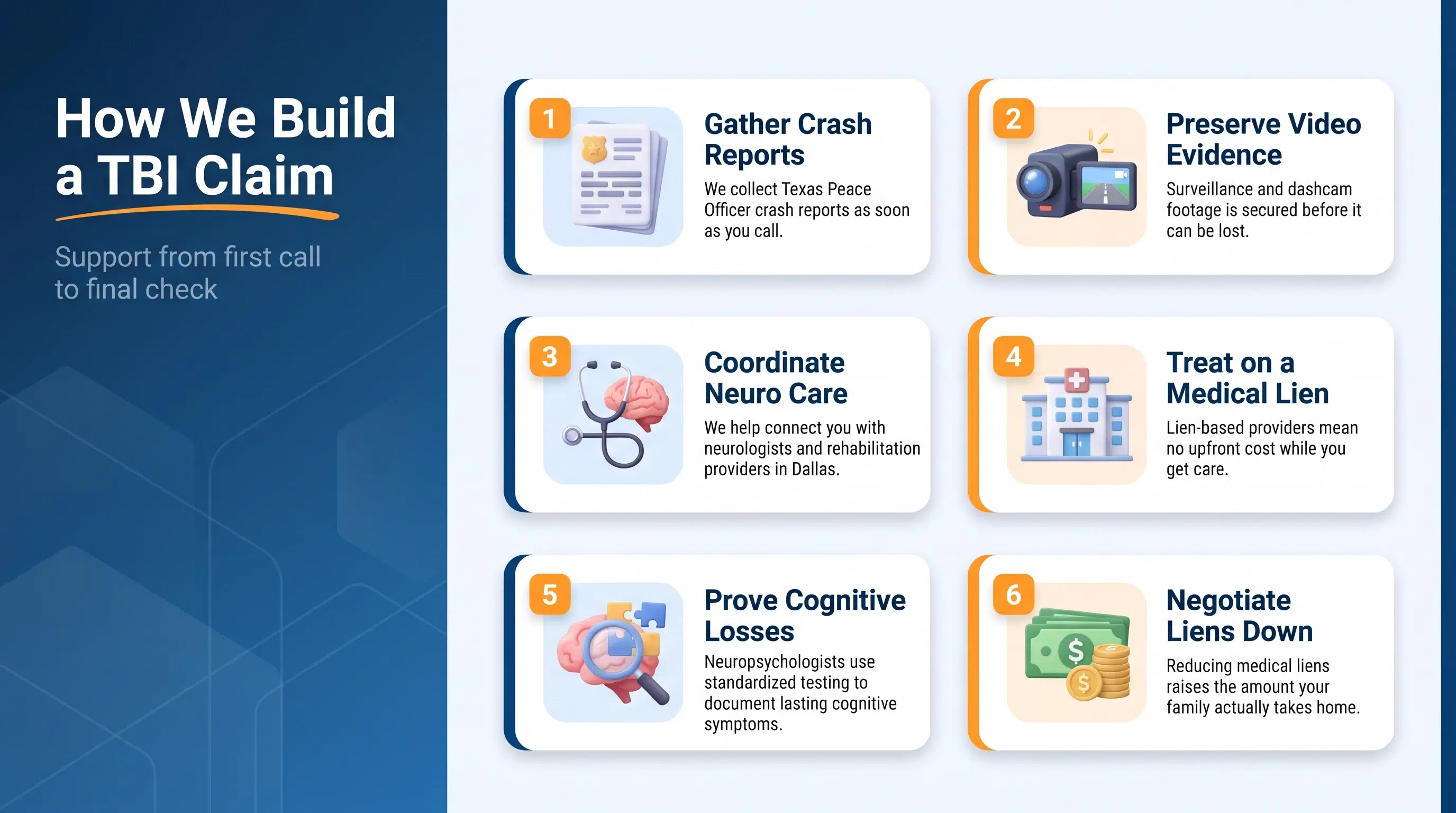
Recovering from a TBI is hard enough without managing a legal claim on top of medical appointments, missed work, and a household in transition. From the moment you reach out, our team begins gathering Texas Peace Officer Crash Reports, preserving surveillance and dashcam footage, and helping coordinate medical care with neurologists, neuropsychologists, and rehabilitation providers in the Dallas area.
From the moment you call us through the day your settlement clears, we manage the full client journey. After a crash, we help arrange a rental car so you can keep working and getting to medical appointments. We connect you with local neurologists, imaging centers, and rehab providers willing to treat on a medical lien, which means no upfront cost while you receive the care a brain injury demands. At the end of your case, we negotiate those medical liens down so the dollars actually reaching your pocket are as high as possible. That is the practical difference between a settlement number on paper and the money your family takes home.
We also know how Texas insurers handle TBI claims. Adjusters often dispute the connection between the incident and lasting cognitive symptoms, especially when imaging looks unremarkable. We work with neuropsychologists who perform standardized cognitive testing and with treating physicians who can connect your symptoms to the mechanism of injury. If the insurance company will not negotiate fairly, we are prepared to take your case to trial in Dallas County District Court. Our Dallas personal injury firm handles head injury, catastrophic loss, and wrongful death matters as a focused practice, and you can schedule a free consultation any time, day or night.
What makes GoSuits different is our knowledge of the Dallas legal field. We know the Dallas County courts, the local trauma centers, and the common defense tactics insurance carriers bring to TBI cases. You’ll receive regular updates, secure access to your file, and a prompt response when you reach out.
We work on a contingency fee basis, which means you don’t pay anything up front. You only owe a fee if we recover compensation for you. When you work with GoSuits, you’re partnering with a legal team focused on transparency, communication, and reliable results.
For more resources, explore our Knowledge Base, including our guide to how much a personal injury case is worth in Dallas.