
































What areas in Cook County and the Chicago region do our commercial property damage lawyers serve?
If your business suffered property damage anywhere in the Chicago metro area, GoSuits is ready to help. While we’re based in Chicago, our legal team serves clients throughout the region from the Loop and River North to the industrial corridors of Cicero and Joliet, the suburban office parks of Naperville, and the neighborhood storefronts of Elgin and Waukegan.
Commercial losses don’t pick a neighborhood. A kitchen fire in a West Loop restaurant on a Saturday night. A water main giving out under a South Side warehouse. A tractor-trailer that doesn’t make the turn in Fulton Market. A hailstorm that chews up the roof of a Naperville office park. We’ve seen all of it, in pretty much every corner of the metro. Wherever your loss happened, we bring local knowledge and the legal chops to protect what you’ve built and chase down the compensation you’re owed.
5 million people in Cook County. Tens of thousands of businesses. And every year, the Chicago metro area sees thousands of commercial property loss events, fires, water damage, vehicle strikes, vandalism, you name it. The U.S. Fire Administration’s National Fire Incident Reporting System actually tracks this stuff, and Illinois alone logs thousands of nonresidential structure fires each year, with direct property loss climbing into the hundreds of millions statewide. Risks aren’t the same across the region. Neither is our approach.
Areas we commonly serve
- Downtown Chicago: The Loop, River North, West Loop, Fulton Market, Streeterville, Magnificent Mile
- North and Northwest neighborhoods: Lincoln Park, Lakeview, Logan Square, Wicker Park, Bucktown, Albany Park
- South and West neighborhoods: Pilsen, Bridgeport, Hyde Park, Bronzeville, Garfield Park, Little Village
- Cook County suburbs and beyond: Cicero, Naperville, Elgin, Waukegan, Joliet, Schaumburg, Oak Park, Evanston, Skokie
Wherever your business is located, we’re just a call away and always ready to step in when you need legal guidance after a commercial loss.
What types of commercial property damage cases do we handle in Chicago?
Lots of ways a business can take a hit on its property. Fire. Flood. Truck through the front window. An insurer slow-walking a clear claim. Whatever the cause, if it traces back to somebody else’s negligence, a covered peril, or just bad faith, you shouldn’t be the one absorbing the bill. At GoSuits we’ve worked with owners all over Chicago and the surrounding counties who got hit by exactly this stuff: fires, water intrusion, vehicle strikes, vandalism, and insurers handling claims like they hope you’ll go away.
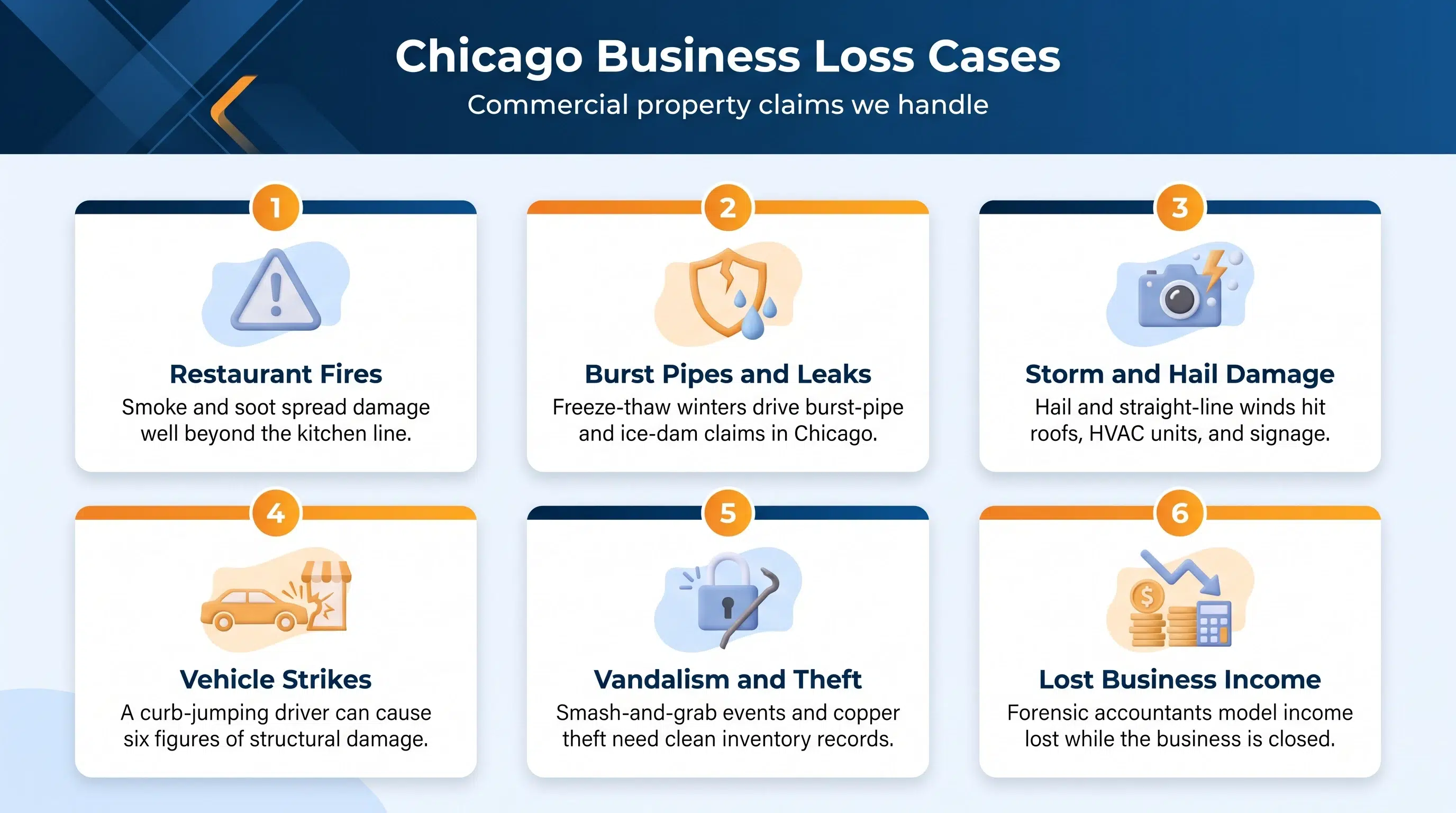
Here’s a look at the most common categories of commercial property damage claims we handle and how we approach each with strategy, empathy, and results.
Fire and smoke damage to commercial property
Restaurant and kitchen fires
Grease-trap flare-up in a West Loop kitchen. Electrical fire behind the walls of an older Pilsen storefront. Either way, restaurant fires almost always cause damage that goes way past the kitchen line. Smoke gets into the upholstery. Soot rides the HVAC into rooms that never saw a flame. Throw in code-required upgrades during the rebuild and the bill climbs fast. We work with public adjusters, certified fire investigators, and contents-restoration vendors to document the whole loss. That includes the business interruption, which is probably the biggest line item while you’re closed.
Warehouse, manufacturing, and industrial fires
Industrial fires along the I-55 and I-90 corridors can wipe out inventory, machinery, and months of revenue in a single afternoon. We coordinate with forensic accountants to calculate lost income under the policy’s business income provisions and work to make sure depreciation arguments don’t unfairly reduce your recovery on equipment that was performing perfectly the day before the loss.
Water, flood, and weather-related damage
Burst pipes, sewer backups, and roof leaks
Chicago’s freeze-thaw winters drive a steady stream of burst-pipe and ice-dam claims. Many policies cover sudden and accidental water discharge but exclude long-term seepage, and that distinction is exactly where insurers tend to push back. We document the timing and source of the loss with plumbers, leak-detection professionals, and moisture-mapping reports so the claim is decided on the policy language, not on a quick adjuster narrative.
Storm, hail, and wind damage
Strong storms moving across the Great Plains regularly deliver damaging hail and straight-line winds to the Chicago area. Roof systems, HVAC units, signage, and fleet vehicles can all be affected. We work with licensed roofers and weather-data services to tie the damage to a specific event date and to push back when carriers try to attribute fresh damage to “wear and tear.”
Vehicle strikes on commercial property
Storefront and loading-dock collisions
A driver who jumps a curb on Milwaukee Avenue or misjudges a turn into a loading dock can do six figures of structural damage in seconds. These claims involve the driver’s auto policy, the business’s commercial property policy, and sometimes a building owner’s policy at the same time. We sort out coverage priority and pursue every available source so you’re not stuck waiting for insurers to point at each other.
Commercial truck and delivery vehicle damage
Box trucks, semi-trailers, and delivery vans cause an outsized share of commercial property strikes in dense city neighborhoods. When a carrier’s driver damages your building, fence, signage, or fleet, our Chicago vehicle collision lawyers coordinate with our property-damage team to recover both the property loss and any business interruption that follows.
Vandalism, theft, and break-in losses
Glass, fixtures, and inventory loss
Smash-and-grab events, copper theft from rooftop HVAC units, and graffiti damage all show up in commercial policies, but the recovery you actually receive depends on how the claim is documented and presented. We help you build a clean inventory schedule, preserve security footage, and coordinate with police reports so the carrier has no reason to delay payment.
Cyber and data-related commercial losses
More commercial policies now include cyber endorsements, and standalone cyber policies are common in the Loop’s professional-services market. When a covered cyber event causes business interruption, system restoration costs, or third-party liability, we work with IT forensics professionals to document the incident and translate technical findings into the language the carrier needs to evaluate the claim.
Insurance bad faith and underpayment disputes
Lowball offers and improper denials
Illinois law gives policyholders real protection when an insurer unreasonably delays, underpays, or denies a covered claim. Section 155 of the Illinois Insurance Code allows recovery of attorney fees and additional damages when the carrier’s conduct is “vexatious and unreasonable.” When the offer on the table doesn’t match the loss on the ground, we build the file the carrier didn’t expect and pursue the additional remedies the statute provides.
Coverage disputes and policy interpretation
Many commercial policies contain anti-concurrent causation clauses, ordinance-or-law sublimits, vacancy provisions, and protective-safeguard warranties that carriers use to reduce or deny coverage. We read your policy line by line, compare it to the facts of the loss, and where the policy language is ambiguous, we apply the Illinois rule that ambiguities are construed against the drafter, the insurer.
Business interruption and lost income claims
Direct business income loss
When a covered loss forces you to close, business income coverage is supposed to put you back in the financial position you would have been in had the loss not happened. Carriers often dispute the period of restoration, the projected revenue, and the saved expenses. We retain forensic accountants to build a defensible income model based on prior tax returns, point-of-sale data, and industry benchmarks.
Civil authority and contingent business interruption
Some claims arise not from damage to your property but from damage nearby. A street closure ordered by the City of Chicago after a building collapse, or a supplier’s fire that cuts off your inventory, can trigger civil authority or contingent business interruption coverage if the policy and facts line up. We evaluate these less-familiar coverages and pursue them when they apply.
Wrongful loss of life on commercial premises
When a commercial loss involves a fatality
Some commercial property events, an industrial fire, a structural collapse, a vehicle strike, also cause the loss of an employee, customer, or bystander. When that happens, the property claim and the survivors’ claim move forward on parallel tracks. Families in this situation should speak with our Chicago wrongful death attorneys as early as possible so investigation, evidence preservation, and statute-of-limitations issues are handled correctly from day one.
Choosing the right commercial property damage legal representation in Chicago, IL
Finding a commercial property damage lawyer in Chicago after a serious loss can feel like trying to find parking in River North on a Cubs game day. It is overwhelming and filled with options, but making the right choice early on can shape your entire recovery.
You need more than a lawyer who occasionally handles property claims. Look for someone who focuses on commercial property and insurance coverage disputes and has a track record of resolving claims like yours. Ask how they read first-party policies, how they calculate business interruption losses, and how they plan to keep you informed. A clear legal strategy and a willingness to communicate in plain English are signs you are in good hands.
Local experience is also key. A commercial property damage attorney in Chicago who knows the Cook County court system, local judges, and the regional carrier adjusters can spot potential delays and move your claim forward faster. Most trusted firms, including GoSuits, offer free consultations and take cases on a contingency basis. That means no attorney fee unless we recover. Case costs and medical bills may still be owed.
When you work with a lawyer who listens and understands your business, the legal process becomes less intimidating and more effective. Choose someone who brings both compassion and skill to the table.
Top-rated commercial property damage lawyers vs. generalists: why does it matter?
If you needed cardiac surgery, you would not choose a general practitioner. You would seek out a board-certified cardiothoracic surgeon. The same logic applies when choosing a lawyer after a serious commercial loss.
Lawyers who do this stuff every day know how it works. They know how to lock down loss evidence before it gets cleaned up. They can read a 90-page policy without their eyes glazing over. And they’ve got the relationships with public adjusters, forensic accountants, and engineering professionals that any solid claim needs. Our civil litigation team handles property and insurance disputes right alongside the regular injury and accident docket, so coverage analysis isn’t some side project we dust off when needed. It’s part of what we do pretty much every day.
Generalist attorneys may not recognize important policy deadlines such as suit-limitation provisions or sworn proof-of-loss requirements. They often lack access to the professionals such as cause-and-origin investigators, structural engineers, and economists who help prove the full value of a commercial claim.
When you choose a law firm that concentrates on these matters, you gain a deeper level of strategy and support. That can translate into stronger negotiation power and better compensation. Your business deserves a legal team that treats commercial property damage law not as an option, but as a focused part of its practice.
Understanding Illinois commercial property damage and insurance laws
Illinois uses what’s called modified comparative fault. The rule, 735 ILCS 5/2-1116, sets a 50% bar. If a jury decides you’re more than 50% at fault, that’s it, no recovery. Anything under that and your damages just get knocked down by your fault percentage. Quick example. Say your business loss is $200,000 and you get hit with 20% of the fault for letting your sprinkler system go. You’d recover $160,000 instead of the full amount.
Timing’s a big one. Illinois law gives you five years from the date of the incident to file a property damage claim, that’s 735 ILCS 5/13-205. Here’s the catch though. Your insurance policy almost certainly contains a separate suit-limitation clause, often just one or two years from the date of loss, and that clause can cut off your right to sue your own carrier long before the statutory clock runs out. Reading the policy early is honestly critical. Most people don’t, and that’s where claims die.
Damages in a commercial property damage case typically include direct property damage (repair or replacement cost), business income loss, extra expense, contents and inventory loss, and in bad-faith cases, attorney fees and additional Section 155 damages capped by statute. In rare situations involving willful or wanton conduct, punitive damages may apply.
Understanding these legal rules is important if you’re considering a claim. The legal process can move quickly, and early guidance from a firm that handles commercial property damage matters regularly can help confirm that deadlines are met and all damages are properly accounted for.
How GoSuits Chicago commercial property damage lawyers can help you

Picking up the pieces after a commercial loss is brutal. We get that. That’s kind of the whole reason we move fast on the legal side, so you don’t have to add ‘lawyer up’ to a to-do list that’s already three pages long. From your first call, we’re gathering policy documents, locking in evidence at the loss site, and helping coordinate emergency mitigation. Because if you don’t get on top of the damage early, it just keeps spreading while the insurance company takes its time.
We know the insurance process. We know what makes a first-party claim actually hold up. From the first call to the day the settlement check clears, we’re juggling a few things at once. Lining up emergency mitigation vendors so the loss site doesn’t get worse. Connecting you with contractors, public adjusters, and forensic accountants who can document the damage and the income hit without making you front their fees. And at the end, we sit down with the vendor liens and balances and negotiate them down so more of the settlement actually lands in your business account. If the insurance company won’t deal fairly? We file in Cook County Circuit Court and take it to trial. Pretty straightforward.
What makes GoSuits different is our deep knowledge of the Chicago legal field. We understand how to navigate local courts and anticipate common obstacles, which helps us move your case forward without unnecessary delays. You’ll receive regular case updates, secure access to your file, and a prompt response when you reach out. If you’d like to talk through your situation, you can schedule a free consultation with our intake team at any hour.
We also work on a contingency fee basis for our litigation matters, which means you don’t pay anything up front. You only owe a fee if we recover compensation on your behalf. When you work with GoSuits, you’re partnering with a legal team focused on transparency, communication, and reliable results, the same standard you’ll find across our broader Chicago personal injury practice.