To prove negligence in a Chicago car accident case, a lawyer generally must establish four elements under Illinois law: duty of care, breach of duty, causation, and damages.
Evidence such as police reports, photographs, witness statements, medical records, and expert testimony may help show how the crash occurred and how the other driver’s actions caused the injuries.
After an accident, many people are unsure what evidence matters or whether their claim can be supported. Proving negligence requires more than showing that a collision occurred; it requires connecting the driver’s conduct to the resulting harm through reliable evidence.
Key Takeaways
- Proving negligence in an Illinois car accident case generally requires establishing four elements: duty of care, breach of duty, causation, and damages.
- Evidence such as police reports, photographs, witness statements, medical records, and expert testimony may help support different parts of a negligence claim.
- A police report or traffic citation can influence fault discussions but does not automatically determine legal responsibility.
- A claim may be supported without a traditional eyewitness through physical, documentary, and expert evidence. In appropriate cases, a statutory violation or the limited doctrine of res ipsa loquitur may also support an inference of negligence.
- Comparative negligence under 735 ILCS 5/2-1116 may reduce recovery when an injured person shares fault, and being more than 50% responsible generally bars recovery.
- Expert witnesses may assist with disputed liability, accident reconstruction, complex injuries, or future damages, but they are not required in every case.
- Building a negligence claim involves reviewing all available evidence and evaluating how the facts support each required element under Illinois law.

What are the four elements of negligence under Illinois law?
A successful negligence claim generally requires proof of four elements: duty of care, breach of duty, causation, and damages.
These elements must work together to establish that another person’s conduct caused legally recognized harm. Failing to prove any required element may prevent a claim from succeeding.
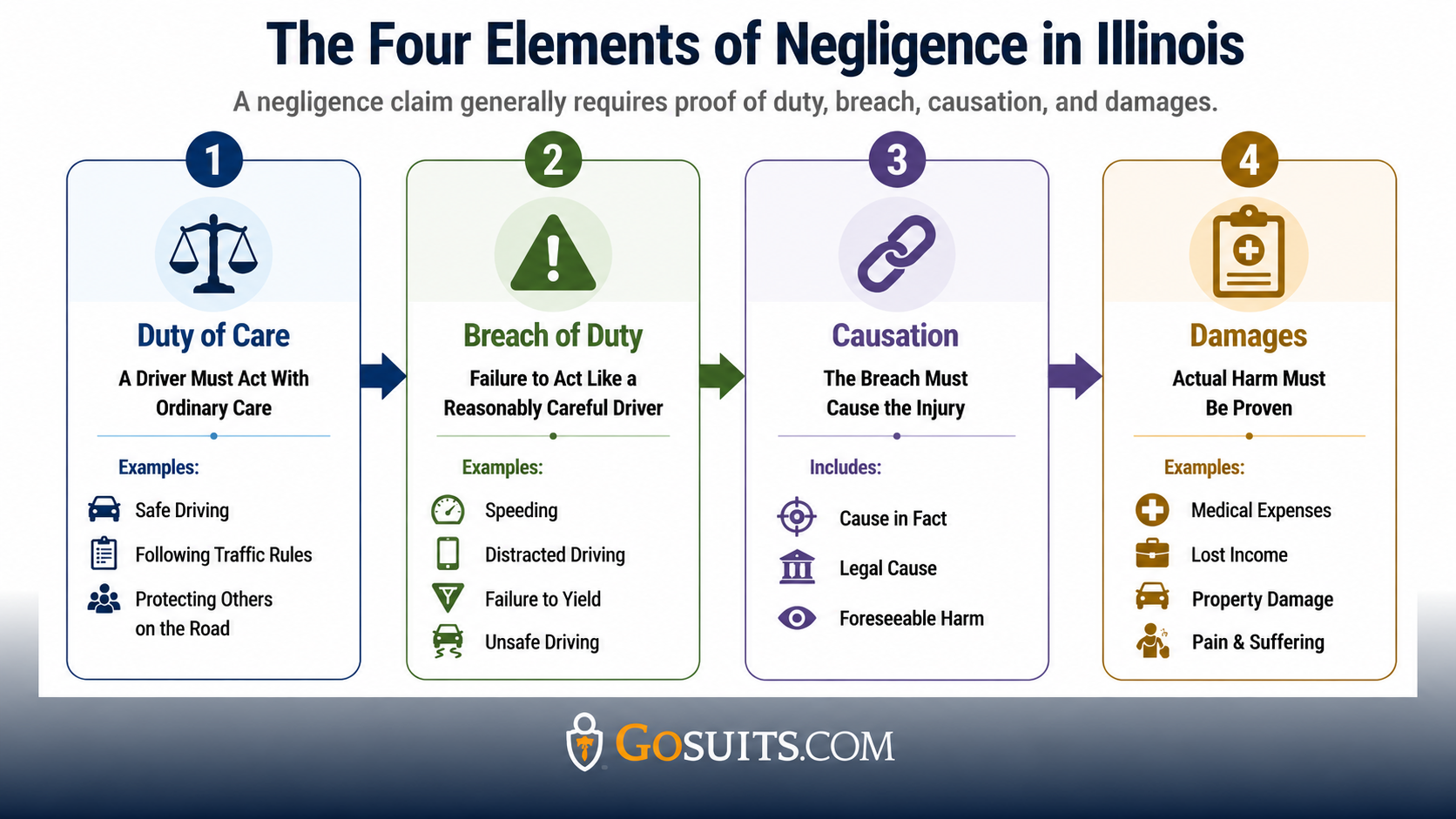
Duty of Care
Illinois law generally requires drivers to use ordinary care when operating a vehicle and to act as a reasonably careful person would under similar circumstances. Illinois Pattern Jury Instruction (IPI) 10.01 reflects this standard by explaining the duty to exercise ordinary care.
In a typical vehicle-collision case, the duty element is often straightforward because drivers must exercise ordinary care toward motorists, passengers, pedestrians, and others foreseeably placed at risk by their operation of the vehicle.
Breach of Duty
Breach occurs when a driver fails to act with the level of care expected from a reasonably careful driver under similar circumstances.
Common examples include speeding, distracted driving, failing to yield, following too closely, ignoring traffic signals, or other unsafe driving behaviors.
A traffic violation may support a negligence claim, but it does not automatically establish liability. The surrounding circumstances and evidence must also show that the driver’s conduct contributed to the accident and resulting injuries.
Causation (Cause in Fact and Legal Cause)
Causation connects the defendant’s conduct to the injury. Under Illinois law, proximate cause generally includes two components: cause in fact and legal cause.
Cause in fact asks whether the injury would have occurred absent the defendant’s conduct. Legal cause considers whether the injury was of a type that was reasonably foreseeable from that conduct.
For example, if a driver runs a red light and causes a collision, injuries produced by the impact may satisfy both requirements. A later injury resulting from a separate and unforeseeable event may require a different causation analysis.
Both aspects must be supported by the evidence. A breach of duty alone is not enough if the claimed injury cannot be legally connected to that breach.
Damages
The final element requires proof that the injured person suffered actual harm. Damages in a Chicago car accident claim may include medical expenses, lost income, pain and suffering, property damage, and future medical needs related to the injury.
A careless act by itself does not create a personal injury claim unless it results in legally recognized damages. The extent of the harm and the evidence supporting those losses are important parts of evaluating a negligence case.
What Evidence Do Lawyers Use to Prove Each Element?
Lawyers use different types of evidence to support each element of a negligence claim in an Illinois car accident case. No single document automatically proves fault or liability. Instead, evidence is evaluated together to show what happened, who may be responsible, how the accident caused injuries, and the extent of the resulting damages.
Evidence Used to Support Negligence Claims in Illinois Car Accidents |
||
|---|---|---|
| Evidence Type | Elements It May Support | Why It Matters |
| Police Reports and Citations | Investigation of Breach | May Identify Observations, Reported Statements, Citations, Witnesses, and Crash Details, Although Admissibility and Evidentiary Use Depend on Illinois Law |
| Photos and Videos | Breach and Causation | May Show Vehicle Damage, Road Conditions, and Crash Circumstances |
| Witness Statements | Breach and Causation | May Provide Independent Accounts of What Occurred |
| Medical Records | Causation and Damages | Help Document Injuries and Treatment Connected to the Accident |
| Expert Testimony | Causation and Damages | Helps Explain Technical Accident or Medical Issues |
A police report or citation does not automatically establish negligence. Attorneys and insurers may use these records during investigation and negotiation, but whether particular information may be introduced in court depends on the Illinois Rules of Evidence and the purpose for which it is offered.
The type of evidence needed depends on the circumstances of the collision. A Chicago car accident attorney may review multiple sources, including accident records, photographs, witness accounts, and expert analysis, to evaluate how the crash occurred and how the available evidence supports each part of a negligence claim.
Can a lawyer prove negligence without a traditional eyewitness?
Yes. A negligence claim may sometimes be supported through evidence other than a person directly witnessing the driver’s actions. While eyewitness testimony can be helpful, a negligence claim may be supported by admissible photographs, video footage, physical evidence, witness testimony, and expert analysis. Attorneys and insurers may also review police reports during their investigation, although the report’s use in court depends on the Illinois Rules of Evidence.
The absence of an eyewitness does not automatically prevent an injured person from pursuing a claim. However, the available evidence must still establish the required elements of negligence, including that the other driver’s conduct contributed to the accident and caused legally recognized damages.
In limited circumstances, Illinois law also recognizes legal doctrines that may allow negligence to be evaluated even when direct evidence of the specific negligent act is unavailable.
How a Traffic-Law Violation May Support Negligence
In Illinois, violating a statute, ordinance, or regulation generally does not constitute negligence per se. A violation may serve as prima facie evidence of negligence when the rule was designed to protect a class of people that includes the injured person and to prevent the type of harm that occurred.
For example, evidence that a driver ran a red light, followed too closely, or violated another applicable traffic-safety rule may support a finding that the driver breached the duty of ordinary care. The driver may still present evidence that the conduct was reasonable or excusable under the circumstances.
A statutory violation does not establish the entire claim. The injured person must still prove that the violation proximately caused the accident and resulted in legally compensable harm.

Res Ipsa Loquitur
Res ipsa loquitur means “the thing speaks for itself.” In limited cases, it may permit the fact finder to infer negligence when the occurrence ordinarily would not happen in the absence of negligence and the injury was caused by an agency or instrumentality that was under the defendant’s control or management at the relevant time.
The doctrine does not automatically establish liability or relieve the injured person of proving the remaining requirements of the claim. Its application depends closely on the facts, and direct evidence of how a routine vehicle collision occurred will usually remain important.
How do insurance companies and defense attorneys challenge a negligence claim?
Insurance companies and defense attorneys typically evaluate a car accident claim by reviewing whether the injured person can establish the required elements of negligence: duty, breach, causation, and damages. Rather than accepting one version of events, they may examine the available evidence and focus on issues involving fault, the cause of injuries, or the extent of claimed losses.
These arguments are part of the claim evaluation process and often involve reviewing accident records, medical documentation, witness accounts, and other available evidence.
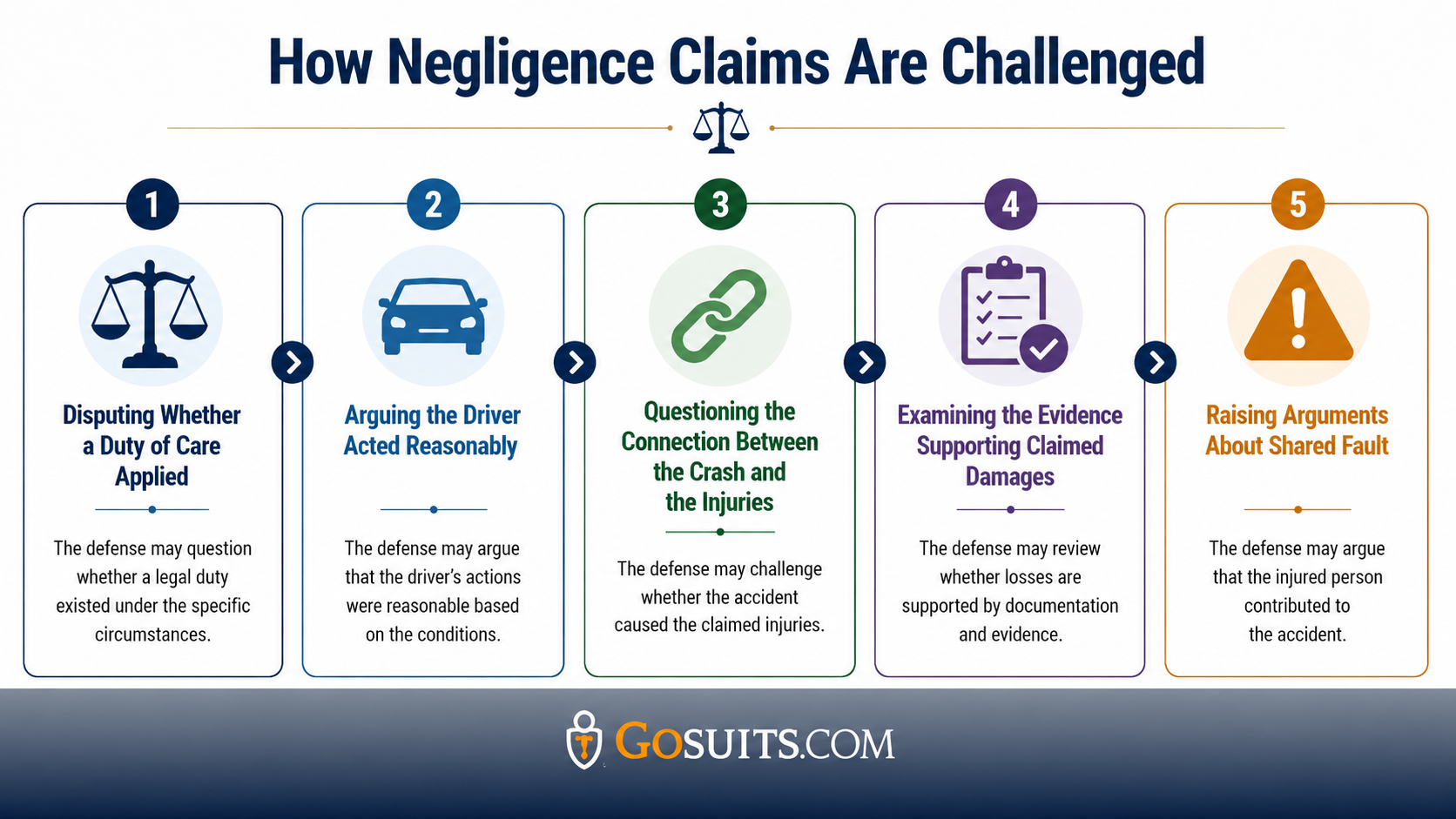
Disputing Whether a Duty of Care Applied
In most Chicago car accident cases, the duty element is usually straightforward because drivers generally owe others a duty to operate their vehicles with ordinary care.
However, in certain situations, a defense may argue that no legal duty existed under the specific circumstances or that the claimed responsibility does not apply.
Arguing the Driver Acted Reasonably
A defense may dispute whether the driver’s conduct amounted to a breach of duty. For example, an insurer may argue that a driver was traveling at an appropriate speed, responded reasonably to road conditions, or made a safe driving decision based on the circumstances.
Evidence such as police reports, citations, photographs, video footage, witness statements, and accident reconstruction analysis may help determine whether the driver’s actions fell below the required standard of care.
Questioning the Connection Between the Crash and the Injuries
Causation is often a significant issue in disputed claims. A defense may argue that the claimed injuries resulted from a pre-existing condition, another event, or circumstances unrelated to the accident.
Medical records, treatment history, physician opinions, and expert testimony may help establish whether the collision caused an injury, aggravated an existing condition, or contributed to the claimed damages.
Examining the Evidence Supporting Claimed Damages
Insurance companies may review whether claimed losses are supported by documentation. This may include questions about medical treatment, lost income, property damage, or the effect of injuries on daily activities.
Medical records, billing documents, employment records, and expert evaluations may help demonstrate the financial and personal impact of an accident.
Raising Arguments About Shared Fault
Illinois follows a modified comparative negligence rule under 735 ILCS 5/2-1116, which allows an injured person’s recovery to be reduced based on their percentage of fault. A defense may argue that the injured person contributed to the accident through actions such as unsafe driving decisions or failure to follow traffic rules.
How does Illinois’ comparative negligence rule affect a car accident claim?
Illinois’ modified comparative negligence rule under 735 ILCS 5/2-1116 affects how fault is assigned and how damages are calculated in a car accident claim. Even when another driver may have acted negligently, the injured person’s own conduct may also be considered when determining the final recovery amount.
Under this rule, each party’s percentage of fault is evaluated based on the evidence available, including accident reports, witness statements, photographs, video footage, and other relevant information.
An injured person may recover damages if they are 50% or less responsible for causing their injuries, but the amount recovered is reduced by their percentage of fault. If they are found more than 50% at fault, they generally cannot recover damages.
For example, if a claim is valued at $100,000 and the injured person is found 20% at fault, the recovery may be reduced by 20% based on that fault percentage. The allocation of fault can become an important issue in cases where drivers provide different versions of how a crash occurred or where both parties may have contributed to the accident.

What role do expert witnesses play in proving negligence?
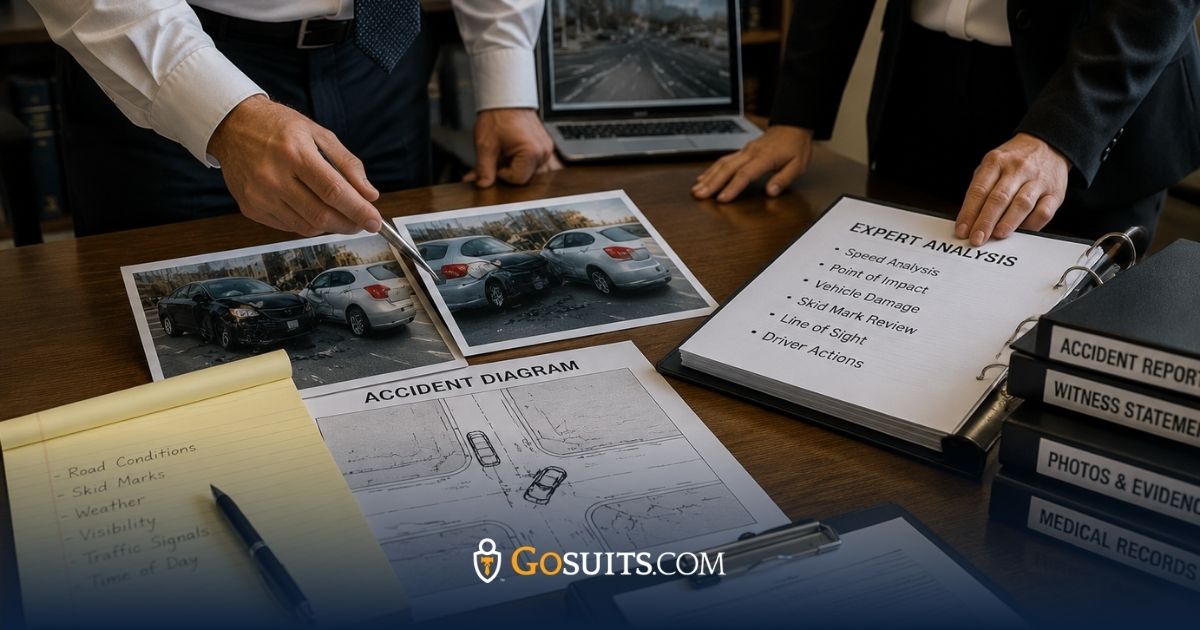
Expert witnesses can help explain technical or specialized issues that are outside the scope of ordinary evidence. In a car accident case, expert testimony may become important when fault is disputed, the cause of the collision is unclear, or the extent of the injuries requires additional explanation.
For example, an accident reconstruction expert may analyze vehicle damage, roadway evidence, photographs, and other available information to explain how a crash occurred.
Medical experts may help address questions about the cause of an injury, the connection between the accident and the claimed harm, or the need for future medical treatment. When an injury affects a person’s ability to work, a vocational expert may help evaluate potential impacts on earning capacity.
Common types of expert witnesses include:
- Accident Reconstruction Experts: Analyze crash evidence to explain vehicle movements, impact points, and possible causes of a collision.
- Medical Experts: Address injury-related questions, including diagnosis, treatment, and future care needs.
- Vocational Experts: Evaluate how injuries may affect employment opportunities or future earning capacity.
Expert testimony is not required in every negligence claim. The need for an expert depends on the specific facts of the accident, the issues being disputed, and whether specialized knowledge is needed to explain important parts of the case. A Chicago personal injury attorney may evaluate whether expert involvement is appropriate based on the evidence available.
FAQs
What happens if there were no witnesses to my accident?
A car accident claim may still be supported without a traditional eyewitness. Evidence such as photographs, vehicle damage, medical records, video footage, accident reports, and expert analysis may help establish how the collision occurred and who may be responsible.
Can a traffic citation alone prove negligence in Illinois?
A traffic citation may support a negligence claim by showing a possible violation of a safety rule, but it does not automatically establish legal liability. Additional evidence is usually considered to determine whether the violation caused the accident and resulting injuries.
What if the insurance company says my injuries existed before the crash?
A pre-existing condition does not automatically defeat a claim. The relevant question is whether the collision caused a new injury or aggravated the prior condition. Medical records, treatment history, physician testimony, and other evidence may be needed to distinguish accident-related harm from the condition’s earlier effects.
Do I need an expert witness for my car accident case?
Not always. Expert witnesses are generally used when a case involves technical questions, disputed accident reconstruction, complex medical issues, or questions about future care and earning capacity.
What is the difference between negligence and willful and wanton conduct in Illinois?
Ordinary negligence involves failing to exercise reasonable care. Willful and wanton conduct generally involves more serious wrongdoing, such as an intentional act or an utter indifference to, or conscious disregard for, the safety of others. Whether conduct reaches that level depends on the specific facts and evidence.