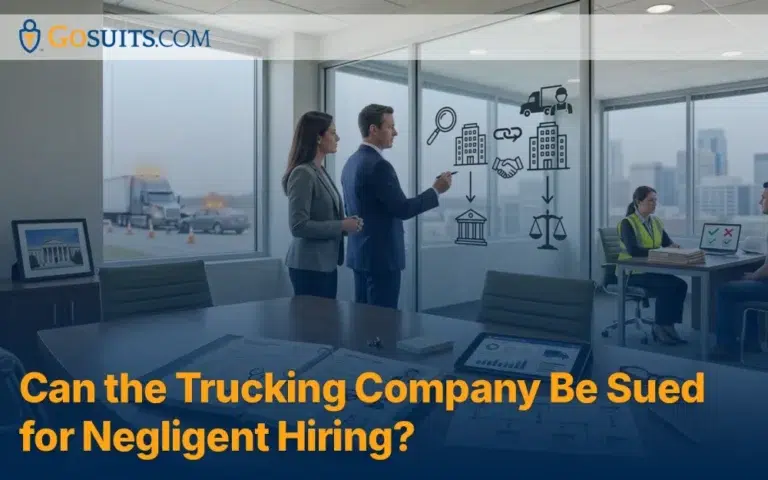
Yes. The trucking company can be sued directly, and I think a lot of injured people don’t realize this. California recognizes several direct claims against the carrier itself, negligent hiring, retention, training, supervision, entrustment, and unsafe scheduling, and they’re separate from any vicarious liability for what the driver did. Totally different lens. These claims ask what the company did or failed to do before putting someone behind the wheel of a semi or an 18-wheeler, not what happened in those final seconds before impact. Each one needs its own elements, its own evidence, its own damages story. And calling the driver an “independent contractor” in some paperwork? That doesn’t end the inquiry. Federal regulations and California common law both impose obligations that can cut right through that label when the facts support it.
Legal Snapshot
- Legal Topic: Negligent Hiring, Retention, Training, Supervision, Entrustment & Unsafe Scheduling Motor Carrier Liability
- Case Stage: Pre-litigation through Discovery and Trial
- Primary Legal Issue: Direct negligence claims against a motor carrier; distinction from vicarious liability
- Primary Authorities: California common law negligence; Cal. Civ. Code § 3294 (punitive damages); 49 CFR Part 391 (driver qualifications); 49 CFR Part 376 (lease regulations); 49 U.S.C. § 14102 (leased motor vehicles); FMCSA regulations
- Jurisdiction: State of California; Federal Motor Carrier Safety Regulations (applicable to interstate commerce)
- Date Legal Authority Last Reviewed: July 14, 2025
Vicarious Liability vs. Direct Negligence: Two Different Claims
When a truck crash happens on I-405 or during stop-and-go traffic on the SR-73 Toll Road near Irvine, injured people often ask a single question: who is responsible? The legal answer can involve multiple defendants under multiple theories.
Vicarious liability, sometimes called respondeat superior if you want the Latin version, basically means an employer is on the hook for its employee’s negligence as long as that negligence happened within the scope of the job. No separate proof needed about the employer messing up. If the driver’s an employee, the carrier owns the acts. That’s it. It’s derivative, meaning the carrier’s exposure rises and falls right alongside the driver’s.
Direct negligence claims are a whole different animal. Not derivative. They zero in on what the carrier itself did or didn’t do, the hiring call, the background check that may or may not have happened, the training that was supposed to prepare the driver, the choice to keep the driver on after warning signs, the dispatch schedule that pretty much required someone to break federal hours-of-service rules. These claims live on their own. If the driver’s negligence gets disputed or trimmed down for whatever reason, the direct claims against the carrier are still there. And that’s the main reason attorneys usually run both theories at the same time. If one falls apart, the other one’s still fighting.
Understanding which theory applies and which produces the stronger claim on the available facts is one of the most important analytical questions in any California truck accident case involving a commercial motor carrier.
What California Law Says About Direct Motor Carrier Negligence
California gives plaintiffs several direct-negligence theories to work with against employers and principals. These aren’t new, decades of common law built them, and the California Civil Jury Instructions (CACI) have locked them in. Then you throw a commercial carrier into the picture. Suddenly you’re not just dealing with state tort law anymore. You’ve got the FMCSA’s federal regulatory framework stacked on top, and the two layers kind of talk to each other throughout the case.
Negligent Hiring
Negligent hiring boils down to this. A carrier puts a driver in a job that could predictably hurt someone, and either the carrier actually knew the driver wasn’t fit, or a reasonable check would’ve turned it up. And “fit” in trucking isn’t some fuzzy character call. It’s concrete stuff, driving history, prior crashes, suspended licenses, substance abuse records, what prior employers reported about safety, FMCSA-reportable violations. The whole paper trail. So when a company hands the keys to an 18-wheeler to someone with a documented string of hours-of-service violations, past out-of-service orders, or disqualifying accidents, and nobody really dug into any of it before hire, that’s probably the kind of decision a court is going to call unreasonable.
Negligent Retention
Even a driver who appeared qualified at hire can become a liability after warning signs emerge. Negligent retention occurs when a carrier continues to employ or use a driver after it knew, or in the exercise of reasonable care should have known, that the driver posed a foreseeable danger. Annual motor vehicle record checks required by 49 CFR § 391.25 are designed precisely to surface disqualifying events that may have occurred after the initial hire. A carrier that ignores adverse entries on an annual review, or that fails to conduct the review at all, creates a retention claim when that same driver later causes a serious crash.
Negligent Training
Commercial truck accident lawyers frequently investigate whether a driver received adequate training before operating a specific vehicle type, hauling a specific cargo category, or navigating high-risk driving environments. Federal regulations require road tests and evidence of training; internal company training records may reveal whether a carrier met its own stated standards. Inadequate training claims arise most frequently when the crash involves a vehicle type or condition such as tanker operations, oversized loads, or adverse weather that requires skills the driver never adequately developed.
Negligent Supervision
Supervision in the trucking context extends beyond watching a driver on the road. It includes monitoring electronic logging device (ELD) data, reviewing inspection reports, acting on violations identified during DOT inspections, and enforcing compliance with hours-of-service rules. A carrier that receives ELD data showing a driver is consistently running beyond the legally permitted driving window, but does nothing to correct it, has arguably supervised that driver negligently.
Negligent Entrustment
Negligent entrustment is the theory most directly focused on the decision to hand a specific driver the keys to a specific vehicle on a specific day. It requires showing that the carrier permitted a driver to operate its vehicle when it knew, or should have known, that the driver was incompetent or unfit to do so safely. Evidence of prior accidents, current license violations, substance abuse history, or out-of-service orders issued near the time of entrustment can all be relevant to this theory.
Unsafe Scheduling and Dispatch Pressure
One of the most systemic and underappreciated forms of direct motor carrier negligence involves the design of routes, delivery windows, and dispatch instructions. When a carrier or its dispatchers create schedules that cannot realistically be completed within legally permitted hours-of-service limits, they are not just encouraging drivers to violate federal law, they are creating a foreseeable risk of fatigued driving. Courts in California and elsewhere have permitted evidence of dispatch pressure and unrealistic delivery windows as part of a direct negligence claim, allowing plaintiffs to argue that the crash resulted from a corporate culture of pressure that the carrier itself created and sustained.
A carrier dispatches a driver from a warehouse in the Inland Empire on a route that requires delivery to two drop points in Orange County before a hard 6:00 a.m. deadline. The driver’s ELD data shows the run cannot be completed within the 11-hour on-duty driving limit without exceeding it by at least two hours. The carrier has received prior complaints about this route but has not adjusted the schedule. Before dawn, the driver, now fatigued, causes a rear-end collision on the I-5 near Costa Mesa. The injured driver of the struck vehicle is not just suing the truck driver for negligent driving, they are pursuing the carrier for the scheduling decision that made fatigue inevitable.
The Driver Qualification File: What It Contains and Why It Matters
Federal regulations under 49 CFR § 391.51 require every motor carrier to maintain a driver qualification file (DQF) for each driver it employs, and to retain that file for as long as the driver is employed and for three years thereafter.[1] This file is one of the most important discovery targets in any negligent hiring or retention case.
The DQF must contain, at minimum:
- The driver’s application for employment (completed per 49 CFR § 391.21);
- A copy of the motor vehicle record received from each licensing authority upon initial hire and at each annual review;
- The certificate of driver’s road test, or equivalent documentation;
- Annual motor vehicle record reviews and notes relating to each annual review of the driver’s driving record;
- The medical examiner’s certificate confirming the driver meets physical qualification standards; and
- Any Skill Performance Evaluation Certificates or medical exemption documents issued by FMCSA.
When a plaintiff’s attorney sends a litigation hold notice and later deposes the carrier’s safety director, the DQF is frequently among the first documents demanded. Missing records, backdated entries, or a file that was assembled only after the crash are all facts that a jury may view with skepticism. The absence of a required annual review, for example, can mean the carrier never knew a driver racked up additional violations in the year before the crash and that the carrier had no system in place to find out.
Prior Employer Safety Performance History
At the time of initial hire, carriers are required under 49 CFR § 391.23 to investigate the driver’s employment history with prior employers for the preceding three years, specifically seeking safety performance history. Prior employers are required to respond to these inquiries. A carrier that fails to make the required inquiry, or that proceeds to hire a driver after receiving adverse safety performance history, has a significantly more difficult time arguing that the hire was reasonable.
FMCSA Inspection and Out-of-Service History
FMCSA’s Safety Measurement System (SMS) and its predecessor systems generate carrier-level and driver-level safety data drawn from roadside inspections conducted across the country. Out-of-service orders, violations cited during inspections, crash history, and compliance review findings are all part of the public record that a careful carrier is expected to monitor. A carrier whose driver had active out-of-service violations or a pattern of hours-of-service violations visible in FMCSA data, but who was still dispatched, faces a pointed question at trial: what did the carrier actually know, and what should it have known, before putting that driver on the road near Newport Beach or Santa Ana?
A commercial vehicle accident lawyers team subpoenas the DQF in a case arising from an 18-wheeler crash on the I-405 near the Irvine Spectrum. The file is produced, but the prior employer inquiry form is missing entirely. The carrier claims it never received a response. FMCSA records, however, show three out-of-service orders against the driver in the two years before hire. The carrier has no written documentation that it ever checked the public FMCSA database before making its hiring decision. This gap becomes central to the negligent hiring claim.
The Independent Contractor Defense and the Federal Statutory Employee Doctrine
Many trucking companies structure their driver relationships as independent contractor arrangements. A driver leases or owns the tractor, enters into a written lease agreement with the carrier, and hauls loads under the carrier’s operating authority. The carrier may argue that because the driver is an independent contractor rather than an employee, it cannot be vicariously liable for the driver’s negligence.
Federal law complicates this defense substantially. Under 49 U.S.C. § 14102 and the regulations at 49 CFR § 376.12, when a carrier leases equipment from an owner-operator for use in regulated transportation, the lease must grant the carrier exclusive possession, control, and use of the vehicle, and the carrier must assume complete responsibility for the vehicle’s operation during the lease period.[2][3] The regulatory framework expressly notes that an independent contractor relationship may still exist under these conditions, but courts have widely recognized a “statutory employee” doctrine: because the federal leasing regulations require the carrier to take control of and responsibility for leased equipment, injured third parties can look to the carrier’s liability insurance regardless of how the driver’s employment status is characterized in the lease agreement.
California courts also apply an economic-realities test for worker classification that examines how control was actually exercised, not merely what the contract says. Evidence of dispatcher instructions, mandated routes, required check-ins, equipment standards imposed by the carrier, and other markers of operational control can all bear on whether the driver was functionally an employee despite the independent-contractor label on the agreement.
The practical effect: a carrier cannot rely solely on calling a driver an independent contractor to escape responsibility for injuries caused during a regulated haul. The statutory employee doctrine and the lease regulations create a baseline of accountability that applies regardless of the contractual characterization.
The Admission-of-Agency Tactic and Its Limits
A tactic that appears in some trucking defense strategies is for the carrier to admit that the driver was acting as its agent or employee at the time of the crash, essentially conceding vicarious liability and then to argue that the direct-negligence claims (negligent hiring, retention, training, supervision, and entrustment) are now cumulative, irrelevant, and unduly prejudicial, and should be excluded from evidence or dismissed.
The logic is that if the jury will already hold the carrier responsible for everything the driver did (through vicarious liability), then evidence of how poorly the carrier screened or trained the driver adds no additional liability exposure but does add substantial prejudicial detail that could inflame the jury in ways that distort the damages analysis.
California courts have not adopted a bright-line rule that an admission of agency automatically defeats all direct-negligence claims. The answer is genuinely fact-specific and depends on whether the plaintiff has independent damages exposure flowing from the direct-negligence theory that is not fully captured by vicarious liability alone, whether punitive damages are at issue (a direct negligence theory may be required to support a punitive damages claim), and whether the trial court exercises its discretion to allow or limit that evidence. When punitive damages under California Civil Code § 3294 are pursued, the direct-negligence evidence is often indispensable, because punitive damages require proof of the carrier’s own oppression, fraud, or malice not merely the driver’s. An admission of agency does not carry that proof.
If you have been seriously injured by a commercial truck and are concerned about how an admission of agency might affect your claims, reviewing the legal overview for truck accident victims in California can provide helpful context: legal overview for truck accident victims in California.
Systemic Evidence: Dispatch Pressure and Unrealistic Delivery Windows
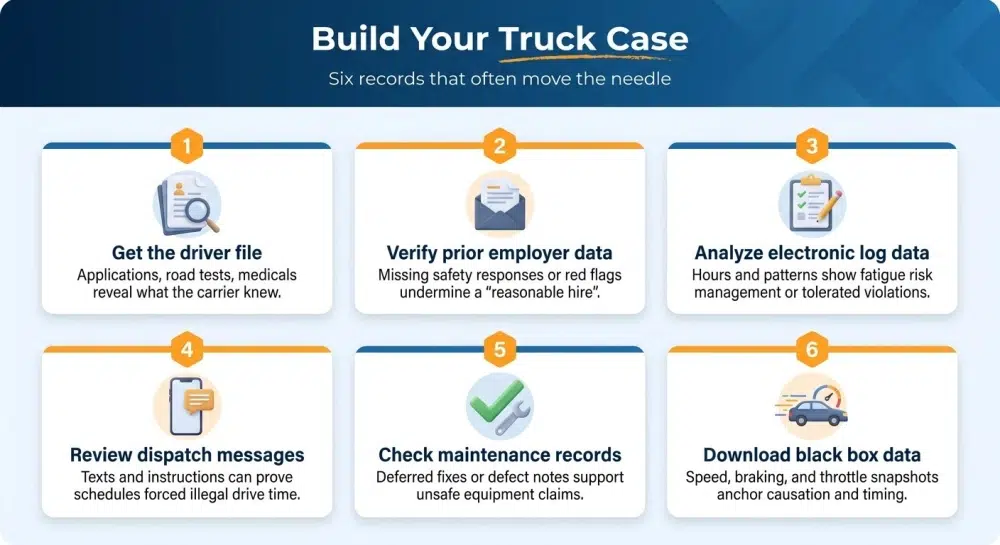
Direct negligence claims in truck cases often succeed or fail based on whether the plaintiff can show that the crash was not the product of one driver’s bad decision on one day, but the predictable result of a carrier’s systemic safety failures. Systemic evidence includes:
- ELD and hours-of-service records showing a pattern of violations across the carrier’s fleet, not just this one driver;
- Internal dispatch communications setting delivery windows that ELD data shows cannot be met without violations;
- Driver complaints or grievances about scheduling pressure that were logged but ignored;
- Prior DOT compliance review findings and the carrier’s response or non-response to cited deficiencies;
- Incentive structures that reward drivers for speed or on-time delivery without adequate safety accountability;
- Maintenance records showing deferred repairs on vehicles known to have safety-critical defects.
This category of evidence is particularly important because it can support both the direct-negligence claim and, in appropriate cases, a claim for punitive damages. A carrier that knows its scheduling creates fatigue risk, receives signals of that problem through ELD data and driver complaints, and does nothing meaningful to correct it has arguably demonstrated conscious disregard for safety the kind of corporate conduct California’s punitive damages statute was designed to reach.
What Evidence Can Matter in These Claims
| Evidence Category | Relevance to Claim |
|---|---|
| Driver Qualification File (DQF) | Shows what the carrier knew or was required to know before and during employment; missing documents are themselves evidence of failure |
| Prior employer safety performance history responses | Reveals whether adverse history was disclosed and whether carrier acted on it |
| FMCSA Safety Measurement System records | Carrier-level and driver-level safety data; out-of-service history; crash history |
| Electronic Logging Device (ELD) data | Hours-of-service compliance; patterns of fatigue-inducing violations across the driver’s history |
| Dispatch records and communications | Shows whether scheduling made legal compliance realistically impossible |
| Internal training records and manuals | Establishes carrier’s own standards and whether they were met |
| Maintenance and inspection records | Vehicle condition; known defects; deferred repairs |
| Lease agreement (49 CFR § 376.12) | Tests independent-contractor characterization; establishes carrier’s assumption of operational responsibility |
| DOT compliance review findings | Prior regulatory notice of safety deficiencies; carrier’s response |
| Post-crash toxicology and driver physical records | Substance use; physical qualification compliance |
| Black box / ECM vehicle data | Speed, braking, throttle position in the period leading up to impact |
| Driver complaints and grievances | Carrier’s actual knowledge of scheduling or safety problems it chose not to address |
Evidence does not automatically prove any element of a claim. It must be properly obtained through discovery, authenticated, and connected through expert testimony or other competent means to the legal standards that apply in California. Experienced truck accident lawyers in Irvine routinely work with accident reconstructionists, trucking industry safety consultants, and vocational economists to assemble and present this evidence effectively.
Damages That May Be Available
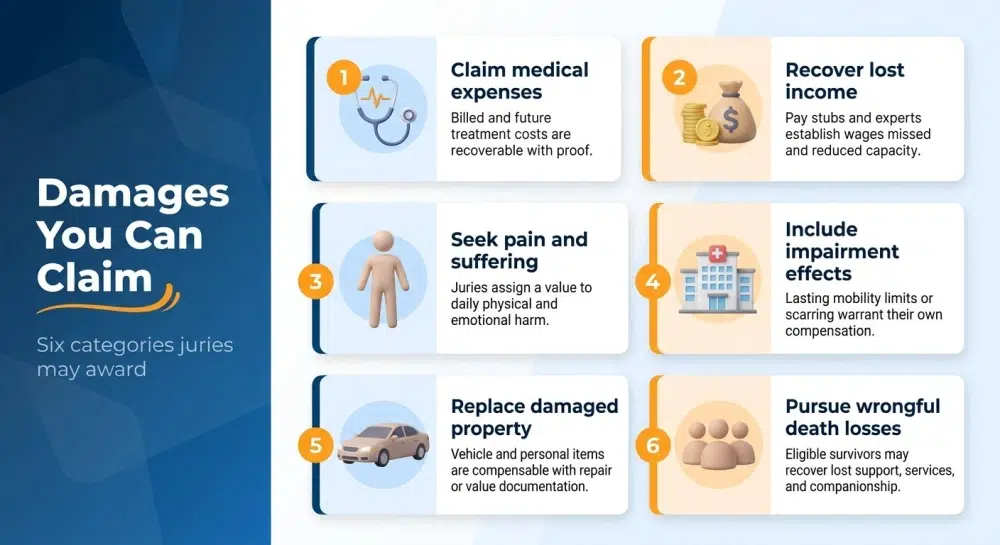
The categories of compensatory damages recoverable in a California personal injury claim arising from a truck crash are well established, though what is actually recoverable in any specific case depends entirely on the evidence and applicable law:
- Past and future medical expenses: including emergency treatment, hospitalization, surgery, rehabilitation, and anticipated future care. California’s rule regarding billed versus paid medical expenses under Howell v. Hamilton Meats [AUTHORITY TO VERIFY for specific citation details] affects how these figures are presented and valued.
- Lost income and impaired earning capacity: wages lost from the date of injury forward, and, where injuries are permanent or severely limiting, the present value of future earning capacity that will not be realized.
- Physical pain and mental anguish: non-economic damages that California permits the jury to value without a fixed formula.
- Physical impairment and disfigurement: separately recognized categories of non-economic harm.
- Property damage: the value of the vehicle and personal property destroyed or damaged in the crash.
- Wrongful death damages: where a truck crash causes a fatality, surviving family members may have claims under California Code of Civil Procedure §§ 377.60 and 377.61 for loss of financial support, loss of companionship, and other recognized items of loss. Fatal crash attorneys in Irvine who handle these cases can explain the specific standing rules and the items of damage available to each category of survivor.
Punitive Damages Under California Civil Code § 3294
California Civil Code § 3294 permits the recovery of punitive (exemplary) damages where the defendant has been guilty of oppression, fraud, or malice.[4] This is a demanding standard that is met in relatively few cases, even those involving serious misconduct. The plaintiff must establish the required conduct by clear and convincing evidence, a higher burden than the preponderance standard that governs compensatory damages.
In the corporate context, the statute additionally requires that the oppression, fraud, or malice was committed by an officer, director, or managing agent of the corporation, or that such a person authorized or ratified the wrongful conduct with advance knowledge of the unfitness of the employee and conscious disregard of the rights or safety of others.
This means that simply proving a carrier was negligent even egregiously so is generally not enough for punitive damages. The plaintiff must show that someone with actual authority in the corporate hierarchy knew about the dangerous condition or practice, recognized the risk it created, and proceeded anyway in conscious disregard of that risk. Evidence of repeated ELD violations that management reviewed and tolerated, or evidence that a driver’s disqualifying history was known to supervisors before hire, can potentially support this showing but the bar is intentionally high, and courts scrutinize these claims carefully.
How Long Do You Have to Act in California?
California’s general statute of limitations for personal injury claims is two years from the date of injury. Cal. Code Civ. Proc. § 335.1.[5] This deadline applies to negligent hiring, negligent entrustment, and related direct-negligence theories against the motor carrier, as well as to the underlying negligence claim against the driver.
The two-year period can be affected by several factors:
- If the injured person was a minor at the time of the crash, different rules may apply regarding when the limitations period begins to run.
- If the claim involves a government entity, the California Government Claims Act imposes a significantly shorter pre-suit claim requirement typically six months from the date of injury that must be satisfied before a lawsuit can be filed. This applies if a government vehicle, road condition, or public entity is involved.
- If the injured person was incapacitated or otherwise legally disabled, tolling rules may apply.
Preservation of evidence is its own urgent concern entirely separate from the limitations period. ELD data, onboard diagnostic data, dispatch records, and surveillance footage are all subject to routine deletion and overwriting. The sooner a litigation hold notice reaches the carrier and its affiliates, the better the chance of preserving what exists. Waiting, even within the limitations period, can result in irreplaceable evidence being lost.
What to Do After a Serious Truck Crash in Orange County
If you or someone in your family was injured in a collision involving a commercial truck on the I-405, SR-55, SR-133, or the SR-73 Toll Road corridor in the Irvine area, the steps you take in the days immediately following the crash can significantly affect what evidence is preserved and what claims remain viable:
- Seek medical attention immediately, even if injuries seem minor at first. Delayed symptoms are common in serious truck crashes, and a documented medical timeline matters in every claim.
- Do not provide a recorded statement to the trucking company’s insurer without legal guidance. Anything said can be used to challenge the claim later.
- Preserve all evidence you can access: photographs of the scene, vehicle damage, road conditions, signage, witness contact information, dashcam footage from your own vehicle if available.
- Note the truck’s DOT number, carrier name, trailer number, and license plates if you are able to do so safely.
- Contact an attorney promptly so that a litigation hold notice can be sent to the carrier before routine data deletion cycles erase ELD records, dispatch logs, and other critical evidence. Orange County Superior Court in Santa Ana hears these cases, and local procedural knowledge matters in complex commercial litigation.
Truck accident claims involving direct negligence theories against a motor carrier are among the most document-intensive cases in personal injury law. The carrier will almost certainly be represented by experienced commercial defense counsel from the moment of the crash. Having legal representation that understands the federal regulatory framework, the discovery tools available, and California’s damages law is not just helpful it is the practical reality of how these claims are successfully prosecuted.
If you were injured and are looking for Irvine personal injury lawyers with experience in commercial vehicle litigation, schedule a free consultation to discuss the specific facts of your situation.
Talk With a GoSuits Attorney
Truck accident claims involving negligent hiring, retention, and training are complex, document-intensive cases. If you were injured in a commercial vehicle crash in Irvine, Orange County, or elsewhere in California, a GoSuits attorney can review your situation, explain what direct-negligence theories may apply, and advise on what evidence needs to be preserved immediately.
No fee unless you recover. No obligation to retain after your consultation.
Related California Truck Accident and Personal Injury Resources
- Legal Overview for Truck Accident Victims in California
- Truck Crash Evidence Preservation in California
- Trucking Layered and Excess Insurance Policies in California
- Broker Negligence: Can You Sue the Trucking Broker?
- Irvine Truck Crash Highways: Evidence and Claims Guide
- Howell: Billed Versus Paid Medical Damages in California
- Wrongful Death Standing Under CCP § 377.60 in California
References and Legal Authorities
- 49 CFR § 391.51 – General Requirements for Driver Qualification Files – Cornell Law School / LII
- 49 U.S.C. § 14102 – Leased Motor Vehicles – Cornell Law School / LII
- 49 CFR § 376.12 – Lease Requirements (Exclusive Possession and Responsibilities) – Cornell Law School / LII
- California Civil Code § 3294 – Exemplary (Punitive) Damages – California Legislative Information
- California Code of Civil Procedure § 335.1 – Two-Year Statute of Limitations for Personal Injury – California Legislative Information
- 49 CFR § 391.23 – Investigations and Inquiries (Prior Employer Safety Performance History) – Cornell Law School / LII
- 49 CFR § 391.25 – Annual Inquiry and Review of Driving Record – Cornell Law School / LII
- 49 CFR Part 395 – Hours of Service of Drivers – Cornell Law School / LII
- 49 CFR Part 376 – Lease and Interchange of Vehicles (FMCSA) – Cornell Law School / LII
- 49 CFR Part 391 – Qualifications of Drivers (FMCSA) – Cornell Law School / LII
- California Code of Civil Procedure § 377.60 – Wrongful Death: Standing to Sue – California Legislative Information
- California Code of Civil Procedure § 377.61 – Wrongful Death: Damages – California Legislative Information