











































What areas in Illinois do our personal injury lawyers serve?
GoSuits represents injured clients throughout the entire state of Illinois. Our office is located at 8 S Michigan Ave, Suite 935, Chicago, and we handle cases in every county, from the densely populated collar counties around the metro area to rural counties downstate. If you were hurt anywhere in Illinois, you do not need to find a local firm, because we come to you.
Illinois has over 12.5 million residents spread across 102 counties. Cook County alone is home to more than five million people and generates a significant share of the state’s traffic crashes, workplace incidents, and premises liability claims. But accidents happen in every corner of the state, from the agricultural communities of central Illinois to the industrial corridors of the Quad Cities region. No matter where your injury occurred, our team has the legal tools and experience to represent you.
We do not have offices in Peoria, Rockford, Springfield, or other Illinois cities. Our single Chicago location serves as the statewide hub for all Illinois cases, and we coordinate with local professionals, court reporters, and medical providers across the state to build and manage your case efficiently.
Areas we commonly serve across Illinois
- Chicago metro and Cook County: Chicago, Evanston, Oak Park, Cicero, Skokie, Berwyn, Harvey, Des Plaines
- North and northwest suburbs: Elgin, Waukegan, Schaumburg, Arlington Heights, Palatine, Rolling Meadows
- West suburbs (DuPage County): Naperville, Wheaton, Downers Grove, Lombard, Elmhurst, Aurora
- South suburbs and Will County: Joliet, Bolingbrook, Tinley Park, Orland Park, Mokena, Frankfort
- Central Illinois: Peoria, Bloomington-Normal, Decatur, Champaign-Urbana, Springfield
- Northern Illinois: Rockford, DeKalb, Belvidere, Freeport
- Southern Illinois: Carbondale, Marion, Belleville, East St. Louis, Collinsville
Wherever you are in Illinois, a phone call or online inquiry connects you directly to our legal team. We handle all necessary logistics so geography is never a barrier to quality legal representation.
Types of personal injury cases we handle across Illinois
Accidents take many forms, but the legal question in every personal injury case is the same: did someone else’s carelessness or wrongdoing cause your harm? If so, Illinois law gives you the right to seek compensation for your losses. At GoSuits, our attorneys handle the full range of personal injury matters that arise in cities, suburbs, and rural communities across the state.
Motor vehicle accidents on Illinois roads
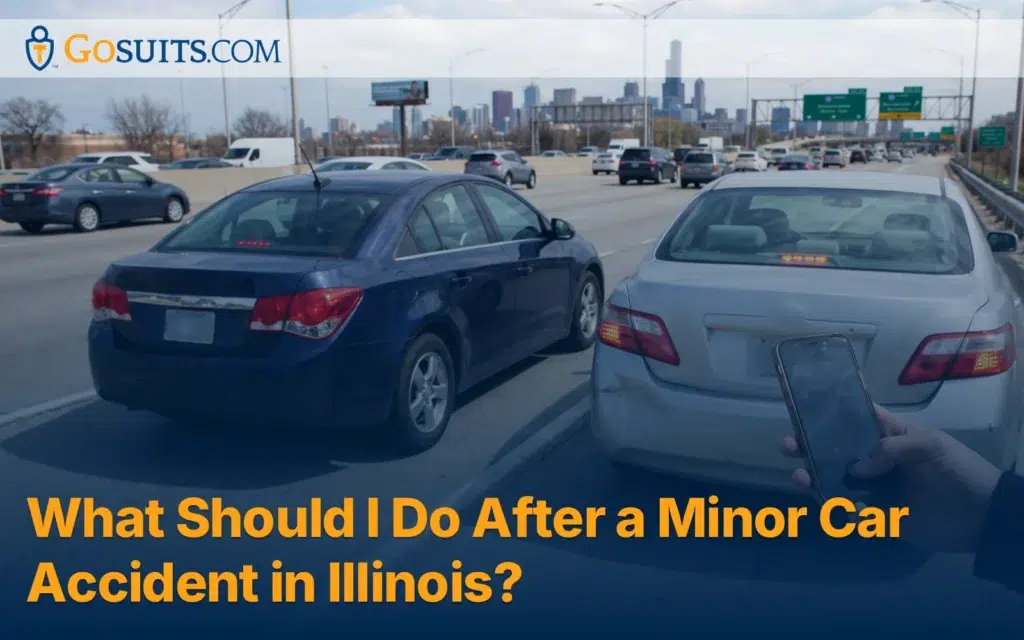
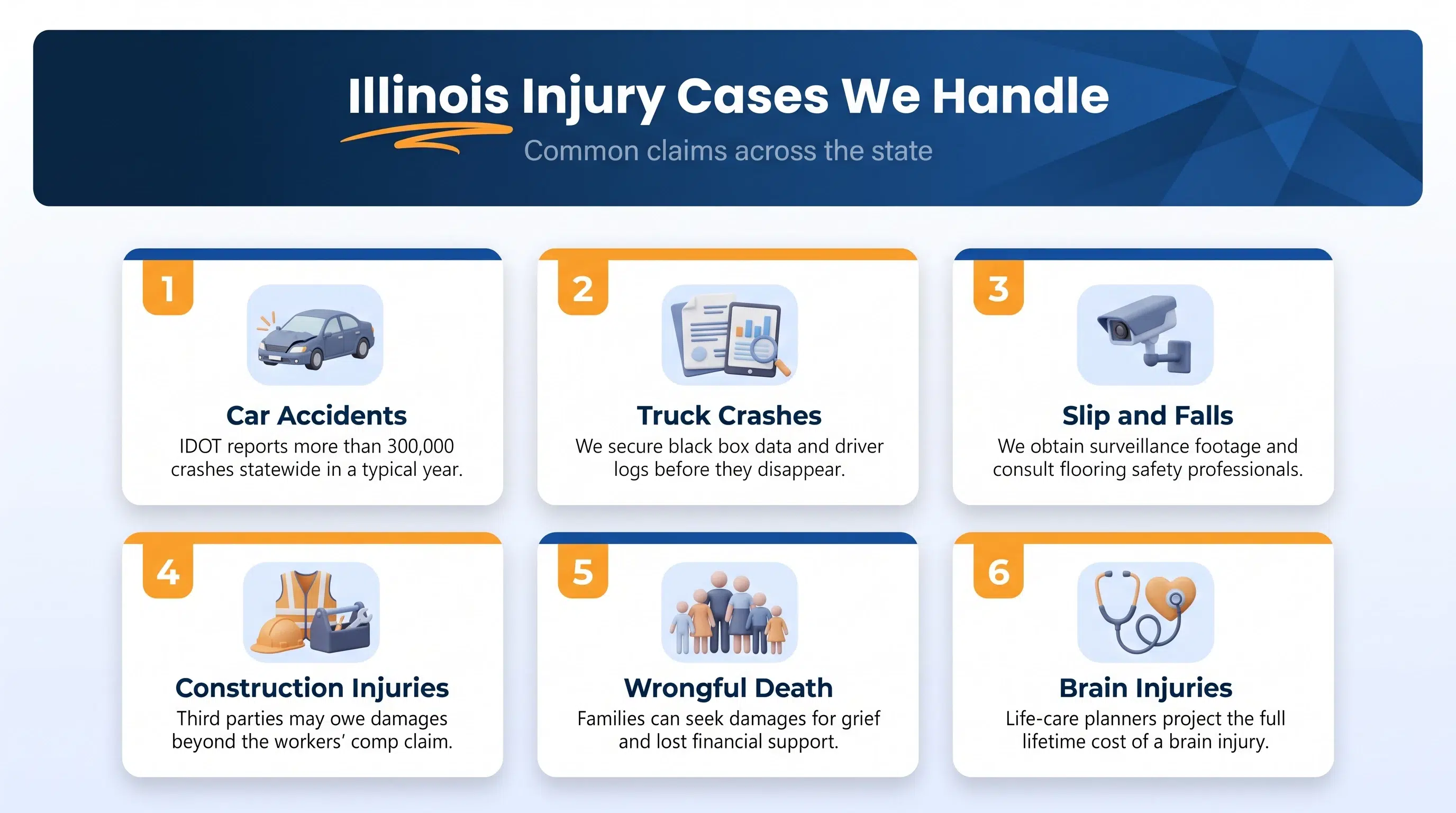
Illinois roads carry millions of drivers each day, and the Illinois Department of Transportation (IDOT) consistently reports more than 300,000 motor vehicle crashes statewide in a typical year. The consequences range from minor property damage to catastrophic, life-altering injuries. Our Chicago motorcycle injury attorneys and vehicle accident team handles claims arising from rear-end collisions on the Dan Ryan, T-bone crashes at suburban intersections, highway pile-ups on I-80, and high-speed interstate crashes along I-94 and I-290.
When a commercial truck is involved, the complexity multiplies quickly. Federal Motor Carrier Safety Administration (FMCSA) regulations under 49 CFR Part 395 govern commercial driver hours-of-service, and violations of those rules are common contributors to Chicago truck accident cases and crashes on interstates throughout Illinois. Our team moves immediately to secure black box data, driver logs, and maintenance records before they are overwritten or destroyed.
SUV and high-center-of-gravity vehicle rollovers are a distinct category of crash that our Chicago SUV rollover practice handles with dedicated attention to product liability overlap, road defect analysis, and roof-crush injuries. If you or a family member was seriously hurt in a rollover anywhere in Illinois, we can assess both the driver-fault and manufacturer-fault angles of your claim.
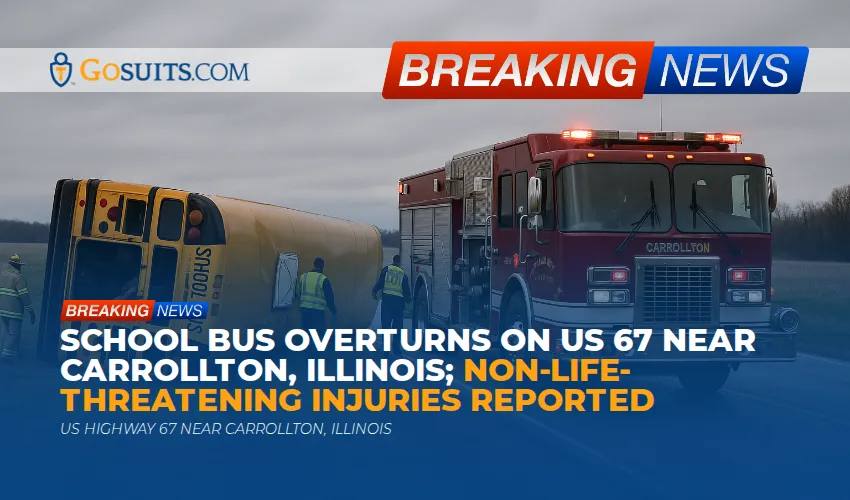
Bus accidents, whether involving CTA buses in Chicago or Pace buses in the suburbs, present unique procedural rules because public transit authorities often have governmental immunity protections. Our Chicago bus accident lawyers understand those protections and the shortened deadlines that apply when a government entity is involved.
Premises liability: slips, falls, and unsafe property
Property owners and occupiers in Illinois owe a duty of reasonable care to people who are lawfully on their premises. When a store fails to clean up a spill, a landlord ignores a broken staircase, or a parking lot operator leaves a known hazard unaddressed, the resulting injuries are preventable. Our Chicago slip-and-fall attorneys investigate the scene, obtain surveillance footage, consult flooring safety professionals, and build claims supported by evidence rather than assumption.
Common premises liability incidents we handle include grocery store and retail slip-and-falls, trip hazards on public sidewalks (which may involve municipal liability and a one-year filing deadline under 745 ILCS 10/8-101), apartment building stairway failures, inadequate lighting in parking structures, and unsafe conditions at commercial properties across the Chicago metro area and downstate.
Workplace and construction injuries
Illinois construction sites are governed by state and federal safety standards, including OSHA’s general industry regulations and Illinois-specific rules under the Illinois Department of Labor. When a contractor fails to maintain fall protection, a sub-contractor ignores scaffold safety requirements, or inadequate safety training leads to a serious injury, injured workers may have claims beyond workers’ compensation. Our Chicago construction accident lawyers analyze whether a third party, such as a general contractor, property owner, or equipment manufacturer, bears civil liability in addition to the workers’ comp insurer.
Wrongful death claims
Losing a family member because of someone else’s negligence is a devastating experience. Illinois’s Wrongful Death Act (740 ILCS 180) allows surviving family members to pursue damages for grief, the loss of financial support, and the loss of the companionship and guidance the deceased provided. Our Chicago wrongful death lawyers handle investigations, insurance filings, and estate coordination while you focus on your family.
Defective and dangerous products
When a manufacturer, distributor, or retailer puts a dangerous product into the hands of Illinois consumers, those companies can be held liable under Illinois product liability law. Whether the defect involves a flawed design, a manufacturing error, or an inadequate warning label, our Chicago product liability attorneys work with engineers and safety professionals to build claims supported by physical evidence and qualified analysis.
Traumatic brain injuries and catastrophic harm
A traumatic brain injury (TBI) can permanently alter a person’s ability to work, communicate, and participate in daily life. The Centers for Disease Control and Prevention (CDC) reports that TBIs account for a significant share of injury-related hospitalizations and deaths in the United States each year, and Illinois is no exception. Our Chicago brain injury legal team works with neurologists, neuropsychologists, and life-care planners to project the full cost of a TBI over a lifetime, then pursues compensation that reflects the true scope of the harm.
Choosing the right personal injury representation in Illinois
After a serious accident, you will likely be contacted by insurance adjusters, medical billing departments, and possibly even other law firms. The first decision you make, which firm to trust with your case, can shape every outcome that follows. Here is what to look for when evaluating your options across Illinois.
First, focus on attorneys who dedicate their practice to personal injury law specifically, not as a sideline to estate planning, divorce, or criminal defense. A firm whose caseload is built entirely around injury claims will have more current knowledge of Illinois Circuit Court procedures, local insurance adjuster negotiating patterns, and the medical professionals whose opinions carry weight in litigation.
Second, ask about the firm’s willingness to go to trial. Insurance companies track which firms settle everything and which firms actually try cases. A firm with a documented trial record in Cook County Circuit Court and other Illinois Circuit Courts is in a stronger negotiating position because adjusters know the threat of trial is real.
Third, understand the fee arrangement before signing anything. Reputable personal injury firms, including GoSuits, represent clients on a contingency fee basis, meaning you pay no attorney fee unless compensation is recovered. Medical bills and other case expenses may still be owed. There are no upfront retainers and no hourly billing.
Understanding Illinois personal injury laws
Illinois follows a modified comparative fault system under 735 ILCS 5/2-1116. This means your compensation is reduced by your percentage of fault, but if you are found to be more than 50% at fault for the accident, you are barred from recovering any damages. For example, if a jury determines your total damages are $200,000 but finds you were 30% at fault, your recovery would be reduced to $140,000. But if the jury found you were 51% at fault, you would receive nothing under Illinois law. This is a critical distinction from the pure comparative negligence rules that apply in states like California, where a plaintiff can recover even if they are 99% at fault.
The standard filing deadline for most personal injury claims in Illinois is two years from the date of the injury, as established by 735 ILCS 5/13-202. Missing this statute of limitations generally bars your claim permanently, which is why contacting an attorney as soon as possible after an accident is important.
When a government entity is involved, such as a city bus, a pothole caused by a municipality, or an injury on public school property, Illinois’s Local Governmental and Governmental Employees Tort Immunity Act (745 ILCS 10/8-101) shortens the filing deadline to one year. Failing to file within this reduced window is as fatal to a claim as missing the standard two-year deadline, so identifying government involvement early in your case is a priority for our team.
Illinois also has specific rules for wrongful death claims. Under the Illinois Wrongful Death Act, the action generally must be filed within two years of the date of death. For claims involving the death of a minor, the limitation period may be extended. An attorney familiar with Illinois’s multi-deadline framework will flag these distinctions at the outset of your case.
Damages in Illinois personal injury cases are divided into economic and noneconomic categories. Economic damages cover out-of-pocket losses such as medical bills, lost wages, future care costs, and property damage. Noneconomic damages compensate for pain and suffering, emotional distress, and loss of normal life. Illinois does not currently cap compensatory damages in most personal injury cases, though there are specific caps that apply in certain circumstances involving governmental defendants.
How GoSuits Illinois personal injury lawyers can help you
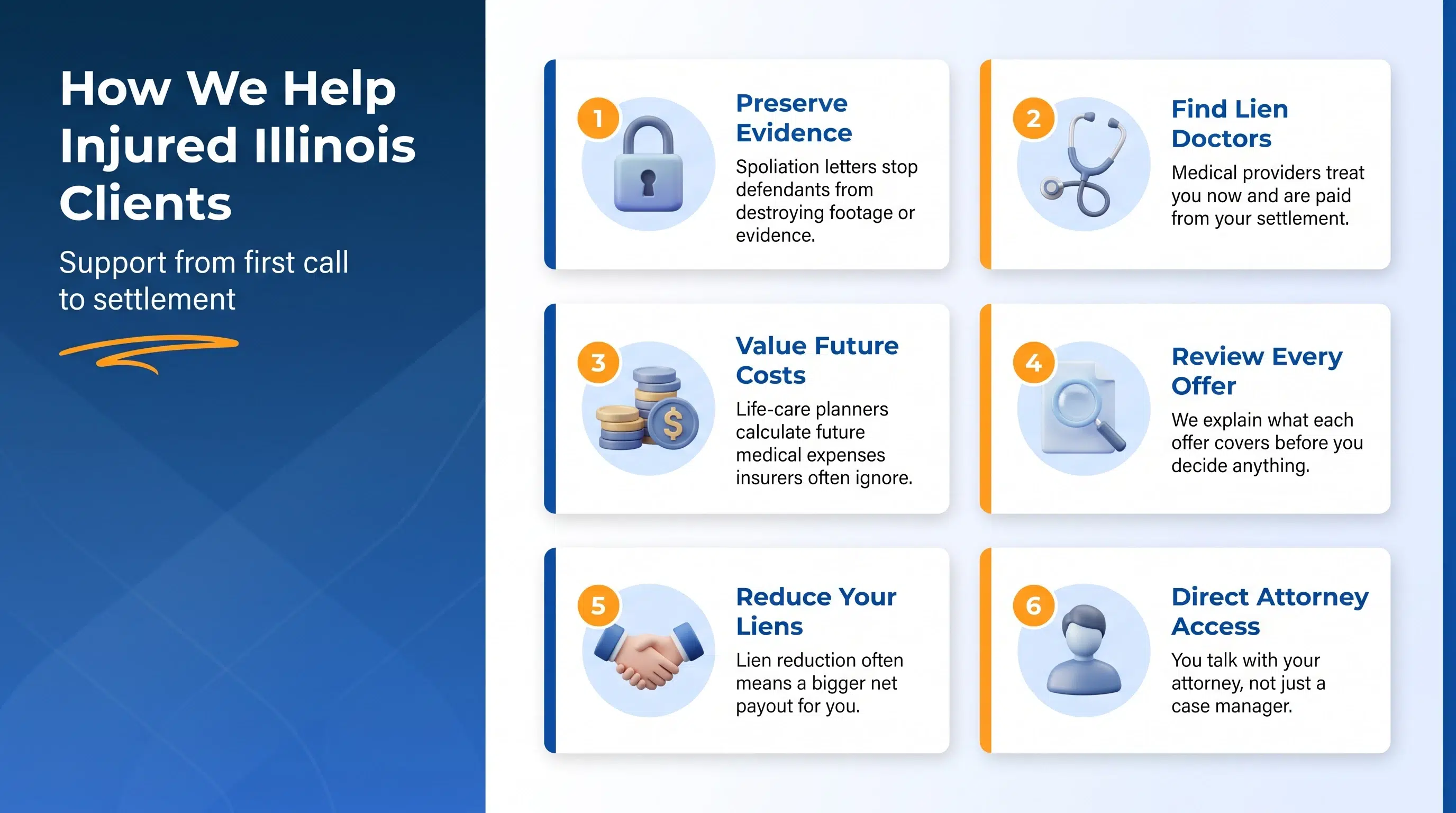
From the moment you call us, our team begins working to protect your legal rights and position your case for the strongest possible outcome. The first hours and days after an injury are the most important for evidence preservation. We move immediately to request police crash reports or incident reports, send spoliation letters to prevent defendants from destroying surveillance footage or physical evidence, and document the scene before conditions change. For crashes involving commercial trucks, we dispatch investigators to photograph skid marks, road conditions, and vehicle damage before those details disappear.
While you focus on medical treatment, we coordinate with your treating physicians to make sure your care is properly documented in a way that supports your legal claim. If you do not yet have a treating physician and your health insurance situation is complicated, we connect you with Illinois medical providers who treat injury patients on a medical lien, meaning you receive care now and the provider is paid from your settlement proceeds later, with no out-of-pocket cost to you during treatment. This arrangement removes one of the biggest barriers injured people face: the fear that they cannot afford the medical care they need while their case is pending.
As your case develops, we work with life-care planners and economic analysts to calculate the full value of your claim, including future medical expenses you may not have incurred yet. For catastrophic injuries involving long-term disability or permanent impairment, that forward-looking calculation is often the most important number in the entire case. Insurance companies routinely offer settlements that cover only current bills while ignoring projected future costs. Our team identifies those gaps and documents them with qualified opinions before we ever enter a negotiation.
When we receive an offer from the insurer, we present it to you with a clear analysis of what it does and does not cover, and we negotiate from a position supported by evidence rather than pressure. If the insurer refuses to offer fair compensation, we file suit in the appropriate Illinois Circuit Court, whether that is the Circuit Court of Cook County or a circuit court in another county where the accident occurred. We handle all procedural deadlines, filings, and court appearances so you are never caught off guard by a missed date.
At the end of your case, whether by settlement or verdict, we negotiate with medical lien holders, health insurers, and any other parties asserting a right to reimbursement from your recovery. That lien-reduction step is where many clients see a meaningful increase in their net payout, the dollars that actually reach their bank account after everything else is resolved. GoSuits manages that process so you are not left navigating it alone when you are already exhausted from months of recovery and litigation.
Throughout the entire process, you have direct access to your attorney, not just a case manager or paralegal. You receive regular status updates, prompt responses to questions, and clear explanations of every significant development. We believe that informed clients make better decisions, and that transparency is a core part of what makes a law firm trustworthy. To get started, schedule a free consultation with our team at no cost and no obligation.