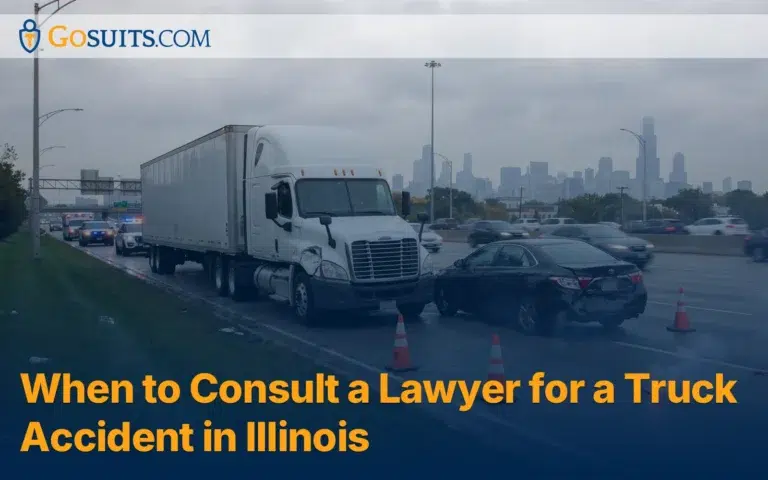
You should speak with a lawyer as soon as you can after an Illinois truck accident, and especially when someone was seriously hurt or killed, when fault is disputed, or when a trucking company or its insurer contacts you. Illinois generally allows two years to file a personal injury lawsuit under 735 ILCS 5/13-202 [1]. But some of the most important evidence, such as driver duty logs, may be kept by a motor carrier for only six months under federal rules [10], and claims against a local government body can face a one-year filing deadline [9]. This article is general legal information, not advice about your situation, and no lawyer can promise a particular result.
Legal Snapshot
-
Legal Topic: Timing of legal consultation after a commercial truck crash in Illinois (civil claims only)
-
Case Stage: Post-accident, pre-claim and pre-litigation
-
Primary Legal Issue: Preserving deadlines and evidence while fault is allocated among drivers, carriers, and other parties
-
Primary Authority: 735 ILCS 5/13-202 (injury limitations period); 735 ILCS 5/2-1116 (modified comparative fault); 735 ILCS 5/2-1117 (joint liability); 740 ILCS 180/2 (wrongful death); 49 CFR 395.8 and 49 CFR 387.9 (federal motor carrier rules)
-
Jurisdiction: Illinois state law and applicable federal motor carrier regulations
-
Date Legal Authority Last Reviewed: November 28, 2026. Statutory text was checked through secondary summaries and should be confirmed against the official Illinois General Assembly and eCFR texts before publication.
What Does “Consulting a Lawyer” After a Truck Accident Mean?
A consultation is a conversation in which a lawyer reviews the facts, explains the legal options, and identifies deadlines and evidence at risk. It is not a commitment to file a lawsuit. Truck cases differ from ordinary car crashes because several parties may share responsibility, including the driver, the motor carrier, a cargo loader, a maintenance contractor, or a vehicle or parts manufacturer. Which of those parties is legally responsible depends on the facts and is not something a crash report settles on its own.
Situations that commonly justify an early call include:
-
Hospitalization, surgery, broken bones, head or spinal injuries, or any injury that may need long-term care
-
A death, which brings special filing rules under the Illinois Wrongful Death Act
-
A disputed account of how the crash happened, or a claim that you share the blame
-
A call or recorded-statement request from the carrier’s insurance adjuster
-
A settlement offer made before your medical treatment is complete
-
A government-owned truck, such as a municipal or transit vehicle, which can trigger shorter deadlines
-
Uncertainty about whether the truck was operating for a company, an owner-operator, or a broker
What Does Illinois Law Say?
Illinois treats most truck crash injury claims as negligence claims. The general limitations statute requires that an action for damages for injury to the person be commenced within two years after the cause of action accrued [1]. Illinois also follows modified comparative fault. Under 735 ILCS 5/2-1116, an injured person whose own fault is more than 50 percent of the proximate cause of the injury is barred from recovering damages, while a person at 50 percent or less may recover damages reduced by their share of fault [2].
Federal law adds a second layer. The Federal Motor Carrier Safety Administration regulates interstate for-hire carriers, including driver hours-of-service records and minimum insurance levels. Those federal rules do not replace Illinois negligence law, but they can shape what records exist and what coverage may be available.
What Legal Rules Apply?
|
Issue |
Authority |
What it generally provides |
Status |
|---|---|---|---|
|
Injury lawsuit deadline |
735 ILCS 5/13-202 (Illinois) |
Two years from accrual [1] |
Confirm against official text |
|
Fault allocation |
735 ILCS 5/2-1116 (Illinois) |
Recovery barred if plaintiff is more than 50% at fault; otherwise reduced [2] |
Confirm against official text |
|
Joint liability among defendants |
735 ILCS 5/2-1117 (Illinois) |
All liable defendants are jointly and severally liable for medical expenses; defendants 25% or more at fault are jointly and severally liable for other damages [4][5] |
See flag on 2025 bill |
|
Wrongful death |
740 ILCS 180/2 (Illinois) |
Action brought by the personal representative for the surviving spouse and next of kin [3] |
Verified in official text |
|
Punitive damages pleading |
735 ILCS 5/2-604.1 (Illinois) |
Cannot be requested in the original complaint; requires a motion and a showing of reasonable likelihood of proof [6] |
Verified in official text |
|
Driver duty-status records |
49 CFR 395.8(k) (federal) |
Carrier retains records and supporting documents for six months [10][13] |
Verified through FMCSA |
|
Minimum carrier insurance |
49 CFR 387.9 (federal) |
$750,000 for for-hire carriers of nonhazardous property in interstate commerce with a vehicle weight rating of 10,001 pounds or more [11][12] |
Applicability depends on the carrier |
Local-government defendants are governed by the Local Governmental and Governmental Employees Tort Immunity Act, 745 ILCS 10/. Section 8-101 requires that a civil action against a local entity or its employees be commenced within one year from the date the injury was received or the cause of action accrued [9].
How Does This Apply to a Real Case?
Hypothetical example (not an actual GoSuits case): A passenger car slows in stop-and-go traffic on the Dan Ryan Expressway and is struck from behind by a tractor-trailer. The driver says the car stopped suddenly. The injured driver needs surgery and misses months of work. Questions that arise include whether the truck driver was following too closely, whether the driver exceeded allowable hours, whether the carrier maintained the brakes, and whether the injured driver bears any share of fault under 735 ILCS 5/2-1116. Because the carrier’s routine retention period for duty-status records is six months [10], waiting until the end of medical treatment to ask a lawyer to send a preservation request could cost the claim useful records.
Hypothetical example (not an actual GoSuits case): A city-owned dump truck changes lanes near the Eisenhower Expressway and sideswipes a delivery van. Because the defendant would be a local public entity, the one-year period in 745 ILCS 10/8-101 may apply instead of the usual two years [9]. Other immunity defenses under the Act may also come into play [8]. Whether a particular entity qualifies as a “local public entity” requires attorney review.
Heavy truck traffic on the Kennedy Expressway, I-55, I-90, and I-94 means commercial vehicles regularly share the road with passenger cars in the Chicago area, which is one reason crash scenes there so often involve several vehicles and several insurers.
What Evidence Can Matter?
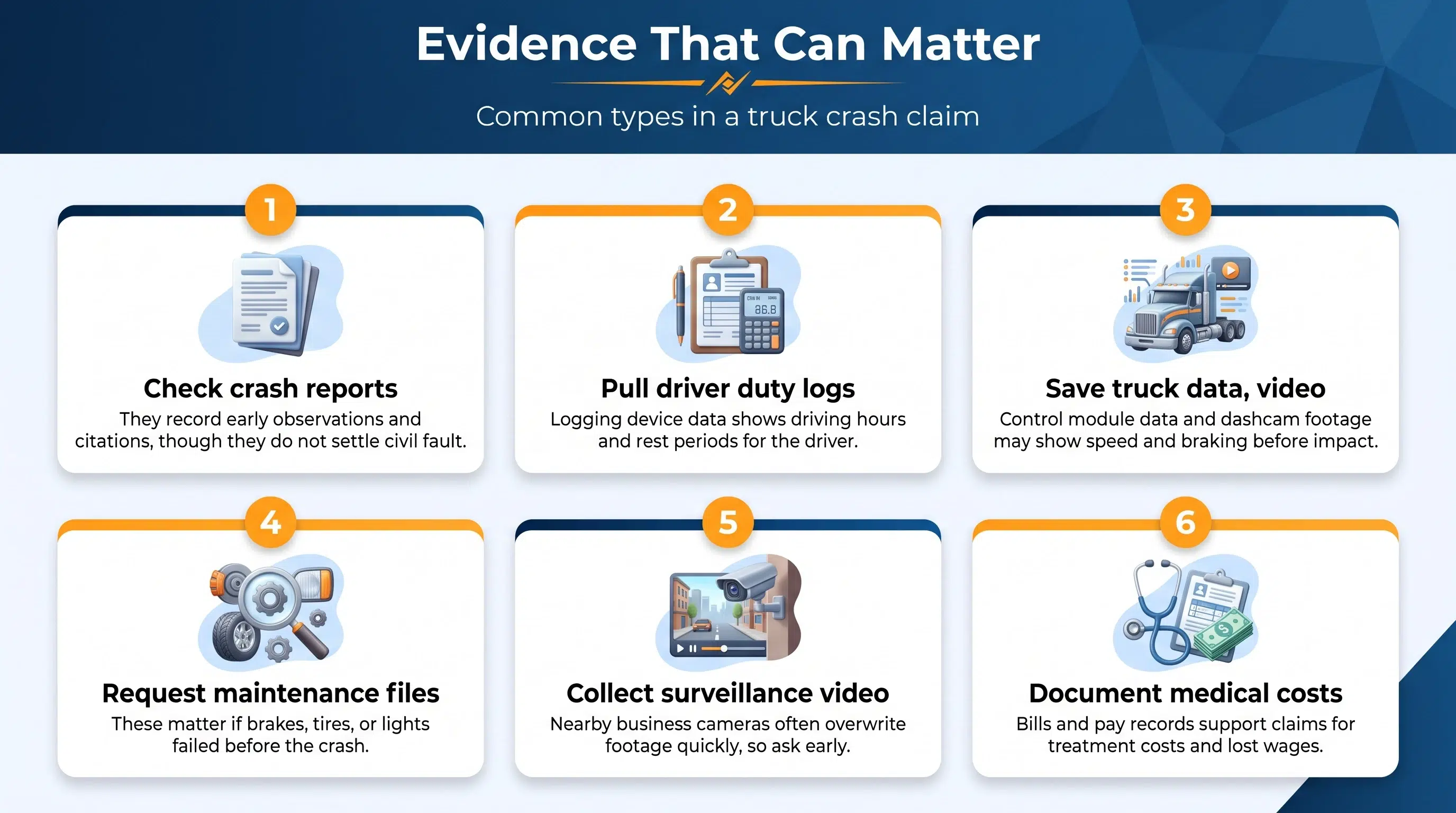
Evidence does not prove liability by itself, but it can help show what happened and who may be responsible. Common categories include:
-
Police and crash reports: They record initial observations and sometimes citations, though they are not a final determination of fault in a civil case.
-
Driver records of duty status and electronic logging device data: These show driving hours and rest periods. Carriers must keep them for six months [10].
-
Truck electronic control module data and dashcam video: These may capture speed, braking, and the moments before impact.
-
Maintenance and inspection records: These can matter if brakes, tires, or lights failed.
-
Driver qualification and hiring files: These may bear on how the carrier screened and supervised the driver.
-
Photographs and surveillance video: Nearby business cameras often overwrite footage quickly.
-
Medical records and bills: They document injuries, treatment, and cost.
-
Employment and income records: They support lost-wage and earning-capacity claims.
-
Accident reconstruction analysis: Qualified engineers may analyze speed, angles, and sight lines.
A lawyer can send written preservation requests to the carrier and other parties. Under Illinois law, there is no general duty to preserve evidence, but a duty can arise in certain situations, such as through an agreement, a statute, or special circumstances, when a reasonable person should have known the evidence would matter to a lawsuit (Boyd v. Travelers Insurance Co., 166 Ill. 2d 188 (1995)),
What Damages or Remedies May Be Available?
Recoverable damages depend on Illinois law and the facts of the case. In an injury claim, categories that may be at issue include past and future medical expenses, lost income, loss of earning capacity, pain and suffering, disfigurement, and loss of a normal life. The categories on which an Illinois jury is instructed are set out in Chapter 30 of the Illinois Pattern Jury Instructions, Civil. Property damage claims for a vehicle are separate and generally carry a five-year limitations period under 735 ILCS 5/13-205 [1].
If a person dies, the Wrongful Death Act allows the personal representative of the person’s estate to bring the lawsuit, with any recovery going to the surviving spouse and next of kin [3]. Punitive damages are not available in every case. In negligence-based injury cases, an injured person cannot ask for punitive damages in the first version of the lawsuit. Instead, they must ask the court for permission to add the request later, showing a reasonable likelihood of proving facts that support such an award [6][7].

What If the Other Party Disputes Liability?
Carriers and insurers commonly argue that the injured person caused or contributed to the crash. That argument matters because of the more-than-50-percent bar in 735 ILCS 5/2-1116 [2]. A finding of 50 percent leaves a reduced recovery, while a finding of 51 percent leaves none. Early evidence gathering and a clear account of the crash sequence can affect how fault is allocated.
When more than one party is sued, another rule applies. Under 735 ILCS 5/2-1117, all defendants found liable are jointly and severally liable for past and future medical expenses, and defendants whose fault is 25 percent or more are jointly and severally liable for other damages [4][5]. A bill introduced in the 104th General Assembly in 2025 proposed raising that threshold to 50 percent [14], The bill has not become law and remains in committee [14].
What If Insurance Is Involved?
Commercial truck crashes often involve more than one insurance policy, such as the carrier’s liability policy, the driver’s or owner-operator’s policy, and your own uninsured or underinsured motorist coverage. Federal law sets a minimum amount of coverage, not a maximum. For a for-hire carrier hauling nonhazardous property across state lines with a vehicle weight rating of 10,001 pounds or more, the federal minimum is $750,000 [11][12]. Carriers that operate only within Illinois, and some other types of operations, may be subject to different minimums. Actual policy limits can be higher and must be confirmed through the claim process or discovery.
An adjuster may ask for a recorded statement or offer a quick payment. Statements and releases can affect later rights, which is one reason to speak with a lawyer first. Medical providers and health insurers may also seek repayment from a recovery. Under Section 10 of the Illinois Health Care Services Lien Act, the combined liens of health care providers generally cannot exceed 40 percent of the recovery (770 ILCS 23/10).
How Long Do I Have to Act?
|
Claim or step |
General period |
Authority |
|---|---|---|
|
Personal injury lawsuit against a private party |
2 years |
735 ILCS 5/13-202 [1] |
|
Vehicle property damage |
5 years |
735 ILCS 5/13-205 [1] |
|
Wrongful death |
Generally 2 years from the date of death |
740 ILCS 180/2 [3] |
|
Lawsuit against a local public entity or its employees |
1 year |
745 ILCS 10/8-101(a) [9] |
|
Carrier retention of driver duty-status records |
6 months from receipt |
49 CFR 395.8(k)(1) [10] |
|
Motion to add punitive damages |
No later than 30 days after the close of discovery |
735 ILCS 5/2-604.1 [6] |
These periods are general rules. Exceptions, such as tolling for minors, different rules for the State of Illinois, the Chicago Transit Authority, and other public bodies, and survival-action timing under the Probate Act, can change the calculation. Illinois repealed its general notice requirement for local governments in 1986, so the main deadline for those claims is the one-year lawsuit deadline, though some bodies, such as the Chicago Transit Authority, still require written notice. Settlement talks do not automatically pause a limitations period.
What Should I Do Next?
-
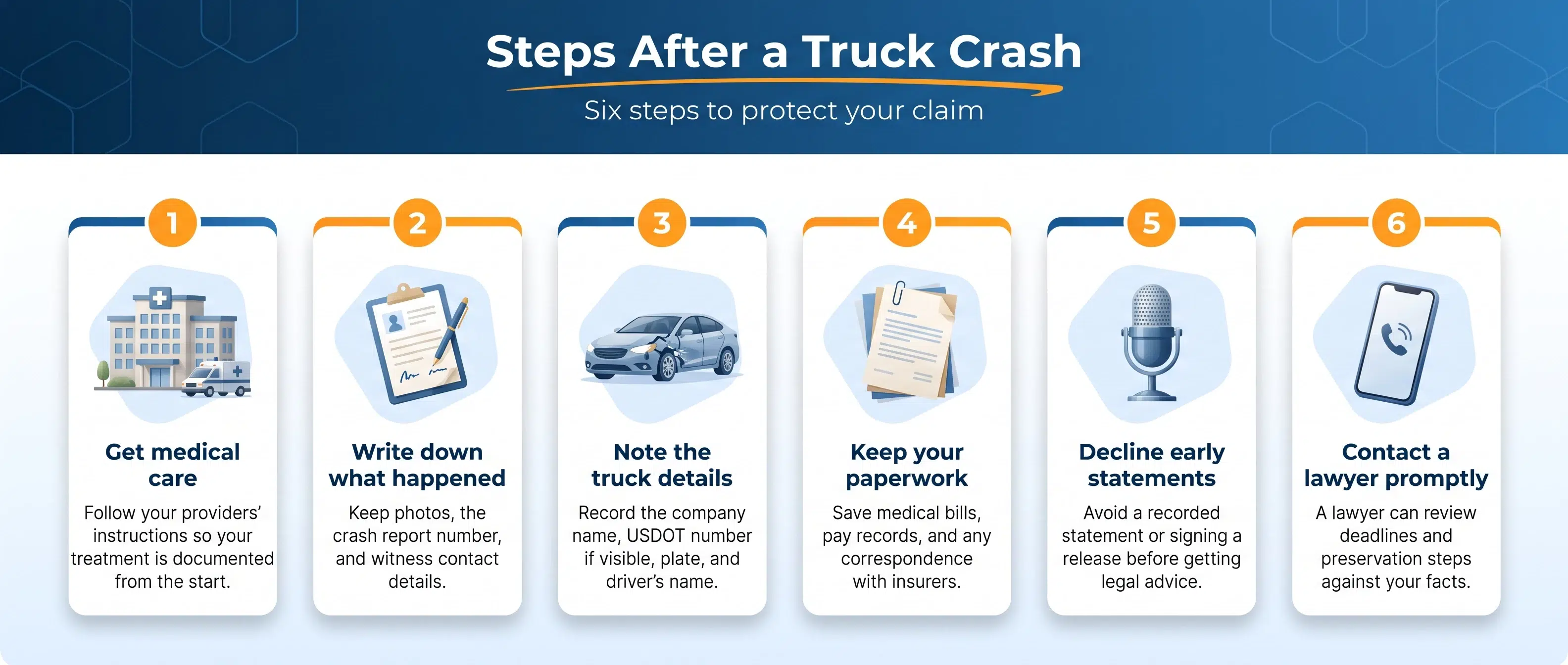
Get medical care and follow your providers’ instructions.
-
Write down what you remember, and keep photographs, the crash report number, and contact details for witnesses.
-
Note the truck’s company name, USDOT number if visible, license plate, and the driver’s name.
-
Keep medical bills, pay records, and correspondence with insurers.
-
Avoid giving a recorded statement to the other side’s insurer or signing a release before getting legal advice.
-
Contact a lawyer promptly so deadlines and preservation steps can be reviewed against your facts.
Injured people are strongly encouraged to seek legal help rather than handle a commercial trucking claim alone, because the parties, coverage, and regulations involved are complex.
Related Illinois Personal Injury Resources
People injured in collisions with commercial vehicles may want to read about how our Chicago truck-crash team approaches these claims. Families dealing with a death may also want information from fatal crash attorneys in Chicago. Because truck cases frequently involve more than one kind of claim, the broader work of our Chicago personal injury team is also relevant. Chicago truck accident lawyers handle cases across the Chicago area, including Cicero, Naperville, Aurora, and Joliet.
A Cook County civil case is generally filed in the Circuit Court of Cook County at the Richard J. Daley Center. Where a particular case may be filed depends on Illinois venue rules and the facts. Under 735 ILCS 5/2-101, a lawsuit is generally filed in the county where a defendant lives or where the events behind the claim happened.
Talk With a GoSuits Attorney
A truck accident claim can involve federal carrier regulations, several insurance policies, disputed fault, and filing deadlines that differ by defendant. If you were hurt in an Illinois truck crash, you can schedule a free consultation to have a GoSuits personal injury attorney review the circumstances and explain your options. Past results do not guarantee a similar outcome in any case.
References
-
740 ILCS 180/2 Wrongful Death Act – Illinois General Assembly
-
735 ILCS 5/2-1117 Joint liability – Illinois General Assembly
-
Unzicker v. Kraft Food Ingredients Corp. (Ill. 2002) – Justia
-
735 ILCS 5/2-604.1 Pleading of punitive damages – Illinois General Assembly
-
Property Carriers (387, Subpart A) – FMCSA Motor Carrier Safety Planner
-
49 CFR 387.9 Financial responsibility, minimum levels – Justia
-
Driver’s Record of Duty Status (395.8) – FMCSA Motor Carrier Safety Planner