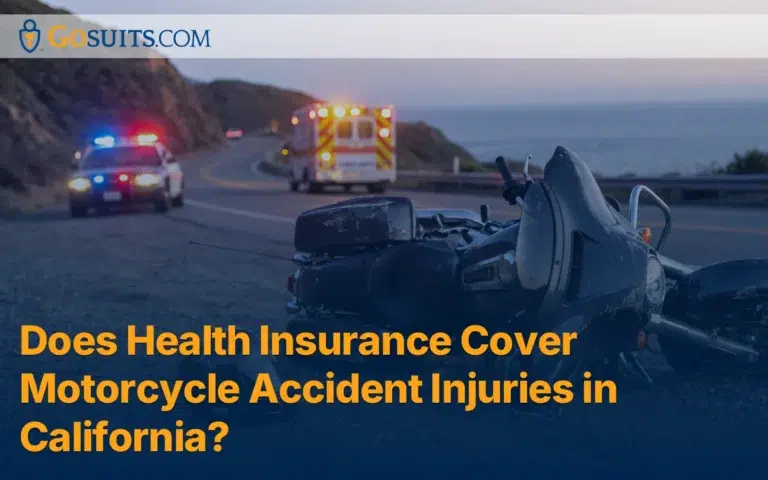
In most cases, yes. A California health plan that covers injuries in general will usually pay for treatment after a motorcycle crash, and the plan does not wait to find out who caused the collision. Federal nondiscrimination rules for group health plans specifically address motorcycling as a basis for denying eligibility [2]. Coverage is only the first step, though. If another driver caused the crash, your health plan may later claim reimbursement from your injury recovery. Whether that claim is capped depends on the type of plan, and California law limits some plans but not others [1]. Coverage terms vary by policy, so the plan documents control.
Legal Snapshot
-
Legal Topic: Health insurance coverage and reimbursement claims after a California motorcycle crash
-
Case Stage: Early treatment and claim-building, through settlement or litigation
-
Primary Legal Issue: Whether the health plan pays, and how much of an injury recovery the plan can take back
-
Primary Authority: California Civil Code section 3040; 29 CFR 2590.702; Howell v. Hamilton Meats & Provisions, Inc. (2011) 52 Cal.4th 541; Code of Civil Procedure section 335.1
-
Date Legal Authority Last Reviewed: November 28, 2026 (research review; attorney review pending)
What Does “Health Insurance Coverage” Mean After a Motorcycle Crash?
Health insurance is first-party coverage. It pays for your medical care under the terms of your plan, regardless of who was at fault. That is different from the at-fault driver’s liability insurance, which pays an injured person’s damages only if the driver is legally responsible.
Three separate questions tend to get mixed together:
-
Will my health plan pay for emergency care, surgery, imaging, and rehabilitation?
-
Will the plan ask to be repaid out of my injury settlement or judgment?
-
How do my medical bills affect the amount I can recover from the person who caused the crash?
Each question has a different legal answer, covered below.
What Does California Law Say?
California does not have a no-fault system for motorcycle injuries, so fault matters for the injury claim, but it does not matter for whether your health plan pays your providers. Several authorities shape the picture.
-
Civil Code section 3040 limits what a health care service plan or insurer licensed by the Department of Managed Health Care or the Department of Insurance can recover through a lien on a third-party recovery [1].
-
Howell v. Hamilton Meats holds that past medical damages are limited to the amount actually paid or incurred, not the full amount billed [3].
-
Welfare and Institutions Code section 14124.70 and following governs reimbursement claims by Medi-Cal [7][8].
-
Code of Civil Procedure section 335.1 sets the general two-year filing deadline for injury lawsuits [4].
Federal law also matters. ERISA governs employer-sponsored plans, and the Medicare Secondary Payer statute governs Medicare’s recovery rights [6][11].
What Legal Rules Apply?
Can a health plan refuse to pay because you were riding a motorcycle?
Federal rules for group health plans do not allow a plan to deny someone coverage because they ride a motorcycle. A federal regulation uses a plan that excludes motorcyclists from coverage as an example of unlawful discrimination [2]. However, the same rules treat benefits differently from eligibility. A plan may be allowed to exclude benefits for injuries based on how they happened, known as a “source-of-injury” exclusion, as long as the injury did not result from a medical condition or domestic violence [13]. In practice, major medical plans generally cover crash injuries like any other accident, but limited-benefit products, such as accident-only or short-term policies, can have different terms. Whether a particular exclusion is lawful for a particular California plan depends on the type of plan and the policy language, so the actual policy should be reviewed.
Can the health plan get its money back?
Often, yes. Most plans include a reimbursement or subrogation clause. For HMOs and other health plans regulated in California, and for health insurance policies subject to the California Insurance Code, Civil Code section 3040 sets limits. The lien generally cannot be more than what the plan actually paid for the injured person’s care. If the injured person has an attorney, it also cannot be more than one-third of the recovery, or one-half if the person has no attorney [1]. The lien may also be reduced if a court makes a special finding that the injured person was partly at fault (§ 3040(e)). Section 3040 does not apply to every plan. Self-funded employer plans governed by federal law, Medi-Cal, and Medicare follow their own repayment rules.
Why the plan type matters
|
Type of coverage |
Who controls reimbursement |
Practical effect |
|---|---|---|
|
Insured plan regulated in California (HMO or PPO, individual or employer-purchased) |
Civil Code section 3040 and plan contract [1] |
Statutory cap and fee-sharing reductions generally apply |
|
Self-funded employer plan under ERISA |
Federal law and the written plan terms [6] |
State caps are generally preempted; plan language controls, subject to equitable limits recognized in US Airways v. McCutchen |
|
Medi-Cal |
Department of Health Care Services under Welfare and Institutions Code section 14124.70 and following [7] |
Notice duties apply, and recovery is limited to the medical portion of a settlement [8] |
|
Medicare |
Medicare Secondary Payer statute [11] |
Medicare may seek reimbursement of conditional payments from a liability recovery |
Because the funding source decides which rules apply, one early task is learning whether an employer plan is insured or self-funded. The plan’s summary plan description or the plan administrator can usually answer that.
How medical bills affect the damages you can claim
Under Howell, an injured person may recover past medical expenses only up to the amount actually paid or incurred. The California Supreme Court limited the plaintiff there to what the providers accepted as full payment, not the larger billed figure [3]. Using health insurance therefore changes how past medical damages are measured. It does not erase the claim, and future medical expenses are analyzed separately.
How Does This Apply to a Real Case?
Hypothetical example (not an actual GoSuits case): A rider is struck by a driver making a left turn across traffic on Pacific Coast Highway. The rider is taken to a hospital by ambulance, has surgery for a fractured femur, and the rider’s employer-purchased insured PPO pays most of the bill. Later, the plan sends a reimbursement notice after the rider’s claim against the driver settles. Because this is an insured plan, the lien is analyzed under Civil Code section 3040. The cap is measured against what the plan actually paid, and the amount is reduced for the rider’s share of fees and costs [1].
Hypothetical example (not an actual GoSuits case): Another rider has coverage through a large employer’s self-funded plan. The plan document says it is entitled to first-dollar reimbursement. Here the analysis shifts toward federal law and the plan text, and the state cap may not apply [6]. Two riders with similar injuries can end up with very different net recoveries because of plan type alone.
Collisions in stop-and-go traffic on the 405 or at freeway merges on the 5 or US-101 often involve several vehicles. That can mean multiple insurers, shared fault arguments, and competing claims on limited policy limits. The minimum liability limits for policies issued or renewed on or after January 1, 2025 are $30,000 per person, $60,000 per accident, and $15,000 for property damage [10]. Serious motorcycle injuries can exceed those figures, so health insurance often carries the immediate cost of care.
What Evidence Can Matter?
Evidence does not automatically prove liability or damages, but several categories commonly matter in both the coverage and reimbursement questions.
-
Health plan documents: The certificate of coverage, summary plan description, and any reimbursement clause show what the plan covers and whether it is insured or self-funded.
-
Explanation of benefits statements: These show amounts billed, amounts paid, and write-offs, which bear on damages under Howell [3].
-
Medical records and bills: They connect the injuries to the crash and show future care needs.
-
Police report, photographs, and video: These help show how the collision happened and who may share fault.
-
Helmet and gear: California requires a compliant helmet for riders and passengers. A violation is an infraction rather than a bar to a claim, but the defense may raise it as to head injuries [9].
-
Insurance declarations pages: The at-fault driver’s limits, plus your own uninsured/underinsured motorist coverage and any medical payments coverage on your motorcycle policy, affect what sources of recovery exist.
-
Lien and reimbursement letters: Keep every notice from the plan, a hospital, Medi-Cal, or Medicare.
What Damages or Remedies May Be Available?
If another party’s negligence caused the crash, the injured rider may seek compensation for past and future medical expenses, lost income, loss of earning capacity, physical pain, mental suffering, and property damage. Recoverability depends on California law and the facts of the case. A health plan’s payment is not an additional category of damages. It is a payment source that may carry a repayment claim.
Fault is shared under California’s pure comparative negligence rule from Li v. Yellow Cab Co. (1975) 13 Cal.3d 804, so a rider who bears some responsibility may still recover a reduced amount. A health plan’s reimbursement claim under Civil Code section 3040 may also be reduced by comparative fault, but generally only when a court makes a special finding of the rider’s share of fault [1].
What If the Other Party Disputes Liability?
Disputes about fault do not change whether your health plan pays your providers. They do affect the injury claim. Defendants and insurers commonly argue that a rider was speeding, lane splitting, or not wearing a proper helmet. These arguments go to comparative fault and causation. Whether they succeed depends on proof, and a helmet argument generally relates only to injuries a helmet would have affected [9]. Because a reduced liability finding can shrink a settlement while a lien stays largely fixed, early attorney involvement matters when the plan is asserting a large claim.
What If Insurance Is Involved?
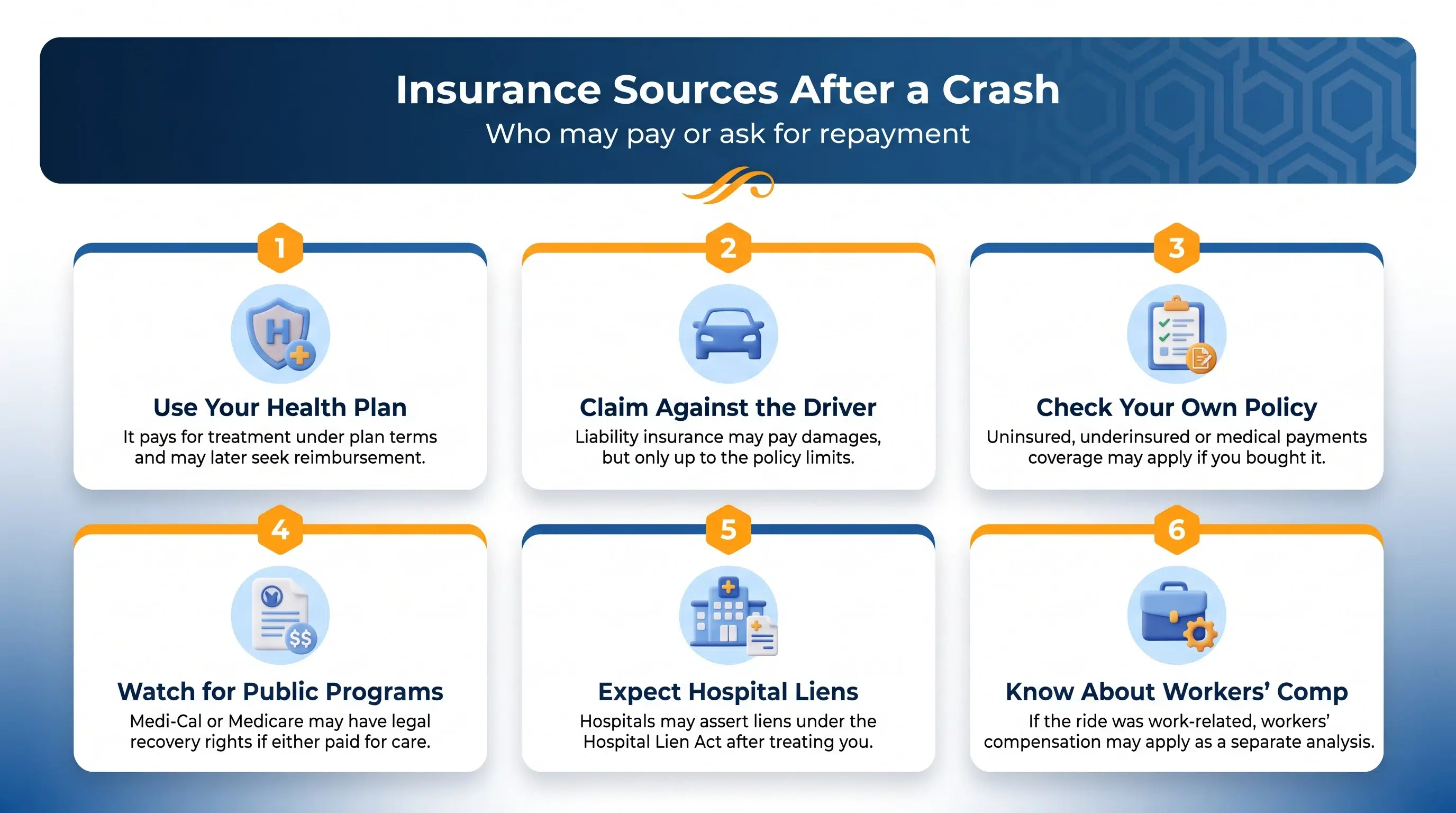
Several insurance sources can overlap after a motorcycle crash:
-
Your health plan pays treatment under plan terms and may seek reimbursement.
-
The at-fault driver’s liability insurance may pay damages up to its limits [10].
-
Your own motorcycle policy may include uninsured/underinsured motorist or medical payments coverage if you purchased it. Check the declarations page.
-
Medi-Cal or Medicare may have statutory recovery rights if either paid for care [7][11].
-
Hospitals may assert liens under the Hospital Lien Act, Civil Code section 3045.1 and following [12].
If a rider had no liability insurance, California law generally prevents uninsured vehicle owners and operators from recovering noneconomic damages, such as pain and suffering, though they may still recover economic damages like medical bills and lost wages (Civil Code section 3333.4). If the ride was work-related, workers’ compensation may be involved, and that is a separate analysis.
When a health plan denies a claim, the denial letter should explain how to appeal. Plans regulated by the California Department of Managed Health Care or the California Department of Insurance also offer state review processes, such as Independent Medical Review.
How Long Do I Have to Act?
Most California personal injury lawsuits must be filed within two years of the injury under Code of Civil Procedure section 335.1 [4]. Claims against a public entity, such as one involving a dangerous roadway condition, can require a written government claim within six months under Government Code section 911.2 [5]. These are general rules. Exceptions, tolling, and accrual questions exist, so an attorney should confirm the deadline for any specific case. Civil lawsuits for a crash are typically filed in the superior court for the proper county, such as Los Angeles County Superior Court or Orange County Superior Court, depending on venue rules.
Plan-side deadlines also exist. Health plans set their own claim-submission and appeal windows, and Medi-Cal requires notice to the Department of Health Care Services when a claim is filed [7]. Check each letter for dates.
What Should I Do Next?
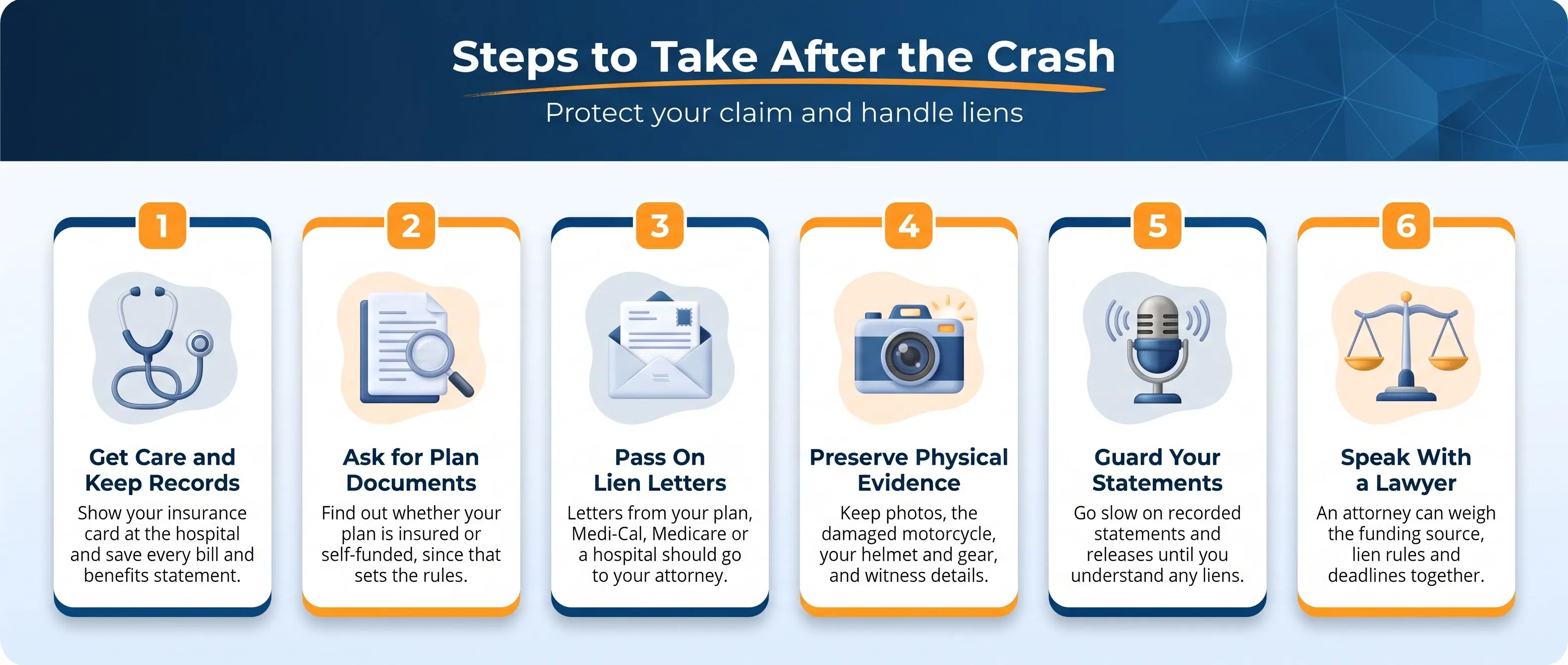
-
Get medical care and follow the treatment plan. Present your health insurance card at the hospital and keep copies of every bill and explanation of benefits.
-
Ask for your plan documents and find out whether the plan is insured or self-funded.
-
Do not ignore reimbursement letters from your plan, Medi-Cal, Medicare, or a hospital. Forward them to your attorney.
-
Preserve photos, the damaged motorcycle, helmet, riding gear, and witness details.
-
Be careful about recorded statements to the other driver’s insurer, and avoid signing releases before understanding any liens.
-
Speak with a lawyer. An attorney can evaluate the funding source, the lien rules, and the deadlines together. Handling a lien and a liability dispute without legal help can carry real financial risk.
The coverage and lien questions are only one part of a larger claim. Riders who need to understand fault, damages, and insurance limits can learn more about our GoSuits California personal injury page. Many riders look for motorcycle accident lawyers once a plan sends a reimbursement notice, and early review can matter because liens, fault disputes, and filing deadlines often interact. A person who has been hurt in a crash is generally better served by speaking with personal injury lawyers early than after a settlement offer has been accepted.
Related California Personal Injury Resources
Related topics that commonly arise alongside this one include health insurance liens and ERISA reimbursement, uninsured and underinsured motorist claims, comparative fault in motorcycle collisions, and California helmet law. Internal links for these topics should be added from the live GoSuits knowledge-base list when it is available.
Talk With a GoSuits Attorney
An injury claim can involve medical evidence, insurance issues, liability disputes, and legal deadlines. If you were injured in a California motorcycle crash, a GoSuits personal injury attorney can review the circumstances and explain your options. You can schedule a free consultation to discuss your situation. No outcome can be promised, and this article is general legal information, not legal advice for your situation.
References
-
California Civil Code section 3040 – California Legislative Information
-
29 CFR 2590.702, Prohibiting discrimination based on a health factor – eCFR
-
Howell v. Hamilton Meats & Provisions, Inc. (2011) – Justia, California Supreme Court Decisions
-
California Code of Civil Procedure section 335.1 – California Legislative Information
-
California Government Code section 911.2 – California Legislative Information
-
US Airways, Inc. v. McCutchen, 569 U.S. 88 (2013) – Justia, U.S. Supreme Court
-
The Personal Injury Lien Process – California Department of Health Care Services
-
California Welfare and Institutions Code section 14124.76 – California Legislative Information
-
California Vehicle Code section 27803 – California Legislative Information
-
California Vehicle Code section 16056 – California Legislative Information
-
42 U.S.C. section 1395y, Exclusions from Medicare – Legal Information Institute, Cornell Law School
-
California Civil Code section 3045.1 (Hospital Lien Act) – California Legislative Information
-
Treasury Decision 8931, HIPAA Nondiscrimination Rules – Internal Revenue Service