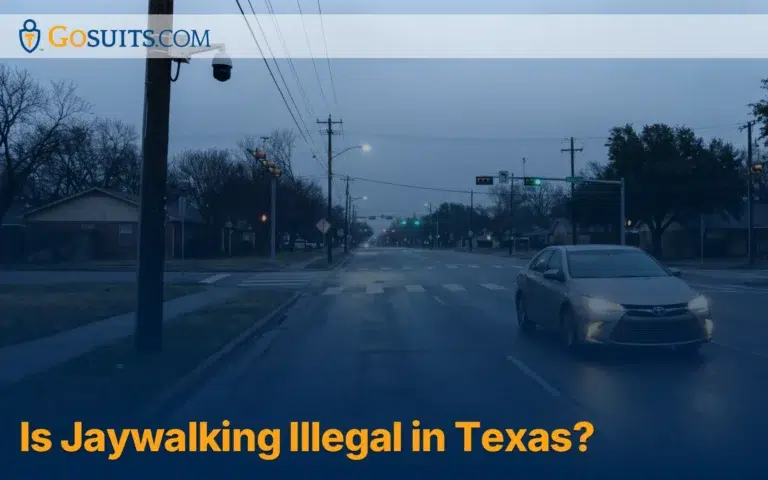
Yes, in many situations. Texas does not use the word “jaywalking” in its statutes, but Chapter 552 of the Texas Transportation Code requires a pedestrian to yield the right-of-way to vehicles when crossing a roadway anywhere other than a marked crosswalk or an unmarked crosswalk at an intersection [1]. Between adjacent intersections with operating traffic signals, a pedestrian may cross only in a marked crosswalk [5]. A violation does not erase a driver’s duty to use due care, and a pedestrian who is partly at fault may still recover damages in a civil case if the pedestrian’s share of responsibility is 50 percent or less [2].
Legal Snapshot
-
Legal Topic: Pedestrian crossing rules and their effect on a civil injury claim in Texas
-
Case Stage: Pre-claim and early investigation (informational overview)
-
Primary Legal Issue: Whether a pedestrian’s violation of Chapter 552 reduces or bars recovery against a driver
-
Primary Authority: Tex. Transp. Code ch. 552 (including §§ 552.005 and 552.008); Tex. Civ. Prac. & Rem. Code §§ 33.001, 33.012, 16.003
-
Date Legal Authority Last Reviewed: November 28, 2026, subject to attorney review
What Does Jaywalking Mean Under Texas Law?
“Jaywalking” is a common term, not a legal one. In Texas, it generally refers to crossing or walking in a road in a way that Chapter 552 of the Transportation Code does not allow. This chapter is part of the Texas ‘Rules of the Road’ and sets duties for both pedestrians and drivers. [1].
Common examples include crossing mid-block when a crosswalk is nearby, starting across against a “Don’t Walk” signal, walking along the roadway when a usable sidewalk exists, and crossing where a pedestrian tunnel or overhead crossing has been provided. Whether a particular movement violated the statute is a fact question that depends on the location, the signals and the traffic at the moment.
What Does Texas Law Say About Crossing Outside a Crosswalk?
Under Texas Transportation Code § 552.005, a pedestrian must yield to vehicles on the road when crossing anywhere other than a marked crosswalk or an unmarked crosswalk at an intersection. The same rule applies where a pedestrian tunnel or overhead walkway is available [5]. Between two nearby intersections that both have working traffic signals, a pedestrian may cross only in a marked crosswalk. A pedestrian may cross an intersection diagonally only if a traffic signal or sign allows it [5].
Texas law also allows local governments to set their own pedestrian rules. Under Transportation Code § 552.009, a city may pass an ordinance that prohibits pedestrians from crossing a road in a business district or on a designated highway except in a crosswalk [7]. As a result, a downtown block in Dallas, Houston, Austin, or San Antonio may be subject to a city rule in addition to the state law.
Importantly, being required to yield is not the same as losing all rights. The statute does not say a pedestrian who crosses outside a crosswalk forfeits a civil claim.
What Legal Rules Apply?
Several Texas rules work together when a jaywalking pedestrian is hit by a vehicle. The table summarizes the main ones.
|
Rule |
What it says |
Authority |
|---|---|---|
|
Pedestrian yields outside crosswalks |
A pedestrian crossing at a place other than a marked crosswalk or an unmarked crosswalk at an intersection must yield to vehicles. |
Transp. Code § 552.005(a) [5] |
|
Driver’s duty of due care |
Notwithstanding other provisions of the chapter, a vehicle operator must exercise due care to avoid colliding with a pedestrian on a roadway. |
Transp. Code § 552.008 [7] |
|
Crosswalk right-of-way |
In a crosswalk without an operating signal, the driver must stop and yield, but a pedestrian may not suddenly leave a curb into the path of a vehicle too close to stop. |
Transp. Code § 552.003 [4] |
|
Sidewalk use |
A pedestrian may not walk along the roadway if an accessible sidewalk is provided. Without a sidewalk, a pedestrian walks on the left side or shoulder facing traffic, unless that side is obstructed or unsafe. |
Transp. Code § 552.006 [6] |
|
51 percent bar |
A claimant may not recover damages if the claimant’s percentage of responsibility is greater than 50 percent. |
Civ. Prac. & Rem. Code § 33.001 [2] |
|
Reduction of recovery |
If not barred, the award is reduced by the claimant’s percentage of responsibility. |
Civ. Prac. & Rem. Code § 33.012(a) [11] |
Section 552.008 is especially important. It begins with the words ‘notwithstanding another provision of this chapter,’ which means the driver’s duty to avoid hitting a pedestrian applies even when the pedestrian broke another rule in the chapter. The section also requires drivers to sound the horn when necessary and to take extra care around a child or a person who is obviously confused or incapacitated.
Texas follows a modified comparative fault system, which Texas law calls proportionate responsibility. The judge or jury assigns each party a percentage of responsibility. A person who is 50 percent or less responsible may recover a reduced award, while a person who is more than 50 percent responsible recovers nothing [2][11]. Insurance companies may focus on a pedestrian’s mid-block crossing to try to raise that percentage. Breaking a traffic law can be treated as evidence of negligence in a civil case, but Texas courts allow a person to show that the violation was excused, so how a violation affects a claim depends on the facts.
This article does not rely on federal law. The crossing rules discussed here come from Texas state law and, where cities have adopted them, local ordinances.
Is Jaywalking a Crime or a Ticket in Texas?
Breaking a rule in the Texas Rules of the Road is a misdemeanor, and when no other penalty applies, the fine is generally between $1 and $200 [3][9]. Cities may set their own penalties for violating local pedestrian ordinances. A traffic citation is usually a minor matter compared with an injury claim. This article covers injury claims, not how to fight a citation. A person who receives a citation after a crash should speak with a lawyer before responding, because statements and guilty pleas can affect the injury case.
How Does This Apply to a Real Case?
Hypothetical example (not an actual GoSuits case): A pedestrian leaves a restaurant in Deep Ellum, crosses mid-block, and is struck by a driver who was looking at a phone and traveling above the posted limit. The pedestrian was required to yield under § 552.005, but the driver still owed a duty of due care under § 552.008. A jury could assign the pedestrian some percentage of responsibility and the driver the larger share. If the pedestrian were found 20 percent responsible, the award would be reduced by 20 percent under § 33.012(a). If found more than 50 percent responsible, recovery would be barred under § 33.001.
Hypothetical example (not an actual GoSuits case): A pedestrian steps off a curb into the path of a car on a frontage road along US-75 at dusk, within a few feet of the vehicle, in a spot with no crosswalk. The driver had almost no time to react and was traveling at a lawful speed. These facts make a defense argument about the pedestrian’s responsibility stronger. Stop-and-go traffic on corridors such as I-635 and Central Expressway can also change the analysis, because slower speeds may give a driver more time to see and avoid a person in the road.
The same law applies from the driver’s side. A driver and the driver’s insurer may argue that the pedestrian’s failure to yield caused the collision, while the pedestrian will point to speed, distraction, lighting and the driver’s lookout. Each side’s position depends on the evidence.
What Evidence Can Matter?
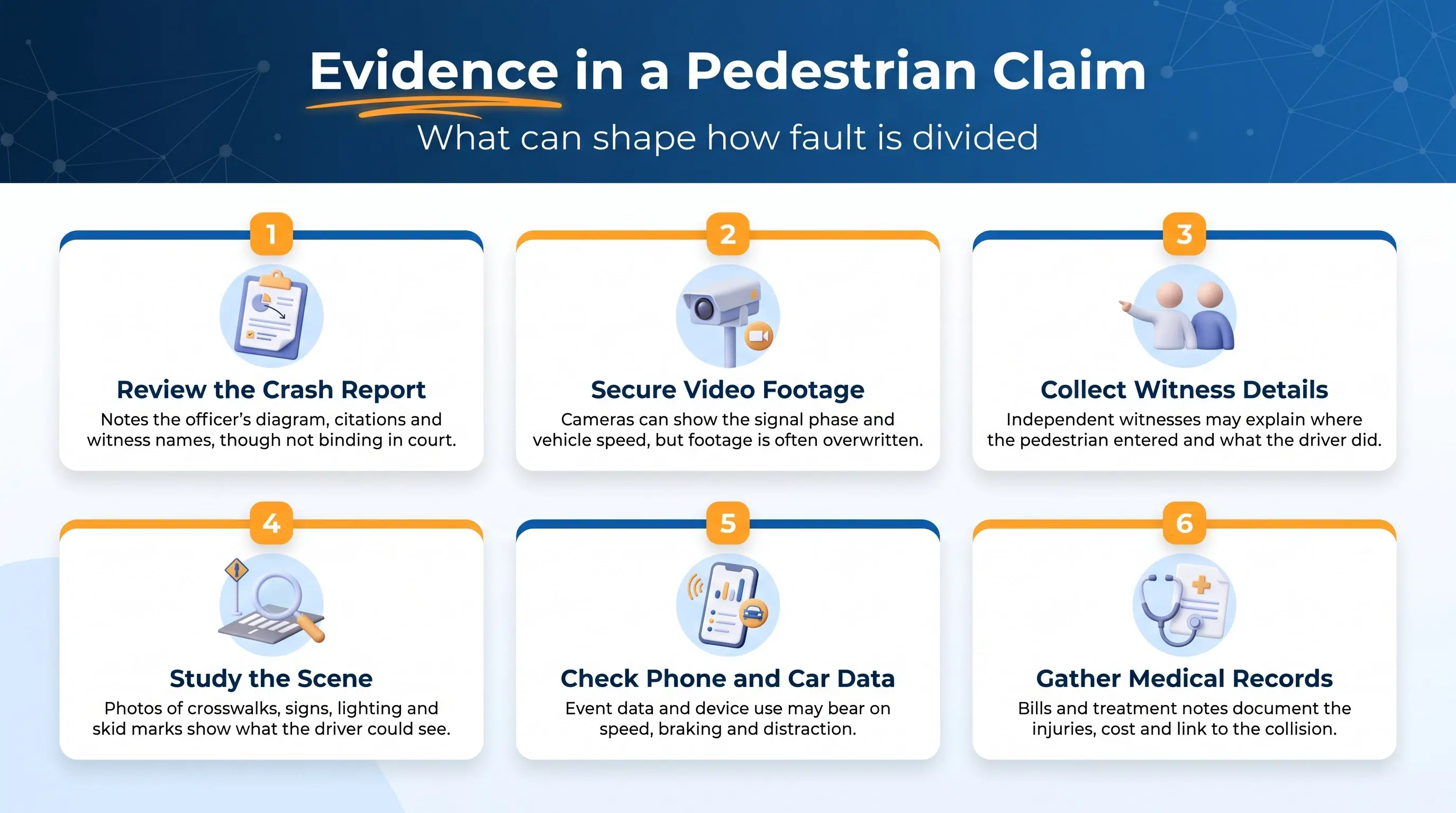
Evidence does not automatically prove fault, but it often decides how responsibility is divided. Categories that may matter include:
-
Police crash report: records the officer’s observations, diagram, citations and witness names. Its conclusions are not binding in a civil case.
-
Video: traffic cameras, business surveillance and dashcams can show the pedestrian’s path, the signal phase and the vehicle’s speed. Footage is often overwritten quickly.
-
Witness statements: independent witnesses may address where the pedestrian entered the roadway and what the driver was doing.
-
Scene evidence: photographs of crosswalk locations, signage, lighting, sight lines, sidewalks and skid marks help show whether a crosswalk was nearby and whether the driver could see the pedestrian.
-
Vehicle data and phone records: event data and device use may bear on speed, braking and distraction.
-
Medical records and bills: document the injuries, treatment and cost, and link the collision to the harm.
-
Employment records: support lost income and any loss of earning capacity.
-
Accident reconstruction analysis: can address stopping distance, perception time and the pedestrian’s position when the driver first had a chance to react.

What Damages or Remedies May Be Available?
Recoverable damages depend on the facts and on Texas law. An injury claim may seek past and future medical expenses, lost income, loss of earning capacity, physical pain, mental anguish, physical impairment, disfigurement, and property damage. In a fatal crash, a wrongful death claim may be available to the surviving spouse, children, or parents of the person who died (Civil Practice and Remedies Code § 71.004). Exemplary (punitive) damages are available only when there is clear and convincing evidence of fraud, malice, or gross negligence (§ 41.003(a)). Whatever the total, a pedestrian’s percentage of responsibility reduces the award under § 33.012(a) [11], and no outcome is guaranteed.
What If the Other Party Disputes Liability?
Disputes over fault are common in pedestrian cases. A defendant may argue the pedestrian crossed illegally, entered the road suddenly or was distracted. A pedestrian may respond that the driver failed to keep a lookout, drove too fast for conditions or was impaired or distracted. Under Chapter 33, the trier of fact determines percentages of responsibility, and a defendant may also seek to designate a responsible third party [2].
A liable defendant is generally responsible only for the percentage of damages equal to that defendant’s own percentage of responsibility, with exceptions, including when the defendant’s share is greater than 50 percent [11]. Because a few percentage points can change the outcome, early evidence preservation matters.
What If Insurance Is Involved?
A pedestrian injury claim usually begins with the at-fault driver’s liability insurance company. The adjuster may ask for a recorded statement and ask whether the pedestrian was in a crosswalk. Statements given before the facts are fully understood can be used to assign fault. A pedestrian’s own auto policy may also help, including medical payments, personal injury protection (PIP), or uninsured and underinsured motorist coverage, depending on the policy terms. Texas insurers must include PIP and uninsured and underinsured motorist coverage in auto policies unless the policyholder rejects them in writing (Insurance Code §§ 1952.101 and 1952.152). Health insurers and medical providers may seek repayment from a settlement, which can affect the amount an injured person keeps.
If a government vehicle or a road condition is involved, different notice rules may apply. Under the Texas Tort Claims Act, written notice generally must be given to the government within six months after the incident (Civil Practice and Remedies Code § 101.101(a)), and some cities set shorter deadlines in their charters.
How Long Do I Have to Act?
Most personal injury lawsuits in Texas must be filed within two years after the cause of action accrues (Civil Practice and Remedies Code § 16.003(a)), and a wrongful death lawsuit generally must be filed within two years from the date of death (§ 16.003(b)) [10]. The deadline is generally paused for injured minors and people of unsound mind (§ 16.001), and claims involving a government entity may require written notice within six months or less. Because these rules depend on the facts, an attorney should confirm the deadline for any specific case. Waiting also risks losing video footage and witnesses’ memories of the crash.
What Should I Do Next?
-
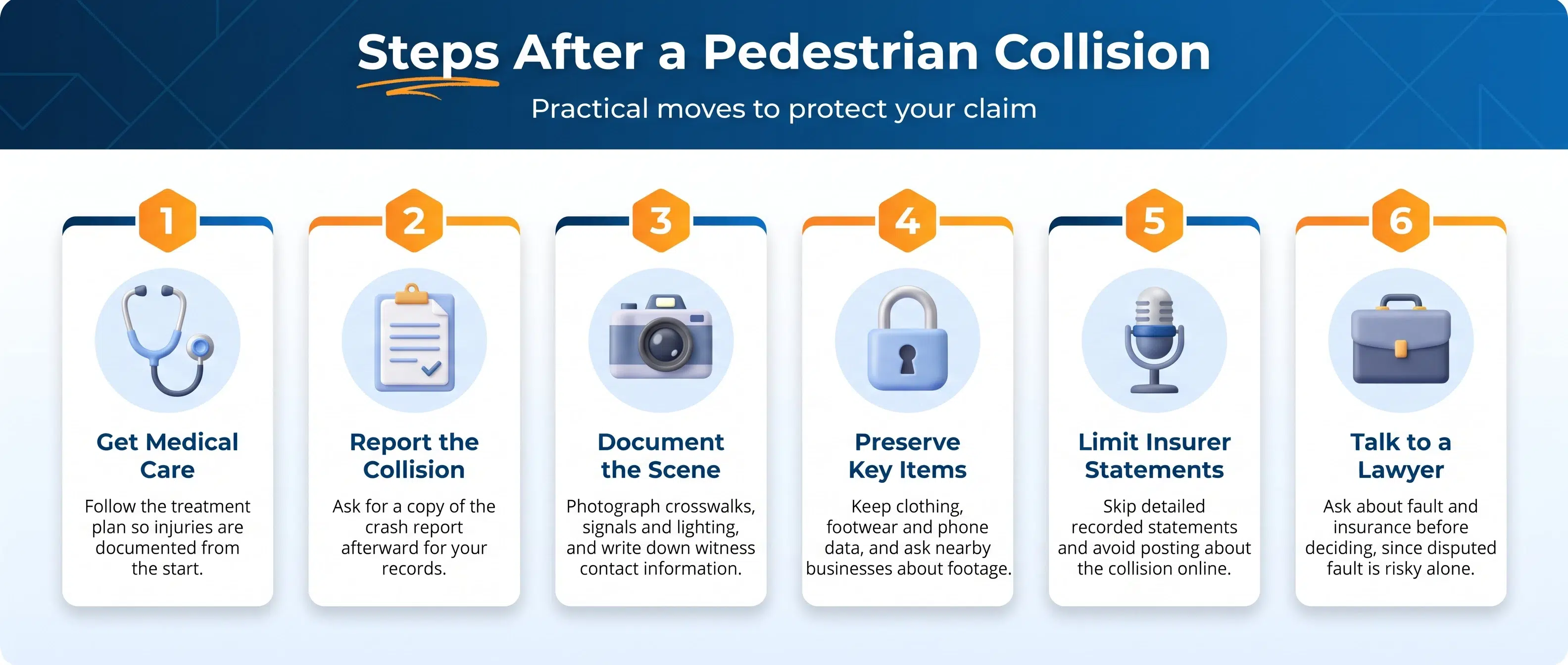
Seek medical care and follow the treatment plan so that injuries are documented.
-
Report the collision and request a copy of the crash report.
-
Photograph the scene, including crosswalks, signals, signage and lighting, and write down witness contact information.
-
Preserve clothing, footwear, phone data and any video, and ask nearby businesses about footage quickly.
-
Avoid detailed recorded statements to insurers and avoid posting about the collision online.
-
Speak with a lawyer about fault, insurance and deadlines before making decisions. Handling a disputed-fault claim without legal help can be risky.
A pedestrian injury claim can turn on how fault is divided, and Texas law is not as simple as “jaywalkers lose.” People hurt while crossing outside a crosswalk may want to speak with pedestrian accident lawyers who can review the circumstances and explain the options. Related practice information is available from the GoSuits Texas pedestrian injury team and the GoSuits Texas personal injury practice.
Related Texas Personal Injury Resources
For a Texas personal injury claim arising from a crossing collision, topics worth reviewing next include Texas proportionate responsibility, the Texas two-year filing deadline, and how insurers evaluate pedestrian fault. These topics apply in Dallas, Houston, Austin, San Antonio and communities across the state, including Plano, Frisco and Irving.

Talk With a GoSuits Attorney
An injury claim can involve medical evidence, insurance issues, disputed fault and legal deadlines. If you were hurt in a Texas pedestrian collision, a GoSuits personal injury attorney can review the circumstances and explain your options. You can schedule a free consultation to discuss what happened. Nothing here guarantees a result, and this article is general legal information, not legal advice for your situation.
References
-
Texas Transportation Code, Chapter 552 (Pedestrians) – Texas Statutes Online
-
Texas Transportation Code, Chapter 542 (General Provisions), Section 542.401 – Texas Legislature
-
Section 552.003, Pedestrian Right-of-Way at Crosswalk – Justia
-
Texas Transportation Code Section 552.005, Crossing at Point Other Than Crosswalk – FindLaw
-
Texas Transportation Code Section 552.006, Use of Sidewalk – FindLaw
-
Texas Transportation Code Chapter 552 Index (Sections 552.008 and 552.009) – Onecle
-
2009 Texas Transportation Code, Chapter 552 (historical text) – Justia
-
Level I Course Materials, Traffic Fines Overview – Texas Municipal Courts Education Center
-
Texas Civil Practice and Remedies Code, Sections 33.012 and 33.013 – Texas Legislature