
There is no fixed timeline. Under Illinois law, a slip and fall claim may settle before a lawsuit is filed, after a lawsuit is filed, in mediation or arbitration, or not at all, and each path can take a very different amount of time. The sources reviewed for this article identify no Illinois statute that sets a deadline for reaching a settlement. The deadlines that do exist govern filing a lawsuit: generally two years under 735 ILCS 5/13-202 [1], and one year when the defendant is a local public entity [11]. How long a settlement takes usually depends on the injured person’s medical course, disputes over fault, insurance handling, medical liens, and court scheduling. This is general legal information, not legal advice, and no outcome or timeline is guaranteed.
Legal Snapshot
-
Legal Topic: Timing of settlement in an Illinois premises liability (slip and fall) personal injury claim
-
Jurisdiction: Illinois state law and Illinois court rules; limited federal law where Medicare is involved
-
Case Stage: Pre-suit claim through litigation, mediation, arbitration, or trial
-
Primary Legal Issue: What controls how fast a premises liability claim can resolve, and which deadlines cannot be missed
-
Primary Authority: Premises Liability Act (740 ILCS 130/); 735 ILCS 5/13-202; 735 ILCS 5/2-1116; 735 ILCS 5/2-1303(c); 745 ILCS 10/8-101; Ill. S. Ct. R. 222
-
Date Legal Authority Last Reviewed: November 28, 2026 (several authorities were reviewed through secondary summaries and are flagged in the text for attorney verification)
What Does a “Slip and Fall Settlement Timeline” Mean?
A settlement timeline is the period between the fall and the day a written settlement is signed and paid. It is not a single event. It includes medical treatment, an investigation into the property owner’s responsibility, negotiation with an insurance company, any lawsuit and discovery, and finally the release, payment of any liens, and the settlement payment.
In Illinois, a slip and fall injury is a negligence claim against a property owner or occupier. The claim and the settlement are separate from any criminal or regulatory process, and this article addresses civil claims only.
What Does Illinois Law Say?
The Illinois Premises Liability Act, 740 ILCS 130/2, states that a property owner or occupier owes visitors reasonable care under the circumstances, both for the condition of the property and for anything done or not done on it [4]. The Act also ended the older common-law distinction between invitees and licensees for this purpose [4]. For an injured person, that means the claim usually depends on the facts: what the hazard was, who controlled the property, whether the owner knew or should have known about it, and whether the fall caused the injuries.
Illinois follows modified comparative fault under 735 ILCS 5/2-1116. A plaintiff whose contributory fault is more than 50% of the proximate cause is barred from recovering damages, while a plaintiff at 50% or less has damages reduced by that percentage [5]. Because fault percentages can change what a case is worth, they are a frequent source of delay when an insurer disputes how the fall happened.
What Legal Rules Apply?
Several Illinois rules shape pace, either by setting deadlines or by creating incentives to settle early or late.
|
Rule |
What it does |
Effect on timing |
|---|---|---|
|
735 ILCS 5/13-202 |
Generally requires a personal injury suit within two years of accrual |
Sets the outer limit for filing, not for settling |
|
745 ILCS 10/8-101(a) |
Requires suit against a local public entity or its employees within one year |
Shortens the time available when a municipality, park district, or similar body controls the property |
|
735 ILCS 5/2-1303(c) |
Adds 6% prejudgment interest in personal injury judgments, with settlement-offer adjustments |
Gives defendants a reason to make written offers early after filing |
|
Ill. S. Ct. R. 222 |
Limited and simplified discovery for cases at or below $50,000 |
Can shorten the discovery phase |
|
Cook County Circuit Court Rules, Part 18 |
Mandatory arbitration for qualifying cases of $30,000 or less |
Moves smaller cases to an arbitration calendar |
|
770 ILCS 23/10 |
Creates and limits health care services liens on recoveries |
Liens must be identified and resolved before funds are distributed |
Prejudgment interest. Under 735 ILCS 5/2-1303(c), an injured person who wins a personal injury lawsuit recovers prejudgment interest on damages other than punitive damages, sanctions, statutory attorney’s fees, and statutory costs. Interest starts on the date the lawsuit is filed [2]. The interest rate is 6% per year, and interest stops being added after five years [3]. If the judgment is equal to or less than the defendant’s highest written settlement offer made within 12 months after filing and not accepted within 90 days, no prejudgment interest is added [2]. If the judgment is higher, interest applies only to the difference [3]. The statute also does not require the State, units of local government, school districts, or other governmental entities to pay this interest [3]. In practice, this rule can encourage written offers in the first year after a lawsuit is filed, which may affect when serious negotiations begin. Whether and how it affects a particular case is a question for an attorney.
Discovery and arbitration. Illinois Supreme Court Rule 222 requires a party seeking money damages to attach an affidavit stating whether the damages sought are more than $50,000. If they are not, simpler discovery rules apply, and any judgment above $50,000 is reduced after trial [6]. In Cook County, the mandatory arbitration program is governed by Supreme Court Rules 86 through 95, and Part 18 of the local rules sends qualifying Municipal District personal injury cases seeking no more than $30,000 to an arbitration calendar [7]. A party who disagrees with an arbitration decision may file a rejection and have the case heard before a judge and jury [8]. The Circuit Court of Cook County also runs an expanded Law Division program for personal injury cases worth between $30,000 and $50,000, with four months to complete discovery once a case is referred [9]. Larger Cook County cases above $30,000 ca.
How Does This Apply to a Real Case?
Hypothetical example (not an actual GoSuits case): A shopper slips on an unmarked wet floor at a grocery store in Naperville, fractures a wrist, and needs months of treatment. The store’s insurer asks for medical records and a recorded statement. Even with clear video, a responsible settlement discussion usually waits until the treating providers can describe the injury’s course and any lasting effects. Settling before that point can mean agreeing to a figure before the full cost of the injury is known. Once a release is signed, it generally cannot be reopened.
Hypothetical example (not an actual GoSuits case): A pedestrian falls on a cracked city sidewalk near the Loop in downtown Chicago during winter. Because a local public entity may be the defendant, the one-year filing limit under 745 ILCS 10/8-101 may apply [11]. If settlement talks continue past that date without a lawsuit being filed, the claim may be barred. Immunity defenses under the Tort Immunity Act may also apply, such as the notice requirement in Section 3-102 and the limits on liability for snow and ice in Section 3-105.
Civil cases filed in Cook County are heard in the Circuit Court of Cook County, with civil filings generally made at the Richard J. Daley Center. Court scheduling, rather than the injured person’s wishes, often sets the pace once a lawsuit is on file.
What Evidence Can Matter?
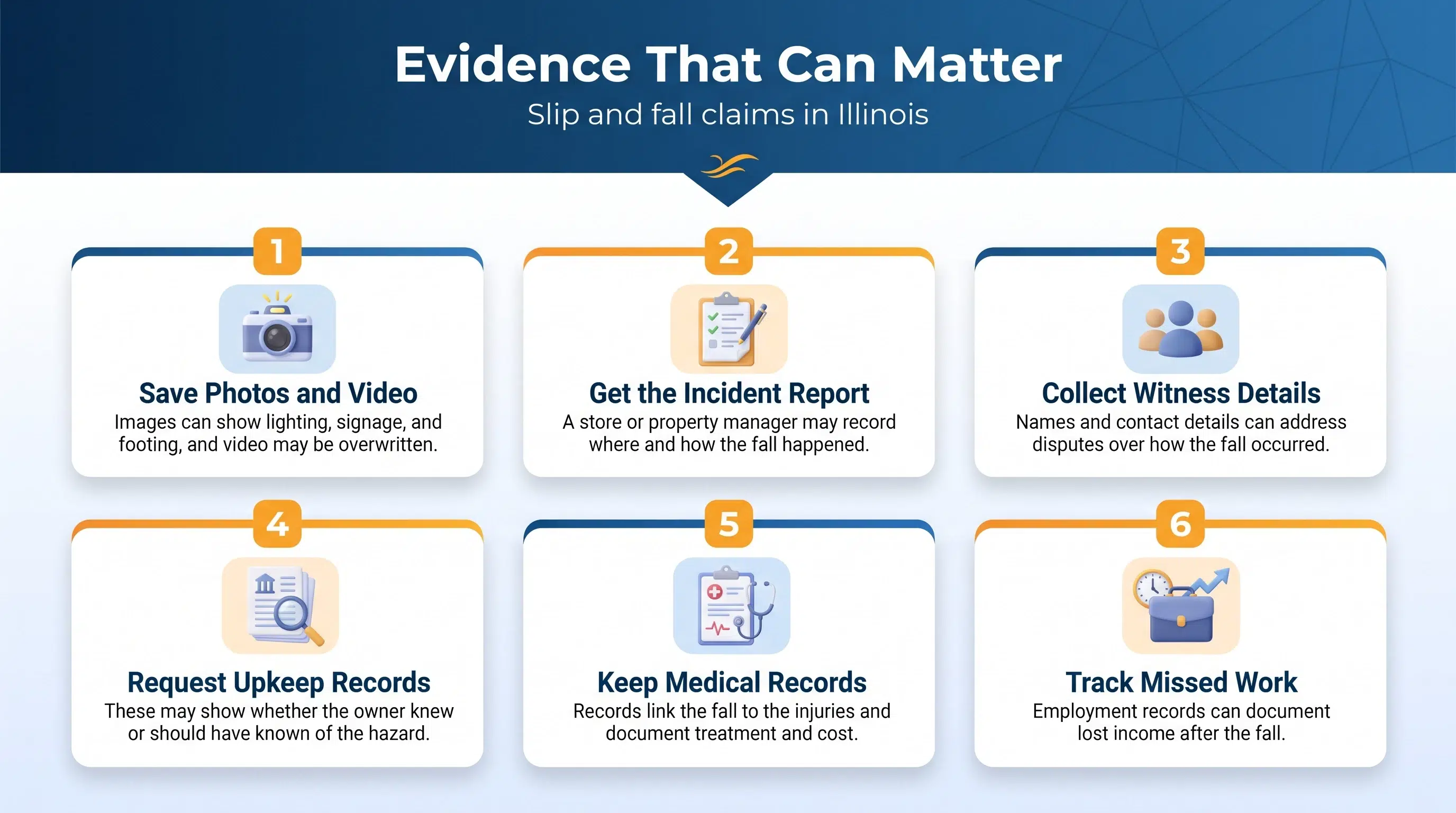
Evidence does not automatically prove liability, but it can shape how quickly an insurer is willing to negotiate. Items that may matter include:
-
Photographs and video: They can show the hazard, lighting, signage, and footing, and surveillance footage may be overwritten if not preserved promptly.
-
Incident reports: A store or property manager’s report may record where and how the fall happened.
-
Witness information: Names and contact details can address disputes over how the fall occurred.
-
Maintenance and inspection records: These may bear on whether the owner knew or should have known about the hazard.
-
Medical records and bills: They link the fall to the injuries and document treatment and cost.
-
Employment records: They can document missed work and lost income.
-
Footwear and clothing: The defense may raise these when arguing comparative fault.
Missing evidence can delay a claim, and gaps in treatment can give an insurance company room to question whether the fall caused the injuries. For snow and ice falls, separate legal rules may apply.
What Damages or Remedies May Be Available?
Depending on the facts and applicable law, an injured person in a slip and fall case may seek compensation for medical expenses, future medical expenses, lost income, loss of earning capacity, pain and suffering, and other legally recognized damages. What can be recovered depends on the evidence and on Illinois law, and any recovery may be reduced by comparative fault under 735 ILCS 5/2-1116 [5]. Punitive damages are not generally part of an ordinary slip and fall case and are not available against local government entities under Section 2-102 of the Tort Immunity Act. If a fall is fatal, the family may have separate wrongful death claims, which have their own deadlines.

What If the Other Party Disputes Liability?
A disputed claim usually takes longer. Property owners commonly argue that they had no notice of the hazard, that the hazard did not cause the injury, that the condition was minor, or that the injured person was careless. If those positions are not resolved in negotiation, the plaintiff may need to file suit, take part in discovery, and attend court-ordered mediation or arbitration. In a lawsuit, a defendant’s written offers can interact with prejudgment interest as described above [2]. The decision to accept or reject an offer carries real consequences, which is one reason injured people should not handle disputed liability alone.
What If Insurance Is Involved?
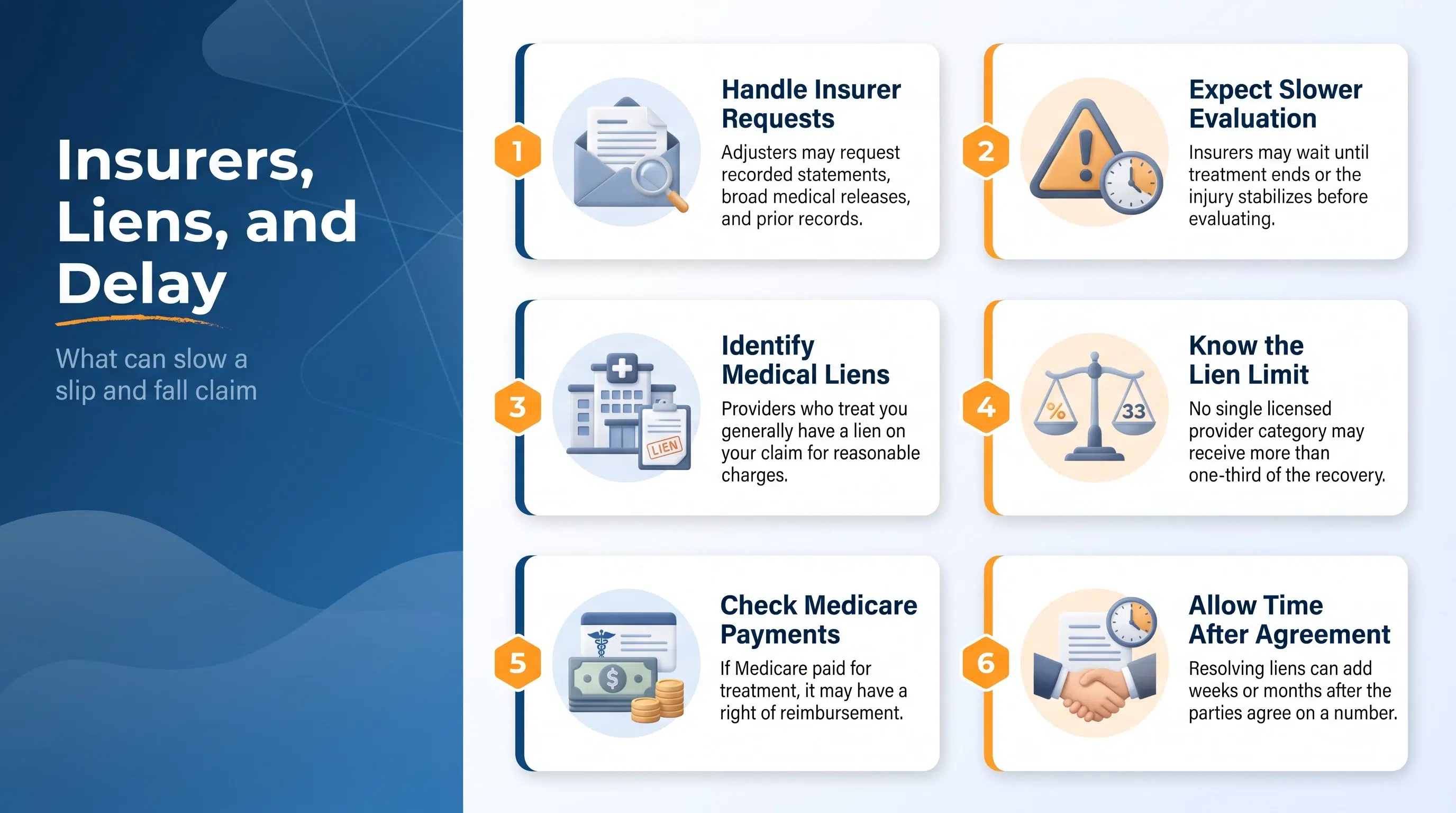
Most premises claims are handled through the owner’s liability insurer, and insurers set much of the early pace. Adjusters may request recorded statements, broad medical authorizations, and prior records. They may also delay evaluation until treatment ends or the injury stabilizes.
Liens can also affect timing. Under the Health Care Services Lien Act, doctors, hospitals, and other providers that treat an injured person generally have a lien on the person’s claim for reasonable charges, and no single type of provider may receive more than one-third of the recovery [13]. The Act also limits the total of all health care liens to 40% of the recovery (770 ILCS 23/10). If Medicare paid for treatment, federal law (42 U.S.C. § 1395y(b)(2)) may give Medicare a right to be repaid, which has to be resolved before funds are distributed [14]. Identifying and resolving liens can add weeks or months after the parties agree on an amount.
How Long Do I Have to Act?
The general Illinois personal injury filing deadline is two years from the date the claim accrues under 735 ILCS 5/13-202 [1]. For a lawsuit against a local government entity or its employees, 745 ILCS 10/8-101(a) requires that the lawsuit be filed within one year from the date the injury was received or the cause of action accrued [11]. The older separate notice statute, 745 ILCS 10/8-102, was repealed in 1986, which means the one-year lawsuit deadline is the controlling date [12]. Claims involving the Chicago Transit Authority, the State of Illinois, minors, or other special circumstances can follow different rules.
Negotiating with an insurer does not stop these clocks. An injured person who waits for a settlement offer before consulting a lawyer can lose the right to sue.
What Should I Do Next?
-
Get medical care and follow treatment recommendations.
-
Photograph the hazard and surrounding area, and write down witness names, if you can do so safely.
-
Report the fall to the property owner or manager and keep a copy of any report.
-
Keep medical bills, insurance letters, and records of missed work.
-
Be cautious about recorded statements, broad medical releases, and early settlement offers.
-
Identify who owns or controls the property, because a public owner can change the deadline.
-
Speak with a lawyer promptly so deadlines and evidence preservation are addressed.
Because the one-year and two-year clocks can run while a claim is still being discussed, injured people in Illinois often work with our Chicago injury team or another qualified attorney early in the process, before signing any release.
Related Illinois Personal Injury Resources
Readers researching a fall may also want to review Illinois comparative fault rules, the Health Care Services Lien Act, and local government injury deadlines. GoSuits maintains a statewide overview of Illinois injury claims. In the Chicago area, injured people frequently look for slip and fall accident lawyers, and those searching specifically for slip and fall accident lawyers in Chicago will find that Cook County practice, including arbitration and mediation programs, can affect how a case moves. Falls in places like Cicero, Joliet, Elgin, and Waukegan fall under the same Illinois statutes, although each county’s local court rules may differ.

Talk With a GoSuits Attorney
A slip and fall claim can involve medical evidence, insurer tactics, comparative fault, liens, and filing deadlines that may be as short as one year. If you were hurt in a fall in Illinois, a GoSuits attorney can review the circumstances and explain your options, and you can schedule a free consultation. The same Illinois deadlines apply whether the property is in Chicago or elsewhere in the state. Results depend on the facts of each case, and nothing in this article guarantees a particular outcome.
This article provides general information about Illinois law and is not legal advice. Reviewing an individual claim requires an attorney’s analysis of the specific facts and current law.
References
-
Illinois Personal Injury Statute of Limitations Explained (735 ILCS 5/13-202) – Collins Law
-
735 ILCS 5/2-1303, Interest on judgment – Illinois General Assembly
-
740 ILCS 130/, Premises Liability Act – Illinois General Assembly
-
How Illinois’ 51% Fault Bar Under 735 ILCS 5/2-1116 Affects Crash Claims – Trapp & Geller
-
Part 18, Mandatory Arbitration of Certain Civil Cases – Circuit Court of Cook County
-
Alternative Dispute Resolution – Circuit Court of Cook County
-
Expanded arbitration program for personal injury cases – Circuit Court of Cook County
-
Public Act 93-0011, amending 745 ILCS 10/8-101 – Illinois General Assembly
-
Illinois Government Injury Claims: 1-Year Deadline – Parker & Parker
-
770 ILCS 23/10, Lien created; limitation – Illinois General Assembly