





























Why is the first week after a Los Angeles scooter or e-bike crash so important?
A rental scooter that was in a crash does not stay where it fell. Operators collect and recharge their vehicles, and a damaged one may be repaired and back on the sidewalk within days. If a brake failed, the proof goes with it. A device you own is the same: do not fix it, sell it or mail it back to the maker until a lawyer has had a chance to arrange an inspection.
Ride data is the next thing to lose. Rental apps usually log when a ride began, the route and the speed. That record can answer an insurer’s claim that you were going too fast, but companies do not keep it indefinitely, and a preservation letter works best when it goes out early.
Not every crash gets a police report. If a car clipped you and left, or you went down on broken asphalt, nobody may have written anything. Report the crash anyway, ask for a report number, and write down what you remember while it is still clear. Photograph the scrapes and bruising in the first few days, because they fade.
California gives most injured people two years to file a lawsuit. A claim against a city or other public entity is different. It generally requires a formal claim within six months, so a pothole case should not wait.
Who can be responsible for a crash in Los Angeles?
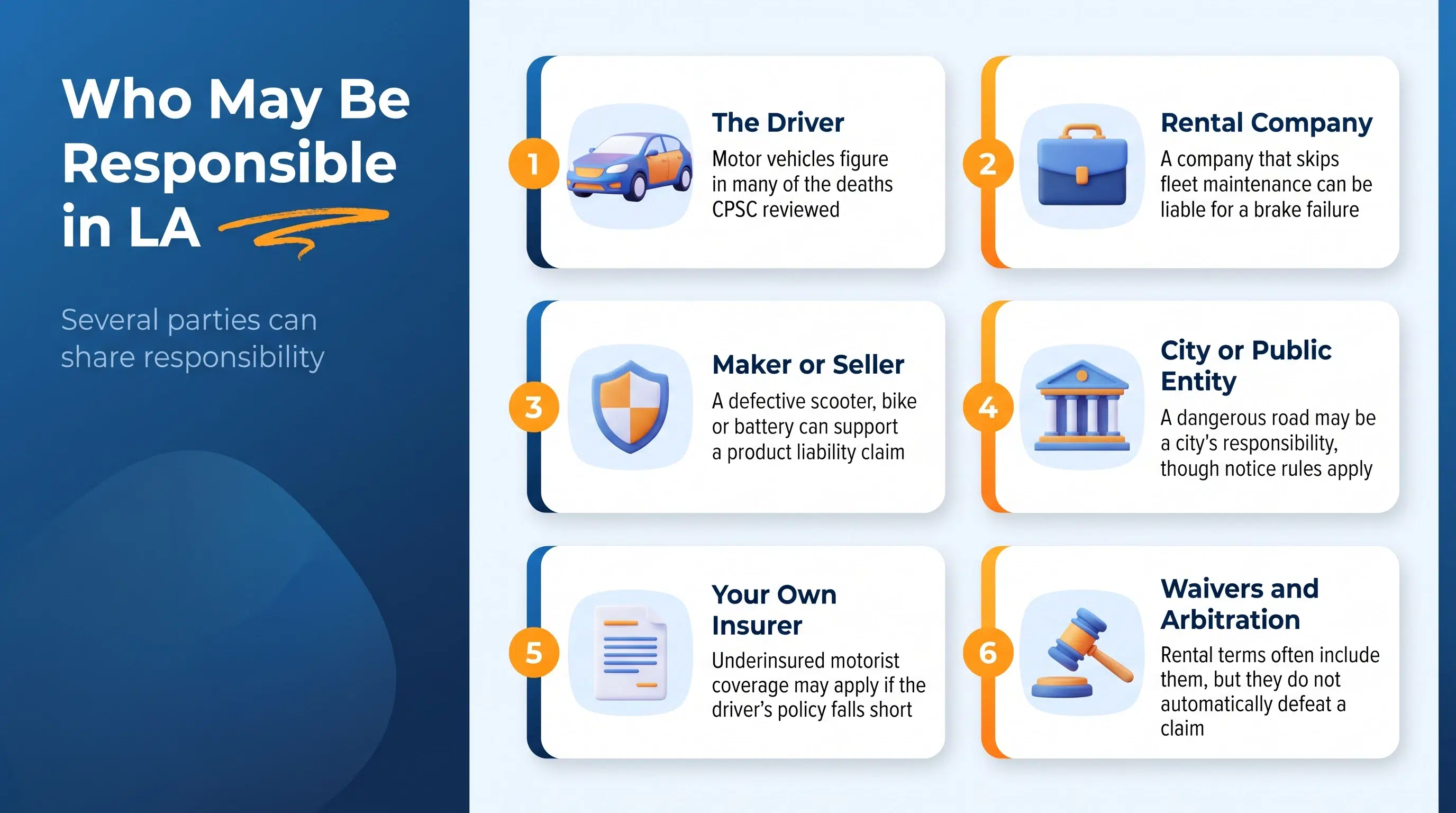
A driver is the most common answer. According to the U.S. Consumer Product Safety Commission (CPSC), motor vehicles were involved in 140 of the 206 e-scooter deaths and 170 of the 310 e-bike deaths it reviewed for 2017 through 2024. In Los Angeles that means a left-turning car crossing a bike lane, a driver pulling out of a driveway or alley, a rideshare car stopping at the curb to drop off a passenger, or a door swung open into a rider’s path.
Others may share responsibility. A rental company that fails to maintain its fleet can be liable when a brake or throttle fails mid-ride. CPSC found brake problems in 40 of the 189 e-scooter incidents it investigated. Rental terms of use often include waivers and arbitration clauses, and those do not automatically defeat a claim, especially where the company’s own negligence caused the harm. A maker or seller of a defective scooter, bike or battery can face a product liability claim. A city or other public entity may be responsible for a dangerous road, though notice rules apply.
Insurance is often the hardest piece. A driver’s liability policy is normally the first source of payment. If it falls short, your own policy’s uninsured or underinsured motorist coverage may apply, depending on its wording. California requires drivers to carry at least $30,000 in bodily injury coverage per person, which a serious injury can exceed quickly.
What causes scooter and e-bike crashes on Los Angeles streets?
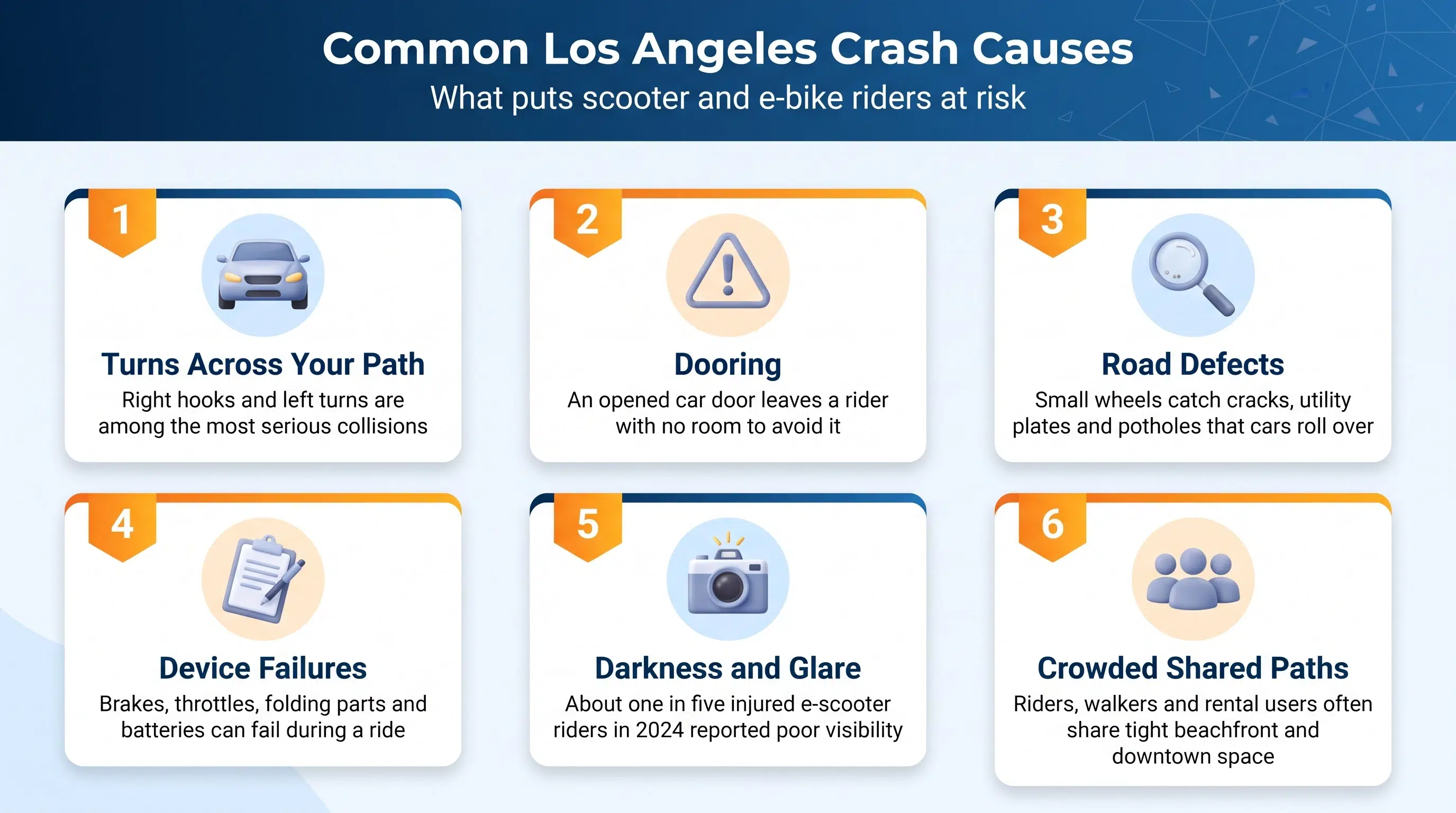
Los Angeles has long, fast arterial streets and a lot of driveways, which gives drivers many chances to miss a small rider. The patterns we see most often:
- Turns across the rider’s path: Right hooks at intersections and left turns into oncoming riders are among the most serious collisions, partly because drivers misjudge an e-bike’s speed.
- Dooring: Parked cars line many commercial streets, and an opened door leaves a rider with no room.
- Road defects: Small scooter wheels catch cracks, utility plates and potholes that a car would roll over.
- Device failures: Brakes, throttles, folding mechanisms and lithium-ion batteries can fail. California requires batteries sold for e-bikes and e-scooters to meet recognized safety standards under SB 1271, so a fire may point to a violation.
- Darkness and glare: CPSC reported that about one in five injured e-scooter riders in 2024 said it was dark or hard to see. Drivers must still look, but poor light gives insurers an argument.
- Crowded beachfront and downtown paths: Riders, walkers and rental users often share tight space, and collisions can injure pedestrians too.
Los Angeles is a year-round riding city, so these crashes are not tied to one season. Fatigue, rush-hour glare and event nights near downtown venues can all play a role.
What do California’s rules say, and do they affect my claim?
Insurers look for any rule a rider may have broken. California sets these basics: an e-scooter rider must hold a valid driver’s license or instruction permit, stay at or under 15 mph, stay off sidewalks except to enter or leave a property, and ride alone. Anyone under 18 must wear a helmet on an e-scooter. E-bikes fall into three classes. A rider under 18 needs a helmet on any class, and a Class 3 rider must be 16 or older and wear a helmet at any age.
| Rule | What California law says | Code section |
|---|---|---|
| E-scooter license | A valid driver’s license or instruction permit is required to ride a motorized scooter. | VC 21235(d) |
| E-scooter helmet | Riders under 18 must wear a properly fitted bicycle helmet. | VC 21235(c) |
| E-scooter speed | 15 mph maximum, even where the posted limit is higher. | VC 22411 |
| Where e-scooters may ride | Not on sidewalks, except to enter or leave a property. On streets posted above 25 mph, only in a bike lane, unless the city allows riding on streets posted up to 35 mph. | VC 21235(b), (g) |
| E-scooter passengers | None. Only the rider may be on the scooter. | VC 21235(e) |
| E-bike classes | Class 1: pedal assist only, up to 20 mph. Class 2: can run on the motor alone, up to 20 mph. Class 3: pedal assist up to 28 mph. | VC 312.5 |
| E-bike helmets | Required for riders under 18 on every class, and for all riders and passengers on a Class 3. | VC 21212, 21213 |
| Class 3 minimum age | No one under 16 may operate a Class 3 e-bike. | VC 21213 |
| E-bike rear light (2026) | A rear red reflector, or a red light with a built-in reflector, at all hours. | AB 544 |
| Battery safety (2026) | E-bike and e-scooter batteries must be tested and labeled to recognized safety standards before sale. | SB 1271 |
This table summarizes California state law as of October 2026. Cities can add their own rules, and the rules in effect on the date of a crash are the ones that apply.
Breaking one of these rules does not automatically end a claim. California applies pure comparative fault, so a rider who bears some responsibility can still recover, with the award reduced by their share. The violation matters most when it actually contributed to the crash. A missing helmet, for example, has little to do with a driver who turns across your lane.
How do scooter and e-bike injuries affect the value of a claim?
With no frame around them, riders take the impact directly. According to CPSC, fractures are the most common emergency-room injury, and the head and neck are among the most often injured areas. CPSC’s 2024 follow-up found that 18% of injured e-scooter riders and 40% of injured e-bike riders were wearing a helmet.
A claim’s value comes from the medical care you need, the work you miss, and how the crash changes your daily life. That includes emergency treatment, surgery, therapy and future care, lost wages and earning capacity, and pain, scarring and the loss of activities you valued. California does not cap those non-economic damages in a standard injury case. Delivery workers who depend on an e-bike for income may also have a claim for future earnings.
Medical bills are not always the end of the story. Hospitals, providers who treated on a lien and health insurers can seek repayment from a recovery. GoSuits negotiates those balances before a case closes, so more of the settlement reaches our client.
What should you do after a crash?
See a doctor the same day, even if you walked away. Concussions and fractures can be slow to show themselves, and a record from day one links your injuries to the crash. If a vehicle was involved, call the police and get the driver’s name, plate and insurance details. If you were on a rental, screenshot the receipt, report the crash in the app in short factual terms, and photograph the scooter before it is collected.
Take pictures of the road, the intersection and any hazard involved, and gather witness names. Note nearby storefronts with cameras. Keep your helmet, clothing and any damaged gear.
An adjuster may call quickly and ask for a recorded statement. You are not required to give one. Before you speak with any insurer, schedule a free consultation with our team. We will review what happened and handle insurer communication so you can focus on healing.
Related practice areas: pedestrian accident lawyers, Los Angeles rideshare accident lawyers, car accident lawyers, product liability lawyers, wrongful death lawyers and our Los Angeles personal injury team.