- What we know about the Angeles Crest Highway crash
- Official cause of death and what it means
- What investigators reported at the scene
- Local context: Angeles Crest Highway risks and conditions
- Where to get official records and documents in Los Angeles County
- Preserving evidence after a fatal crash
- Understanding civil claims after a fatal crash in California
- Insurance issues families commonly face
- Timelines that matter
- Why timely action matters
- Commentary from Gosuits Los Angeles, California Personal Injury Attorney
- References
What we know about the Angeles Crest Highway crash
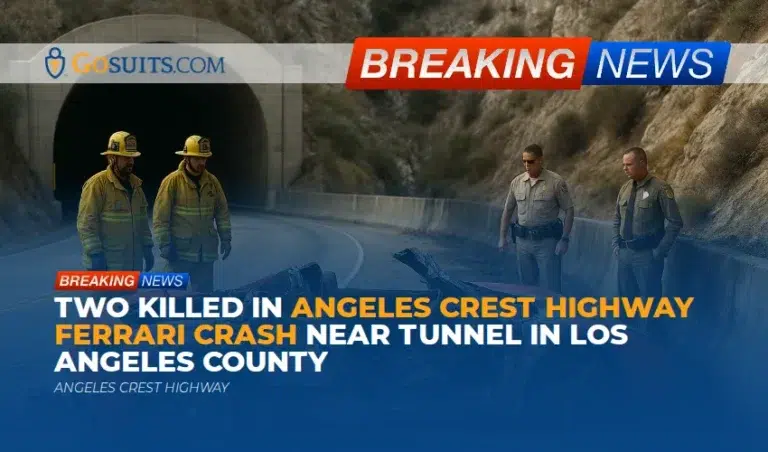
On a December evening along the winding stretch of State Route 2 in the Angeles National Forest, a serious crash occurred on Angeles Crest Highway, a route locals associate with mountain tunnels, steep drop-offs, and sweeping views above La Cañada Flintridge and Pasadena. Two people lost their lives. Public records from the Los Angeles County Department of Medical Examiner identify the decedents as Vince Zampella, 56, and Zachary Marks, 38. The Medical Examiner’s database lists Zampella’s cause of death as thermal injuries and smoke inhalation, with blunt trauma also documented [1]. Marks’ cause of death is recorded as blunt force injuries [2].
The crash involved a red Ferrari convertible traveling on the southbound side of Angeles Crest Highway. Video shared publicly by bystanders shows the car exiting a tunnel at high speed and impacting a concrete barrier where the road curves, followed by a post-collision fire. CHP responders reported the passenger was ejected and the driver became trapped in the vehicle. Both individuals were pronounced deceased at the scene. While the video and preliminary reports shed light on some circumstances, the precise reasons the vehicle left the roadway have not been officially attributed to a single cause by public authorities at the time these records were last checked.
The stretch where this happened is a familiar weekend drive for many Los Angeles area residents who head into the San Gabriels for fresh air, sunrise views near Mt. Wilson, or coffee runs once anchored by Newcomb’s Ranch before its closure. That local familiarity can make losses like this feel close to home, even for those who never met the individuals involved.
Official cause of death and what it means
According to the Los Angeles County Department of Medical Examiner’s public case detail, Zampella’s official cause of death is thermal injuries and smoke inhalation, with blunt trauma also present [1]. Marks’ cause of death is listed as blunt force injuries [2].
For families, cause of death findings serve several important functions. They establish medical conclusions based on autopsy and investigative findings, which can be essential for vital records, life insurance claims, probate matters, and potential civil claims. If questions arise later about survivability, entrapment, or the timeline between impact and fire, the Medical Examiner’s documentation and any associated toxicology or histology can become pivotal. Copies of reports are typically available to qualified requesters through the Medical Examiner’s records unit [3].
What investigators reported at the scene
California Highway Patrol is the investigating agency for most collisions on Angeles Crest Highway, which is a state highway. In its initial release, CHP indicated that the vehicle veered off the roadway for unknown reasons, struck a concrete barrier, and became fully engulfed. The passenger was ejected and the driver remained trapped. Both died from their injuries.
Families or representatives can request the official traffic collision report from CHP using the CHP 190 process, which involves identifying the party status and providing sufficient details to locate the report [4]. If a collision report exists, it often includes diagrams, statements, measurements, and sometimes photographs. CHP may also have documentation of any event data recorder downloads if performed, though EDR access can involve additional steps and technical coordination [10].
Local context: Angeles Crest Highway risks and conditions
Angeles Crest Highway, or State Route 2, climbs quickly from foothill neighborhoods into the Angeles National Forest. Weather, rockfall, and seasonal closures are part of life for this route, which Caltrans District 7 maintains and frequently updates for slides, washouts, and other hazards [11]. Tunnels, limited shoulders, and long-radius curves can compress reaction time at higher speeds, especially when transitioning from dark tunnels to bright daylight or vice versa.
Speed remains a well-documented factor in severe and fatal crashes nationwide. NHTSA has reported that speeding contributes to a significant share of traffic deaths in recent years, and crash energy rises rapidly with even modest increases in speed [9]. On a mountain highway where curves, grade, and elevation can change quickly, speed control and line-of-sight management are critical.

Where to get official records and documents in Los Angeles County
Grieving families often ask a practical question first: who holds which records, and how are they obtained? Here’s a straightforward map of the public agencies and documents commonly at issue after a fatal highway crash in Los Angeles County.
1. Medical Examiner documents
The Los Angeles County Department of Medical Examiner maintains autopsy reports, cause and manner of death statements, and related case materials. Public case details can be searched online, and qualified requesters may obtain certified copies as available. Start with the Medical Examiner’s case detail pages that confirm decedents and causes of death [1] [2] and use the department’s records request portal for copies [3].
2. California Highway Patrol collision report
CHP is typically the lead agency for State Route 2 collisions. Family members, legal representatives, and insurers can request the CHP collision report by using the CHP 190 process. Requests can be made by mail or in person depending on the Area Office that investigated the crash. Detailed guidance is on CHP’s website [4].
3. DMV collision report (SR-1) when required
California law requires drivers to report certain crashes to DMV within 10 days using Form SR-1, including crashes involving injury, death, or property damage above a statutory threshold. While this is often handled by involved drivers or their insurers, representative compliance can be an issue in fatal cases. The DMV provides instructions and forms online [6].
4. Fire department incident records
Los Angeles County Fire Department may hold incident reports, response times, and suppression logs for collisions with fire in unincorporated county or contracted jurisdictions. Requests can be submitted through the department’s records portal [5]. Fire service documents can be useful in understanding the fire’s behavior, extrication timeline, and any hazards encountered by crews.
5. Death certificates
The Los Angeles County Registrar-Recorder/County Clerk issues certified death certificates which are required for many estate and benefits processes. Information and ordering options are available online [7].
6. Roadway and maintenance records
When road conditions or recent repairs are potentially relevant, Caltrans District 7 may have maintenance logs, lane closure schedules, and work orders for State Route 2. Some of this can be requested through public records processes, and Caltrans provides route and closure information on its website and traveler tools [11].
7. Potential traffic camera or private video sources
Mountain highways have limited fixed traffic cameras, but tunnel exits and popular pullouts sometimes yield bystander footage. If a nearby agency or public body maintains cameras, California’s public records laws can apply. Where cameras are private, prompt, well-crafted preservation letters are essential to prevent routine overwriting. California agencies and legal guides recognize the importance of early requests to preserve and obtain footage [12].
For a step-by-step overview of paperwork families often need to assemble after a fatal crash in the city, this guide can help: Los Angeles wrongful death checklist.
Preserving evidence after a fatal crash
Because high-consequence crashes can implicate multiple factors, preserving evidence early is crucial. Consider the following, keeping in mind that each situation is unique and that general guidance is not a substitute for case-specific legal counsel.
- Secure the vehicle and its data. Modern vehicles often contain an event data recorder that can store parameters like speed, throttle, and braking for short windows around a trigger event. Access and retrieval need technical capability and care to maintain integrity. NHTSA provides an overview of EDR technology and its role in crash analysis [10].
- Preserve digital evidence. Demand letters to potential custodians of relevant video or telemetry should go out quickly. This includes public agencies, local businesses near tunnel exits or pullouts, and any social media posters who shared original files.
- Roadway condition documentation. Photographs of the scene, including the barrier, curve signage, lighting transitions at tunnel exits, and any debris fields, should be captured as soon as feasible. Caltrans maintenance records, if relevant, should be requested and preserved [11].
- Medical and fire response timelines. EMS and fire logs can establish arrival times and interventions. Where entrapment or post-impact fire is at issue, these timestamps help reconstruct survivability windows [5].
- Communications with insurers. Before calling any insurer, it is prudent to consult an attorney. Statements made to insurance companies can be recorded, interpreted narrowly, and later used to challenge or minimize claims.
In many fatal collision matters, families eventually consult wrongful death lawyers to direct preservation efforts, coordinate with investigators, and identify potential third parties who might have contributed to the risk or severity of the crash. Keeping a simple log of all requests and replies is helpful in the months ahead.
Understanding civil claims after a fatal crash in California
California permits certain heirs and a decedent’s personal representative to bring a wrongful death action for losses such as loss of financial support and companionship under Code of Civil Procedure section 377.60 [8]. In some situations, an additional survival action may allow the decedent’s estate to recover for damages the person sustained before death.
Causation and fault are not always straightforward in a single-vehicle crash. Potential civil inquiries can include the driver’s conduct, roadway design or maintenance conditions, the performance of safety systems, and whether any third-party negligence heightened the severity of injuries after impact. Each of these requires careful, fact-specific evaluation.
Families navigating these questions often benefit from working with wrongful death lawyers who can assess whether any entity beyond the driver might bear responsibility. When the crash occurs in the San Gabriels and investigative agencies are the local CHP Area Office and the Los Angeles County Medical Examiner, familiarity with how these teams document findings can shorten the time it takes to build an accurate reconstruction [4] [1].
When a local perspective is important, some choose to consult Los Angeles wrongful death lawyers who know how to obtain CHP diagrams and EDR data efficiently and how to coordinate scene inspections before rain or roadwork change the evidence.
Insurance issues families commonly face
Insurance layers in fatal crashes can be complex, particularly when high-performance vehicles and severe fires are involved. Policies that may come into play include liability coverage, underinsured or uninsured motorist coverage, medical payments coverage, and sometimes umbrella policies.
- Recorded statements. Claims adjusters often move quickly to obtain recorded statements. Statements may be used later to contest liability, dispute causation, or argue damages. Consult an attorney first before speaking to any insurer, and understand that what is said can be used against a claim.
- Policy limits disclosure. California law provides mechanisms to request liability policy information in certain contexts, which can help set realistic expectations for recovery.
- EDR and subrogation. Where event data is relevant, preserving and interpreting it correctly can influence liability findings and subrogation.
- Special damages documentation. Funeral expenses, counseling, and lost support must be documented thoroughly. Certified death certificates and Medical Examiner documentation are often required [7] [3].
For any insurer contact or claim initiation, it is strongly recommended to consult an attorney first to understand rights, the strategic value of withholding a statement at early stages, and which documents should be released.
Timelines that matter
California’s statute of limitations for wrongful death is generally two years from the date of death under Code of Civil Procedure section 335.1 [13]. Shorter, earlier claims deadlines can apply if a public entity is a potential defendant. Preservation letters to possible custodians of video or digital vehicle data should be issued as soon as practicable because retention periods can be short and sometimes measured in days.
DMV reporting obligations for involved parties also have strict time limits. The SR-1 must be filed within 10 days for crashes involving injury or death in California [6]. In fatal cases, compliance typically runs through representatives, estates, or insurers, but it is important to verify who is responsible for filing to avoid administrative complications.
Why timely action matters
When a collision occurs on a mountain highway with limited shoulder space and changing conditions, evidence can be lost within days. Caltrans repair crews may replace barriers, rains can shift debris fields, and videos posted by bystanders can disappear if not saved quickly. Early steps can make a difference.
- Issue preservation letters immediately to CHP, Caltrans, nearby businesses, and any known video custodians so that raw files and logs are not overwritten.
- Request official records in parallel, including the CHP collision report and Medical Examiner documents, so that timelines and causes are documented using primary sources [4] [3].
- Secure the vehicle and components if possible, and coordinate non-destructive inspections and downloads under chain-of-custody protocols [10].
- Coordinate benefits and paperwork early, including death certificates and any benefits claims that require certified copies or cause of death language [7].
- Speak with an attorney before insurers. Initial statements can shape claim trajectories and are often used to narrow or challenge future recovery. A free consultation helps clarify rights and obligations before any recorded statement is made.
Commentary from Gosuits Los Angeles, California Personal Injury Attorney
Our team extends heartfelt condolences to the families and communities mourning these two lives. Articles like this are meant to provide general information and help neighbors understand what official records mean, how agencies document serious crashes, and what steps often come next.
From a civil injury perspective, several issues stand out in a crash like this. The combination of a tunnel exit, a curve, and the physics of speed can compress a driver’s margin for error. Post-impact fire and entrapment raise additional survivability questions that investigators typically examine through scene measurements, fire response logs, and Medical Examiner findings. Where a passenger is ejected, investigators also document restraint use and occupant kinematics, not to assign blame to those who cannot speak for themselves, but to understand the mechanics of injury. Ultimately, fault and causation are determined from a full record, not one video clip or a single early statement.
Insurance companies and large corporations are sophisticated repeat players. They understand how quickly evidence can disappear and how an early recorded statement can be interpreted to narrow a claim. They also know many people are unfamiliar with how CHP reports, Medical Examiner findings, and Caltrans records fit together. This information gap can be used to deny, delay, or minimize claims. Preserving data and understanding what should and should not be shared early on helps balance that playing field.
It is important for anyone facing the aftermath of a fatal crash to consider a free consultation before engaging with insurers. A consultation creates space to ask questions about timelines, evidence, and options without pressure. It can also help coordinate requests to public agencies in the right order, so that the most time-sensitive items do not fall through the cracks.
References
- Case Detail 2025-19864 – Los Angeles County Department of Medical Examiner
- Case Detail 2025-19866 – Los Angeles County Department of Medical Examiner
- Request Decedent Case Records – Los Angeles County Department of Medical Examiner
- Collision Report Request (CHP 190) – California Highway Patrol
- Request for Copies of Reports – Los Angeles County Fire Department
- Traffic Collision Reporting Requirements (SR-1) – California DMV
- Death Records – Los Angeles County Registrar-Recorder/County Clerk
- Code Civ. Proc. § 377.60 – California Legislative Information
- Speeding – National Highway Traffic Safety Administration
- Event Data Recorders (EDRs) – National Highway Traffic Safety Administration
- District 7 Road Closures and Conditions – Caltrans
- Crash Data and Tools – California Office of Traffic Safety
- Code Civ. Proc. § 335.1 – California Legislative Information