- What Illinois law governs Uber and Lyft insurance?
- What are the three coverage periods that determine when the $1M applies?
- What coverage exists when a driver has the app on but no ride accepted?
- When does Uber or Lyft’s $1 million policy actually kick in?
- Who can file a claim under the $1M rideshare policy in Illinois?
- What happens if the rideshare driver is hit by an uninsured motorist?
- Does the independent contractor classification affect your injury claim?
- What should an injured passenger or pedestrian know before filing a claim?
- What defenses do transportation network companies typically raise?
- What local factors affect rideshare accident claims in Chicago?
- What is the statute of limitations for a rideshare accident claim in Illinois?
- What steps should you take immediately after a rideshare accident in Illinois?
- How Gosuits Chicago Can Help You After a Rideshare Accident
- References
What Illinois law governs Uber and Lyft insurance?
Illinois regulates rideshare companies through the Transportation Network Providers Act, codified at 625 ILCS 57/1 et seq., which was enacted in 2015 and has been amended since. [1] Under this statute, companies like Uber and Lyft are defined as “transportation network companies” (TNCs), and their driver-partners are classified as “transportation network company drivers.” The law imposes minimum insurance requirements on TNCs based on where a driver falls in the trip process at any given moment.
Understanding the statute is the starting point for any Illinois rideshare accident claim. The coverage that applies depends entirely on which of three distinct periods the driver occupied at the time of the crash. A driver who has the app open while stuck in stop-and-go traffic on the Kennedy Expressway occupies a very different legal position than a driver who has already accepted a rider request and is en route to pick someone up. The dollar amounts and responsible parties shift accordingly, which is why injured people often need help sorting through the layers of coverage before they can even begin to build a civil claim.
The Illinois Department of Insurance oversees TNC insurance compliance, and consumers who encounter disputes over coverage can contact that agency for guidance. [2] However, insurance disputes in rideshare crashes are civil matters that require strategic legal navigation, particularly when multiple policies may overlap or conflict.
What are the three coverage periods that determine when the $1M applies?
The Transportation Network Providers Act divides a TNC driver’s activity into three coverage periods, and each period carries its own insurance floor. [1] Courts and insurance adjusters look at app data and trip records to determine which period applied at the time of the collision.
- Period 0 — The driver is not logged into the TNC app. No TNC insurance applies whatsoever. Only the driver’s personal auto policy is in play.
- Period 1 — The driver is logged into the app and available to accept rides, but has not yet accepted a specific trip request. A contingent liability policy applies.
- Period 2 — The driver has accepted a ride request and is traveling to pick up the passenger. The $1M primary liability policy applies.
- Period 3 — The passenger is in the vehicle and the trip is underway. The $1M primary liability policy continues to apply.
The transition between Period 0 and Period 1 is often disputed in litigation. Drivers sometimes log out of the app moments before or after a crash, raising questions about when the app was actually active. Preserving app data and timestamped GPS records is critical in these cases. Our team of Chicago personal injury lawyers regularly encounters this exact dispute when advocating for crash victims.
What coverage exists when a driver has the app on but no ride accepted?
During Period 1, when a driver is logged in but waiting for a fare, the TNC must maintain the following minimum coverage under 625 ILCS 57/25 [1]:
- $50,000 per person for bodily injury
- $100,000 per accident for bodily injury
- $25,000 for property damage
Importantly, this Period 1 coverage is contingent. The TNC policy only pays if the driver’s personal auto insurer denies the claim or its limits are exhausted. Many personal auto policies contain exclusions for “transportation for hire,” which means a driver’s insurer might deny coverage as soon as it learns the driver was operating for a TNC. In that scenario, the TNC’s contingent policy steps in.
Period 1 coverage tops out at $50,000 per person. Sounds okay. Until it isn’t. Think about a pedestrian hit by an Uber driver who’s cruising the West Side with the app on, just trolling for fares, or a cyclist clipped somewhere near the Loop. Their actual damages, medical bills, lost wages, the works, can blow right past that ceiling. It’s kind of the dirty secret of rideshare insurance in Illinois, and probably the single biggest reason you want to talk to a Chicago Illinois rideshare accident lawyer before you do anything else.
When does Uber or Lyft’s $1 million policy actually kick in?
Once a driver accepts a ride request or has a passenger in the vehicle, both Uber and Lyft maintain at least $1 million in primary third-party liability coverage, along with uninsured and underinsured motorist coverage of the same amount. [3] This is a primary policy, meaning it pays before the driver’s personal insurance.
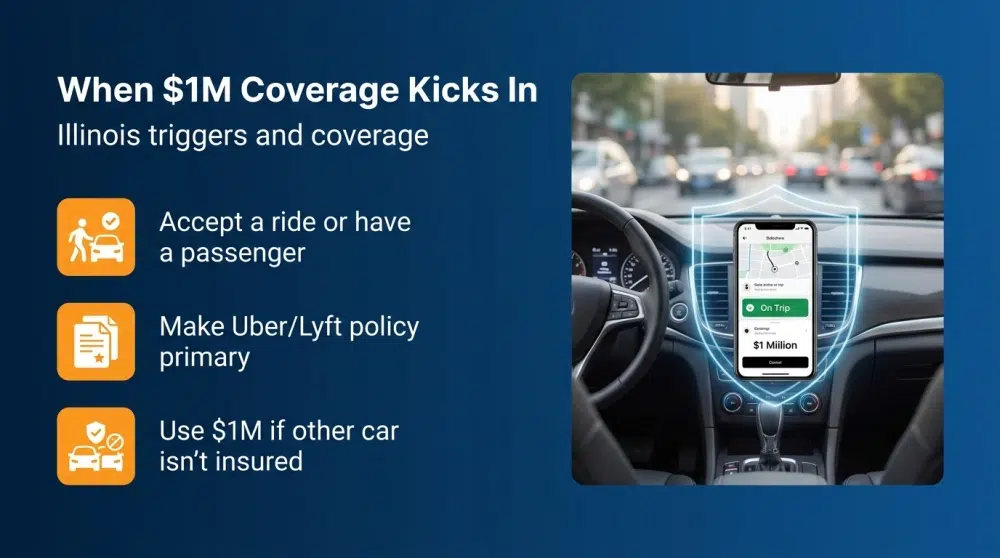
The $1 million coverage applies to:
- Passengers injured while riding in the TNC vehicle
- Third parties such as occupants of another vehicle, pedestrians, or cyclists who are harmed when the TNC driver is at fault
- Third parties injured by an underinsured or uninsured at-fault driver when the TNC vehicle is involved
Here’s the legal floor. Under the Transportation Network Providers Act, TNCs can’t require their drivers to carry anything less than the state minimums during Periods 2 and 3. Uber and Lyft have both published coverage commitments that line up with those statutory floors. [3] But the published limits and what an insurer actually pays in a real claim? Two very different things. Adjusters are paid to minimize payouts, and that $1M number is a ceiling on what the policy can pay, not a floor for what they’ll offer.
Why does the exact second a driver tapped ‘accept’ or a passenger climbed in matter so much? Because the gap between Period 1 coverage and Period 2 or 3 coverage is the gap between $50,000 and $1M. So ride data, GPS logs, and the TNC’s internal records end up being the heart of the civil case. In Illinois, these disputes get filed in the Circuit Court of Cook County, and for Chicago crashes, that means the Richard J. Daley Center downtown.
Who can file a claim under the $1M rideshare policy in Illinois?
Several categories of injured parties may have civil claims against a TNC’s $1M policy when Periods 2 or 3 are established:
- Passengers who are injured while riding in a TNC vehicle during an active trip
- Occupants of other vehicles struck by a TNC vehicle when the driver is at fault
- Pedestrians and cyclists injured by a TNC vehicle during an active trip
- Surviving family members in cases where a crash causes a fatal injury, who may bring a wrongful death claim under the Illinois Wrongful Death Act, 740 ILCS 180/1 et seq. [4]
Wrongful death cases tied to a rideshare crash in Illinois follow the same procedural playbook as any other fatal negligence claim. The difference is where the money comes from. If the driver was at fault during Period 2 or 3, the TNC’s $1M policy is your primary recovery source. And fatal crashes on the busy corridors, Lake Shore Drive, I-290 coming into the city, can actually produce two distinct claims: a wrongful death claim for the family, and a survivor claim for whatever conscious pain and suffering the victim experienced before passing.
Here’s something that gets overlooked. The TNC’s coverage doesn’t get the driver off the hook personally. A civil judgment can be pursued against the driver individually if it exceeds policy limits, sure, but collecting on a personal judgment against an individual rideshare driver? Usually a dead end. They typically don’t have the assets. The real work is mapping out every layer of available coverage, the TNC policy, the driver’s own auto policy, any applicable umbrella coverage. That layered analysis is kind of the foundation of building a successful injury claim.
What happens if the rideshare driver is hit by an uninsured motorist?
Illinois law requires that TNC insurance during Periods 2 and 3 include uninsured motorist (UM) and underinsured motorist (UIM) coverage of at least $1 million. [1] This matters significantly in Chicago and throughout Cook County, where uninsured drivers remain a real issue on roads ranging from South Michigan Avenue to Cicero Avenue.
Picture this. You’re riding in an Uber, another car runs a light and hits you, and the other driver has no insurance. In Illinois, you can still file a UM/UIM claim against the TNC’s own policy, up to $1 million. That’s a huge deal for passengers. It means the at-fault driver’s lack of coverage, or junky minimum-limits coverage, doesn’t have to be the end of your recovery story.
UM/UIM coverage under a TNC policy is subject to conditions and claim procedures that differ from those under personal auto policies. The claim must generally be made directly with the TNC insurer, and disagreements over fault or damages are handled through the insurer’s own processes or, ultimately, arbitration or litigation. If you or someone you love was injured as a passenger in a rideshare vehicle hit by an uninsured driver, understanding how to trigger and preserve these rights is something that personal injury lawyers who handle these cases in Chicago can help you with.
Does the independent contractor classification affect your injury claim?
Yes, significantly. Both Uber and Lyft classify their drivers as independent contractors rather than employees. [5] This classification directly affects how a civil claim is framed. Under traditional respondeat superior principles, an employer can be held vicariously liable for an employee’s negligence in the course of employment. That doctrine does not automatically apply to independent contractors.
However, the Transportation Network Providers Act effectively sidesteps this question by imposing a direct statutory insurance obligation on the TNC that does not depend on whether the driver is an employee. [1] The TNC must carry the required coverage regardless of employment classification. The practical result is that for most victims, the insurance claim against the TNC’s policy proceeds normally without needing to litigate the employment relationship.
Where the classification does matter is in negligent hiring and retention claims. Courts in Illinois have recognized that companies can face liability for hiring individuals they knew or should have known posed a risk. If a TNC driver had a prior history of reckless driving that a proper background check would have revealed, there may be a direct negligence claim against the TNC itself, separate from the statutory insurance obligation. [6]
This area of law isn’t settled. Not really. The independent contractor classification gets attacked in courts and statehouses across the country, and both state and federal legislation could shift how these driver relationships work in future cases. For now though, the statutory insurance framework is still the cleanest path to compensation for injured people in Illinois.

What should an injured passenger or pedestrian know before filing a claim?
If you were injured in a rideshare crash in Illinois, several practical realities shape how your civil claim will proceed:
- Preserve all digital records. The TNC app stores trip data including acceptance timestamps, GPS routes, and fare receipts. This data can establish which coverage period applied. Request preservation of this data through formal legal channels as early as possible.
- Get the police report. Illinois law requires crashes involving injury to be reported, and the police report creates an official record of date, time, location, and the driver’s app status if officers investigate.
- Obtain medical documentation. Your injury claim depends on documented medical records connecting the crash to your injuries. Seeking care promptly, and consistently following up, supports your claim.
- Do not give recorded statements to insurance adjusters without counsel. A TNC insurer’s adjuster works for the company, not for you. Statements made early in the process can be used to minimize your claim.
- Understand that multiple insurers may be involved. In some crashes, the TNC’s insurer, the at-fault driver’s personal insurer, and potentially a third driver’s insurer may all play a role. Coordinating claims across these entities requires careful legal management.
Injured victims are encouraged to consult with personal injury lawyers who handle rideshare claims in Chicago before taking any steps that could affect their rights. The time immediately after a crash is when the most critical evidence exists, and it is also when mistakes are easiest to make.
What defenses do transportation network companies typically raise?
From the defense side, TNC insurers and their counsel typically challenge claims on several grounds:
- Period disputes. Insurers often argue that the driver was in Period 0 or Period 1 at the time of the crash, not Period 2 or 3, in order to limit coverage. Resolving this requires app records, GPS data, and expert analysis.
- Comparative fault. Illinois follows a modified comparative negligence rule. Under 735 ILCS 5/2-1116 [7], a plaintiff whose fault exceeds 50% cannot recover. TNC insurers routinely argue that the injured party was partially at fault to reduce damages or bar recovery entirely.
- Causation disputes. Insurers may contest whether the crash caused the injuries claimed, particularly for soft-tissue injuries or conditions with pre-existing components.
- Scope of employment. In cases where a negligent hiring theory is raised, the TNC may argue that the driver’s conduct fell outside the scope of any duty the TNC owed, or that the driver’s background check was adequate under industry standards.
Understanding these defenses in advance allows injured claimants and their legal teams to build records that address them directly. Evidence gathered at the scene, in medical records, and from the TNC’s own systems can neutralize many of these arguments before they take hold.
What local factors affect rideshare accident claims in Chicago?
Chicago runs on rideshares. From Wicker Park and the West Loop down to the South Side, you’re going to see Ubers and Lyfts at pretty much any hour. The heavy corridors are no surprise either, Lake Shore Drive, the Dan Ryan (I-94), the Eisenhower (I-290), they’re all packed with rideshare traffic around the clock. And surge pricing makes it worse. When prices spike, drivers cluster downtown near the Loop and around the transit-heavy neighborhoods, which means more rideshares on the road and more crashes waiting to happen.
The Kennedy at rush hour is basically a rolling parking lot. I-90/94, stop-and-go, especially around the I-90 interchange. That’s where you get the classic rear-enders and the messy lane-change crashes, and a surprising number involve rideshare drivers trying to read app notifications mid-merge. The I-94 and I-57 interchange on the South Side is another hot spot. Heavy rideshare activity in both directions, passengers coming and going pretty much all day.
If your rideshare crash happened in the Chicago area, the case lands in the Circuit Court of Cook County. The Daley Center, 50 W. Washington Street, that’s the main filing venue for civil cases in the county. The statute of limitations and procedural rules track Illinois civil procedure, but honestly, the bigger advantage usually comes from working with attorneys who know the local courts, the judges, and the day-to-day rhythm of Cook County civil practice.
Cook County also has a substantial arbitration program for smaller claims. Cases with a potential verdict of $50,000 or less are subject to mandatory arbitration under local court rules, though parties retain the right to reject the arbitration award and proceed to trial. Knowing which track your case will follow affects litigation strategy from the very beginning.
What is the statute of limitations for a rideshare accident claim in Illinois?
In Illinois, most personal injury claims arising from a vehicle collision must be filed within two years of the date of the injury, pursuant to 735 ILCS 5/13-202. [8] Wrongful death claims must generally be filed within two years of the date of death under the Illinois Wrongful Death Act. [4]
Hard cutoffs. That’s what these deadlines are. Miss the statute of limitations and the right to sue is gone, period, no matter how strong the underlying claim was. Two years sounds generous until you actually try to do it. Building a real civil case means preserving TNC app records, finishing medical treatment, calculating damages, all of that. It takes time. Getting started early gives your legal team the runway to investigate, negotiate, and, if they have to, litigate.
There are narrow exceptions to the two-year rule, including circumstances involving minors and discovery rules for certain injury types, but these exceptions are fact-specific and cannot be relied upon without careful legal analysis. If you were injured in a rideshare crash in Illinois, do not wait to seek a free consultation with a personal injury lawyer who handles these claims.
What steps should you take immediately after a rideshare accident in Illinois?
The steps you take in the hours and days following a rideshare crash directly affect the strength of your civil claim. We offer the following general guidance:
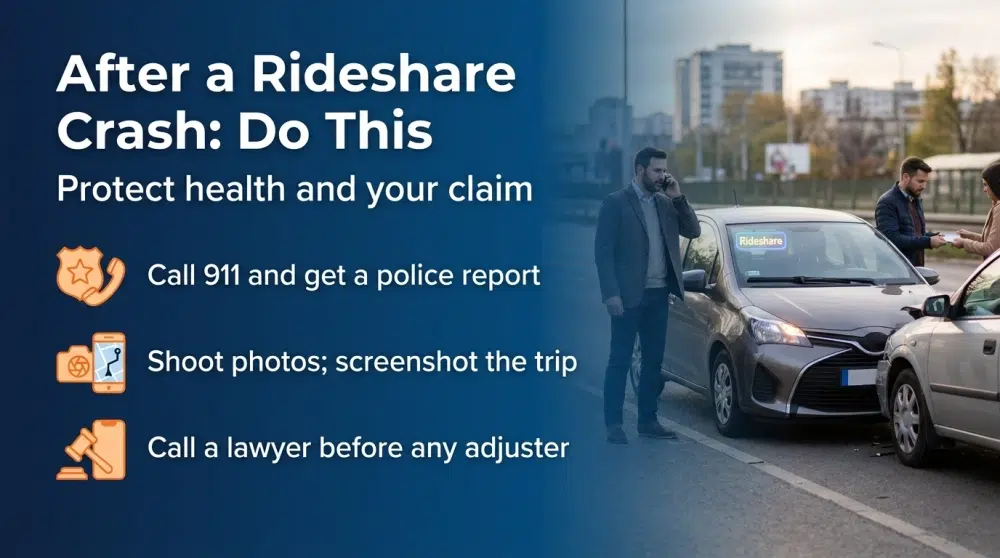
- Call 911. Request police and, if needed, medical assistance. A police report creates an official record of the crash and its circumstances.
- Take photographs. Document the scene, vehicle damage, road conditions, traffic signals, and any visible injuries before vehicles are moved.
- Collect driver and vehicle information. This includes the driver’s name, contact information, and vehicle plate number. Also note the driver’s rating and whether the TNC app was active.
- Screenshot your trip data. If you were a passenger, take a screenshot of the ride details in the Uber or Lyft app immediately. This documents the trip, driver, and timing.
- Seek medical care promptly. Do not delay treatment even if injuries seem minor at first. Many serious injuries, including soft tissue and internal injuries, present symptoms hours or days after impact.
- Avoid posting on social media. Statements and photographs posted publicly can be obtained by opposing insurers and used to undermine your claim.
- Contact a personal injury attorney before speaking with any insurance adjuster. You have the right to consult an attorney before providing any recorded statements.
Our knowledge base article on what to do after an Uber or Lyft accident provides additional guidance on the immediate steps that protect both your health and your legal rights.
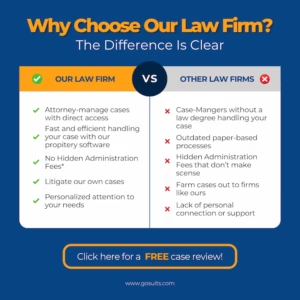
How Gosuits Chicago Helps Rideshare Accident Victims
Rideshare accident insurance in Illinois involves layered policies, statutory coverage periods, and disputes over which policy applies when. For injured victims, this legal complexity arrives at a moment when they are focused on recovery. That is where our team comes in.
Quick intro. Gosuits is a technology-driven personal injury firm with offices in Chicago plus locations across Illinois, California, and Texas. Our attorneys work cases throughout Illinois, including Cook County and the broader Chicago metro. Combined, we’ve got 30 years of personal injury litigation experience. The thing we hear clients appreciate most? You get a dedicated attorney, not a case manager. Direct line to your lawyer, start to finish.
What sets Gosuits apart is our proprietary technology platform, built to accelerate case development, evidence organization, and communication. Our attorneys use this system to move cases forward faster without compromising quality. Technology handles the administrative workflow; your attorney handles your case.
Our attorneys try cases. We’re ready to take a matter into the Circuit Court of Cook County if that’s what it takes to land a fair result for a client. And that’s not theoretical posturing. Insurance companies pay close attention to which firms will actually walk into a courtroom and which will fold, and that read shapes how they negotiate from day one. Our prior cases reflect outcomes from both negotiated settlements and full-on litigation.
We represent personal injury clients across a full range of accident types, including vehicle collisions, rideshare accidents, wrongful death claims, and more. You can review our full practice areas and learn about our approach on our about us page. Our our attorneys page introduces the team working on your behalf.
If you or a family member was injured in a rideshare accident in Illinois, we offer a free consultation with no obligation and no attorney fees unless we recover for you. There is a two-year statute of limitations on most personal injury claims in Illinois, and your window to act closes faster than you might expect. Schedule a free consultation with our Chicago team today.
References
- Transportation Network Providers Act, 625 ILCS 57/1 et seq. – Illinois General Assembly
- Illinois Department of Insurance – Official Website
- Uber Insurance Program – Uber Official Site
- Illinois Wrongful Death Act, 740 ILCS 180/1 et seq. – Illinois General Assembly
- The “Sharing” Economy: Issues Facing Platforms, Participants and Regulators – Federal Trade Commission
- Negligent Hiring – Legal Information Institute, Cornell Law School
- 735 ILCS 5/2-1116 – Modified Comparative Fault – Illinois General Assembly
- 735 ILCS 5/13-202 – Two-Year Statute of Limitations – Illinois General Assembly
- United States Courts – Case Records – PACER
- Illinois Courts – Official Website