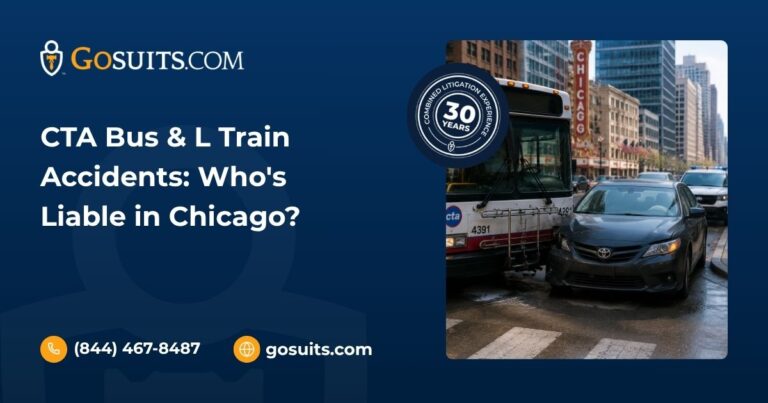
The Chicago Transit Authority (CTA) may be held liable for injuries resulting from a bus or L train accident when its negligence contributed to the incident. As a common carrier, the CTA owes passengers a heightened duty of care under Illinois law while they are riding, boarding, or exiting its buses and trains. However, claims involving the CTA differ from ordinary motor vehicle accident claims because they are governed by specific statutes and procedural requirements that can affect how and when a claim must be pursued.
After a CTA accident, concerns about medical expenses, lost income, and the process for bringing a claim against a public transit agency often arise quickly. Determining who may be legally responsible depends on the circumstances of the accident, the parties involved, and the laws that apply to claims against the CTA.
Key Takeaways
- The CTA may be held liable when its negligence causes injuries during the operation or maintenance of its buses, trains, stations, or related facilities.
- As a common carrier, the CTA owes passengers a heightened duty of care while they are boarding, riding, and exiting CTA vehicles.
- Liability may also involve third-party drivers, contractors, or other individuals depending on how the accident occurred.
- Illinois follows a modified comparative negligence rule, which may reduce or, in some cases, bar recovery based on an injured person’s percentage of fault.
- Claims involving the CTA are subject to specific statutory and procedural requirements, making it important to understand the applicable deadlines and evidence preservation obligations.
- Promptly preserving evidence, including surveillance footage, maintenance records, and incident reports, can be an important part of evaluating a CTA accident claim.

Why is suing the CTA different from an ordinary Chicago car accident claim?
A claim involving the Chicago Transit Authority (CTA) is different from a typical car accident claim because it involves a public transit agency that operates as a common carrier under Illinois law.
While many motor vehicle accidents involve private drivers and insurers, CTA claims may be governed by additional statutes, procedural requirements, and legal standards that do not apply in ordinary automobile negligence cases. Determining liability often requires evaluating both the facts of the accident and the legal framework that applies to public transportation claims.
The CTA as a Common Carrier Under Illinois Law
The CTA operates as a common carrier, meaning it provides public transportation for paying passengers. Under Illinois law, common carriers owe passengers the highest degree of care consistent with the practical operation of their business. This heightened duty generally applies in connection with passenger transportation, including qualifying boarding and exiting situations.
Although the CTA is not an insurer of passenger safety, it may be liable when an injury results from a failure to exercise the level of care required of a common carrier. Different legal principles may apply depending on the person’s status, the location of the accident, and the specific facts of the claim.
The heightened common-carrier duty does not necessarily apply to every person or every condition on CTA property. The applicable duty can depend on whether the injured person had passenger status and whether they were boarding, riding, exiting, or had already reached a place of safety.
Why the Tort Immunity Act Generally Does Not Apply to the CTA’s Common-Carrier Operations
Section 2-101 of the Illinois Local Governmental and Governmental Employees Tort Immunity Act (745 ILCS 10/2-101) provides that the Act does not apply to an entity organized under or subject to the Chicago Transit Authority Act (70 ILCS 3605) in connection with its operation as a common carrier. CTA liability may therefore be evaluated under the CTA Act, applicable Illinois statutes, and common-law negligence principles rather than the broad immunity framework that governs many other local public entities.
This does not mean the CTA is automatically liable whenever an accident occurs. As with other negligence claims, a claimant generally must establish that the CTA owed a legal duty, breached that duty, that the breach was the proximate cause of the injury, and that legally compensable damages resulted.
What kinds of negligence create CTA bus or L train liability?
The CTA is not automatically responsible whenever a passenger is injured. Like other negligence claims, liability generally depends on whether the accident resulted from a failure to exercise the level of care required under Illinois law.
Depending on the circumstances, responsibility may arise from the actions of a CTA employee, the condition of a vehicle or station, or the conduct of another party.
Common Types of Negligence in CTA Accident Claims |
||
|---|---|---|
| Category | Example Scenario | Who May Be Liable |
| Driver or Operator Error | Bus Operator Makes an Allegedly Unusual or Unnecessarily Abrupt Maneuver That Evidence Connects to the Injury | CTA, If Employee Negligence Caused the Injury |
| Negligent Maintenance | Brake Failure, Defective Doors, or Rail Equipment Problems Linked to Inadequate Maintenance | CTA, If Negligent Maintenance Contributed to the Accident |
| Platform, Station, or Track Hazards | Person Is Injured Because of an Allegedly Unsafe Condition at a CTA Facility | Liability Depends on Control of the Property, Notice, the Nature of the Condition, and Applicable Illinois Law |
| Third-Party Driver or Passenger Conduct | Another Motorist Collides With a CTA Bus, or Another Passenger Contributes to an Injury | Third Party, CTA, or Multiple Parties Depending on the Facts |
Driver or Operator Error
CTA accident claims may involve allegations such as failure to yield, distracted operation, unsafe speed, movement before boarding or exiting is reasonably complete, or an unusual or unnecessarily abrupt acceleration, stop, or turn.
A passenger’s fall during ordinary bus or train movement does not by itself establish negligence. The evidence must connect the injury to conduct that fell below the applicable standard of care.
If a CTA employee acting within the scope of employment negligently caused an injury, the CTA may be held responsible under Illinois law.
Negligent Maintenance
Some accidents result from vehicle or rail equipment issues rather than operator error. Examples include brake failures, malfunctioning doors, defective rail equipment, or inadequate inspection and maintenance. Liability depends on whether negligent maintenance contributed to the accident.
Platform, Station, and Track Hazards
Some injuries occur because of conditions at CTA stations rather than during the operation of a bus or train. Depending on the circumstances, claims may involve allegedly hazardous walking surfaces, inadequate lighting, malfunctioning escalators or elevators, or other conditions affecting station facilities.
Liability depends on the specific facts, including who controlled the property, whether the CTA had any applicable legal duty regarding the condition, whether notice can be established where required, and the applicable provisions of Illinois law.
Third-Party Drivers and Other Passengers
Not every CTA-related accident is caused by the CTA. Another motorist may collide with a CTA bus, or another passenger’s actions may contribute to an injury. In these situations, Illinois law may allocate responsibility among multiple parties based on each person’s conduct.
How long do you have to file a lawsuit against the CTA in Illinois?
Under section 41 of the Chicago Transit Authority Act, 70 ILCS 3605/41, a civil action against the CTA for personal injury generally must be commenced within one year from the date the cause of action accrued.
Because filing requirements and procedural issues can vary depending on the facts and the parties involved, the applicable law should be evaluated carefully in each case.
Why Early Legal Consultation Matters
CTA accident claims may involve footage, electronic data, incident documentation, and other records that might not remain readily available indefinitely, depending on the type of material and applicable retention practices.
Taking prompt action can help preserve relevant information and ensure the applicable filing requirements are identified as early as possible.
Relevant evidence may include onboard video, operator reports, incident records, maintenance documentation, witness information, photographs, and medical records.
Because claims against the CTA are subject to specific statutory requirements, preserving evidence early can help provide a clearer understanding of the circumstances surrounding the accident and reduce the risk of important information becoming unavailable while the claim is being evaluated.

How does Illinois comparative negligence apply to CTA accident claims?
Illinois follows a modified comparative negligence rule under 735 ILCS 5/2-1116. This means an injured person may still recover damages if they are 50% or less at fault, but any recovery is reduced by their percentage of fault. If they are found more than 50% at fault, they generally cannot recover damages.
Comparative fault may be disputed when evidence suggests that an injured person disregarded a warning, entered a restricted area, or attempted to board or exit under unsafe circumstances. Whether that conduct was negligent and how much it contributed to the injury depend on the facts.
For example, if a passenger is found 20% at fault for disregarding a warning sign but 80% of the fault is attributed to a mechanical failure or another negligent act, the passenger’s recovery would generally be reduced by 20%.
Although the legal standard is the same as in other Illinois personal injury claims, the allocation of fault in CTA cases often depends on evidence such as surveillance footage, operator reports, maintenance records, and witness statements.
What evidence helps prove a CTA bus or L train claim?
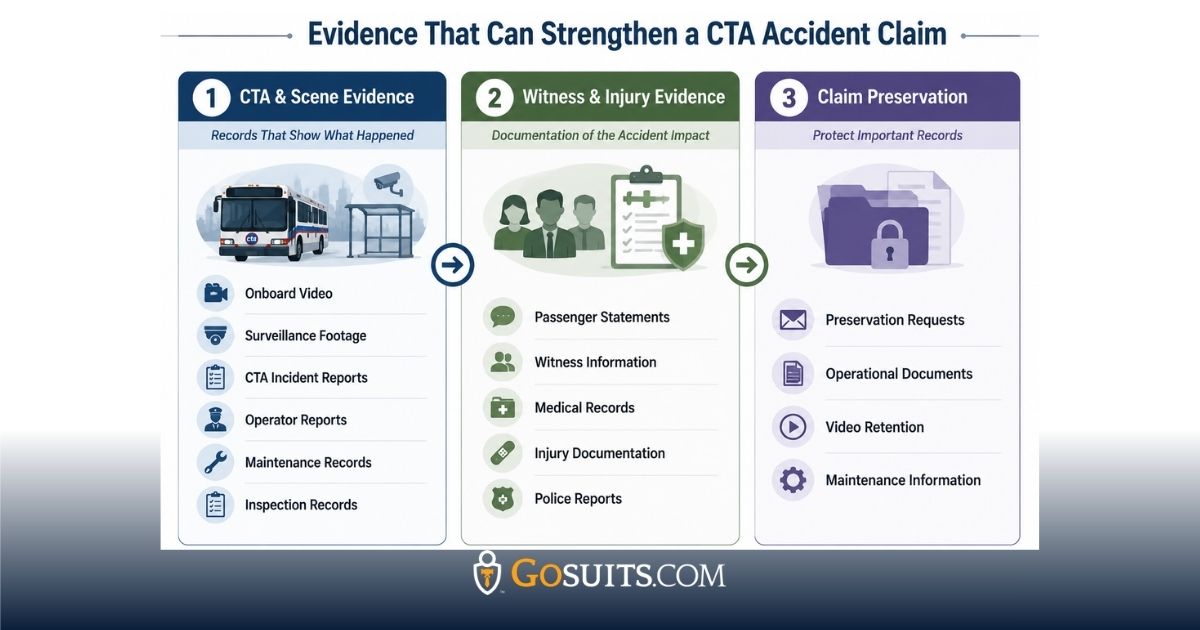
The strength of a CTA accident claim often depends on the available evidence. Establishing how the accident occurred may require reviewing records from the CTA, the accident scene, and other sources to determine whether negligence contributed to the injury.
Documentation That Strengthens a CTA Claim
The following evidence may help establish liability and the extent of the injuries:
- Onboard video or surveillance footage
- CTA incident and operator reports
- Vehicle, rail, or station maintenance and inspection records
- Statements and contact information for passengers, employees, or other witnesses
- Medical records documenting accident-related injuries and treatment
- Photographs or videos of the accident scene, vehicle, or station conditions
- Police or other investigative reports, when applicable
- Documentation of lost wages or other accident-related losses
- Keeping these records organized can help provide a clearer understanding of how the accident occurred and the damages resulting from the incident.
Why Preservation Requests Matter in CTA Cases
Some records relevant to a CTA accident claim may not remain available indefinitely. Depending on the applicable record-retention practices, surveillance footage, onboard video, maintenance records, and other operational documents may eventually become unavailable.
A timely preservation request can place the appropriate parties on notice that potentially relevant records should be retained. Whether particular material exists or must be produced depends on the facts, applicable procedures, and governing law. Taking this step early may reduce the risk of important information becoming unavailable before the facts of the accident can be fully assessed.
What damages can be recovered in a CTA accident claim?
The damages available after a CTA bus or L train accident depend on the nature of the injuries, the available evidence, and the circumstances of the incident.
In qualifying cases, Illinois law may allow recovery for both financial losses and the personal effects of an injury resulting from a collision, sudden stop, station hazard, or other negligent act.
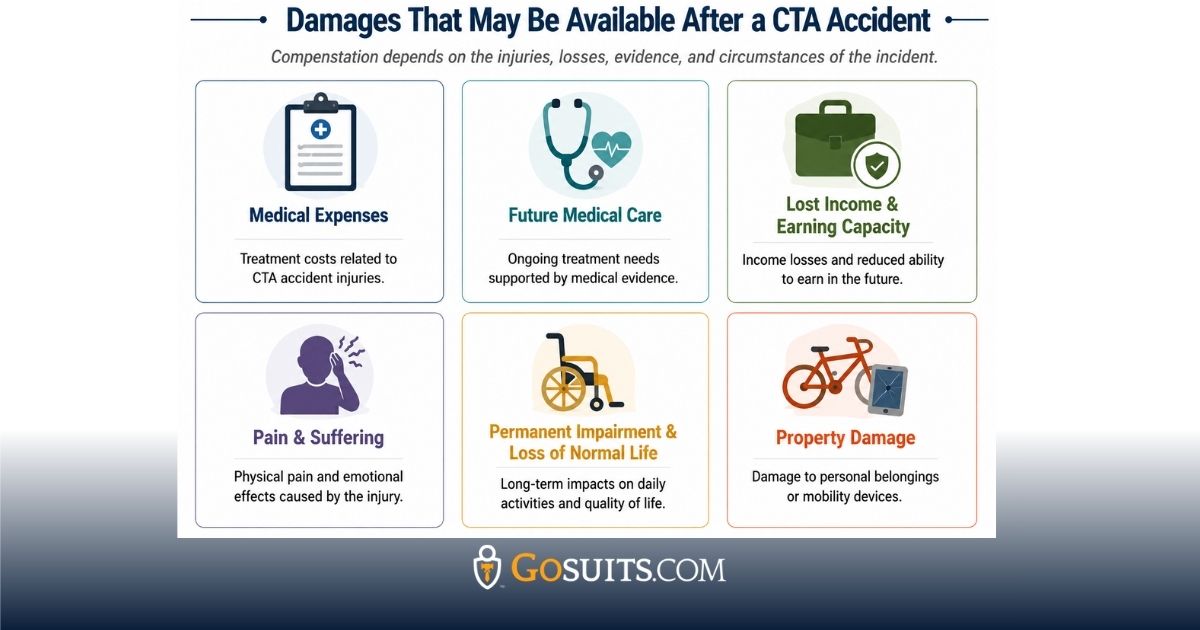
Medical Expenses
Compensation may include emergency medical care, hospitalization, rehabilitation, prescription medications, and other treatment related to injuries sustained on a CTA bus, L train, or station.
Future Medical Care
When an injury requires ongoing treatment, future medical expenses may also be recoverable if supported by the available medical evidence.
Lost Income and Reduced Earning Capacity
Individuals who are unable to work because of their injuries may be able to recover compensation for lost wages or other employment-related income.
If the injuries permanently affect a person’s ability to perform their job or reduce their future earning potential, compensation may also be available for a loss of earning capacity.
Pain and Suffering
Illinois law may allow recovery for the physical pain, emotional distress, and other non-economic effects resulting from a CTA accident.
Permanent Disability, Disfigurement, and Loss of Normal Life
Serious injuries that result in permanent impairment, scarring, or a reduced ability to participate in everyday activities may also be considered when evaluating damages.

Property Damage
If personal property such as a bicycle, wheelchair, mobility device, electronic device, or other belongings was damaged in the accident, compensation may also be available where appropriate.
Speak With GoSuits About a Chicago Transit Accident
CTA bus and L train accidents can raise questions about common-carrier duties, responsibility for vehicle or station conditions, evidence preservation, and the one-year filing period that may apply.
GoSuits helps people evaluate Chicago transit accident claims and understand the legal options that may be available under Illinois law. Learn more about the services provided by our Chicago bus accident attorneys.
Whether the incident involved a bus, train, station platform, or another part of the CTA system, early action may help identify applicable deadlines and preserve relevant evidence.
Contact GoSuits for a free case evaluation.
FAQs
Can I sue the CTA if I was injured while boarding or exiting a bus or train?
The CTA’s heightened common-carrier duty may apply while a person is boarding, riding, or exiting a bus or train. The applicable duty depends on the person’s passenger status, the location of the incident, and the specific circumstances.
What if another driver, not the CTA, caused the crash?
If another driver caused the collision, that driver may be legally responsible for the resulting injuries. Depending on the facts, liability may involve the third-party driver, the CTA, or multiple parties.
Can a family bring a claim if a CTA accident results in a fatality?
When a CTA accident results in a death, eligible family members or a personal representative may have rights under Illinois wrongful-death and survival laws. The available claims depend on the circumstances and applicable deadlines. Learn more from our Chicago wrongful death attorneys.
Is there a general damages cap on CTA personal injury claims?
Section 41 of the Chicago Transit Authority Act establishes a shortened filing period but does not itself set a general cap on personal injury damages. The compensation available still depends on the evidence, the recognized categories of damages, comparative fault, and any other law applicable to the particular claim.
What if I was partly at fault for my own injury on a CTA vehicle?
Illinois follows a modified comparative negligence rule. If you are 50% or less at fault, you may still recover damages, although your recovery may be reduced by your percentage of fault. If you are more than 50% at fault, you generally cannot recover damages from another at-fault party.
How is a claim against the CTA different from a claim against Metra or Pace?
Each transit agency operates under its own legal framework. The applicable procedures and requirements may differ depending on the agency involved.
What should I do immediately after a CTA bus or L train accident?
Seek medical attention if needed, report the incident to the appropriate personnel, document the accident scene when possible, and keep records of your injuries, medical treatment, and other evidence related to the accident.
Can pedestrians or cyclists bring a claim after a CTA accident?
Potentially. Pedestrians, cyclists, motorists, and passengers may all have legal rights depending on how the accident occurred and the applicable Illinois law.