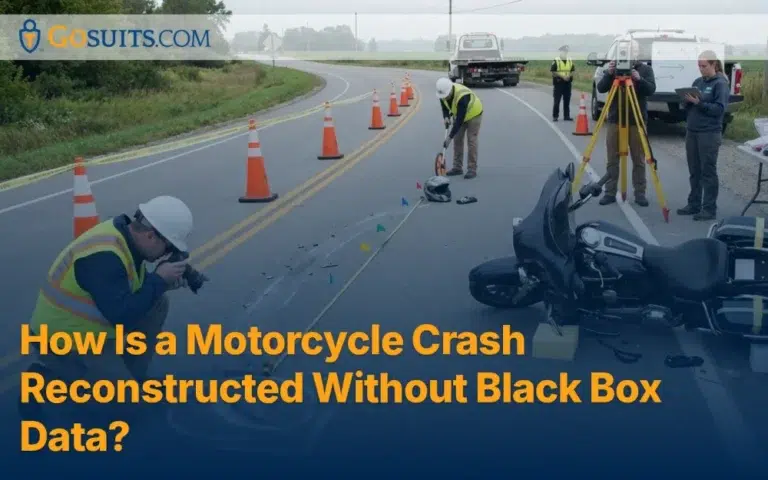
Most motorcycles carry no event data recorder. When a collision happens on a busy Orange County corridor such as the I-405 or SR-73, engineers cannot simply pull a digital file to learn how fast the rider was traveling or when braking began. Instead, crash reconstruction relies entirely on physical evidence: the distance and direction a rider travels after impact, gouge and scrape patterns in the pavement, the geometry of tire marks, deformation in the forks and frame, and the crush profile of the helmet and gear. Each of these physical traces has a collection window measured in hours to days. Understanding what those traces show, and how quickly they disappear, matters to anyone who has been injured in an Irvine-area motorcycle collision and is evaluating a civil claim.
Legal Snapshot
- Legal Topic: Motorcycle accident reconstruction; California personal injury negligence
- Case Stage: Pre-litigation evidence preservation; expert witness preparation
- Primary Legal Issue: Establishing speed, impact angle, and point of contact without electronic data
- Key Statute: California Vehicle Code § 22350 (basic speed law) [1]
- Comparative Fault: California pure comparative negligence Li v. Yellow Cab Co., 13 Cal.3d 804 (1975) [2]
- Statute of Limitations: Two years from date of injury California Code of Civil Procedure § 335.1 [3]
- Government Entity Claims: Written claim required within six months Government Code § 911.2 [4]
- Date Legal Authority Last Reviewed: 2025
Why Most Motorcycles Carry No Event Data Recorder
Federal regulations require event data recorders (EDRs) in passenger cars and light trucks. Under 49 C.F.R. Part 563, vehicles covered by the rule must record pre-crash speed, throttle, braking, and occupant-restraint data in a standardized format that investigators can retrieve with commercially available tools.[5] Motorcycles fall outside that mandate. The federal rule does not extend to two-wheeled vehicles, and no equivalent state requirement applies in California.
A small number of premium touring and sport motorcycles include manufacturer-proprietary telematics or inertial measurement unit (IMU) logging. These systems vary widely by brand and model, record different variables, and output data in formats that require manufacturer cooperation to read. For the vast majority of motorcycles on California roads, including the sport bikes, standard bikes, and cruisers commonly seen on the I-405 corridor through Irvine, no standardized crash data recorder exists.
That absence changes the way reconstruction engineers approach a case. Instead of beginning with a digital record and working outward, they work inward from physical evidence to reconstruct what the digital record would have shown. The method is well-established in the personal injury lawyers community and in California courts, but it demands that the physical evidence be identified, photographed, measured, and preserved before it is lost.
Throw Distance and Trajectory: Estimating Pre-Impact Speed
When a motorcycle collides with another vehicle, a rider who separates from the motorcycle becomes a projectile. Reconstruction engineers use the physics of projectile motion to calculate a minimum speed from the distance and trajectory the rider traveled before coming to rest. The inputs are the rider’s launch height above the road surface, the horizontal distance from launch point to rest position, and the applicable drag factor for the road surface over which the rider slid.
The calculation produces a floor, not a ceiling. A rider who traveled a measured distance was moving at at least that fast. In practice, engineers present a range that accounts for variation in launch angle and surface friction, and that range is compared against other physical evidence to narrow the estimate.
Trajectory analysis adds directional information. The vector from launch point to final resting position indicates the primary direction of the collision force. A rider who comes to rest perpendicular to the lane of travel was struck from the side; a rider who continues in the original direction of travel was struck from behind. When the motorcycle, the rider, and separated components such as mirrors, footpegs, and saddlebags all come to rest, the spatial pattern of those rest positions forms a diagram of the collision dynamics. Capturing that diagram requires accurate distance measurements and georeferenced photography taken while the scene is undisturbed.
Gouge and Scrape Marks: Pinpointing the Point of Impact
When a rigid motorcycle component strikes the road surface under significant downward force, it cuts into the pavement rather than merely sliding across it. The resulting mark, called a gouge, is a divot or furrow with characteristic edges and a depth that reflects the force applied. Gouges produced by footpegs, handlebar ends, and engine cases look different from one another, and engineers who work regularly with motorcycle crash scenes recognize those signatures.
The location of primary gouges relative to lane markings establishes where in the roadway the motorcycle first contacted the ground after the initial collision. That position is one of the most disputed facts in motorcycle injury litigation, because it bears directly on which vehicle was in which lane and whether either rider violated a lane-use rule.
Scrape marks are produced as components slide across the surface after ground contact. Their direction, length, and depth record the path the motorcycle traveled while decelerating. Engineers photograph scrape marks with measurement scales in frame and sometimes use ultraviolet light or oblique-angle illumination to reveal faint marks that are invisible under ordinary lighting conditions.
Both types of marks are temporary. On high-traffic arterials around Irvine such as Jamboree Road and Alton Parkway, tire traffic and road-sweeping equipment begin degrading marks within hours of a crash. On state freeway surfaces maintained by Caltrans District 12, patch-repair cycles can eliminate gouge evidence within days. Early, systematic photography is the only way to preserve this category of evidence.
| Evidence Type | What It Reveals | Typical Loss Window | Preservation Priority |
|---|---|---|---|
| Gouges and scrape marks | Point of first ground contact; direction of post-impact travel | Hours to a few days (traffic wear, sweeping, patching) | Critical – photograph immediately with scale |
| Tire marks (skid and yaw) | Braking effort; pre-brake speed estimate; lateral slide path | Hours to days (rain, traffic) | Critical – wide-angle and close-up photos |
| Motorcycle (stored) | Impact angle; fork and frame deformation; paint transfer | Lost if released to salvage before inspection | Critical – do not authorize release |
| Helmet | Impact location, angle, and force magnitude | Lost if discarded at scene or hospital | Critical – preserve exactly as-is |
| Riding gear (jacket, gloves, boots) | Direction of ground contact; pattern of road abrasion | Weeks if bagged and stored; destroyed if washed | High – bag and label, do not wash |
| Scene photography | Comprehensive spatial and dimensional record | Conditions change within hours | Immediate – GPS-tagged, overlapping frames |
| Private surveillance video | Pre-impact speeds; movements of all parties | 24 to 72 hours (camera overwrite cycles) | Urgent – preservation letters same day |
| Traffic and intersection cameras | Vehicle positions; signal phase; approach speeds | Varies by agency retention policy | High – public-records or preservation request |
Tire Mark Interpretation: Distinguishing Braking from Yaw
Two distinct tire-mark types appear at motorcycle crash scenes, and misidentifying them leads to significant errors in speed and fault analysis. Reconstruction engineers read both types as part of a coordinated scene analysis.
Skid Marks
A skid mark is produced when a tire stops rotating while the vehicle continues moving forward, creating a locked-wheel drag condition. On a motorcycle, aggressive rear-wheel braking deposits a dark, continuous stripe that typically tapers at the leading edge as the wheel initially locks and widens as the tire heats. Front-wheel lockup generates a similar stripe with a characteristic weave pattern because a locked front wheel loses directional stability. Speed-at-braking calculations use the length of the skid mark and a drag factor coefficient appropriate to the road surface to estimate the minimum speed at the moment braking began.
Yaw Marks
A yaw mark is produced when a tire continues rotating but loses lateral traction and slides sideways. On a motorcycle, yaw marks appear as curved striations across the lane surface with a striated edge pattern different from locked-wheel skids. Yaw marks frequently appear in lane-change and sideswipe collisions because they record the lateral component of the motorcycle’s motion at the moment of contact. On multi-lane arterials in Irvine where traffic merges and lane changes occur at highway speeds, yaw marks can establish the lateral position of both vehicles at the precise moment of contact, which is central to fault analysis under California’s pure comparative negligence framework.[2]
California Vehicle Code § 21658.1 permits lane splitting and lane filtering under conditions established by the statute and the California Highway Patrol’s accompanying safety guidance.[6] When a crash involves a rider who was lane-splitting, the geometry of tire marks can demonstrate the lateral positions of the motorcycle and adjacent vehicles in the moments before impact, evidence that is factored into comparative fault apportionment.
Fork and Frame Deformation: Reading the Impact Angle
A motorcycle’s front fork assembly and perimeter frame absorb collision energy in a mechanically predictable pattern. Experienced reconstruction engineers examine several indicators on the physical machine.
- Fork tube compression and bend axis. The direction and angle of fork deformation indicate the principal direction of the collision force vector. Symmetric fore-aft compression points to a near-straight-on frontal impact; asymmetric bending toward one side indicates an oblique strike.
- Frame rail and subframe deformation. After energy is absorbed at the fork, secondary forces propagate through the main frame. The pattern of frame-rail buckling reveals where those secondary forces traveled, which helps confirm or refute alternative collision scenarios proposed by the defense.
- Wheel displacement. A front wheel driven rearward into the engine cases records the magnitude of the frontal force. A wheel displaced laterally beyond the fork geometry indicates a side-loading event.
- Paint transfer and contact impressions on fairings and bodywork. Transfer of paint from the other vehicle onto motorcycle bodywork, and corresponding contact impressions in the plastic, can establish the height and horizontal position of contact, which helps identify the precise portion of the other vehicle that struck the motorcycle. In hit-and-run cases that occur on SR-73 or connecting Irvine surface streets, these paint transfers may assist in identifying the vehicle type or color.
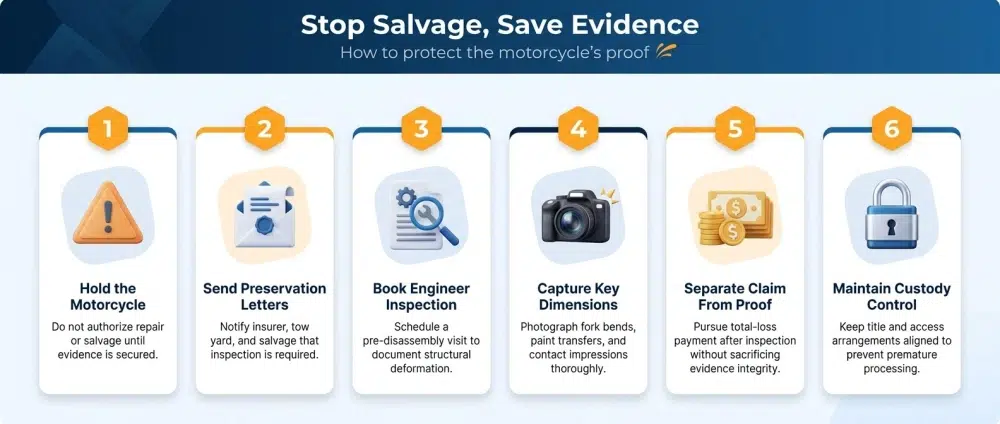
All of this dimensional information is destroyed when a salvage yard processes the motorcycle or a repair facility begins disassembly. The engineer’s inspection must occur before either event. Coordinating that inspection promptly after a crash is among the most time-sensitive tasks in a motorcycle injury case.
Helmet and Gear Damage: Recording the Forces the Rider Absorbed
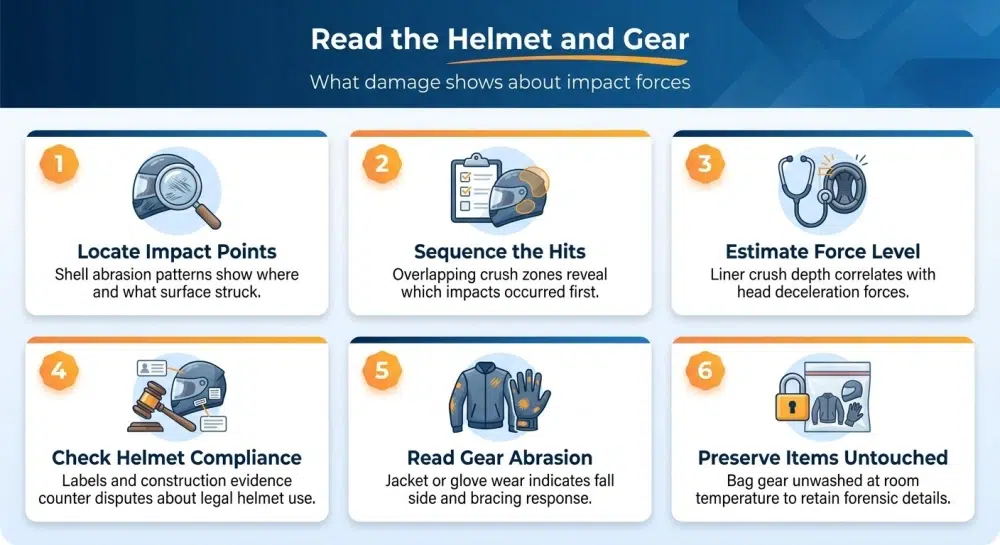
A motorcycle helmet is a calibrated energy management device. Its outer shell distributes impact force across a larger surface area, and its expanded polystyrene liner crushes irreversibly to absorb the energy before it reaches the skull. That crush is a permanent physical record of the location, angle, and approximate magnitude of each impact the helmet sustained.
What the Helmet Can Tell an Engineer
- Contact location. Abrasion and crush patterns on the shell surface identify where the helmet contacted a surface, whether that surface was the road, a vehicle, a guardrail, or a curb, and at what angle contact occurred.
- Impact sequence. Multiple crush zones on a single helmet indicate multiple impacts. Engineers can sometimes determine which impact came first by examining crack propagation patterns and the way earlier abrasions are partially overlaid by later ones.
- Force magnitude estimate. The depth and area of liner crush correlate with the deceleration forces the head experienced. This information is relevant in traumatic brain injury cases where the defense disputes whether a significant head impact occurred.
- Helmet compliance. California Vehicle Code § 27803 requires riders and passengers to wear helmets that comply with federal safety standards.[7] If helmet use is disputed, an engineer can examine the certification markings and construction of the preserved helmet. That information is gone once the helmet is discarded.
Riding gear tells a complementary story. A leather jacket with heavy abrasion across the left shoulder and sleeve indicates the rider fell to the left. Gloves with palm abrasion record the instinctive outstretched-arm bracing response that frequently produces wrist fractures. Preserving gear in a labeled bag, unwashed and at room temperature, preserves that physical record.
For riders who are transported directly to a trauma center, gear is often removed at the scene or in the emergency department. A family member or friend who can retrieve and preserve that gear on the day of the crash performs a task that cannot be undone later.
Evidence That Vanishes Fastest at Irvine Intersections and Freeway Scenes
Not all evidence degrades at the same rate, and local geography affects how quickly certain categories are lost. Several factors specific to the Irvine area accelerate that loss.
High-volume arterials such as Culver Drive, Jeffrey Road, and Jamboree Road carry thousands of vehicles daily. Tire marks from a morning collision may be partially obscured by midday commute traffic before investigators arrive. Caltrans District 12 maintains freeway surfaces on the I-405 and I-5 corridors on active sweeping and patching schedules, meaning gouge marks that are clearly visible on the day of a crash may be gone within the week. Businesses near the Irvine Spectrum, along Von Karman Avenue, and throughout the Irvine Business Complex typically overwrite camera footage on 24 to 72-hour loops. A preservation letter delivered the afternoon of a crash captures footage that a letter sent three days later will not.
Orange County’s mild coastal climate provides some protection from rapid weather degradation. Rain events that would wash scrape marks from grooved pavement in Illinois or Texas are less frequent in Irvine, but a winter storm system arriving from the Pacific can accelerate evidence loss significantly. The road surface along SR-73 between Newport Beach and the I-5 interchange is regularly treated for safety during wet weather, and that treatment can alter surface friction characteristics that reconstruction engineers need to know.
Personal injury lawyers who handle motorcycle cases in the Irvine area consistently identify immediate scene documentation as the single most important step a rider’s family or friends can take in the first hours after a crash. Riders who are transported to an emergency facility often assume they can return to the scene later. Frequently, the most valuable physical evidence is gone before they are discharged.

Scene Documentation: Photography, Total Station Surveys, and Drone Photogrammetry
Reconstruction accuracy depends on the quality and completeness of the scene record. Three methods are used in professional reconstruction work, often in combination.
Conventional Photography
Overlapping photographs at consistent heights, with calibrated measurement scales placed adjacent to marks and components, create a scalable visual record. The most valuable photographs are taken as quickly as possible after the crash, before fluid trail evaporation, before tire marks are obscured by responding emergency vehicles, and before debris is swept. GPS metadata embedded in smartphone photographs records location and timestamp information that can be authenticated through expert testimony. California Evidence Code § 1552 addresses the authentication of photographs as writings and may be relevant when photographic evidence is contested at trial.[8]
Total Station Surveying
A total station is an optical instrument that measures horizontal and vertical angles along with distances to produce precise three-dimensional coordinates for every mark, component, and reference point on a scene. Licensed surveyors using a total station can produce a dimensionally accurate plan diagram of the crash site that engineers use to test collision scenarios in simulation software. The precision of total station data supports expert testimony foundations under California Evidence Code § 720 (qualifications of expert witnesses) and the general business-records principles in Evidence Code § 1271.[9]
Drone Photogrammetry
Unmanned aerial vehicle photography processed through photogrammetry software generates three-dimensional point-cloud models of a scene from overlapping aerial images. The resulting models can be measured to sub-centimeter accuracy and rendered for presentation to a jury. This technology is particularly useful at freeway scenes, such as collision sites along the northbound I-405 approaching the SR-55 interchange, where ground-level photography cannot fully capture the spatial relationships between marks, gore-point geometry, on-ramp curvature, and adjacent infrastructure.
Preserving the Motorcycle Before Salvage
California’s insurance regulations require insurers to process total loss claims within defined time periods, and salvage facilities operate on processing schedules that do not pause for ongoing litigation. Motorcycles declared a total loss can move from the tow yard to processing within days of the crash unless someone takes affirmative steps to stop that process.
Once a salvage facility crushes or disassembles a motorcycle, the dimensional data embedded in the fork deformation, the paint transfer on the fairing, and the contact impressions on the engine cover are permanently lost. A reconstruction engineer typically needs only a few hours at the salvage yard to complete a pre-disassembly inspection, photograph key components, and take measurements. The financial total-loss process can proceed after that inspection is complete.
A preservation letter sent to the insurer, the salvage facility, and the tow operator creates a legal notice that the motorcycle contains relevant evidence. Under California’s discovery sanctions framework, the deliberate destruction of evidence after such notice may constitute spoliation and can support adverse inference arguments at trial.[10] Sending that letter on the same day an attorney is retained, before title has transferred to the insurer, is a standard early step in motorcycle injury cases.
Riders should also know that even when the insurer takes the position that the motorcycle is beyond economical repair, the physical machine retains evidentiary value that is entirely separate from its monetary value. Accepting a total-loss payment does not automatically authorize salvage processing, but the timeline for asserting preservation rights is short.
How a Reconstruction Expert’s Conclusions Are Tested at Deposition
When a reconstruction expert submits opinions in a California personal injury case, those opinions must be disclosed under Code of Civil Procedure §§ 2034.210 through 2034.290, which govern the exchange of expert witness information before trial.[11] After disclosure, the opposing party has the right to depose the expert. Understanding how those depositions proceed helps both attorneys and injured riders evaluate the durability of reconstruction evidence before trial.
Foundation Challenges
Defense counsel will examine the basis for each opinion in detail. Was the throw-distance calculation based on measurements taken at the scene by the engineer, or derived from photographs taken by someone else? Were the drag-factor values used in speed calculations drawn from published literature appropriate to the specific road surface type and weather conditions present at the time of the crash? Did the engineer personally inspect the motorcycle, or did the inspection occur after an intervening repair? A well-prepared expert will have documented the chain of custody for every measurement and photograph relied upon.
Alternative Scenario Testing
Defense reconstruction experts frequently propose alternative collision scenarios with lower pre-impact speeds, different points of impact, or different lane positions for the motorcycle. The plaintiff’s expert will be asked whether each alternative is consistent with the physical evidence and, if not, which specific marks, measurements, or dimensional findings eliminate it. An expert who can point to a gouge mark at a specific coordinate, a yaw mark curve radius inconsistent with the proposed alternative, or a fork bend angle incompatible with the suggested impact geometry is in a much stronger position than one who relies on general impressions.
Methodology and Professional Standards
California courts apply a reliability inquiry to technical expert testimony. Reconstruction experts are typically examined on whether their methods are generally accepted within the accident reconstruction field, whether they hold relevant professional credentials such as certification from the Accreditation Commission for Traffic Accident Reconstruction (ACTAR), and whether they followed the documented methodology consistently from scene to opinion. An expert who can trace each opinion back to a measured physical datum and a published analytical method is substantially more difficult to discredit on cross-examination than one who relies on undocumented experience.

How Reconstruction Connects to Negligence and Damages Under California Law
Reconstruction evidence does not stand alone. Its purpose in a civil claim is to connect measured physical facts to the legal elements of negligence: duty, breach, causation, and damages. California Vehicle Code § 22350 requires every driver to operate at a speed that is reasonable and prudent given the existing conditions, including traffic, road surface, weather, and visibility.[1] When reconstruction establishes that a driver was traveling significantly above the speed appropriate for conditions on a congested surface street, or that a driver failed to initiate any braking before striking a motorcycle at an intersection, that finding supports the breach element of a negligence claim.
Because California applies pure comparative negligence, the reconstruction expert’s findings regarding the motorcycle rider’s speed, lane position, visibility choices, and reaction timing are equally relevant to fault apportionment. A rider who was maintaining a speed appropriate for conditions and holding a proper lane position enters comparative fault analysis from a stronger factual position than one whose speed is inconsistent with the physical evidence. This dynamic is one reason that an honest, thorough reconstruction serves a client’s interests better than an advocacy-driven one: accurate fault apportionment leads to more realistic case valuation and more effective settlement negotiation.
Recoverable damages in California motorcycle injury cases may include past and future medical expenses, lost income and diminished earning capacity, physical pain and suffering, mental anguish, physical impairment, disfigurement, and property damage, depending on the specific facts and applicable law. When a rider’s injuries prove fatal, surviving family members may bring a wrongful death claim under California Code of Civil Procedure § 377.60, and a survival action may be brought by the estate for losses the decedent suffered before death.[12] The same reconstruction evidence that establishes fault in an injury case forms the foundation of a wrongful death claim. Consulting with motorcycle accident lawyers in Irvine early preserves the ability to use that evidence before it is lost.
Your Motorcycle Crash Evidence Has a Short Window
A motorcycle injury claim can involve physical evidence that disappears within days, an insurer moving quickly to process a total loss, and legal deadlines that do not wait for a full recovery. If you or a family member was injured in a motorcycle collision in Irvine or the surrounding Orange County area, our Irvine personal injury team can help evaluate the circumstances of your case and explain your options.
This article provides general legal information, not legal advice. Every case depends on its specific facts.
References and Legal Authorities
- California Vehicle Code § 22350, Basic Speed Law – California Legislative Information
- Li v. Yellow Cab Co., 13 Cal.3d 804 (1975), Pure Comparative Negligence – CourtListener
- California Code of Civil Procedure § 335.1, Two-Year Personal Injury Statute of Limitations – California Legislative Information
- Government Code § 911.2, Six-Month Government Claims Deadline – California Legislative Information
- 49 C.F.R. Part 563, Event Data Recorders – GovInfo (Federal Register)
- California Vehicle Code § 21658.1, Lane Splitting – California Legislative Information
- California Vehicle Code § 27803, Motorcycle Helmet Requirement – California Legislative Information
- California Evidence Code § 1552, Authentication of Photographs – California Legislative Information
- California Evidence Code § 1271, Business Records Exception – California Legislative Information
- California Code of Civil Procedure § 2023.030, Sanctions for Misuse of Discovery – California Legislative Information
- California Code of Civil Procedure § 2034.210, Expert Witness Exchange – California Legislative Information
- California Code of Civil Procedure § 377.60, Wrongful Death Standing – California Legislative Information
- Lane Splitting Safety Guidelines – California Highway Patrol
- Motorcycle Safety Overview – National Highway Traffic Safety Administration (NHTSA)