





























Award-Winning Chicago IL Slip and Fall Lawyers | GoSuits

Award-Winning Chicago, IL Slip and Fall Accident Lawyers

30 Years of Experience Emblem

Slip and Fall Accident? Go Smart, GoSuits.

Get your free case estimate, takes 60 seconds.

No Fees Unless You Win*
No Hidden Administrative Fees
Fast Response Time and Available 24/7

If you slipped, tripped, or fell on someone else’s property in Chicago and got hurt, you are probably dealing with a lot at once: medical appointments, missed work, pain that does not go away on schedule, and an insurance company that may already be asking questions. GoSuits helps slip and fall accident victims across Cook County pursue the compensation they are owed from property owners, businesses, and their insurers. We handle these cases from the first call through settlement or trial, without charging anything unless we win.

Chicago’s geography creates a specific set of fall hazards. Icy sidewalks along Lake Shore Drive in January. Wet floors in the grocery stores and big-box retailers spread across the South Side and the West Side. Broken pavement on the city’s older commercial corridors. Cases here can involve landlords, retail chains, restaurant owners, building management companies, and municipalities, and sorting out who is responsible for a dangerous condition is not always straightforward. That is exactly the kind of analysis our attorneys do every day.

Hero Image
$1,900,000 Premises Liability
Litigated and Settled
$1,400,000 Premises Liability
Litigated and Settled
$1,000,000 Premises Liability
Litigated and Settled
$675,000 Premises Liability
Litigated and Settled
$450,000 Premises Liability
Litigated and Settled
The National Top 40 Under 40 Trial Lawyers Attorney At Law Magazine - Law Firm of The Month Sean Chalaki - Best Lawyers 2025 Sean Chalaki - Best Lawyers Ones to Watch 2022

Reviews And Testimonials

Why choose GoSuits as your Chicago slip and fall accident lawyer?

Slip and fall cases in Chicago live or die on evidence, and evidence disappears fast. Surveillance footage gets overwritten in 24 to 72 hours at most commercial properties. Spills get cleaned up. Icy patches get salted and sanded by morning. The property owner’s incident report gets filed away, and the maintenance logs that would show how long a hazard was ignored stay inside the building unless someone demands them. Our attorneys move quickly at the outset of every case specifically because of this. We send spoliation letters to preserve records and footage while the condition that caused your fall is still documented somewhere.

We also visit the scene. Reading a description of a fall is different from standing at the intersection of the broken sidewalk panel, seeing the gap in the lighting, or understanding how the floor plan of a store makes it impossible for a shopper to see a spill until they are already on top of it. That site knowledge shapes how we frame the case to a jury in the Circuit Court of Cook County if the insurer will not make a fair offer.

Investigating the physical condition that caused the fall is a core part of what we do. Worn floor surfaces, inadequate drainage, the absence of handrails on a staircase that should have had them, a floor mat that bunched and was never fixed. These details matter because they distinguish a hazard that was a one-time event from a hazard the property owner created or let linger. One points toward negligence more clearly than the other, and how we characterize the condition shapes the claim from the beginning.

We also look hard at what the property owner knew and when they knew it. Illinois premises liability law turns on notice: did the owner have actual knowledge of the hazard, or should they have discovered it through reasonable inspection? Prior incident reports at the same location, maintenance logs with gaps, inspection checklists that were not followed, these are the documents that establish constructive notice. Our team knows how to get them, and we know what to do with them.

Local knowledge matters in this practice area more than most people realize. Illinois follows a modified comparative fault rule, which means your recovery can be reduced if the defense claims you share some responsibility for the fall. Cook County juries have their own tendencies and expectations. The Circuit Court of Cook County runs its own calendars and motion practice. Our attorneys work in this jurisdiction regularly, and that familiarity shows in how we prepare and how we negotiate. Chicago slip and fall accident cases along busy corridors like I-290 or the commercial strips of Milwaukee Avenue or Western Avenue involve property types that come with their own liability patterns, and we know those patterns.

Contact Us Today
30+ years of combined experience

30+ years of combined experience

Our team has litigated slip and fall and premises liability cases across Cook County for years, standing beside clients through some of the most difficult recoveries they will ever face. We have handled falls in grocery stores, apartment buildings, parking garages, and public sidewalks throughout Chicago and the surrounding area, and that depth of experience shapes how we approach each new case from the first call.

No fees unless you win

No fees unless you win

We represent slip and fall accident clients in Chicago on a contingency basis. You owe us nothing unless we recover compensation for you. That means you can focus on healing and getting back on your feet without worrying about legal bills piling up while your case is pending. Our no-win, no-fee policy is straightforward and applies from the first day we take your case.

No hidden administrative fees

No hidden administrative fees

Some firms charge clients for postage, copying, filing fees, and other administrative costs that quietly reduce what you actually take home from a settlement. We do not do that. Our pricing is fully transparent with no surprise costs added after the fact. What we agree to at the start is what holds throughout the case when you work with our Chicago slip and fall accident lawyers.

Fast response time and 24/7 availability

Fast response time and 24/7 availability

Falls happen at all hours, and the days right after an injury are the most important ones for preserving evidence and getting the claim started correctly. Our intake team is available 24 hours a day, seven days a week, with free consultations at any time. We have Spanish and Farsi speakers available around the clock, and we follow up fast regardless of when you reach out about your Chicago slip and fall accident case.

Contact Us Today
No Win. No Attorney Fees*

Start Your FREE Case Evaluation!

If you need immediate assistance, do not hesitate to call Chicago IL Slip and Fall Accident Lawyers!

Call Our Lawyer

Our commitment to Chicago through events and outreach

GoSuits is active in the Chicago community beyond the cases we handle. We participate in premises safety awareness efforts across Cook County, working to help residents and business owners understand their rights and responsibilities around maintaining safe property conditions, particularly during Illinois winters when slip and fall hazards multiply across the city. We engage with neighborhood associations and community organizations in areas ranging from the South Side to the Northwest Side, sharing practical information about what to do after a fall and how Illinois law works for people who get hurt on someone else’s property.

We also support road and pedestrian safety initiatives along Chicago’s high-traffic corridors, including the commercial strips on Milwaukee Avenue, Western Avenue, and the neighborhoods surrounding the I-290 and I-90/94 interchange areas where foot traffic and vehicle traffic mix in ways that produce regular hazards. Our attorneys regularly contribute legal education content about Illinois premises liability law, the Snow and Ice Removal Act, and the rights of injured residents across Chicagoland.

We believe that people make better decisions after an injury when they understand how the legal process works, what their rights are, and what to expect. That belief drives the time we put into community education and the straightforward communication we maintain with every client throughout their case.

Affiliations & Community Involvement

  • Texas Trial Lawyers Association - Members, Sean Chalaki & Shawn S. Hashemi (Sean Chalaki serves on the Executive Board for Technology and Innovation)
  • Dallas Trial Lawyers Association - Members, Sean Chalaki & Shawn S. Hashemi
  • Illinois Trial Lawyers Association - Member, Shawn S. Hashemi
  • State Bar of Texas, Torts and Insurance Practice Section - Member, Shawn S. Hashemi
  • Dallas Association of Young Lawyers - Member, Shawn S. Hashemi
  • Phi Delta Phi Honor Society - Member, Shawn S. Hashemi, and graduate of the Dallas Bar Association Trial Academy
  • Orange County Bar Association - Member, Sean Chalaki
  • Irvine, Beverly Hills, and Frisco Chambers of Commerce - Member, Sean Chalaki
  • Network of Iranian Professionals of Orange County - Member, Sean Chalaki
  • Heritage Reimagined - Founding Member, Sean Chalaki
  • South Australian Bar Association and the Iran Central Bar Association - Member, Yasamin Moussavi
  • Turtle Rock Elementary School - Former PTA President, Sean Chalaki
  • Legal Aid - Volunteer, Shawn S. Hashemi
  • Supporters of local schools, nonprofits, and community organizations in every region we serve

How can I find a reliable slip and fall accident attorney near me?

Our Chicago Office

8 S Michigan Ave Suite 935
Chicago, IL 60603

(312) 646-4566

Open 24/7 for Emergencies

What should I bring to my first meeting with a Chicago slip and fall accident lawyer?

Bring everything you have, even if you are not sure it matters. The most useful items are any photos or video you took at the scene, the incident report if the property owner or manager filled one out, your medical records and bills from treatment so far, health insurance information, any correspondence you have received from the property owner's insurer, and a written timeline of what happened and what has happened since. If you were wearing specific footwear that day, note that too. The more concrete detail you bring, the faster we can identify what the claim involves and what needs to be preserved immediately.

What does Illinois premises liability law actually require of property owners?

Illinois premises liability law is codified in the Premises Liability Act, 740 ILCS 130, which sets a single reasonable-care standard for property owners toward people who are lawfully on the property. Before 1984 Illinois courts applied different standards depending on whether you were a paying customer, a social guest, or a licensee. The Act collapsed those distinctions. Today, if you were on the property with permission, the owner owed you reasonable care.

What “reasonable care” means depends on the specific circumstances. A grocery store that runs a self-service floor plan and generates hundreds of customer interactions per hour has a different set of obligations than a private homeowner who rarely has guests. Courts look at what the owner knew or should have known, how much time passed before something was done about it, what kind of inspection system the owner had in place, and whether the hazardous condition was something the property’s normal operations created. None of these questions have automatic answers. They get resolved through evidence.

Illinois also follows a modified comparative fault rule under 735 ILCS 5/2-1116. If you are found partly responsible for the fall, your recovery is reduced by your percentage of fault. But as long as you are less than 51 percent at fault, you can still recover. Defense attorneys push hard on comparative fault because it is one of their most effective tools. Solid evidence of how the hazard arose and how long it existed is the best counter to a comparative fault argument.

When can you actually sue over a fall on snow or ice in Chicago?

Illinois follows what courts call the natural accumulation rule. A property owner has no duty to remove snow, ice, or meltwater that accumulated naturally from the weather. The Illinois Supreme Court applied that rule in Krywin v. Chicago Transit Authority in 2010. If you slipped on ordinary snowfall or on ice that formed the way ice forms in a Chicago January, the fact that nobody shoveled is usually not enough on its own.

What changes the analysis is an unnatural accumulation: ice or snow that human activity or a defect in the property created or made worse. A downspout that empties across a walkway and freezes. A parking lot graded so meltwater runs to the bottom of a ramp and refreezes overnight. A roof or canopy that drips onto an entrance. Snow plowed into a pile that melts during the day and sends water back across the pavement after dark. Tracked-in water pooling inside an entrance because no mats were put down. Each of those is a condition somebody made, not weather.

There is a second path. A commercial property owner, landlord, or condominium association that voluntarily takes on snow and ice removal has to do it with reasonable care. Choosing to clear a lot and then doing it badly is different from never clearing it at all.

So the first question we ask about a winter fall is not whether the surface was icy. It is where that ice came from. That answer usually lives in the physical evidence, photographs taken before the thaw, drainage and grading at the spot, the snow removal contract and its service logs, weather records for the days before the fall. It is also the reason winter cases reward calling early. Once the ice melts, the condition that would have proved your case is gone.

Who bears responsibility when someone falls in Chicago?

Property owners are the obvious defendant, but “property owner” covers a lot of ground in Chicago, and the right defendant is not always the person who holds title to the building. Large commercial properties are often managed by a separate company under contract. Retail leases frequently divide maintenance obligations between the landlord and the tenant. A grocery store chain may own the national brand but operate through a franchise structure. An apartment building may be owned by an LLC that shares management duties with a property management company.

Getting the defendant right matters because insurance coverage and available assets vary significantly between parties. Our attorneys pull the deed, the lease, the management agreement, and the liability insurance information early in every case to make sure we are pursuing the right parties. Filing against the wrong entity, or missing a party that carries the actual insurance, can dramatically affect what a case is worth at the end.

For falls on public sidewalks or city-owned property, the City of Chicago or another municipal entity may be the responsible party. Those claims run under the Local Governmental and Governmental Employees Tort Immunity Act, 745 ILCS 10, which gives public entities defenses a private property owner does not have and cuts the filing deadline to one year from the date of injury under Section 8-101. Illinois does not require a separate notice of claim before suing a city or a park district. That requirement was repealed, and what remains is the shortened deadline. The CTA is the exception, because Section 2-101 places it outside the Act entirely. A fall at a CTA station, on a platform, or on a CTA vehicle requires written notice within six months under 70 ILCS 3605/41 along with filing within one year. If your fall happened on a sidewalk, a city-owned building, a Park District property, or CTA property, that needs to be identified in the first weeks.

After a fall in Chicago, what should you do first?

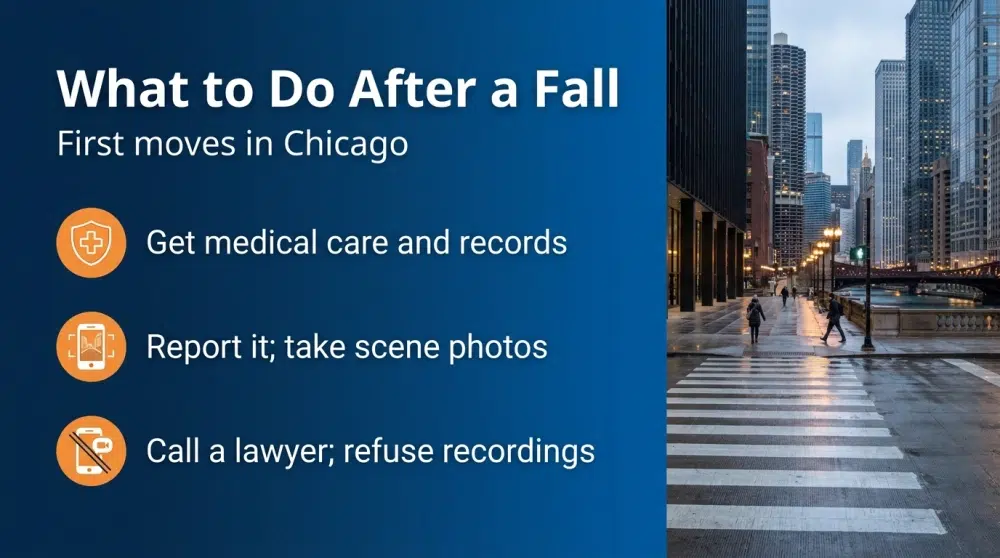
Get medical attention. That is first. Even if you think the injury is minor, a documented medical evaluation creates the record that connects your injuries to the fall. Gaps in medical treatment are one of the first things defense attorneys look for when they are trying to minimize a claim.
What to Do After a Fall — First moves in Chicago infographic

Report the fall to whoever is in charge of the property before you leave if you can. Ask for a copy of any incident report. Get the name and contact information of whoever you speak with. If there are witnesses, get their names and numbers too. Photograph the condition that caused the fall, the surrounding area, any wet floor signs or the absence of them, poor lighting, broken surfaces. Do all of this before anything gets cleaned up.

Do not give a recorded statement to the property owner’s insurance company. You are not required to, and doing so before you have legal guidance is consistently harmful to claims. Insurers conduct recorded statements specifically to lock in statements they can use against you later. Politely decline and tell them you will have your attorney be in touch.

Preserve your footwear and clothing from the day of the fall. These items can be relevant physical evidence. Do not wash them.

Contact an attorney as early as possible. Surveillance footage at commercial properties in Chicago is typically retained for 30 to 72 hours before it gets automatically overwritten. The window to preserve it is short, and it often requires a formal preservation demand sent directly to the property. That is something an attorney can do the same day you call.

What evidence decides a Chicago slip and fall claim?

The core legal question in most of these cases is notice: did the property owner know about the hazardous condition, or should they have known about it through reasonable inspection? Notice determines whether there was a breach of duty, and breach is where liability lives.

Key Evidence That Wins — Chicago slip-and-fall cases infographic

Surveillance footage is often the most valuable piece of evidence because it can show how long a spill sat on the floor before the fall, whether any employee walked past it without addressing it, and the condition of the area at the moment of impact. Getting a spoliation letter to the property within hours of the fall is frequently the single most important step in the early investigation.

Maintenance logs and inspection checklists are the second category. Most commercial properties have written policies about how often employees are supposed to inspect the floor or conduct safety walks. When the logs show those inspections were not conducted, or show gaps that correspond to the time of the fall, that is constructive notice in documentary form. We request these records early through formal discovery once a lawsuit is filed, and we send preservation demands before filing to prevent them from disappearing.

Prior incident reports at the same location matter a lot. If other customers have fallen at the same display, the same stairwell, or the same entrance, those records go directly to whether the owner had actual notice of a recurring problem. In Illinois, evidence of prior substantially similar incidents is generally admissible to establish notice. Our attorneys look for that history in every case.

For a deeper look at how actual notice and constructive notice work in Illinois premises liability claims, our knowledge base article on constructive vs. actual notice in premises liability walks through the legal framework in detail.

How are slip and fall claims valued in Cook County?

Illinois lets slip and fall victims pursue economic damages, noneconomic damages, and in limited circumstances, punitive damages. Economic damages are the measurable financial losses: medical bills (both the amounts billed and the amounts actually paid can be relevant under Illinois law), lost wages, lost earning capacity, and out-of-pocket costs for things like transportation to medical appointments or home care assistance during recovery. Noneconomic damages cover pain and suffering, emotional distress, loss of enjoyment of life, and disfigurement.

What drives the number in a Cook County slip and fall case? The severity and permanence of the injury is the biggest factor. A broken hip that requires surgery and months of physical therapy, or a traumatic brain injury from a head strike on a hard floor, produces a different valuation than a sprained ankle that resolves in a few weeks. The clarity of liability matters too. A case where surveillance footage shows the spill sitting on the floor for 45 minutes with two employees walking past it is worth more than a case where the fall happened seconds after a spill and no one had any opportunity to address it. The amount of available insurance coverage also shapes what is recoverable as a practical matter.

Beyond the gross recovery from the at-fault insurer, our team negotiates with hospitals, ER groups, and medical-lien holders at settlement to reduce what you actually owe out of the award. The Illinois Health Care Services Lien Act, 770 ILCS 23, governs how medical liens work in Illinois and provides mechanisms for reducing those liens. The result is that more of the money you recover actually reaches you rather than flowing straight back to providers.

How do insurers handle slip and fall claims in Illinois?

Property owners and their general liability insurers do not approach these claims the same way every time, but there are patterns worth knowing about. Early low offers are common, particularly in the first few weeks after a fall when the full scope of your injuries may not be clear yet. Accepting a settlement before you have reached maximum medical improvement almost always means leaving money on the table.

Comparative fault arguments are the other consistent tactic. The insurer will look for anything that suggests you were not paying attention, that your footwear was inappropriate, that you were distracted, or that the hazard was “open and obvious” and you should have avoided it. Illinois courts have developed significant case law on the open-and-obvious doctrine, and its application is more nuanced than insurers sometimes suggest in early negotiations.

Delaying the investigation is also common. The longer a claim sits before an attorney is involved, the more likely it is that crucial evidence has been lost. Property owners are not required to retain surveillance footage indefinitely, and many systems automatically overwrite in a day or two. Maintenance logs can be incomplete or conveniently unavailable if no one demanded their preservation at the outset. Getting an attorney involved early closes those gaps before they open.

What is the filing deadline for a slip and fall case in Illinois?

The general statute of limitations for personal injury claims in Illinois is two years from the date of the injury, under 735 ILCS 5/13-202. Missing that deadline means losing the right to recover, regardless of how strong the underlying claim is. Two years sounds like a lot of time, but building a solid slip and fall case takes longer than most people expect. Medical treatment needs to stabilize before damages can be fully documented. Investigation, evidence preservation, and expert consultation all take time. Negotiating with an insurer, and filing suit if those negotiations fail, takes more time still.

Claims against government defendants are on a shorter clock, and the rule is not what most people assume. Illinois repealed the old requirement that you serve a notice of claim on a municipality before filing suit. What replaced it is a straight one-year statute of limitations under 745 ILCS 10/8-101 for claims against the City of Chicago, the Chicago Park District, a county, or a school district. One year from the date of injury, not two. The CTA is governed separately under 70 ILCS 3605/41, which does require written notice within six months, stating your name and address, the date, time, and location of the fall, the nature of the injury, and the hospital and physicians who treated you, along with filing suit within one year. Missing a CTA notice or a one-year deadline ends the claim no matter how strong the underlying case is.

Our Chicago personal injury team can evaluate your situation and tell you exactly what timelines apply to your case. The consultation is free, and knowing where you stand on the deadline is the first thing to confirm.

Common fall locations across Chicago and Cook County

Grocery stores and big-box retailers generate a large share of the slip and fall cases we handle. The produce section, the deli area, the entrance on a rainy day, the spot near the refrigerated cases where condensation drips onto the floor. These are not freak events; they are foreseeable conditions built into the daily operation of a self-service retail environment. Illinois courts have recognized that stores operating this kind of model carry a heightened duty to monitor for the conditions their own operations create.

Apartment buildings, particularly the older two-flat and three-flat buildings that define the residential fabric of neighborhoods like Logan Square, Pilsen, Bridgeport, and Avondale, produce significant numbers of fall cases. Deteriorating back porches, broken interior stairwells, and inadequate lighting in common areas are recurring issues, and landlord liability for those conditions turns on notice: what did the landlord know, and what did they do about it? Winter falls at these buildings follow a different rule. Ice that simply formed on a front step is a natural accumulation, and a landlord who did nothing usually owes nothing. What creates a claim is ice traced to the building itself, a leaking gutter over the stairs, a porch that drains toward the treads, or a landlord who cleared the walk and left a ridge behind.

Parking lots and garages are another frequent location. Poor lighting, uneven pavement surfaces, and unmarked speed bumps and curb transitions account for a steady share of these cases. Lots are also where unnatural accumulation claims are strongest in winter, because so much of the ice in them is made rather than fallen: plow piles that melt and run back across the pavement, drainage that sends water to a low point near an entrance, and refreezing in the shaded bays of a structure. Responsibility for these spaces can fall on building owners, property management companies, the businesses that lease the space, or the snow removal contractor whose service logs show what was done and when.

Public sidewalks along the city’s commercial corridors, on the blocks around transit stations, and adjacent to construction zones generate their own category of claims. The frost-heave cycle Chicago endures through the winter months cracks concrete and creates elevation changes that are genuinely difficult to see. Who is responsible depends on where the sidewalk is and whether the adjacent property owner or the city bears the maintenance obligation under municipal code.

If you were injured in a fall anywhere in Cook County and you are not sure who is responsible or whether a claim makes sense, contact our team for a free consultation. There is no charge for the conversation, and we will give you a direct assessment of what we see.

Chicago, Illinois slip and fall accident lawsuit steps and process

Collect all available evidence after a slip and fall accident

Evidence preservation in a Chicago slip and fall case starts within hours of the fall. We send preservation demands to the property owner or manager immediately to secure surveillance footage before it is overwritten, and we request maintenance logs, inspection checklists, and prior incident reports that document the condition of the area where you fell. Our attorneys often visit the scene directly to photograph and document the hazard while it still exists in the condition that caused the injury.

Write a demand letter to the insurance company

Once your medical treatment has stabilized and we have a complete picture of your economic losses, we prepare a formal demand letter to the property owner’s general liability insurer. The demand documents your injuries, the evidence of the property owner’s negligence and notice of the hazardous condition, your medical expenses and lost wages, and your noneconomic damages. We also address any applicable medical liens and lien reduction obligations under the Illinois Health Care Services Lien Act, 770 ILCS 23, as part of the demand package.

Negotiate a settlement with the insurance adjuster

General liability adjusters handling slip and fall claims in Cook County use their own valuation methods, and their opening offers frequently do not reflect what the claim is actually worth. We negotiate from the documented evidence, the permanence and severity of your injuries, and the strength of the notice and breach of duty case we have built. We advise you honestly about what offers we think are reasonable and what we believe a jury would likely do with the case if it went to trial in the Circuit Court of Cook County.

File a slip and fall accident lawsuit in Cook County

If negotiations do not produce a fair result, we file suit in the Circuit Court of Cook County. The complaint sets out the duty the property owner owed you, how they breached that duty by allowing a known or knowable hazardous condition to exist, how that breach caused your fall, and what damages you suffered as a result. Filing also triggers formal discovery mechanisms that allow us to compel the production of documents the property owner may have been reluctant to provide voluntarily.

Begin the discovery process in a lawsuit

Discovery in a Cook County slip and fall case typically includes written interrogatories to the property owner, document requests targeting maintenance records, inspection logs, prior incident reports, and insurance information, and depositions of the property’s employees, managers, and any witnesses to the fall. In cases involving complex property configurations or disputed liability, we may retain qualified professionals in accident reconstruction or premises safety to analyze the condition and prepare reports for use at trial or in settlement negotiations.

Mediate the case before trial

Many Cook County slip and fall cases resolve through mediation before they reach a courtroom. A mediator, typically an experienced attorney or retired judge, works with both sides to find a settlement number both can accept. Mediation is non-binding, which means you are not required to accept any outcome you do not want. It is frequently productive, particularly when both sides have done the evidentiary work and have a realistic sense of where a jury might land. We prepare thoroughly for every mediation session and do not walk in without a clear floor number agreed on with you in advance.

Go to trial in a Chicago slip and fall accident case

If mediation does not resolve the case, we go to trial in the Circuit Court of Cook County. Our trial team presents the evidence to a judge or jury: the surveillance footage, the maintenance records, the testimony of witnesses and qualified professionals, your own account of how the fall happened and what the recovery has cost you. Illinois’s modified comparative fault rule means the defense will try to pin some responsibility on you, and our trial preparation addresses that directly. We have tried these cases to verdict in Cook County and we are comfortable doing it when the alternative is an inadequate settlement.

Finalize a slip and fall accident settlement

When a settlement is reached, whether through negotiation, mediation, or during trial, we work through the settlement documents with you to confirm the terms are clear and that every obligation is properly addressed. Critically, we negotiate the reduction of outstanding medical liens with hospitals, ER physician groups, and health insurers at this stage under the Illinois Health Care Services Lien Act so that the money you actually receive is not immediately absorbed by unpaid bills. Our goal is that the settlement figure on paper translates into dollars that reach you.

Appeal a verdict if a legal error affected the outcome

If a trial verdict goes against you due to a legal error, such as an improper jury instruction, an evidentiary ruling that should have gone the other way, or a procedural mistake that affected the outcome, Illinois appellate procedure provides a path to challenge it. Appeals in Illinois civil cases go to the Illinois Appellate Court, and then potentially to the Illinois Supreme Court. We evaluate appellate options honestly when the circumstances warrant it and advise you plainly about the likelihood of success before recommending that path.

Talk to a Lawyer. NO WIN. NO ATTORNEY FEES.*

Call Us Now

Meet our Chicago slip and fall accident attorneys

It's time we do things the SMART way rather than the hard way
“Hire the Smart Suits for Your Lawsuits”

We'll Evaluate Your Case - Totally Free

(312) 646-4566

Frequently asked questions

How long do I have to file a slip and fall lawsuit in Illinois?

The general filing deadline is two years from the date of injury under 735 ILCS 5/13-202. That applies to a claim against a private property owner, a landlord, or a business. If the fall happened on property owned or controlled by the City of Chicago, the Chicago Park District, or a county, the deadline drops to one year under 745 ILCS 10/8-101. If it happened on CTA property, written notice is due within six months under 70 ILCS 3605/41 and suit must be filed within one year. Confirm which of these applies to you early, because the one-year deadlines can pass while a person is still in treatment.

More Questions?

Call Our Lawyer

Sources Reviewed for This Page

Statutory and agency materials consulted when preparing the legal and factual statements on this page. Links open external government and bar resources.

Reviewed by Shawn Hashemi , Attorney · Jurisdiction: Cook County, Illinois

CONTACT US TODAY - 24/7 (312) 646-4566

Limited time to file your claim. Don't wait!

We’re here to help you get the compensation you deserve.

No Win. No Attorney Fees*

Start Your FREE Case Evaluation!