






























What areas in Cook County and greater Chicago do our truck accident lawyers serve?
If you were injured in a commercial truck crash anywhere in the Chicago area, GoSuits is ready to help. Our legal team serves clients throughout Cook County and the surrounding region, from the dense expressway corridors of the city proper to the suburban communities beyond the county line.
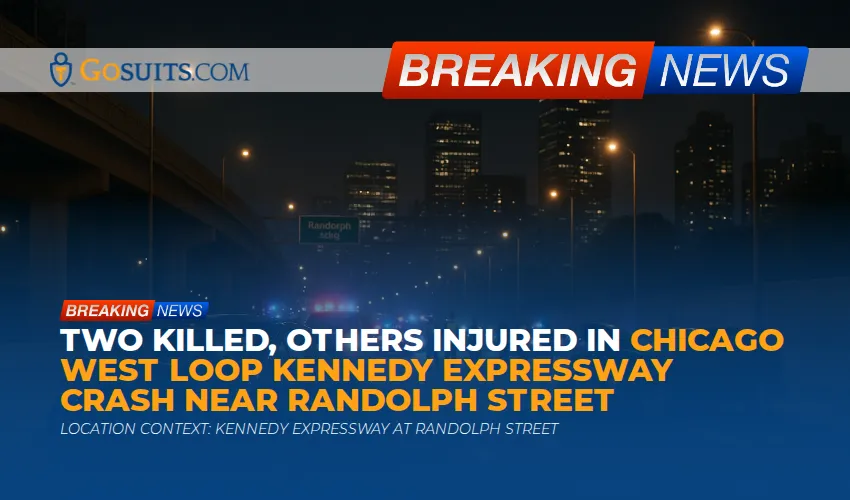
We understand that truck crashes in Chicago happen on some of the most dangerous stretches of road in the country: on I-90/94 through the West Loop, on I-290 near the Eisenhower Expressway, on I-57 and I-55 in the south suburbs, and on Lake Shore Drive where commercial vehicles sometimes operate in violation of local ordinances. No matter where your crash occurred, we bring local knowledge of Chicago’s roads, courts, and cargo corridors to your case.
Areas we commonly serve
- City of Chicago neighborhoods: West Loop, Pilsen, Hyde Park, Wicker Park, Lincoln Park, Bridgeport, South Side, North Side, Logan Square, Bronzeville
- North and northwest suburbs: Evanston, Skokie, Des Plaines, Rosemont, Schaumburg, Arlington Heights, Palatine
- West suburbs: Oak Park, Cicero, Berwyn, Elmhurst, Lombard, Downers Grove, Aurora, Naperville
- South suburbs: Joliet, Harvey, Calumet City, Orland Park, Tinley Park, Oak Lawn, Chicago Heights
- Far northern communities: Waukegan, North Chicago, Gurnee, Lake County
- Satellite communities: Elgin, Naperville, Joliet, Cicero, Waukegan
Wherever your crash happened in the Chicago area, we’re a call away and prepared to step in immediately when the evidence window is still open.
What types of truck accident cases do our Chicago lawyers handle?
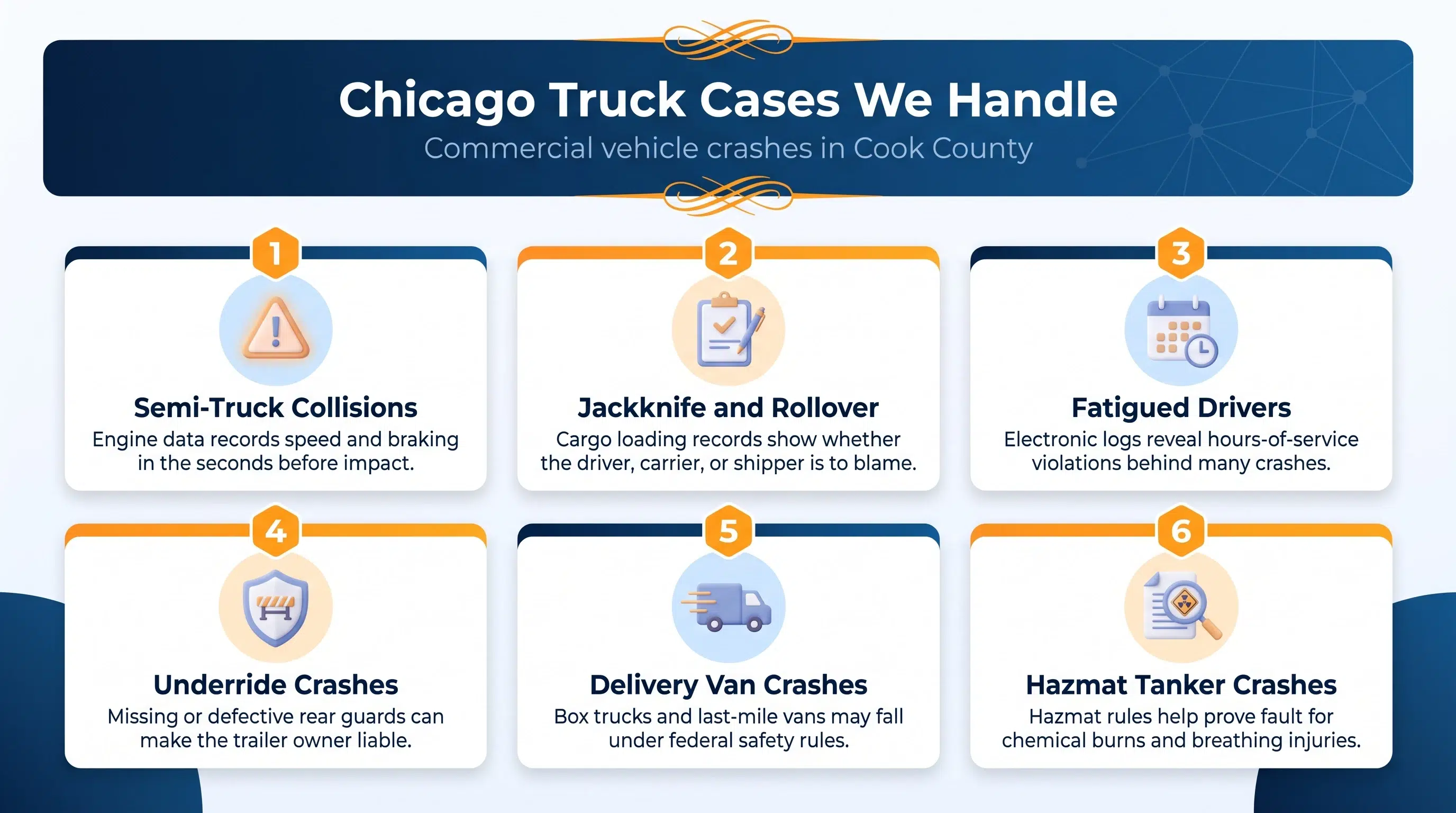
Commercial truck crashes cover a wide range of fact patterns, vehicle types, and legal theories. Below is an overview of the most common types of cases our team handles in Chicago and Cook County.
Semi-truck and tractor-trailer collisions
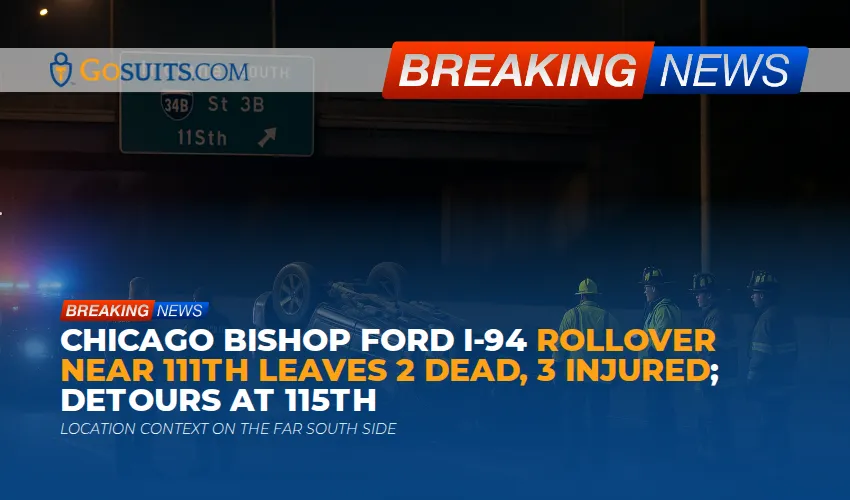
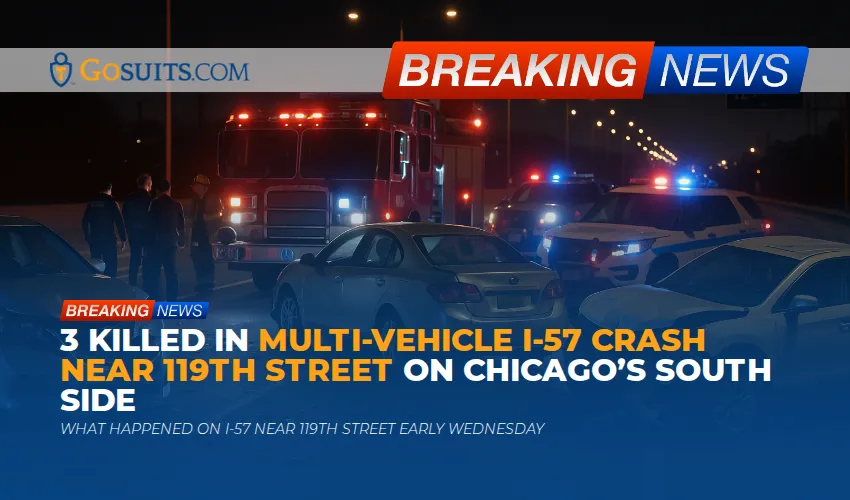
Fully loaded semi-trucks can weigh up to 80,000 pounds under federal weight limits set by the Federal Highway Administration. When a vehicle that size strikes a passenger car, the resulting injuries are often catastrophic or fatal. Our team moves immediately to preserve the truck’s Electronic Control Module (ECM) data, which records speed, braking, and throttle inputs in the seconds before impact. We also subpoena the driver’s hours-of-service logs, which under FMCSA regulations at 49 CFR Part 395 must document driving time, rest periods, and duty status, to identify whether fatigue or log falsification contributed to your crash. We have handled semi-truck collisions on every major Chicago expressway, including the Kennedy (I-90), the Dan Ryan (I-94), the Eisenhower (I-290), and the Bishop Ford Freeway (I-94 south).
Jackknife and rollover accidents
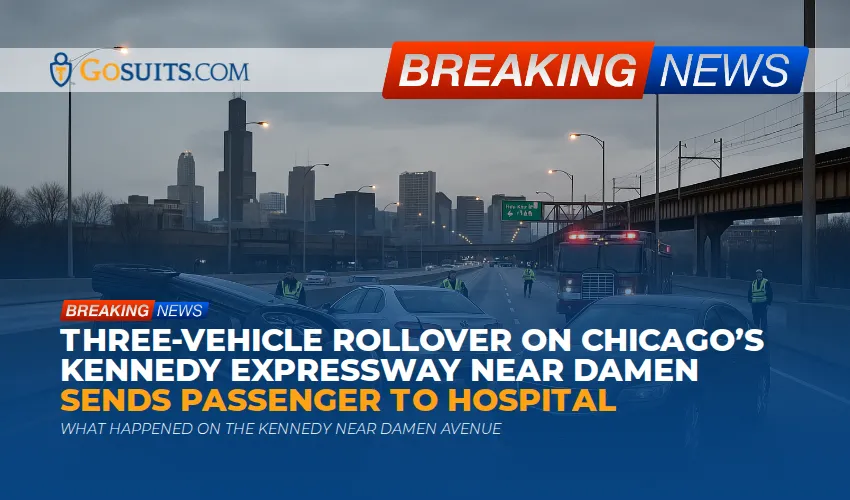
Jackknife crashes occur when a trailer swings outward relative to the cab, often due to hard braking, slippery pavement, or improperly loaded cargo. Rollovers frequently result from excessive speed on curves, top-heavy loads, or driver error on ramps and interchange loops. Both crash types cause extreme damage to surrounding vehicles. Our attorneys work with accident reconstruction professionals to analyze the physical evidence, cargo loading records, and route data to determine whether the driver, the carrier, or the cargo shipper bears responsibility.
Fatigued and hours-of-service violation crashes
According to the Federal Motor Carrier Safety Administration, drowsy driving is a contributing factor in a significant percentage of large-truck fatal crashes nationally. FMCSA rules under 49 CFR Part 395 limit commercial drivers operating property-carrying vehicles to 11 hours of driving after 10 consecutive hours off duty, with a 14-hour on-duty window per shift. Violations of these limits are a form of negligence per se under Illinois law, meaning a documented HOS violation can establish liability without requiring additional proof of fault. Our team is experienced in subpoenaing electronic logging device (ELD) records, paper log books, and carrier dispatch records to prove HOS violations in Cook County Circuit Court.
Underride collisions
Underride crashes happen when a passenger vehicle slides beneath the rear or side of a trailer. These collisions often cause catastrophic head, neck, and brain trauma because the occupant compartment of the car is compromised at roof level. The National Highway Traffic Safety Administration has studied underride guard standards for decades, and FMCSA regulations require rear underride guards on trailers. When a guard is absent, defective, or improperly maintained, the trailer owner and carrier may face product liability and negligent maintenance claims in addition to ordinary negligence. Our attorneys evaluate the guard’s compliance with FMCSA standards and document defects for use in litigation.
Delivery van and last-mile truck crashes
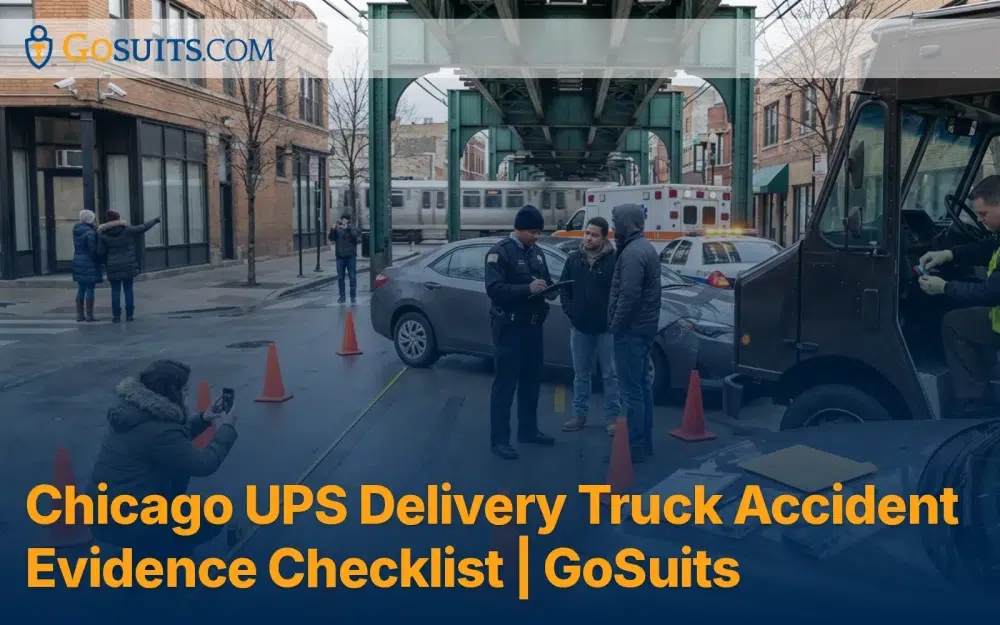
Not every commercial vehicle crash involves an 18-wheeler. Delivery vans, box trucks, and last-mile carriers operate throughout Chicago’s neighborhoods every day, and crashes involving these vehicles are increasingly common in denser areas like the West Loop, Wicker Park, and Lincoln Park. Even medium-duty vehicles weighing 10,001 pounds or more may be subject to FMCSA regulations depending on the type of cargo and the carrier’s operating authority. We assess whether federal or Illinois commercial vehicle rules apply and pursue claims against the carrier, the vehicle owner, and the cargo shipper where appropriate.
Hazardous materials and tanker truck accidents
Tanker trucks and vehicles transporting hazardous materials are subject to additional federal regulations under 49 CFR Parts 171 to 180, which govern hazmat labeling, loading, and transport documentation. A crash involving a leaking tanker can cause chemical burns, respiratory injuries, and long-term health consequences beyond the immediate impact trauma. Our team coordinates with safety professionals and engineers to document HAZMAT compliance failures and pursue compensation for the full scope of your injuries, including future medical monitoring costs.
Broker and carrier liability
In many truck accident cases, the driver works for a carrier that was hired by a freight broker. Following the Seventh Circuit’s analysis of broker liability and the ongoing development of federal preemption doctrine under 49 U.S.C. Section 14501, broker liability claims in Illinois require careful analysis of the broker’s role in selecting the carrier, vetting the driver, and monitoring safety compliance. The Appellate Court of Illinois addressed motor carrier liability and agency relationships in cases like Brettman v. M&G Truck Brokerage, Inc., 2019 IL App (2d) 180236, where the court analyzed the extent of a broker’s responsibility for a carrier’s negligence. Our attorneys know how to identify all potentially liable parties in the freight chain and bring claims against each one.
What makes truck accident cases in Illinois different from ordinary car crash claims?
Illinois truck accident cases are more complex than typical motor vehicle claims for several reasons, and understanding those differences can affect the value of your recovery.
First, commercial trucks are federally regulated. The FMCSA, operating under authority delegated by Congress through 49 U.S.C. Chapter 311, issues safety regulations covering driver qualifications (49 CFR Part 391), hours of service (49 CFR Part 395), vehicle inspection and maintenance (49 CFR Part 396), and cargo securement (49 CFR Part 393). A violation of any of these regulations can support a negligence per se theory under Illinois law, which removes the need to prove that a reasonable person would have acted differently.
Second, the Illinois Vehicle Code at 625 ILCS 5/15-101 et seq. imposes additional state-law requirements on commercial vehicles, including weight limits, overwidth load permits, and lighting standards. When a truck violates these state requirements and causes a crash, those violations are also relevant to the liability analysis.
Third, Illinois follows a modified comparative fault rule under 735 ILCS 5/2-1116. Under this standard, a plaintiff who is found to be 51% or more at fault for their own injuries may not recover any damages at all. This differs from California’s pure comparative negligence rule, which allows partial recovery regardless of fault percentage. In a Chicago truck accident case, the defense will work hard to shift blame onto the injured driver. Our team builds a thorough liability case from the outset to keep that assigned percentage as low as possible.
Fourth, trucking companies typically carry large commercial insurance policies, sometimes with limits of $1 million or more required by FMCSA regulations at 49 CFR Part 387. That insurance means more money is available to compensate you, but it also means a professional adjusting team and defense counsel are assigned to your claim from day one. Having dedicated legal representation from a team familiar with these dynamics makes a real difference in the outcome.
Choosing the right Chicago truck accident attorney
Selecting legal representation after a serious truck crash is one of the most consequential decisions you will make during your recovery. You need more than a general personal injury firm that occasionally handles truck cases. You need attorneys who know federal motor carrier safety regulations, understand ECM data interpretation, and have experience litigating against large carriers and their insurers.
When evaluating a firm, ask whether they have handled FMCSA-regulated trucking cases before. Ask how they preserve time-sensitive digital evidence like ECM data and ELD records. Ask whether they work with accident reconstruction professionals and biomechanical engineers. And ask whether they have a trial team prepared to take your case to verdict if the carrier’s insurer refuses to negotiate in good faith.
At GoSuits, members of our team have received recognition from groups including TopVerdict, National Trial Lawyers, Super Lawyers, and Best Lawyers, reflecting their standing in the Illinois personal injury and trial bar. Our trial team has tried cases to verdict in Cook County Circuit Court when insurers have refused to make reasonable offers. We bring that same commitment to every Chicago truck accident case we accept.
Most reputable firms, including GoSuits, take truck accident cases on a contingency fee basis. That means you pay nothing upfront and owe no fee unless we recover compensation for you.
What does Illinois law say about damages in a truck accident case?
Illinois permits injured plaintiffs to recover two broad categories of damages in a personal injury or wrongful death case.
Economic damages include all quantifiable financial losses: past and future medical expenses, lost wages, loss of future earning capacity, property damage, and the cost of assistive devices or home modifications required by a permanent disability. In catastrophic truck crash cases, future care costs can extend over decades, and accurately projecting them requires collaboration with life care planners and economic analysts.
Noneconomic damages cover pain and suffering, emotional distress, disfigurement, and loss of normal life. Illinois does not currently cap noneconomic damages in personal injury cases following the Illinois Supreme Court’s decision in Lebron v. Gottlieb Memorial Hospital, 237 Ill. 2d 217 (2010), which struck down a prior statutory cap as unconstitutional. That ruling means there is no ceiling on the noneconomic portion of your recovery, but the amount is still tied to the facts of your case and the persuasiveness of your presentation at trial or in mediation.
In cases involving willful and wanton conduct, such as a carrier that knowingly dispatched a driver it knew had falsified HOS logs or had a disqualifying safety record, Illinois courts may also award punitive damages under 735 ILCS 5/2-1115. Punitive damages are not available in every truck crash case, but when the evidence of intentional misconduct is strong, they can significantly increase a defendant’s exposure and drive settlements upward.
The statute of limitations for personal injury claims in Illinois is two years from the date of injury under 735 ILCS 5/13-202. Wrongful death claims must be filed within two years of death under the Illinois Wrongful Death Act, 740 ILCS 180/2. Missing these deadlines generally bars your claim entirely, regardless of how strong the merits are. If a government entity or municipal vehicle is involved, even shorter notice deadlines may apply.
How GoSuits Chicago truck accident lawyers can help you
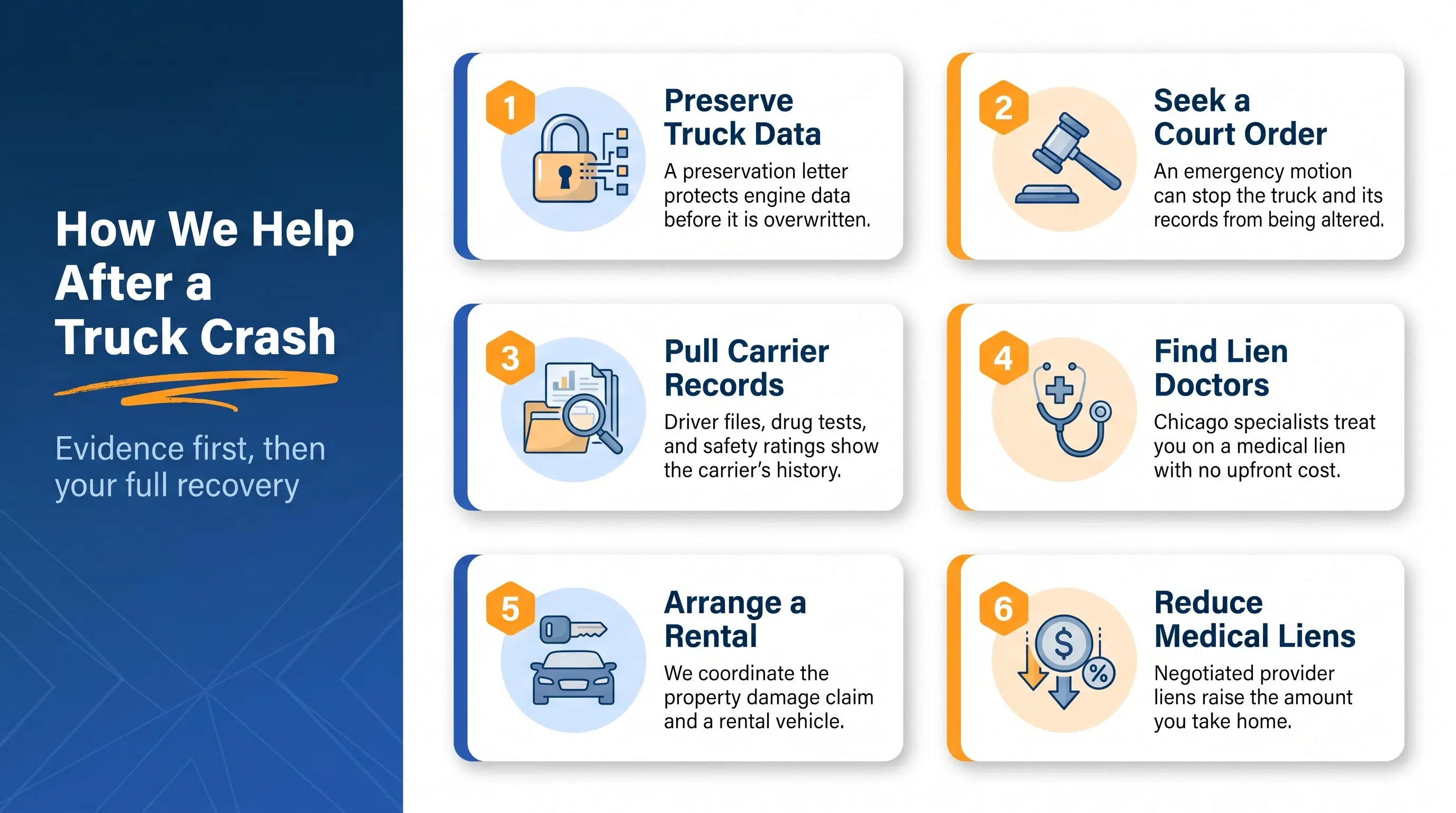
The moment you call GoSuits after a Chicago truck accident, we begin working. Our first priority is preserving evidence before it disappears. Commercial trucks are equipped with Electronic Data Recorders (EDRs) and Engine Control Modules (ECMs) that store pre-crash speed, braking, and throttle data, but that data can be overwritten within days if the truck returns to service. We send a preservation letter to the carrier and, when necessary, file an emergency motion for a court order preventing destruction or alteration of the vehicle, its data, and its maintenance records. We also secure driver qualification files, drug and alcohol testing records, and the carrier’s FMCSA safety rating history from SAFER, the Safety and Fitness Electronic Records system maintained by the Department of Transportation.
While we build the liability side of your case, we make sure your medical needs are covered. We connect you with Chicago-area doctors and rehabilitation specialists who treat on a medical lien, meaning there is no upfront cost to you for your care. You receive treatment from qualified physicians while we work on recovering the money needed to pay those bills. When your case resolves, we negotiate each medical lien with the provider, often reducing the outstanding balance, so that the net amount you take home is as large as possible after all bills and fees are settled.
If your vehicle was damaged or totaled, we coordinate with the carrier’s insurer on the property damage claim and help arrange a rental vehicle so your daily life is disrupted as little as possible. Every piece of the recovery puzzle, from your medical care to your transportation needs to the legal claim itself, is handled by our team so you can focus on getting better.
Throughout the case, you’ll have direct access to your attorney, real-time updates on your file, and a team that returns calls and messages promptly. If the trucking company’s insurer refuses to offer fair compensation, our trial team is fully prepared to take your case before a Cook County jury. We don’t settle cases for less than they are worth simply because litigation is inconvenient, and the carriers’ insurance adjusters know it.
When you work with GoSuits, you’re partnering with a legal team that treats your case with the same intensity we would want applied to our own families. Ready to talk? Schedule a free consultation with our Chicago truck accident attorneys today.
Injured in a different type of accident? Our practice also covers Chicago wrongful death claims, Chicago car accident cases, and Chicago brain injury cases caused by commercial vehicle crashes and other serious collisions. If you want a full overview of our practice, visit our Chicago personal injury team page.