
































Why the first 72 hours after an Irvine truck crash matter more than most people realize?
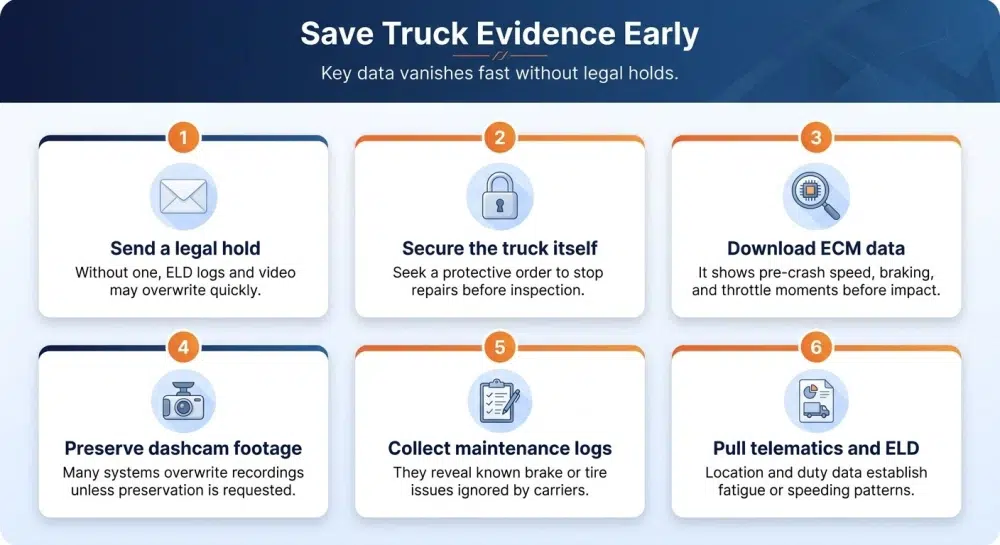
A commercial truck generates records that no passenger car produces. The electronic logging device in the cab records the driver’s duty status, rest periods, and location in real time. Federal regulations under 49 CFR Part 395 require carriers to preserve ELD data, but those regulations also allow carriers to follow standard retention schedules once a legal hold demand is not in place. Without a written preservation demand sent immediately after a crash, data that could show the driver was violating hours-of-service rules when the collision happened may simply be overwritten.
The engine control module is different from the ELD. It captures pre-crash speed, braking inputs, throttle position, and in some systems, steering data from the seconds before impact. That data sits on the truck itself. Once the truck goes back into service or gets repaired, clean access to a pre-collision snapshot becomes difficult or impossible.
Dashcam footage from the truck’s forward-facing camera, and in newer fleets from side and interior cameras, runs on a loop. Most systems overwrite footage after 48 to 72 hours unless someone tells the carrier in writing to preserve it. Fleet telematics systems, which track vehicle location, speed, and hard-braking events, can also reset on short cycles.
Carrier maintenance records are a separate category. Under 49 CFR Part 396, carriers must conduct and document systematic inspections. Those records can show whether a brake deficiency or tire problem that contributed to the crash was known to the carrier and ignored. Carriers are not motivated to volunteer those records. We send preservation demands, and in serious cases we file motions for a protective order preventing the truck from being repaired or put back on the road before it can be inspected.
This is why the clock on a truck accident investigation does not follow the same rhythm as a standard auto claim. The two-year filing deadline under California Code of Civil Procedure section 335.1 is real, but the practical evidence deadline is measured in days, not years.
Who can actually be held responsible?
In a rear-end collision between two passenger cars, there is usually one driver whose negligence caused the crash. Truck accidents are different. The driver may be negligent, but the driver is frequently not the only responsible party.
The motor carrier, the company that owns or leases the truck and employs or contracts with the driver, has its own obligations under federal law. Under 49 CFR Part 391, carriers must verify a driver’s licensing, physical fitness, safety record, and prior employment history before putting them on the road. When a carrier hires a driver with a history of violations or falsified logs and that driver causes a crash, the carrier’s own negligence in hiring is a separate basis for liability.
Freight brokers arrange shipments between shippers and carriers. If a broker selects a carrier with a documented safety record problem, or if the broker constructs a delivery schedule that makes hours-of-service compliance impossible, the broker may share liability for the crash that results. California courts have addressed broker liability in trucking cases, and it is an active issue in commercial vehicle litigation.
Maintenance contractors can be liable when they perform or sign off on work that was inadequate. If the brake system failed because a third-party shop cleared the truck with worn linings two weeks before the crash, that contractor is a defendant. Parts manufacturers are also on the hook when a component fails because of a design or manufacturing defect, not just ordinary wear.
Shippers and cargo owners bear responsibility in cases where improper loading or inadequate securement caused the cargo to shift and destabilize the truck. Under 49 CFR Part 393, carriers and shippers both have obligations for how freight is loaded and secured. When a rollover or jackknife traces back to cargo distribution rather than driver error, the liability picture extends beyond the carrier.
Understanding how a jackknife crash unfolds and which party bears responsibility for the conditions that caused it is something our team addresses regularly. For a detailed look at the mechanical and legal dynamics involved, the article on jackknife truck accidents and how liability is established covers the analysis in plain terms.
What causes truck crashes on Irvine’s roads?
The I-405 at the SR-133 interchange is where Irvine’s commuter traffic and its freight traffic meet in the tightest space. The interchange compresses the 405 into reduced lanes while trucks are decelerating toward the SR-133 exit or holding freeway speed in the through lanes. Rear-end collisions and sideswipe events happen there because the margin for error shrinks exactly where driver inattention, fatigue, and inadequate following distance are most dangerous.
The I-5 through eastern Irvine carries a different kind of risk. It is an interstate freight corridor, and the trucks using it are often on long hauls from distribution centers south of the city toward ports and warehouses throughout Southern California. Fatigue is a recurring factor in I-5 crashes. According to the FMCSA’s Large Truck Crash Causation Study, driver fatigue was identified as a factor in a significant portion of fatal large-truck crashes. Hours-of-service violations documented in ELD records connect directly to that finding.
SR-55 through Irvine sees delivery traffic serving the business parks near the Irvine Spectrum, and wide-turn collisions at intersections along the Spectrum corridor are a known pattern. A tractor-trailer making a right turn from Von Karman Avenue or Alton Parkway swings wide and may not see a cyclist or vehicle on the right side until contact has already occurred.
Distracted driving is a factor in commercial vehicle crashes that often gets underweighted in initial investigations. California Vehicle Code section 23123.5 prohibits handheld device use while driving, but many commercial drivers also interact with electronic logging devices, dispatch communications systems, and navigation units mounted in the cab. Cell phone records and carrier telematics data together tell a more complete story about where the driver’s attention was in the seconds before impact.
Mechanical failures, brake problems in particular, are more common in large truck crashes than most people outside the trucking industry understand. FMCSA roadside inspection data consistently shows brake defects as one of the leading violation categories. A carrier that deferred brake maintenance to meet a dispatch schedule bears responsibility that goes beyond what the driver did in the final moments before the crash.
How injuries from truck crashes are different?
A fully loaded tractor-trailer can weigh up to 80,000 pounds under federal weight limits. When that mass hits a passenger vehicle, the injury patterns are not comparable to what happens in a car-on-car collision. Traumatic brain injuries, spinal cord damage, multiple fractures, and internal organ injuries are common outcomes. So are injuries that seem minor at the scene but worsen significantly over the following days as inflammation develops or a slow bleed becomes apparent on imaging.
The severity of these injuries shapes how we build a case. Medical expenses for a serious TBI or spinal injury can extend for years, requiring life care planning to project future costs accurately. Lost earning capacity, not just lost wages during recovery but permanent reduction in the ability to work, requires vocational and economic analysis. These are not estimates we pull from a formula. They come from the specific records of the specific person injured, reviewed by qualified medical and economic professionals.
Soft tissue injuries from truck crashes also tend to be more serious than the same mechanism in a car crash, because the forces are larger. Cervical and lumbar disc injuries that produce persistent radiculopathy are common, and the defense’s standard response is to attribute them to pre-existing degeneration. Having medical records that document the timeline, symptoms that were not present before the crash and appeared afterward, is what counters that argument.
How is an Irvine truck accident case valued?
Several factors drive the value of a truck accident claim, and they do not all move in the same direction at the same time.
Medical expenses form the economic foundation of the damages calculation. Past bills are documented from medical records and itemized billing. Future medical costs require a different approach: treating physicians, life care planners, and sometimes economists project what ongoing care will cost based on the diagnosis, the prognosis, and the specific person’s situation. In cases involving permanent disability, those projections can represent the largest single component of the claim.
Lost wages and lost earning capacity are separate calculations. Lost wages covers the income the injured person could not earn during recovery. Lost earning capacity covers the difference between what they could have earned over their remaining working years and what they can now earn given the injuries. For a commercial driver, a construction worker, or anyone whose occupation depends on physical capacity, that gap can be significant.
Noneconomic damages, pain and suffering, emotional distress, loss of enjoyment of activities the person could do before the crash, do not come with a receipt. California does not cap these damages in standard personal injury cases. How they are presented at trial or in a settlement negotiation depends on how well the human impact of the injury has been documented through medical records, personal testimony, and the accounts of people close to the injured person.
Net recovery matters as much as the gross settlement number. Medical providers who treat on a lien have a legal right to payment from whatever the case produces. GoSuits negotiates those lien balances directly with hospitals, ER groups, and other lien holders at the end of the case. Reducing what goes out to lien holders directly increases what the client takes home, and that negotiation is part of how we do our job, not an afterthought.
If you want to understand what your case might involve before making any decisions, our Irvine personal injury team offers free consultations and can walk you through the process without any obligation.
What to do in the days after a crash in Orange County?
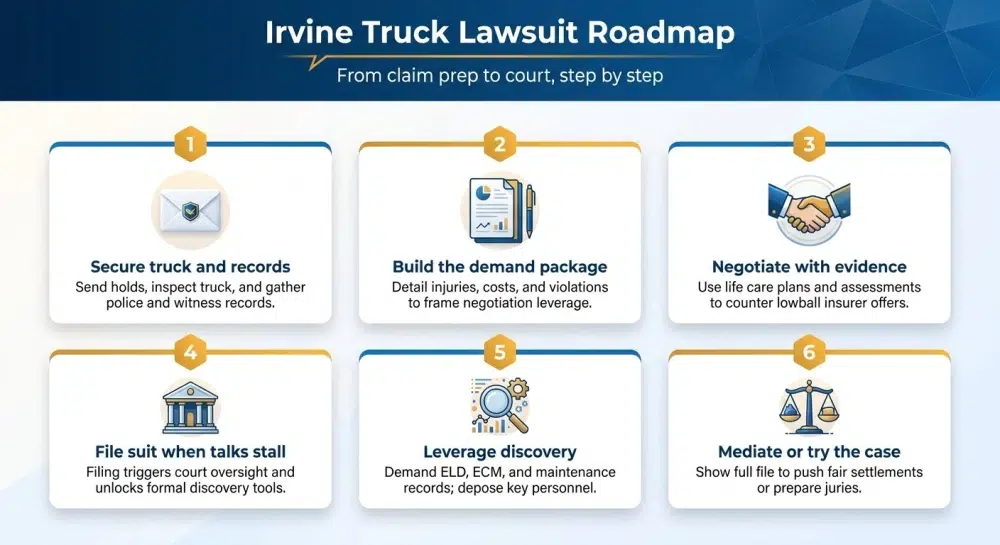
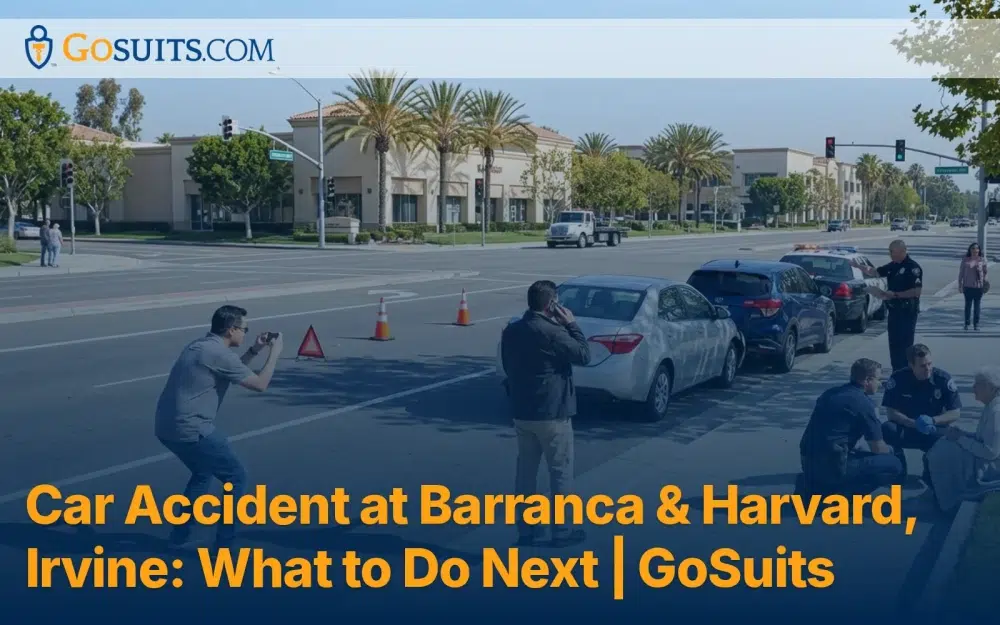
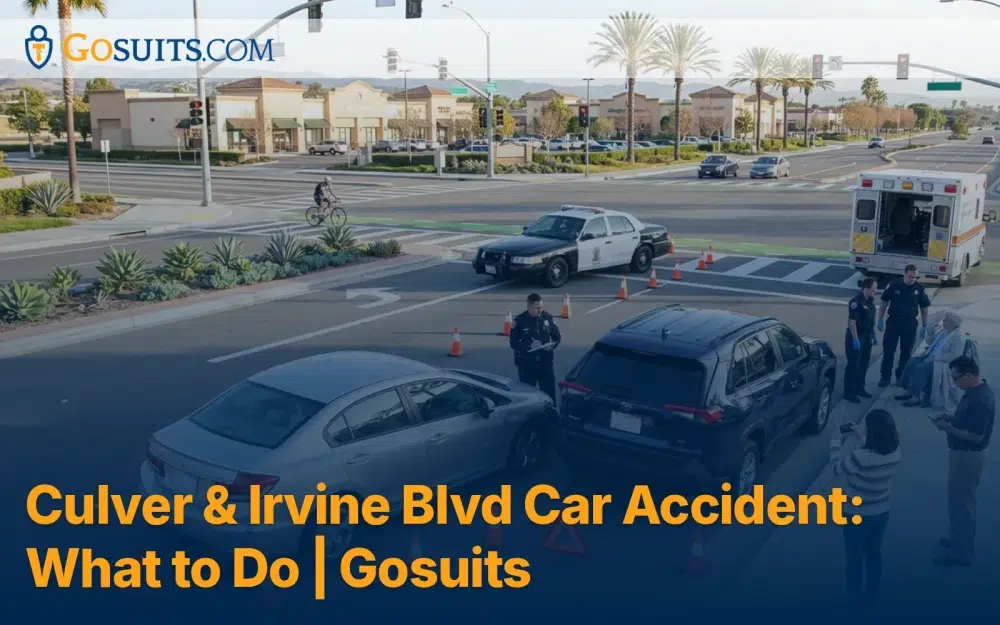
Call 911 and stay at the scene unless you need immediate emergency transport. Get medical care the same day, even if you feel relatively intact. The adrenaline response to a serious crash can mask pain, and internal injuries, brain injuries, and spinal compression can all be present without obvious symptoms in the first hours. A same-day medical evaluation creates a record that connects your injuries to the crash. A delay of several days creates a gap the defense will use.
Do not give a recorded statement to the carrier’s insurance adjuster. You are not legally required to, and an adjuster who calls within hours of the crash is not doing you a favor. The carrier’s insurer employs people who handle commercial truck claims regularly. Their job is to manage the claim’s cost, not to help you recover fairly. Anything you say in a recorded statement can be used to minimize the value of your case.
Preserve what you have. If your vehicle has a dashcam, pull the footage and back it up immediately. Take photos of the scene, the vehicles, the road conditions, and any visible injuries. Get the carrier name, the driver’s information, and the truck’s license plate and DOT number. Write down what you remember about what happened while it is fresh.
Then contact an attorney before the evidence window closes. The carrier’s legal team may already be working. Schedule a free consultation with our team and we will assess your case and tell you what needs to happen next.