

































What types of bus accident cases do we handle in Irvine and Orange County?
Bus crashes in Irvine come in many forms, and the right legal strategy depends on which type of bus, which carrier, and which insurance structure is involved. OCTA runs dozens of fixed routes through Irvine, with buses on Jamboree Road, Culver Drive, and Alton Parkway daily. Charter operators run constantly between Orange County and casinos, sports venues, and Southern California destinations. Hotel shuttles serve John Wayne Airport and the MacArthur Boulevard hotel corridor. School buses serve Irvine Unified, Tustin Unified, and Saddleback Valley districts every weekday morning. Each of those vehicles is governed by a different legal framework, and the claim process changes accordingly.
OCTA and OC ACCESS are public agencies, which means claims against them are governed by the California Government Claims Act. Under Government Code section 911.2, you generally have six months from the date of the crash to file a written claim with the agency before you can sue. Miss that window and your case can be barred entirely, regardless of how strong the underlying facts are. That six-month clock runs whether or not you feel your injuries are serious yet, and it runs whether or not you’ve finished treatment. Getting an attorney involved early is the only real protection against that deadline.
Charter and private carrier claims work differently. These operators are regulated by the Federal Motor Carrier Safety Administration and, in California, the California Public Utilities Commission. Federal rules under 49 CFR Part 395 cap passenger-carrying drivers at 10 hours of driving after 8 consecutive hours off duty. Carriers must maintain inspection and maintenance records under 49 CFR Part 396. When those rules are violated, the records become powerful liability evidence. And charter carriers often carry $5 million or more in combined primary and excess coverage, which means the recovery potential is real when the case is built correctly.
School bus cases can involve the district, a contracted private operator, the other driver, or some combination of all three. California Vehicle Code section 22454 requires drivers to stop for a school bus with its stop arm extended. When someone ignores that signal and strikes a child, we move immediately to secure the stop-arm camera footage from the bus and the incident report from the district. Both have short retention windows.

Who can be held responsible after an Irvine bus crash?
This is where bus cases get complicated fast. A car accident usually involves two parties. A bus crash can involve the driver, the carrier company, a maintenance contractor, a parts manufacturer, a public agency, and their respective insurers, all at once. Getting this right at the start matters because California’s statute of limitations gives you two years for private defendants, but only six months to file a Government Claims Act notice against a public entity. Name the wrong parties or miss the notice window and you may lose the ability to recover from the most responsible party.
The bus driver is usually the starting point. Driver fatigue, distraction, and hours-of-service violations are common causes. But the driver’s employer, whether a transit authority, a charter company, a school district contractor, or a hotel shuttle vendor, carries its own liability. Under the theory of respondeat superior, an employer is generally liable for an employee’s negligence while they’re on the job. When a carrier has a pattern of prior safety violations, we pursue the carrier directly for negligent supervision and negligent hiring.
Maintenance contractors are another avenue. When a brake failure, tire blowout, or door malfunction causes a crash, we look at who was responsible for maintaining the bus. Carriers routinely contract out maintenance, and when a contractor ignored a known defect, they can be held independently liable. FMCSA out-of-service violation records are public documents we pull during investigation. A bus that was flagged for brake defects and continued operating is a very different case than a bus with a clean inspection history.
In some cases, a third-party driver shares fault. A car that cuts off a bus on the I-405, forcing an emergency stop that throws standing passengers to the floor, creates liability for both the bus carrier (under the common-carrier duty of care) and the other driver. California’s pure comparative negligence rule means recovery is reduced by your share of fault, not eliminated. So even a complicated multi-party case is worth pursuing.
California’s bus laws and what they mean for your claim
California treats bus operators as common carriers under Civil Code section 2100. The statute requires them to use the utmost care and diligence for passenger safety, a standard that is meaningfully higher than the ordinary negligence rule. In practice, this means a sudden stop that throws a standing passenger to the floor, or a door that closes on a rider mid-boarding, can support liability in ways that the same conduct by an ordinary driver might not.
California also follows a pure comparative negligence system. If you were partially at fault for the crash, your damages are reduced proportionally to your share. Even if you were 40 percent at fault, you can still recover 60 percent of your total damages. Carriers and their insurers will almost certainly try to push some fault onto you, which is exactly why having an attorney handling the communications matters.
The Government Claims Act clock is the most dangerous deadline in public-agency cases. Six months sounds like a long time, but between treatment, recovery, and trying to get your life back on track, it goes fast. The agency has 45 days to respond after you file. If it rejects the claim or stays silent, you then have a defined window to file suit. Punitive damages are not available against public entities under Government Code section 818, but full compensatory damages including medical bills, lost wages, pain and suffering, and future care are still recoverable.
Evidence that makes or breaks a bus accident claim
The window to preserve the most valuable evidence in a bus case is genuinely short. Onboard digital video recorder footage from transit and charter buses can be overwritten in as few as 30 days, sometimes less. Driver hours-of-service logs and electronic logging device data have their own retention timelines. Carrier maintenance and inspection records get filed away or purged. We send preservation letters to the carrier immediately, before any of that happens.
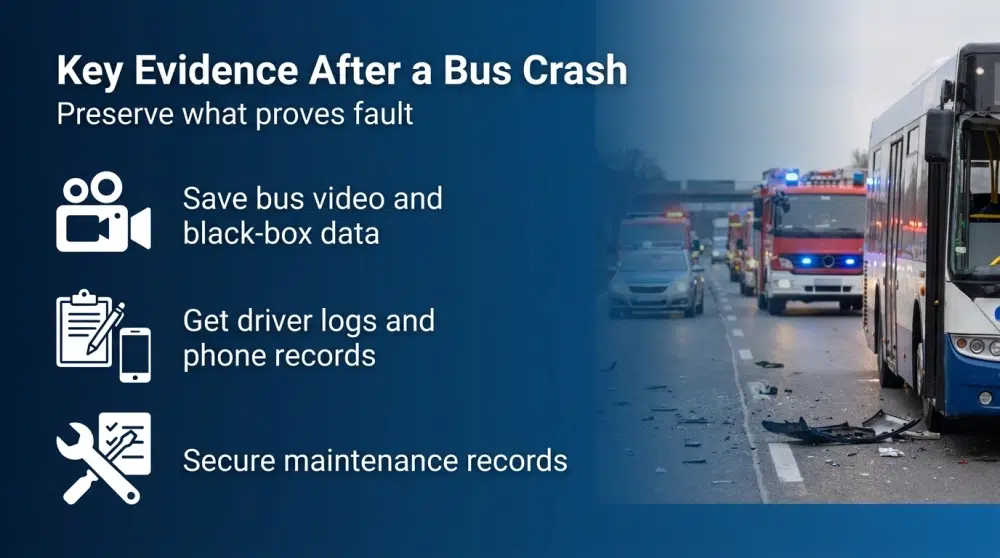
The evidence that matters most tends to be specific to bus cases. The driver’s hours-of-service logs and ELD data, which tell us whether the driver was fatigued or over-limit. The carrier’s inspection and maintenance files, which reveal whether brake failures, tire defects, or door malfunctions were known before the crash. The bus’s onboard cameras, which often capture both interior passenger injuries and exterior view of the collision. Cell phone records from the driver, which can prove distraction. Drug and alcohol test results, which FMCSA rules require post-accident.
On top of those, the standard personal injury evidence applies: the police or CHP collision report, ER and treating records from Hoag Irvine or Kaiser Permanente Irvine or wherever you were seen, photographs of the bus and the scene, witness contact information, and pay stubs or tax records to document lost income. A pain journal, started as soon as possible after the crash, supports the noneconomic damages portion of the claim in ways that medical records alone can’t capture.
How is a bus accident claim valued in Orange County?
Settlement value in a bus case comes from two categories: economic damages and noneconomic damages. Economic damages are the calculable losses, past medical bills, projected future treatment and rehabilitation, lost wages, reduced earning capacity, property damage, and out-of-pocket costs. Noneconomic damages cover pain and suffering, emotional distress, loss of enjoyment of life, and disfigurement. There’s no formula for noneconomic damages in California. Juries assess them based on injury severity, treatment duration, and how the injuries affect daily life.
Beyond the gross recovery number, one thing that actually changes what you take home is what happens to your medical liens. Hospitals, ER groups, and health insurers often have lien rights against your settlement. Our team negotiates with those lien holders directly at the end of your case to reduce what you owe out of the award. More of the money reaches you, rather than going back out in lien payments the moment the settlement check clears.
Charter bus cases tend to carry higher policy limits, sometimes $5 million or more in combined coverage, and the potential for a larger recovery is real when liability is clear. Public agency cases are capped at compensatory damages only, punitive damages are off the table, but full medical, wage, and pain-and-suffering recovery is still available. OCTA’s claim process has its own procedures and its own risk management office, and knowing how to present a claim to that office versus a private carrier’s adjuster genuinely affects the outcome.
What to do in the days after an Irvine bus crash
Get medical care first. That’s not just practical advice; it’s case advice. Gaps between the crash and the first medical visit are one of the first things a carrier’s adjuster will point to when arguing your injuries were minor or unrelated to the crash. Get seen, follow your treatment plan, and keep records of every appointment.
Don’t talk to the carrier’s insurer or the agency’s risk management office before you’ve spoken with a lawyer. Call a lawyer first. Before the carrier insurer’s adjuster calls. Before the public-agency risk office reaches out asking you to give a recorded statement or tossing out some lowball number that doesn’t come close to what the case is worth. They will use your own words to chip away at your claim, and it’s not paranoia to assume that. It’s just how these files get worked. Having a bus accident lawyer step in from day one means somebody else takes those calls, and you don’t accidentally hand them ammunition.
Gather what you can at the scene if you’re physically able: photos of the bus, the point of impact, the road, and any visible injuries. Get names and contact information for any other passengers or witnesses who might be willing to talk later. Write down everything you remember about the crash itself as soon as you can, before the details start to blur.
Then contact our team so we can start the preservation process and evaluate your claim. The earlier we get involved, the more evidence we can protect.
Deadlines that apply to Irvine bus accident claims
Two clocks run in California bus cases, and they don’t run at the same speed.
For crashes involving private bus carriers, charter operators, hotel shuttles, and corporate commuter vans, California Code of Civil Procedure section 335.1 gives you two years from the date of the crash to file a lawsuit. That’s the same two-year window that applies to most personal injury claims.
For crashes involving public agencies, the Government Claims Act deadline under Government Code section 911.2 is six months. That means if your crash involved OCTA, OC ACCESS, an Irvine Unified or Tustin Unified school bus, a UC Irvine shuttle, or any other government-operated vehicle, you must file a written claim with the agency within six months or lose the right to sue. The agency then has 45 days to act on the claim before you can file suit. Miss the six-month window and the case is almost always barred, regardless of how strong the underlying facts are.
If you’re not sure which category your crash falls into, that’s exactly the kind of question a free consultation answers. Don’t wait on getting that question resolved.