

































Workers’ compensation covers some of the loss. Third-party claims cover the rest.
This is the point that matters most for a hurt construction worker in Irvine. California’s workers’ compensation system, under Labor Code sections 3600 and 3602, provides medical care and a portion of your lost wages without requiring you to prove fault. The trade-off is that you generally cannot sue your direct employer for pain and suffering or full lost income.
The workers’ compensation bar applies only to your direct employer. On almost every Orange County construction site, multiple companies are present: a general contractor, several subcontractors, equipment rental companies, material suppliers, design professionals, and the property owner. If any of those non-employer parties contributed to your injury, you can pursue a separate civil case against them. That is called a third-party claim, and it allows you to recover the full range of damages California civil law recognizes: past and future medical expenses, full lost earnings and earning capacity, pain and suffering, emotional distress, and loss of consortium.
Running both tracks at once is where the real work is. A workers’ compensation attorney who handles only the comp file may miss the third-party defendants entirely. A civil attorney who doesn’t coordinate with the comp file may leave money on the table when the comp carrier asserts its lien against the civil recovery. Our team manages both simultaneously, and when settlement comes, we negotiate down the comp lien, the medical liens, and the health insurance subrogation so more of the recovery lands in your pocket.
Beyond the lien work, our team connects you with orthopedic surgeons, neurologists, and pain management physicians who treat on a medical lien, which means no upfront cost when money is tightest. We coordinate transportation after a serious site incident. As your case progresses, we work with life-care planners and economists to project the long-term cost of your injuries, including future surgeries, vocational retraining if your trade is no longer an option, and lost earning capacity over a working lifetime. To start that conversation with no obligation, you can schedule a free consultation any time, day or night.
Who is actually liable when a construction site injury happens?
The short answer is: often more than one party, and not always the most obvious one.
California’s multi-employer worksite doctrine, rooted in Labor Code section 6400 and Title 8, section 336.10, means that general contractors, controlling employers, and creating employers can all be cited by Cal/OSHA for hazardous conditions, even when their own workers were not the ones exposed. That regulatory framework translates into civil liability when the hazard actually injures someone.
On a typical Irvine build-out, the parties worth examining include the general contractor (who sets the site safety standards and controls the overall project), each subcontractor on site (who may have created the hazard or failed to protect their own workers), the property owner (who may have control over permanent conditions), the equipment rental company or manufacturer (if a crane sling, scaffold component, or power tool failed), and any outside safety consultant who reviewed or approved a plan that turned out to be defective.
Identifying every responsible party is time-sensitive. Equipment gets repaired. Subcontractors demobilize. Surveillance footage is overwritten on cycles as short as seven days. The Cal/OSHA inspector who responds immediately after a serious incident creates a record that is far more useful to your case than one reconstructed later. We send preservation letters to every relevant party as soon as we are retained, and we request the full Cal/OSHA inspection file the moment the agency closes its inquiry.
What evidence makes or breaks a construction accident case?
Three categories of evidence drive most construction injury claims in Orange County.
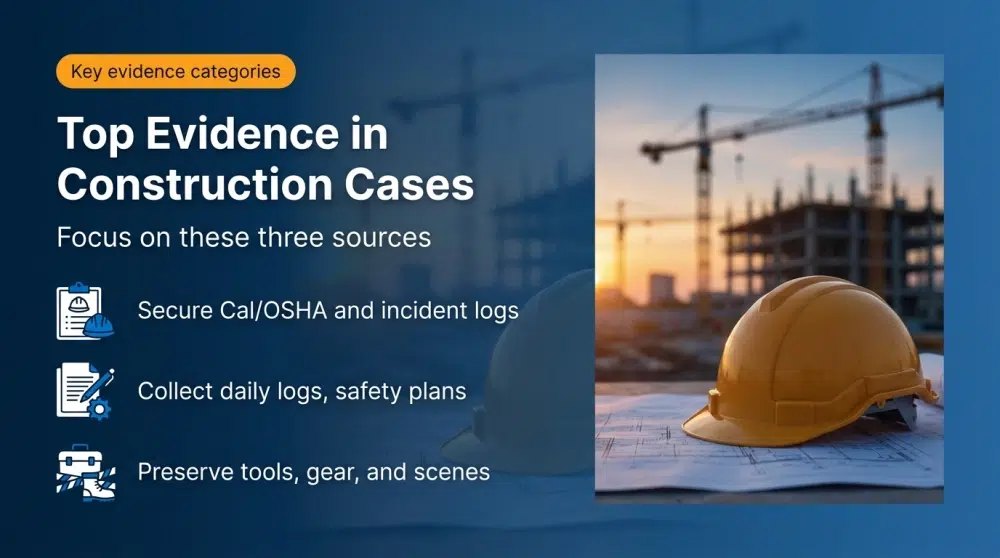
The first is the regulatory record: Cal/OSHA Form 300 incident logs, employer accident reports, inspector field notes, and citations. A Cal/OSHA citation does not automatically establish civil liability, but it is powerful evidence of the standard of care and often establishes negligence per se when the violation directly caused the injury. We take depositions of the inspector when needed and build the civil case around the regulatory findings.
The second is the site documentation that contractors produce during construction: daily inspection logs, toolbox-talk sign-in sheets, the Injury and Illness Prevention Program, the site-specific safety plan required under Title 8 section 1509, subcontractor agreements, and indemnity provisions in those agreements. Those documents tell us who had control, who created the hazard, and who agreed in writing to protect against it.
The third is the physical evidence, which is also the most perishable. The scaffold components, the crane, the forklift, the power tool, the harness, the trench box, and all the surrounding conditions need to be documented and, where possible, preserved before anyone repairs or replaces them. Our guide on construction site injury legal options covers this process in more detail, including what to document in the days immediately after an incident.
The Cal/OSHA rules that come up most often in Irvine construction cases
California has some of the most detailed construction safety standards in the country. Title 8 of the California Code of Regulations is the operative source, and the sections that appear in our cases most often are these:
Fall protection, Article 24: guardrails, safety nets, and personal fall arrest systems are required on most construction surfaces above 7.5 feet. This is Cal/OSHA’s most-cited category in California construction, and a documented violation often establishes negligence in the parallel civil case.
Scaffolding, sections 1644 and following: platform width, planking, guardrails, design loads, daily inspection by a competent person, and worker training requirements vary by scaffold type but apply to all of them. Scaffold erection plans and daily logs are the first documents we request.
Excavation and trenching, Article 6: protective systems (sloping, shoring, or shielding) are required for trenches five feet deep or greater. The competent person must inspect daily and after every rainfall. Soil classification determines which system is required, and cases often turn on whether the classification was done correctly.
Crane operations, Article 15: operator certification, daily inspections, load-chart compliance, and ground-condition assessment are all required. Crane telematics data and outrigger-pad photographs are the first things we preserve when a crane incident is involved.
Heat illness prevention, section 3395: water, shade, rest, acclimatization, and a written heat plan are required for outdoor work. On Orange County summer job sites, heat collapse incidents can support both a Cal/OSHA citation and a civil claim against the employer or controlling contractor.
Deadlines you cannot afford to miss
Two years is the general statute of limitations for personal injury in California, under Code of Civil Procedure section 335.1. The clock starts from the date you knew, or reasonably should have known, of the injury and its cause.
There is a shorter deadline that catches people off guard. If any part of your construction project involved a public entity, whether a city- or county-owned worksite, a public works contract, or a joint powers authority, you generally have six months to file a written government tort claim under Government Code section 911.2 before you can file any lawsuit at all. Missing that window typically bars the claim against the public entity entirely.
Workers’ compensation has separate, shorter notice requirements: written notice to your employer within 30 days of the injury, and a DWC-1 claim form filed promptly after that. A missed comp deadline can affect both your benefits and your ability to coordinate the civil case later.
The practical takeaway is simple. If you were hurt on a job site in Orange County and you are not sure whether a public entity is involved, talk to an attorney before you assume the two-year window applies. For a fuller overview of how these timelines work together, our Irvine personal injury team covers California filing deadlines and how workers’ compensation and civil claims interact.
How the value of a construction injury claim is built
A construction injury claim on a California job site can involve economic damages and noneconomic damages, and in rare cases of egregious conduct, punitive damages under Civil Code section 3294.
Economic damages cover what can be calculated: past and future medical expenses, lost wages during recovery, and lost earning capacity going forward. For a skilled tradesperson with a shoulder injury that ends their ability to do overhead work, the lost-earning-capacity number is often the largest single component. We work with vocational specialists and economists to project that number over a working lifetime and present it in terms a jury can evaluate.
Noneconomic damages, pain and suffering, emotional distress, and loss of enjoyment of life, are real and recoverable under California Civil Code section 1714, but they require documentation. Treatment records, therapy notes, lay-witness accounts from family and co-workers, and the injured person’s own testimony about how daily life has changed all go into the noneconomic picture. A gap in treatment is one of the first things a defense carrier points to in order to suggest the injury wasn’t serious. Consistent care and consistent documentation close that door.
California uses pure comparative negligence, which means a finding that a worker was partly at fault does not bar recovery. A 20% fault assignment reduces a $600,000 recovery to $480,000. It does not eliminate it. Defense teams regularly try to shift blame onto the worker, citing things like failing to wear PPE or working in an area they were warned to avoid. The worker’s training records, the toolbox-talk logs, and the employer’s own safety documentation usually tell a more accurate story.