




























An SUV rollover isn’t a routine crash. Here’s why that matters.
Most crashes happen in a single plane. A rear-end hit, a sideswipe, a T-bone at an intersection. An SUV rollover is different. The vehicle is taller, carries more weight up top, and runs a track width that doesn’t really forgive a sideways slide. Once the tires lose lateral grip, physics takes over in a way that multiplies injury severity fast. NHTSA data shows rollovers account for roughly 2 percent of all crashes but cause about a third of vehicle-occupant fatalities. SUVs and pickups appear in that statistic at substantially higher rates than passenger cars.
That number is why these cases get worked differently. The evidence is different, the liable parties are often different, and the injuries that result tend to be more severe than what a standard auto claim involves. An insurer who wants to process a rollover like a fender bender is counting on you not knowing that.
Where do rollovers happen in Orange County?
Rollovers don’t pick a lane. The high-speed stretches of I-5 and I-405 are the obvious ones. The I-405 through Irvine backs up hard at the SR-133 interchange, and aggressive lane changes in stop-and-go traffic set off rollovers regularly. The SR-73 toll road sees them too, particularly where speed transitions happen quickly. But the crashes that surprise people are the ones that don’t involve a freeway at all.
Tight off-ramps near the Irvine Spectrum have advisory speeds that a fully loaded SUV doesn’t always respect. Rural sections of Santiago Canyon Road and curves along Sand Canyon put a top-heavy vehicle’s center of gravity to the test in ways the driver may not anticipate. And parking structures, where a slow turn in the wrong SUV is enough to tip it, account for a share of rollover cases nobody expects until they’re sitting in one.
Orange County logs several thousand injury and fatal collisions every year according to California Office of Traffic Safety rankings, and with SUVs and light trucks now making up most of California’s vehicle mix, rollovers are a consistent part of that picture. The risk profile is different depending on where the crash happens. A highway rollover at speed produces different evidence and different injuries than one on a residential curve or in a parking garage, and the case gets built around where it actually occurred.
Who actually bears responsibility after a rollover?
This is the question that separates a mediocre rollover claim from a complete one. The at-fault driver is the obvious starting point. But a rollover case often touches parties the driver had nothing to do with.
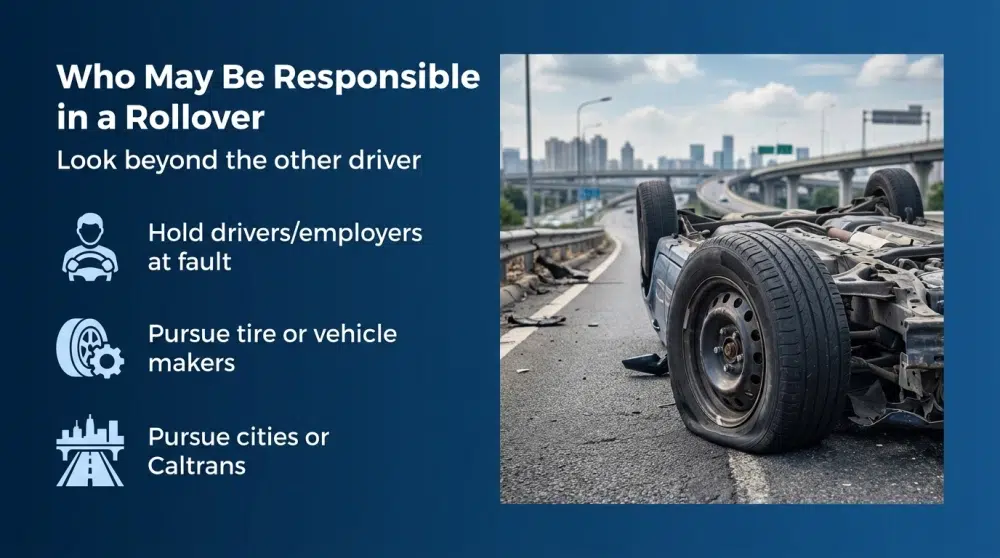
If the tire that failed had a tread-separation defect, the manufacturer carries liability. If the SUV’s roof collapsed below survival space during the roll, the vehicle manufacturer may face a parallel product claim under California’s strict liability framework. If a roadway shoulder drop-off tripped the vehicle, the responsible public entity, whether Caltrans or a city, may be liable under Government Code section 835. An employer whose driver was working at the time of the crash can be brought in under respondeat superior. A cargo loader who overloaded the roof rack may have contributed to the center-of-gravity shift that made the rollover possible.
Identifying all of these parties early matters because some have short claim windows. Claims against public entities in California generally require a written notice under Government Code section 911.2 within six months of the injury. Miss that window and the claim against the government defendant is gone, even if the two-year personal injury deadline under Code of Civil Procedure section 335.1 hasn’t run yet.
Beyond the liability analysis, recovering full compensation in a rollover often means working with multiple insurers at once: the at-fault driver’s carrier, a manufacturer’s insurer, and possibly your own uninsured or underinsured motorist coverage if policy limits fall short. Our team coordinates that from the start so nothing gets left behind.
What happens to the evidence if you wait?
The rollover itself takes seconds. The evidence window is only a little longer. The SUV’s event data recorder captures pre-impact speed, braking input, steering angle, and seatbelt status, but many systems overwrite that data within days if the vehicle is powered on or moved. Surveillance cameras near the Irvine Spectrum, along Jamboree Road, or at freeway on-ramps typically retain footage for seven to thirty days before it’s overwritten. The tire that failed has to be physically preserved before the salvage yard destroys it.
Understanding how attorneys preserve vehicle black-box evidence and act quickly on scene data is one of the things that separates a well-built rollover case from one that falls apart at deposition. We send preservation letters to salvage yards, body shops, and property owners as soon as we’re retained. We download the event data recorder ourselves and bring in qualified accident reconstruction professionals to document the scene before physical evidence changes. The police report is a starting point, not a finish line.
The six-month government-claims deadline adds urgency when a roadway defect is in the picture. If a Caltrans-maintained shoulder or a city-owned road surface contributed to the crash, the clock on that claim is running from the date of injury, not the date a lawsuit is filed.
The injuries that come out of these crashes
Rollovers create multi-directional forces that don’t resolve cleanly. Occupants are thrown into the roof, struck by intruding metal, and sometimes ejected even when belted if a window blows out during the roll. The injuries we see most often in Orange County rollover cases: traumatic brain injuries from roof crush and side impact, spinal cord injuries from violent flexion and rotation, internal organ damage from belt loading and blunt trauma, fractures requiring surgical hardware, and severe lacerations from broken glass. In fatal rollovers, ejection and roof crush are the two leading mechanisms.
These injuries have long recovery arcs. A spinal cord injury at the cervical level may require lifetime attendant care. A TBI with structural changes on imaging can affect work capacity for years. The demand in a rollover case has to capture not just what the bills show today but what future surgeries, rehabilitation, and reduced earning capacity look like over the client’s lifetime. Building that number requires treating physicians, life-care planners, and vocational professionals, not just a stack of ER records.
Beyond pursuing the gross recovery from the at-fault insurer, we negotiate with hospitals, ER groups, and medical-lien holders at settlement to reduce what you owe out of the award. The number that matters is what lands in your pocket, not what appears on the demand letter.
California law and deadlines that apply to your case
California follows pure comparative negligence. If you’re found partly responsible for the rollover, your recovery is reduced by that percentage, but you’re not barred from collecting. An insurer who inflates your share of fault by ten or twenty points is doing so deliberately, and the evidence gathered early is what counters it.
Most rollover injury claims must be filed within two years of the date of the crash under Code of Civil Procedure section 335.1. Wrongful death claims for fatal rollovers fall under the same two-year window. But as noted above, if a public entity is involved, the six-month government-claims deadline controls first. California’s vehicle code also supports negligence per se arguments when a driver was cited for speeding, handheld device use under Vehicle Code section 23123.5, or driving under the influence under Vehicle Code section 23152. A DUI finding can also open the door to punitive damages under Civil Code section 3294 when the conduct was sufficiently reckless.
What to do in the days after an Irvine SUV rollover
Get medical care first, even if you feel okay at the scene. Adrenaline masks injury, and the gap between the crash and the first medical visit is one of the first things insurers point to when disputing the severity of a claim. Go to Hoag, UCI Medical Center, Kaiser Irvine, or the nearest emergency room and let the providers document what they find.
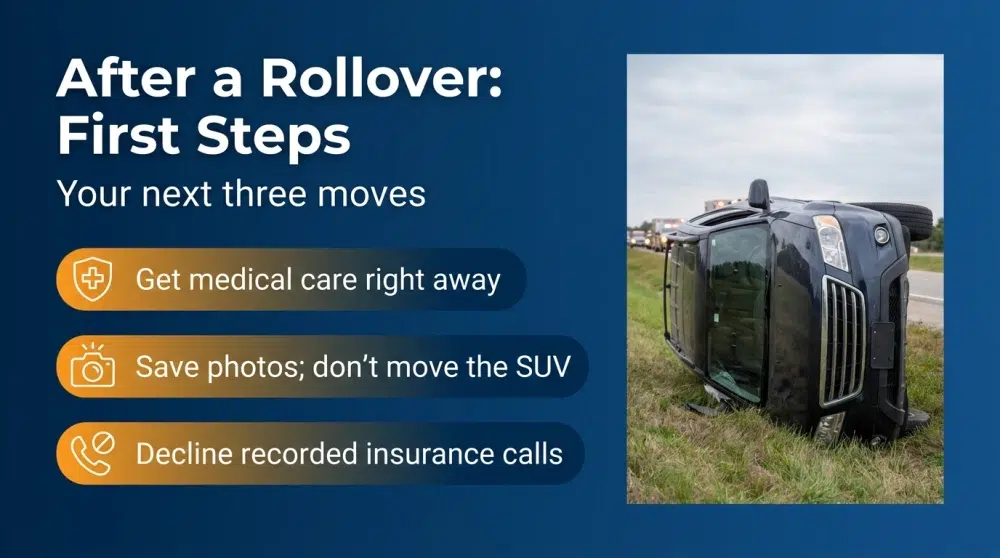
After that: don’t talk to the at-fault driver’s insurer without legal guidance. A recorded statement taken in the first days of a claim is almost always used against you later. Preserve everything you have from the scene, photos, witness contact information, dashcam footage, and the names of any officers at the scene. And don’t let anyone move or repair the SUV until it’s been inspected.
When you’re ready to talk to an attorney, we’re available around the clock. You can schedule a free consultation at any time, day or night, and someone who can act on your case will pick up. The first conversation costs nothing and locks in nothing. It just gets the process started before the evidence window closes.