


















The bias problem: why rider claims start behind
Insurance adjusters do not approach motorcycle claims the way they approach car accident claims. Riders carry a credibility deficit that is built into the valuation process before a single medical record is reviewed. The unstated assumption is that the rider was speeding, splitting lanes recklessly, or doing something that invited the crash, and that assumption shapes the first offer even when the police report puts fault entirely on the other driver.
NHTSA’s reporting on multi-vehicle motorcycle crashes shows that in roughly two-thirds of cases, the other driver violated the rider’s right of way, most commonly by failing to yield before a left turn. That means the majority of motorcycle cases should be straightforward liability cases. Instead, riders routinely receive first offers that treat the crash as a shared-fault situation.
Knowing this bias exists is the first step. Countering it takes a specific kind of preparation: accident reconstruction that addresses sight lines and approach speeds, CHP-guideline analysis if lane splitting is in the picture, and a willingness to put the case in front of an Orange County Superior Court jury if the insurer’s offer doesn’t reflect the evidence. Our team does all three.
After the crash, what actually needs to happen in the first few days
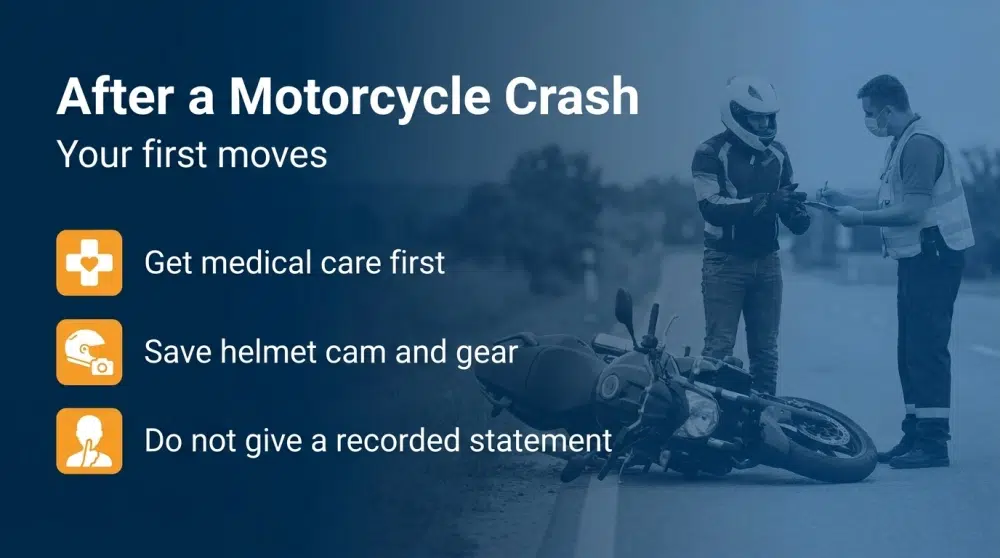
Get medical care first. That is not legal advice, it is the correct order of operations both for your health and for your case. A gap between the crash and your first medical visit becomes an argument in the adjuster’s favor, and riders are already fighting an uphill credibility battle. Go to the ER, go to your doctor, go somewhere, and keep going until a provider clears you.
While you are getting treatment, there are things happening on the evidence side that have a short window. Helmet-cam and dashcam footage gets overwritten, often within days. Nearby business surveillance systems cycle on 7 to 30-day loops. Signal-timing data at the intersection where you were hit may be purged on a similar schedule. The CHP or Irvine PD report takes time to be released, but requesting it early puts you in the queue. Witness memory also degrades fast.
Do not give the at-fault driver’s insurer a recorded statement. They will ask for one, often within hours of the crash, framing it as routine and necessary. It is neither. What you say in that call becomes part of the adjuster’s file and will be used to limit what they pay. You are not obligated to cooperate with the other driver’s insurer. Your own insurer may have its own contractual requirements, which is a separate question worth discussing with an attorney early.
Preserve your gear. The helmet, jacket, gloves, and boots carry physical evidence of the crash: impact direction, energy distribution, the story of what your body went through. Do not clean them, repair them, or throw them away.
Who is actually liable when a rider gets hurt in Orange County
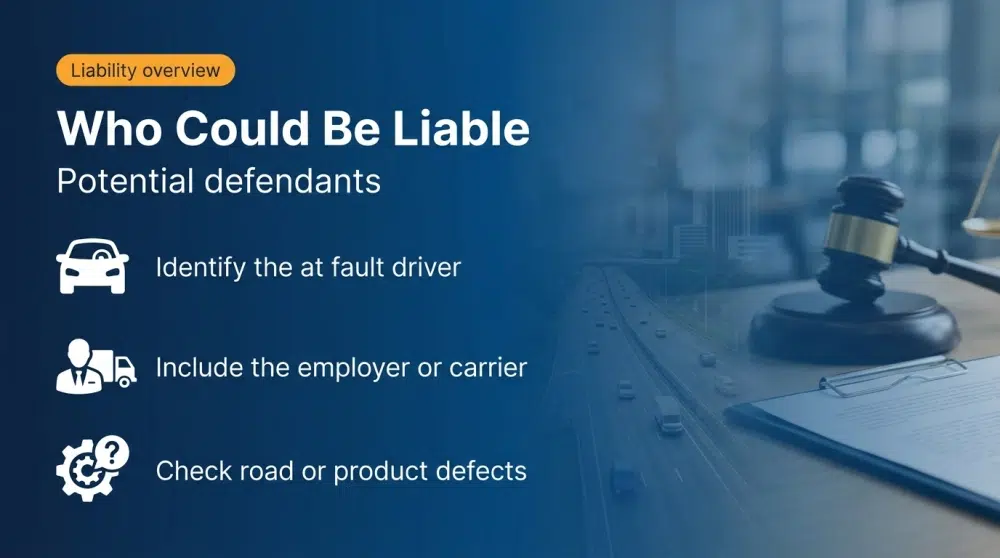
The at-fault driver is the most common defendant, but motorcycle crashes in Irvine and Orange County regularly involve more than one responsible party.
When a commercial vehicle is involved, including delivery vans, rideshare vehicles, and tractor-trailers, the driver’s employer or the carrier may be liable alongside the driver. Federal Motor Carrier Safety Regulations impose separate duties on carriers, and electronic logging device data, driver qualification files, and maintenance records can show violations that the driver’s personal conduct alone doesn’t capture. These records are only preserved if someone acts quickly. Carriers are not obligated to hold them indefinitely.
When a roadway defect contributed to the crash, a public entity may be responsible. Caltrans maintains the state highways, the City of Irvine maintains its surface streets, and the County of Orange maintains unincorporated roads. California Government Code §835 allows claims against public entities for dangerous conditions of public property, but Government Code §911.2 sets a hard six-month deadline to present a written claim before any lawsuit can be filed. Missing that deadline almost always bars the claim entirely.
When a motorcycle component failed, the manufacturer, distributor, or retailer may face a product liability claim under California’s defect theories: design defect, manufacturing defect, or failure to warn. Preserving the bike intact, before it goes to a body shop and gets disassembled, is the single most important step in a product liability case.
And when a driver opened a car door into traffic near the Irvine Spectrum, on Campus Drive, or along MacArthur Boulevard, California Vehicle Code §22517 assigns liability to the door-opener. In rideshare scenarios, the platform’s commercial insurance may also respond.
California law as it actually applies to your claim
A few statutes and legal rules come up in nearly every Orange County motorcycle case, and understanding them changes how you read the situation you’re in.
California Vehicle Code §27803 requires every rider and passenger to wear a U.S. DOT compliant helmet. Riding without one does not bar your claim, but it gives an adjuster something to argue. An insurer may try to reduce the noneconomic damages on head-injury claims by raising the helmet issue. If you were wearing a compliant helmet, preserve it and document the DOT label and chin strap. If you were not, it does not end your case; it becomes one argument among many, and the physical injuries are not undone by the violation.
California Vehicle Code §21658.1 makes California the only state where lane splitting is expressly authorized, with CHP-published safety guidelines on speed differentials and roadway conditions. A driver who changes lanes without checking their mirror and strikes a rider who was splitting lanes legally is not absolved because the rider was between lanes. Drivers who claim the rider “came out of nowhere” during a legal maneuver are usually describing their own inattention. We use the CHP guidelines, traffic-camera evidence, and reconstruction to establish what “reasonable” looks like under the statute. For a deeper look at how the law applies to crash claims, see our breakdown of the role of a personal injury lawyer in California motorcycle accident cases.
California follows pure comparative negligence. If a jury finds a rider 20 percent at fault for a crash that produced $300,000 in damages, the rider recovers $240,000. The rule does not bar partial-fault riders from any recovery, and adjusters who use comparative fault to justify very low offers are often overstating the rider’s share. Strong reconstruction and CHP-guideline evidence shift that allocation.
Under CCP §335.1, most motorcycle injury lawsuits must be filed within two years of the crash. The clock starts on the date of the incident. For government-entity claims under Government Code §911.2, the written claim must be presented within six months. Insurers sometimes let negotiations run past the 18-month mark, counting on the deadline pressure to produce a discounted settlement. Filing a complaint while negotiations are ongoing is entirely proper and preserves rights.
How a motorcycle case is valued, and what moves the number
The gross settlement demand in a motorcycle case is built from two pools of damages: economic and noneconomic.
Economic damages are the tallied costs: medical bills paid to date, projected future treatment, lost income, reduced earning capacity, property damage to the bike and gear, and out-of-pocket costs like mileage and co-pays. These are documented in records and supported by vocational evaluators and care planners where long-term loss is involved. Riders who work in trades, drive for a living, or perform skilled physical labor often carry high earning-capacity losses that require an economist’s analysis to project properly.
Noneconomic damages, pain and suffering, disfigurement, loss of enjoyment, and emotional distress, are less formulaic. They are supported by the medical record, a pain journal, and testimony from people who knew the rider before and after the crash. Visible scarring from road rash, a permanent limp, and cognitive changes from a head injury all affect this number. Orange County juries are not insensitive to these losses when they are documented honestly and presented clearly.
What moves the number up or down on the defense side is usually comparative fault allocation, the completeness of the medical record, and how quickly the rider established consistent treatment. A gap in care is one of the most common tools adjusters use to argue the injury wasn’t that serious. Continuous treatment, even at reduced frequency, is important.
The gross number is not what the rider takes home. After liens, hospital reimbursement claims, and legal fees, the net figure can be substantially lower. We track every Medi-Cal lien, ERISA lien, hospital lien, and provider balance from day one and negotiate each of them at the end of the case, because the dollars that reach the client’s pocket are the actual outcome, not the number on the demand letter.
How GoSuits handles an Irvine motorcycle accident case from call to close
When you contact us, we start working. That means requesting the CHP or Irvine PD traffic collision report, sending preservation demands to businesses near the crash site, and getting hold of any helmet-cam or dashcam footage before it disappears. We photograph the scene, document the bike and gear, and speak with witnesses as quickly as we can get to them.
While the investigation runs, we coordinate medical care. Many riders worry about how they will pay for treatment when health insurance is limited or non-existent. We connect you with orthopedic surgeons, neurologists, physical therapists, and trauma specialists in the Irvine area who treat on a medical lien, meaning you owe nothing up front and your bills are addressed at settlement. We also coordinate rental vehicle arrangements while your bike is being repaired or replaced.
We build the damages model as treatment progresses, working with care planners and economists to document future costs before the case closes. If the insurer will not negotiate fairly, we file in Orange County Superior Court and prepare the case for trial. The fact that we are ready to try a case changes how insurers price their offers. As part of our Irvine personal injury practice, we draw on the firm’s full investigative and trial resources, not just the bandwidth of a single attorney.
At the end of the case, we negotiate down the medical liens and outstanding balances so the dollars that reach you are maximized. You receive regular updates, secure file access, and a prompt response when you reach out. We work on contingency, so you owe nothing unless we win. To talk through your situation, schedule a free consultation any time, day or night.