















What areas in Los Angeles County do brain injury lawyers serve?
If you suffered a traumatic brain injury anywhere in Los Angeles County, GoSuits is ready to help. While we are based in the LA metro, our brain injury legal team serves clients throughout the region from the coastal stretches of Manhattan Beach and Santa Monica to the busy streets of Downtown LA, Hollywood, the San Fernando Valley, and the Antelope Valley.
It could happen anywhere, and honestly, it does. A 70 mph wreck on the I-405 or I-10. A slip in some big-box retail aisle. An assault in a poorly lit parking structure near downtown. A worksite incident on a construction project somewhere in the county. None of it discriminates. Wherever your injury happened, we know the area, we know the law, and we’ll fight for the compensation you deserve.
Los Angeles County is home to nearly 10 million residents and sees thousands of TBI-related visits to emergency rooms each year, according to data published by the California Department of Public Health and the federal Centers for Disease Control and Prevention. We know the unique risks across different parts of the county, and we tailor our approach accordingly.
Areas we commonly serve
- Central LA & Westside: Downtown, Hollywood, Koreatown, Mid-Wilshire, Santa Monica, Venice, Culver City, Westwood
- South Bay & Coastal: Manhattan Beach, Redondo Beach, El Segundo, Torrance, San Pedro, Long Beach
- San Fernando & San Gabriel Valleys: Burbank, Glendale, Pasadena, El Monte, North Hollywood, Sherman Oaks, Van Nuys, Northridge
- Gateway, South, and Antelope Valley: Norwalk, Lancaster, Palmdale, Inglewood, Compton, Lynwood
Wherever you are in Los Angeles County, we are just a call away and always ready to step in when you need legal guidance after a brain injury.
What types of brain injury cases do we handle in Los Angeles?
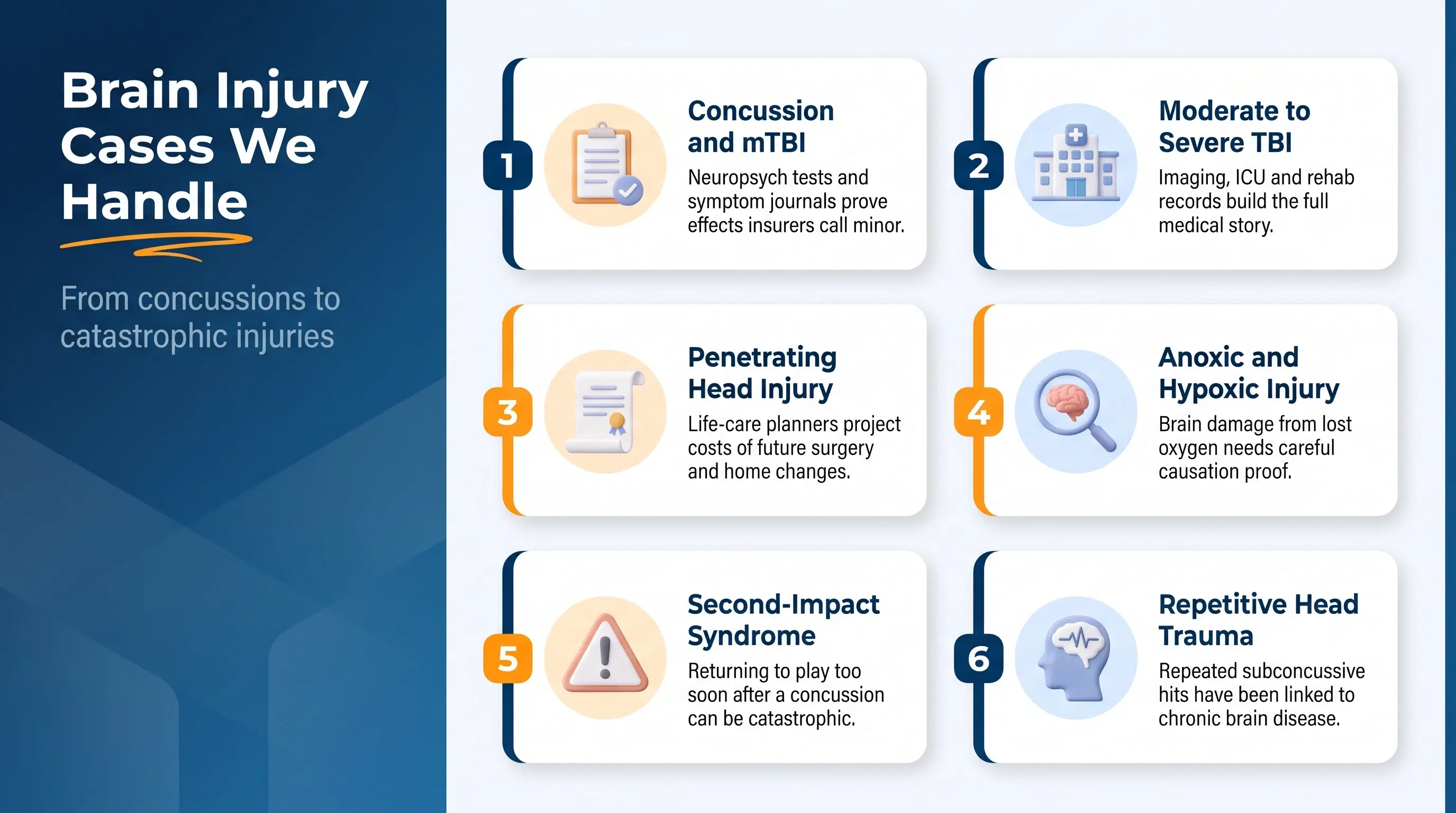
Brain injuries range from mild concussions that resolve in weeks to catastrophic, life-altering damage that requires lifelong care. The legal strategy, the medical proof, and the value of the claim shift dramatically depending on severity, cause, and the long-term picture. Our Los Angeles brain injury attorneys work each case to that specific level.
Concussion and mild traumatic brain injury (mTBI)
Insurance adjusters have a habit of calling concussions minor. Even when they aren’t. Even when the symptoms drag on for months. And the symptom list isn’t small either, headaches, light sensitivity, sleep that’s gone sideways, mood changes, trouble focusing, all of it adding up to people who can’t work or finish a semester. We document it the right way: treating-neurologist visits, neuropsychological testing, and a contemporaneous symptom journal so the file shows what post-concussive syndrome really looks like, not the carrier’s version.
Moderate and severe traumatic brain injury
Moderate to severe TBIs commonly involve loss of consciousness, post-traumatic amnesia, intracranial bleeding, contusions, or diffuse axonal injury. These cases often start in the trauma bay at hospitals like LAC+USC Medical Center, Cedars-Sinai, Ronald Reagan UCLA, or Harbor-UCLA. We collect imaging studies, neurosurgical reports, ICU records, and rehabilitation notes from facilities such as Casa Colina and Rancho Los Amigos National Rehabilitation Center to build a complete medical narrative.
Penetrating and open head injuries
Penetrating injuries from gunshot wounds, falling debris on a worksite, or sharp objects in a crash can cause focal damage with permanent deficits. We work with neurosurgeons and life-care planners to project the cost of follow-up surgeries, anti-seizure medication, assistive devices, and home modifications.
Anoxic and hypoxic brain injuries
Not every brain injury comes from impact. Anoxic and hypoxic brain damage occurs when the brain is deprived of oxygen, sometimes after a near-drowning at a public pool, a workplace asphyxiation incident, or a delayed response to cardiac arrest. These cases require careful causation work, often supported by qualified neurology opinions.
Second-impact syndrome and repetitive head trauma
Returning to activity too soon after a first concussion can cause catastrophic second-impact syndrome, particularly in youth athletes. Repetitive subconcussive hits over time have been linked to chronic traumatic encephalopathy. When these injuries arise from a school, league, or coaching failure to follow California’s youth concussion protocols, we investigate the duty of care that was owed and breached.
What causes most traumatic brain injuries in Los Angeles?
The federal Centers for Disease Control and Prevention identifies falls, motor vehicle crashes, and being struck by or against an object as the leading causes of TBI-related emergency department visits, hospitalizations, and deaths nationwide. Our Los Angeles caseload reflects those same patterns.
Motor vehicle collisions
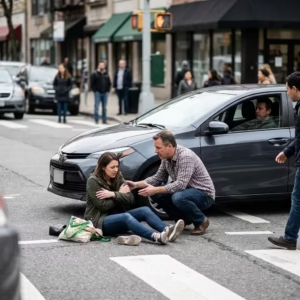
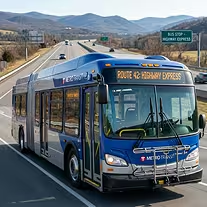
Crashes are the leading cause of the moderate-to-severe TBIs that come through our door, cars, trucks, motorcycles, rideshares, pedestrians, the whole list. The California Office of Traffic Safety and CHP’s Statewide Integrated Traffic Records System keep telling the same story, too: LA County reports the highest crash and serious-injury totals in the state, basically every year. Most of it happens on the I-405, I-10, I-110, and US-101, with plenty more on surface streets like Sunset, Wilshire, and Vermont. And the part that surprises people, sudden deceleration on its own, no direct head contact required, is enough to cause a coup-contrecoup injury.
Falls
The CDC ranks falls as the top cause of TBI hospitalizations for people 65 and older. In LA, the usual suspects are pretty mundane. Wet supermarket aisles. Busted stair treads in apartment buildings. Construction openings nobody bothered to guard. The buckled sidewalks you find all over the older parts of the city. Each one shows up in our caseload more often than people probably realize. And here’s the part that catches families off guard, slip-and-fall TBIs frequently get overlooked at the scene because the symptoms don’t always hit right away. Sometimes it’s hours. Sometimes a couple of days.
Struck-by and assault injuries
Falling merchandise in big-box stores, dropped tools on construction sites, and assaults at venues with inadequate security all produce head trauma. When a property owner failed to provide reasonable security in a high-crime area, California premises-liability law allows a claim against that owner alongside any criminal proceedings.
Sports, recreation, and youth-league incidents
From youth football in the South Bay to club soccer in the Valley, sports-related concussions remain a meaningful share of pediatric TBIs. California Education Code section 49475 sets concussion-protocol requirements for school athletic programs, and a failure to follow protocol can support a negligence claim.
What compensation can a Los Angeles brain injury claim recover?
Brain injury damages are typically larger and more complex than other personal injury claims because the harm reaches into nearly every part of life: cognition, employment, relationships, and independence. Under California law, recoverable damages fall into economic and non-economic categories, with punitive damages available in rare cases of egregious conduct.
Economic damages are the parts of the case you can pin a number to. Medical care now, medical care later, neurosurgery, neurology, neuropsychology, speech therapy, OT, vocational rehabilitation. Wages you’ve lost. Wages you’ll never earn. The earning capacity that just isn’t there anymore. Ramps, grab bars, other home modifications. Attendant care. The out-of-pocket stuff that adds up in a hurry. We don’t guess at any of this. Life-care planners and forensic economists work the numbers with us so a multi-decade plan ends up with real figures attached.
Non-economic damages cover pain and suffering, emotional distress, loss of enjoyment of life, and the cognitive and personality changes that families often describe as losing the person they knew. These damages are real and compensable under California law, even though they do not come with a receipt.
Spouses may have a separate claim for loss of consortium. If a TBI causes death, surviving family members may pursue a wrongful death action under California Code of Civil Procedure section 377.60.
How does California law treat brain injury claims?
California follows a pure comparative negligence rule. If you are found partially responsible for the incident that caused your TBI, your recovery is reduced by your percentage of fault, but you can still recover even if you are 99% at fault. This rule, set by the California Supreme Court in Li v. Yellow Cab Co. (1975) 13 Cal.3d 804, is more favorable to injured plaintiffs than the modified comparative-fault rules used in many other states.
Most personal injury claims, including TBI claims, must be filed within two years of the date of injury under California Code of Civil Procedure section 335.1. There are important exceptions. Claims against a public entity (a city bus, an LAUSD vehicle, a county hospital) require a written government claim within six months under Government Code section 911.2. The discovery rule may extend the deadline when a brain injury or its full extent was not reasonably discoverable at the time of the incident, which happens often with mild TBIs that worsen over time.
Joint-and-several liability for economic damages applies under California Civil Code section 1431.2 (Proposition 51), while non-economic damages are allocated by each defendant’s share of fault. In multi-defendant TBI cases, this allocation strategy materially affects the net recovery.
How do we prove a brain injury claim?
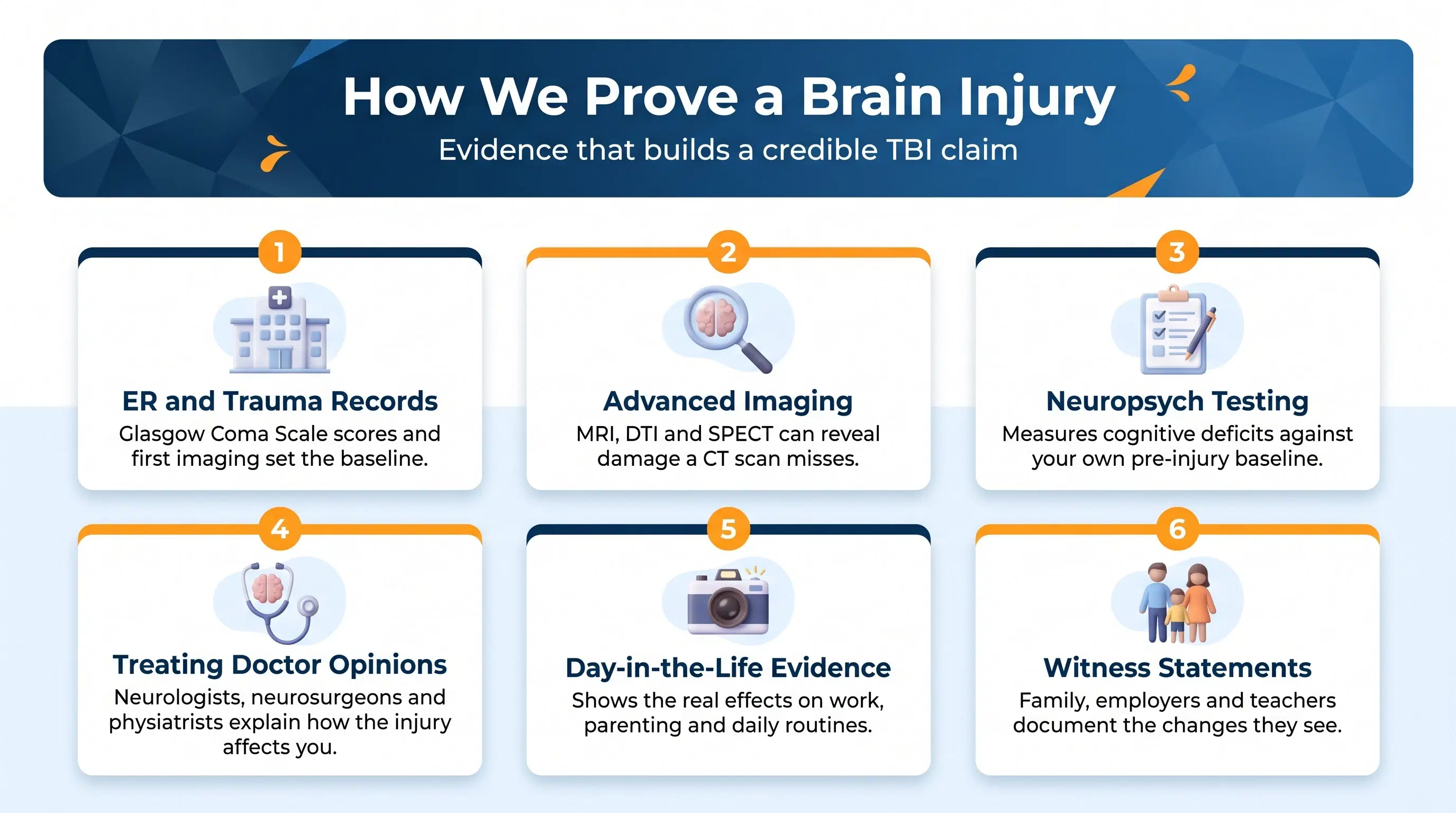
Insurance carriers routinely contest TBI claims, especially mild traumatic brain injury, because the damage is not always visible on standard CT scans. Building a credible record requires layering evidence:
- Emergency room and trauma records, including Glasgow Coma Scale scores and initial imaging
- Advanced imaging such as MRI, diffusion tensor imaging, and SPECT where clinically indicated
- Neuropsychological testing that quantifies cognitive deficits against the client’s own pre-injury baseline
- Treating-physician opinions from neurologists, neurosurgeons, and physiatrists
- Day-in-the-life evidence showing real-world effects on work, parenting, and daily routines
- Witness statements from family, employers, and teachers documenting changes
- Vocational and economic analysis projecting lost earning capacity
We pair this medical proof with liability evidence: police reports, electronic data recorder downloads from passenger vehicles, commercial vehicle logs, surveillance video from nearby businesses, and accident reconstruction where causation is contested.
How do we choose the right Los Angeles brain injury legal representation?
Finding a brain injury lawyer in Los Angeles after a serious head injury can feel like merging onto the I-10 at rush hour. It is overwhelming, fast-moving, and full of options, but the choice you make early shapes the rest of your recovery.
What you actually need is more than a general-practice accident lawyer. Look for a firm that handles catastrophic injuries all the time, and that already knows how to coordinate with neurologists, neuropsychologists, life-care planners, and forensic economists. Then ask three questions. How often do they actually try cases? How do they put numbers on long-term medical care? And how exactly are they going to keep you informed? Clear strategy. Plain-English answers. Those are the real signals that the firm is the right fit.
Local experience matters too. A Los Angeles brain injury attorney who knows the LA County Superior Court system, local judges, and area trauma centers can move your case forward faster. Most trusted firms, including GoSuits, offer free consultations and take cases on a contingency basis. That means no attorney fee unless we recover. Case costs and medical bills may still be owed.
Why do dedicated brain injury lawyers outperform generalists?
If you needed brain surgery, you would not choose a general practitioner. You would seek out a board-certified neurosurgeon. The same logic applies when choosing a lawyer after a TBI.
Catastrophic-injury attorneys limit their practice to serious injuries, brain and spinal cases, and wrongful death. They understand how to preserve crash data, push back on aggressive insurance companies, and work with the medical professionals who can support a claim. At GoSuits, our entire team is focused exclusively on personal injury law. Our trial team has tried cases to verdict in Los Angeles County Superior Court, and our founding attorney, Sean Chalaki, is recognized in The Best Lawyers in America (2025, 2027) and Texas Super Lawyers (2022-2026).
Generalist attorneys may not recognize the warning signs of a missed mild TBI, may not know how to challenge a defense neuropsychologist, and may not have access to the life-care planners and economists who quantify long-term cost. When you choose a firm focused on personal injury, you gain a deeper level of strategy and a stronger negotiating position.
How GoSuits Los Angeles brain injury lawyers can help you
Recovering from a brain injury is hard enough. That is why our team steps in early to manage the legal side, so your attention stays on neurology appointments, rehabilitation, and your day-to-day stability. From the moment you call us through the day your settlement clears, we manage the moving parts. We pull police reports and 911 audio, preserve vehicle and surveillance evidence, and help coordinate care with neurologists, neuropsychologists, and rehab providers. If a crash totaled your vehicle, we coordinate rental car arrangements so your transportation does not become another problem. If you do not have health insurance or your plan will not cover the right specialists, we connect you with local providers who treat on a medical lien, with no upfront cost to you. At the end of the case, we negotiate those liens down so more of the settlement actually reaches your pocket.
We are familiar with the insurance process and what it takes to build a strong TBI claim. Our team works with treating physicians and life-care planners to estimate long-term costs like future neurosurgical care, attendant care, and lost earning capacity. If the insurance company will not negotiate fairly, we are fully prepared to take your case to trial. Our trial attorneys try cases to verdict in Los Angeles County Superior Court, and our founding attorney, Sean Chalaki, is recognized in The Best Lawyers in America (2025, 2027) and Texas Super Lawyers (2022-2026).
What makes GoSuits different is our deep knowledge of the Los Angeles County legal field. We understand how to navigate local courts and anticipate common obstacles, which helps us move your case forward without unnecessary delays. You will receive regular case updates, secure access to your file, and a prompt response when you reach out. Brain injury cases also routinely overlap with other claim types, so when an injury arises in a different context we coordinate with the right team inside the firm. If you would like to schedule a free consultation with a Los Angeles brain injury attorney, we are available 24/7 in English, Spanish, and Farsi.
We also work on a contingency fee basis, which means you do not pay anything up front. You only owe a fee if we recover compensation on your behalf. When you work with our Los Angeles personal injury team, you are partnering with a legal team focused on transparency, communication, and reliable results.
For more resources, explore our Knowledge Base, including our guide to how much most personal injury cases settle for.