






























What areas in North Texas do Dallas SUV rollover lawyers serve?
If you were injured in an SUV rollover anywhere in the Dallas-Fort Worth Metroplex, GoSuits is ready to help. While we’re rooted in Dallas, our legal team serves clients throughout the region, from the suburban corridors of Plano and Carrollton to the busy streets of Irving and the eastern reaches of Greenville.
Rollovers happen everywhere: on freeway interchanges like the High Five at I-635 and US-75, on rural farm-to-market roads in southern Dallas County, in shopping center parking lots, and on construction-zone detours along I-30. No matter where your crash occurred, we bring local knowledge and legal experience to protect your rights and pursue the compensation you deserve.
Most Dallas crashes aren’t rollovers. The ones that are, though, do an outsized share of the killing. TxDOT recorded 43,946 reportable crashes in Dallas County in 2025, according to its crash report data as of April 7, 2026. Nationally, the Insurance Institute for Highway Safety (IIHS) reports that rollover crashes accounted for 28% of all passenger vehicle occupant deaths in 2024, and 33% of occupant deaths in SUVs. That higher SUV share has more to do with center of gravity than driver behavior. And because risk looks different on the LBJ than it does on a feeder road in Oak Cliff, we work each case with that geography in mind.
Areas we commonly serve
- Central Dallas: Downtown, Uptown, Oak Lawn, Deep Ellum, Bishop Arts, Oak Cliff
- North Dallas and suburbs: Preston Hollow, Lake Highlands, Plano, Carrollton, Richardson, McKinney, Frisco
- East and Southeast: Mesquite, Garland, Rowlett, Greenville, Forney
- West and Mid-Cities: Irving, Grand Prairie, Farmers Branch, Coppell
Wherever you are in the Dallas area, we’re just a call away and always ready to step in when you need legal guidance after a rollover.
What is an SUV rollover and why are these crashes different?
A rollover is what it sounds like. The vehicle tips onto its side, or all the way onto its roof, during a crash. SUVs, pickups, and the tall passenger vans you see hauling kids around are especially at risk because they sit up high and carry a lot of weight at the top, which means a higher center of gravity and a smaller margin before things go sideways. Literally. The Insurance Institute for Highway Safety has shown that SUVs roll over noticeably more often than sedans in single-vehicle wrecks, especially when a driver swerves hard or clips a curb, guardrail, or soft shoulder.
Rollovers don’t injure people the way a fender-bender does. Not even close. When a vehicle flips, occupants get tossed against the roof, the side pillars, the windows, sometimes all of it in the span of a second or two. That’s when roof crush becomes a problem. Or ejection through a window. Or a seatbelt that doesn’t hold. The injuries you see, severe spinal cord damage, traumatic brain injury, multiple fractures, fatalities, are nothing like a sore neck after a parking-lot tap. So the cases come in heavier too. Bigger medical bills, longer recoveries, and liability questions that involve drivers, manufacturers, and sometimes road agencies all at once.
Common causes of SUV rollovers in Dallas
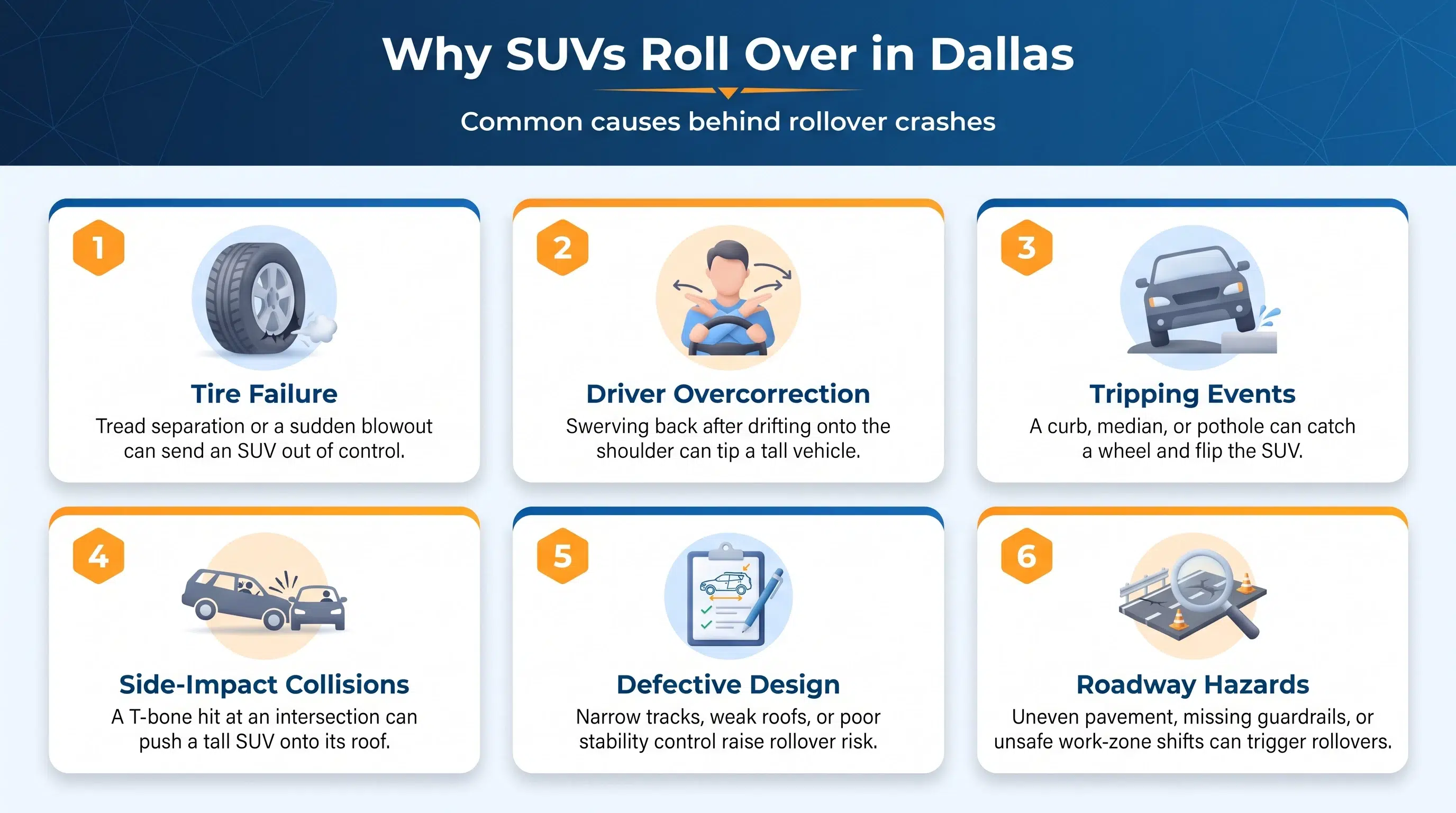
- Tire failure: tread separation or a sudden blowout on I-35E or the Dallas North Tollway can send a top-heavy SUV out of control in seconds.
- Driver error: overcorrection after drifting onto the shoulder, especially at highway speeds.
- Tripping events: hitting a curb, median, or pothole that catches the wheel and flips the vehicle.
- Side-impact collisions: a T-bone hit at an intersection like Northwest Highway and Preston Road can flip a tall SUV onto its roof.
- Defective design: SUVs with narrow tracks, weak roofs, or inadequate electronic stability control are more rollover-prone.
- Roadway hazards: uneven pavement, missing guardrails, poorly designed shoulders, or unsafe construction-zone transitions.
Types of SUV rollover cases we handle in Dallas
Rollover crashes can happen in countless ways, but if someone else’s negligence is to blame, you shouldn’t have to bear the costs alone. At GoSuits, we’ve helped clients across Dallas and North Texas recover from serious injuries caused by all of the rollover scenarios below.
Single-vehicle SUV rollovers
Single-vehicle rollovers are everywhere. SUV drifts, swerves, or hits something, and over it goes. The easy answer is ‘driver made a mistake,’ and the insurer will run with that all day. But pretty often, when we actually look at the vehicle, we find something else going on, a defective tire, a worn suspension component, an unmarked hazard in the road, or an electronic stability control system that didn’t do its job. So we pull the EDR data, photograph tread separations before the SUV gets crushed at salvage, and bring in reconstruction professionals to walk back the physics.
Multi-vehicle rollover collisions
Side-impact crashes at Dallas intersections, sudden lane changes on I-635, and rear-end hits at highway speed can all push an SUV into a rollover. We collect police reports, dashcam video, and witness statements to map out who hit whom and in what order, which matters under Texas’s modified comparative-fault rule.
Commercial and fleet SUV rollovers
When the rollover involves a company-owned SUV, a chartered passenger SUV, or an oversized commercial vehicle, the case looks more like a trucking claim. Driver logs, maintenance records, and corporate safety policies all become important. Our work in this area runs alongside our broader commercial-vehicle litigation experience.
Defective vehicle and tire claims
If a manufacturing defect contributed to the rollover, the claim moves beyond the at-fault driver and reaches the manufacturer. Roof crush, seatbelt failure, defective tire tread, missing rollover protection, and inadequate stability control are all recognized product-liability theories. We preserve the vehicle, hire engineers, and coordinate with safety professionals to build the technical record.
Fatal rollover and wrongful death claims
Because rollovers cause a disproportionate share of vehicle fatalities, families too often face a wrongful death claim instead of a personal injury one. We handle the investigation, paperwork, and insurance filings while you focus on grieving and supporting your family. The Texas wrongful death statute (Tex. Civ. Prac. and Rem. Code Ch. 71) allows surviving spouses, children, and parents to recover lost earnings, lost companionship, and mental anguish.
Injured in a different type of crash? We also handle Dallas truck rollover claims and motorcycle injuries, and we partner with families through fatal-crash recovery when an SUV rollover takes a loved one.
Common injuries from SUV rollover crashes
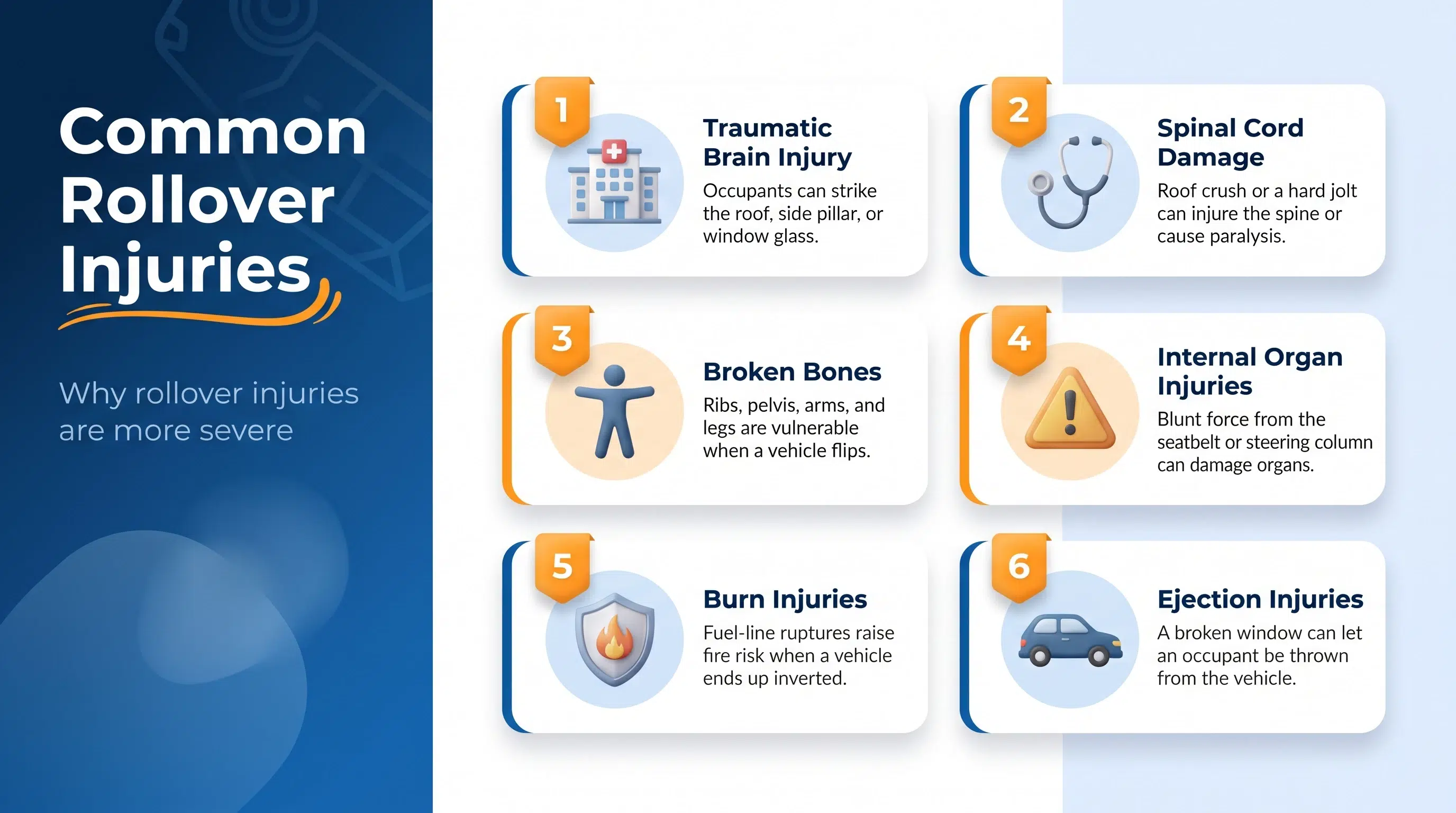
Rollover injuries tend to be more severe than the average crash injury because of the physics involved: occupants experience multiple impacts during a single event. The injuries we see most often in Dallas rollover cases include:
- Traumatic brain injuries: from striking the roof, side pillar, or window glass.
- Spinal cord injuries and paralysis: when the roof crushes downward or the occupant is jolted hard against the seat structure.
- Broken bones and crush injuries: ribs, pelvis, arms, and legs are all vulnerable when a vehicle flips.
- Internal organ damage: from blunt force against the seatbelt, steering column, or interior trim.
- Burns: rollovers carry a higher fire risk because of fuel-line ruptures and inverted fuel-tank positioning.
- Ejection injuries: when a window breaks and an occupant is partially or fully thrown from the vehicle.
Choosing the right SUV rollover legal representation in Dallas TX
Finding a personal injury lawyer in Dallas after a rollover can feel like trying to merge onto Central Expressway during rush hour. It is overwhelming and filled with options, but making the right choice early on can shape your entire recovery journey.
You need more than a lawyer who occasionally handles accident claims. Look for someone who focuses on serious-injury and rollover litigation, and who has worked through the engineering side of these crashes. Ask how often they go to trial, how they calculate long-term medical costs, and how they plan to keep you informed. A clear legal strategy and a willingness to communicate in plain English are signs you are in good hands.
Local experience is also key. A Dallas SUV rollover attorney who knows the Dallas County District Court system, local judges, and area hospitals can spot potential delays and move your case forward faster. Most trusted firms, including GoSuits, offer free consultations and take cases on a contingency basis. That means no attorney fee unless we recover. Case costs and medical bills may still be owed.
Dedicated injury lawyers vs. generalists: why it matters
If you needed back surgery, you would not choose a general practitioner. You would seek out a board-certified spine surgeon. The same logic applies when choosing a lawyer after a rollover.
Focused personal injury attorneys limit their practice to accident claims, serious injuries, and wrongful death cases. They understand how to preserve crash data, negotiate with aggressive insurance companies, and work with medical professionals who support your claim. At GoSuits, our entire team is focused on personal injury law, with particular attention to high-severity vehicle crashes like rollovers.
Generalist attorneys may not recognize important deadlines or know how to calculate the full value of a long-term disability. They often lack access to specialists such as orthopedic surgeons, accident reconstruction professionals, biomechanical engineers, and economists who help prove damages.
Understanding Texas SUV rollover laws
Texas follows a modified comparative fault rule, often called the “51% bar.” Under Texas Civil Practice and Remedies Code Section 33.001, if you are found more than 50% at fault for the crash, you cannot recover damages from another party. If you are 50% or less at fault, your recovery is reduced by your share of fault. For example, if your damages total $200,000 and you are deemed 20% at fault, your recovery would be $160,000.
Timing also matters. Most personal injury claims in Texas must be filed within two years from the date of the incident, under Tex. Civ. Prac. and Rem. Code Section 16.003. If a government vehicle, road defect, or municipal entity is involved, the Texas Tort Claims Act often requires written notice within 6 months, and many Texas cities (including Dallas) require notice even sooner under their charters.
Damages in a rollover case are typically split into economic and noneconomic categories. Economic damages cover medical expenses, lost wages, future care, and property damage. Noneconomic damages cover pain, mental anguish, disfigurement, and loss of enjoyment of life. In rare situations involving gross negligence (for example, a manufacturer that knew about a rollover defect and concealed it), punitive damages may apply, capped under Tex. Civ. Prac. and Rem. Code Section 41.008.
Product-liability claims involving defective tires, roof structures, or stability systems are governed by Tex. Civ. Prac. and Rem. Code Chapter 82, which sets the framework for manufacturer liability. A separate 15-year statute of repose for many products appears in Tex. Civ. Prac. and Rem. Code Section 16.012.
How GoSuits Dallas SUV rollover lawyers can help you
Recovering from a rollover is hard enough. That’s why our team steps in early to manage the legal side, so your attention stays on your health and day-to-day stability. From the moment you call us through the day your settlement clears, we run the case as a single coordinated process.
Right after you reach out, our intake team gathers the basics, dispatches an investigator if needed, and begins preserving evidence: the police crash report, the vehicle itself (so it isn’t crushed by a salvage yard before it can be inspected), the tire that may have failed, photos of the scene, and any nearby surveillance video. We also coordinate a rental car so you have transportation while your damaged SUV is held for inspection or repaired.
If you don’t have health insurance or your deductible is steep, we can connect you with Dallas-area doctors who treat on a medical lien, meaning no upfront cost to you. You get the orthopedic, neurological, and physical therapy care you need, and the providers wait to be paid out of the eventual settlement. At the end of the case, we go back and negotiate those liens down so the dollars that actually reach your pocket are as large as possible. That last step matters: a strong gross settlement is only worth so much if half of it goes to medical liens.
Behind the scenes, we work with medical providers and care planners to estimate long-term costs like future surgeries, assistive devices, home modifications, and lost income. If the insurance company won’t negotiate fairly, we are fully prepared to file in Dallas County District Court and take your case to a jury. As part of our full Dallas personal injury firm, you get the resources of a larger litigation team plus the attention of a lawyer who returns your calls.
What makes GoSuits different is our deep knowledge of North Texas’s legal environment. We understand how to navigate local courts and anticipate common obstacles, which helps us move your case forward without unnecessary delays. You’ll receive regular case updates, secure access to your file, and a prompt response when you reach out.
We also work on a contingency fee basis, which means you don’t pay anything up front. You only owe a fee if we recover compensation on your behalf. When you’re ready to talk to a lawyer about your rollover, you can contact our team for a free, no-pressure consultation, or reach out to our Dallas personal injury team for help on a related claim.
For more resources, explore our Knowledge Base, including our guide to how much a personal injury case is worth in Dallas.