
Bus and shuttle crash claims in Texas follow a different set of rules than ordinary car accident claims. Texas law imposes a heightened standard of care on commercial passenger carriers. When the bus is operated by a government entity such as Dallas Area Rapid Transit (DART) or a public school district, the Texas Tort Claims Act limits how much you can recover and requires you to act on a short notice deadline. When the bus is a private charter, a commercial shuttle, or a motor coach operated by an interstate carrier, different rules apply. In any crash involving multiple injured passengers, the single available insurance policy must stretch to cover every victim, which can dramatically reduce what each person receives. This article explains those distinctions so you understand the landscape before making decisions about your claim.
What Is a Common Carrier and Why Does It Matter?
Texas law recognizes a distinction between ordinary negligence and the heightened duty owed by a common carrier. A common carrier is an entity that holds itself out to the public as available to transport passengers for compensation. City buses, regional transit systems, commercial motor coaches, airport shuttles, and school buses operated under contract all qualify. [1]
The heightened standard means a common carrier must exercise the utmost care and diligence that a very cautious, prudent, and competent person would use given the mode of transportation. This is a stricter obligation than the ordinary “reasonable person” standard that applies to private drivers. In a Dallas personal injury claim, plaintiffs who were injured as paying passengers can point to this elevated duty to establish that even a relatively minor lapse in driver judgment or vehicle maintenance can constitute actionable negligence.
Courts applying Texas law have consistently held that the heightened standard does not make carriers insurers of passenger safety, but it does mean the carrier bears the burden of explaining why a preventable crash occurred. This matters at the George L. Allen Sr. Courts Building in Dallas County, where bus injury cases are tried, because juries are instructed on a higher standard when the defendant is a common carrier.
If you were injured on a DART bus, a charter vehicle, or a school bus and you are trying to sort through your options, the Dallas personal injury lawyers at GoSuits can review the specific circumstances of your case.
What Texas Law Says About DART Bus Crashes
DART is a regional transit authority created under Texas law. As a governmental entity, DART enjoys sovereign immunity from lawsuits unless a specific statute waives that immunity. The Texas Tort Claims Act (TTCA), codified at Texas Civil Practice and Remedies Code Chapter 101, provides that limited waiver. [2]
Under the TTCA, a governmental unit can be liable for personal injuries caused by the negligent operation of a motor-driven vehicle by an employee acting in the scope of employment. DART buses meet that description. However, the waiver comes with significant restrictions.
Damage Caps Under the TTCA
The TTCA caps damages against a governmental unit at $250,000 per person and $500,000 per single occurrence, regardless of the number of claimants. Punitive or exemplary damages are not available against governmental entities under the Act. [3]
These caps apply in the aggregate to a single incident. If a DART bus crash on a busy I-35E corridor injures ten passengers, the total the agency must pay across all claims from that single event is limited to $500,000 no matter how severe the collective injuries are. Each injured person’s share must fit within that pool.
The Mandatory Notice Deadline for DART Claims
Before suing a governmental unit under the TTCA, an injured person must provide written formal notice of the claim to the governmental unit within six months of the date of the incident. [2] This notice requirement is separate from and shorter than the general statute of limitations for personal injury claims. Failure to provide timely notice generally bars the claim.
The notice must be delivered to an authorized officer of the governmental unit and must state the damage or injury claimed, the time and place of the incident, and the incident that caused the damage or injury. Many injury victims are unaware of this deadline and lose otherwise valid claims because they wait too long before consulting legal help.
Personal injury lawyers who handle bus accident claims in Dallas know that the six-month notice clock begins running immediately after the crash, even if you are still in the hospital and still treating injuries. Do not wait.
School Bus Crash Claims: How Are School Districts Treated?
Texas school districts are also governmental entities that receive the same TTCA protections. A school district can be sued for a crash involving a district-owned, district-operated bus only if the claim falls within the Act’s waiver for motor vehicle negligence. The same $250,000/$500,000 damage caps apply, and the same six-month notice requirement governs. [2]
If a school district contracts with a private bus company to transport students, the analysis changes. The private carrier does not share the school district’s governmental immunity. Injured students, parents, and others harmed by the negligence of a private contractor’s driver may pursue a claim against the private company under ordinary common carrier negligence principles, without the caps and without the six-month notice rule.
One important wrinkle in school bus cases involves whether the student’s injury occurred on or off school property and whether the district had control over the bus at the time. These fact-specific questions can affect both liability and the applicable legal standard. An attorney familiar with personal injury lawyers Dallas handles can help navigate that analysis.
Example: DART Bus vs. Private Charter
Hypothetical for illustration purposes only. Not based on any actual GoSuits case.
Suppose two separate crashes occur on the same day in Dallas. In the first, a DART bus rear-ends a vehicle at a stop on South Lamar Street during morning rush hour, injuring three passengers on board. In the second, a private charter bus returning from a corporate event on the Dallas North Tollway blows a tire and rolls, injuring twelve passengers. In the DART scenario, all three passengers share a $500,000 TTCA cap, must file a six-month notice, and cannot seek punitive damages. In the private charter scenario, the twelve passengers can pursue the full commercial carrier’s liability policy (which may be $5 million or more under federal minimums for large buses), no governmental notice deadline applies, and punitive damages may be available if the evidence shows gross negligence. The two crashes involve similar mechanisms of injury but dramatically different legal frameworks.
Private Charter and Commercial Shuttle Operators: Different Rules Apply
Private charter buses, airport shuttles, limousine services, and interstate motor coaches are not governmental entities. They do not receive TTCA protection. They are subject to the full range of Texas common carrier negligence liability and, for interstate carriers, to federal Motor Carrier Safety Administration regulations found at 49 C.F.R. Parts 390 through 399. [4]
Federal law requires commercial buses designed to carry more than 15 passengers to carry minimum liability insurance of at least $5,000,000. Smaller vehicles designed to carry 8 to 15 passengers must carry at least $1,500,000. These federal minimums are substantially higher than what a private automobile driver must carry under Texas law. [5]
Private carriers can also be held liable for negligent hiring, negligent supervision, and negligent maintenance of their fleets. If a charter operator hired a driver with a history of commercial vehicle violations on US-75 or allowed a bus with known mechanical defects to remain in service, those facts can form independent grounds for liability beyond the driver’s individual negligence.
The bus accident lawyers in Dallas who handle these cases pursue all available defendants, including the operating company, the vehicle owner if different, and any maintenance contractor responsible for the failed component.
How Policy Limits Are Apportioned When Many People Are Injured
A bus crash is fundamentally different from a two-car collision because it often produces multiple injured claimants competing for coverage from a single policy. Understanding how that works is critical when evaluating the potential value of your claim.
First-Come-First-Served Is Not the Rule in Texas
Texas does not follow a strict first-come-first-served rule for insurance proceeds when multiple claimants share a single policy. If a carrier’s total liability exceeds the policy limits, all claimants generally must be paid proportionately, or the insurer must interplead the funds into court for a judge to allocate. This process can result in each claimant receiving a fraction of the policy limit even if their individual damages far exceed it.
Policy Exhaustion and Underinsured Claims
If you carry underinsured motorist (UIM) coverage on your own auto policy, that coverage may apply when a bus at fault carries inadequate limits to fully compensate you. This is true even though you were not in your own vehicle at the time of the crash. Texas law allows UIM coverage to follow the insured person, not just the insured vehicle, in certain circumstances. Verifying your own policy terms immediately after a crash is important. [6]
Priority of Claims in Multi-Victim Crashes
In a mass-casualty bus crash, the severity and extent of each person’s documented injuries plays a significant role in how policy proceeds are distributed during settlement negotiations. Victims with catastrophic injuries, significant documented medical expenses, and clear lost income have stronger positions in the allocation process. Victims who do not document their injuries promptly, or who delay seeking medical treatment, may find their share reduced.
This is one reason why prompt medical evaluation and thorough documentation matter so much in bus crash cases. If you were injured in a Dallas crash involving wrongful death lawyers handling passengers who did not survive, those wrongful death claims may also compete with injury claims for the same policy pool.
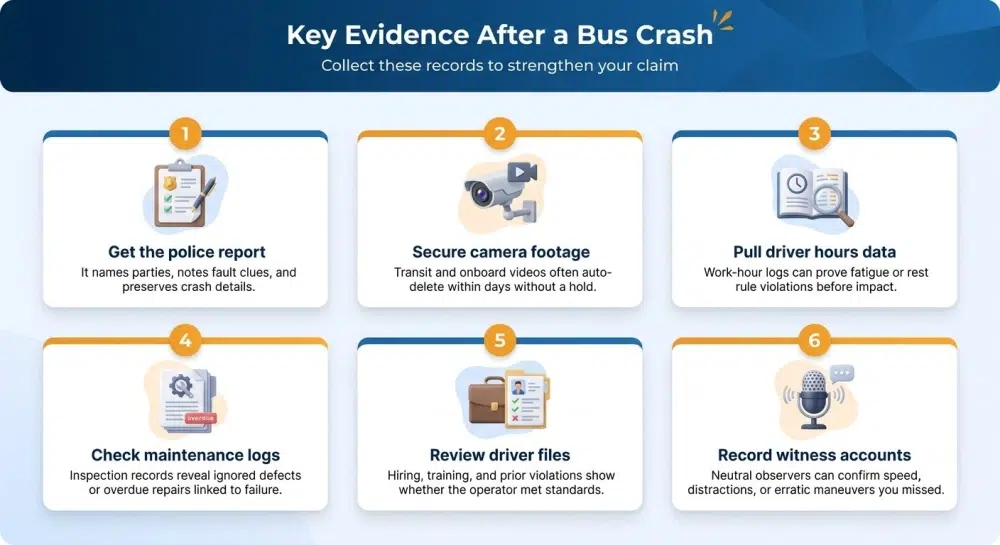
What Evidence Can Matter in a Bus Crash Claim
Bus crashes, whether on a DART route in Oak Cliff or on a charter coach traveling between Plano and downtown Dallas, generate a substantial evidentiary record. The following types of evidence can significantly affect the outcome of a claim.
- Police and accident reports: Texas law requires a written crash report when injury or death results. The report identifies the parties, witnesses, and preliminary fault findings.
- Dashcam and onboard camera footage: Many commercial buses carry multiple cameras. This footage can show the driver’s actions in the seconds before impact and the force of the collision. Preservation letters must go out immediately after the crash because carriers routinely overwrite digital recordings within days.
- Electronic logging device (ELD) data: Federal law requires interstate carriers to maintain hours-of-service records. ELD data can show whether the driver was fatigued or in violation of federal rest rules at the time of the crash.
- Maintenance and inspection records: Vehicle inspection records, pre-trip inspection logs, and repair histories can reveal whether a mechanical failure had been reported and ignored before it caused a crash.
- Driver background and qualification records: A motor carrier’s driver qualification file must contain driving history, training records, physical examination certificates, and prior employment history.
- Witness statements: Other passengers, bystanders, and other motorists may have observed the bus’s speed, the driver’s behavior, or road conditions before the impact.
- Medical records and bills: Contemporaneous medical documentation ties the crash to your injuries and establishes the foundation for economic damages.
For a thorough breakdown of preserving evidence after a multi-vehicle incident in the Dallas area, the multi-vehicle pileup fault on Dallas highways resource explains how courts assess fault when multiple parties are involved.

What Damages or Remedies May Be Available?
The categories of damages potentially recoverable in a Texas bus injury claim include the following. Recoverability depends on the facts, the type of defendant, and applicable legal caps.
- Past and future medical expenses for all reasonably necessary treatment caused by the crash
- Lost income and lost earning capacity if injuries affect the ability to work
- Physical pain and mental anguish, both past and anticipated future suffering
- Physical impairment, including limitations on daily activities and quality of life
- Disfigurement for visible permanent scarring or deformity
- Wrongful death damages if a family member was killed, including loss of consortium, loss of companionship, and funeral expenses, subject to applicable caps if the defendant is a governmental entity
- Exemplary (punitive) damages against private defendants in cases of gross negligence, but not against governmental units under the TTCA
- Property damage for personal property destroyed or damaged in the crash
When the defendant is DART or a school district, total recoverable damages are subject to the TTCA caps described above. When the defendant is a private carrier, damages are limited only by the evidence and the applicable policy limits, which may be substantial under federal minimums.
What If the Bus Operator Disputes Liability?
Bus operators and their insurers regularly dispute liability in serious crash claims. Common defenses include arguing that the crash was caused solely by another vehicle, that the passenger assumed the risk by standing in a moving bus, or that the passenger’s own conduct contributed to the injury. Texas applies a modified comparative fault rule: your damages are reduced by your percentage of fault, and you are barred from recovering at all if you are found to be more than 50% responsible. [7]
Governmental units sometimes assert that the TTCA waiver does not apply to the specific facts of the crash. For example, they may argue that the driver was not acting within the scope of employment at the time, or that the injury falls within an exception to the waiver. These disputes require careful legal analysis of both the factual record and the statutory text.
How Long Do I Have to Act?
The deadlines in bus crash cases are among the most important practical concerns. Missing any one of them can permanently bar a valid claim.
| Defendant Type | Notice Requirement | Statute of Limitations |
|---|---|---|
| DART (governmental unit) | Written notice within 6 months of the incident (TTCA §101.101) | 2 years from date of incident [AUTHORITY TO VERIFY: Tex. Civ. Prac. & Rem. Code §16.003] |
| Texas school district (governmental unit) | Written notice within 6 months of the incident | 2 years from date of incident |
| Private charter / commercial shuttle | No statutory pre-suit notice required | 2 years from date of incident for personal injury |
If the injured person is a minor, additional rules may extend the limitations period. If the injured person died, wrongful death and survival claims have their own limitations analysis. Each deadline requires attorney review to confirm accuracy for your specific situation.
What Should I Do Next?
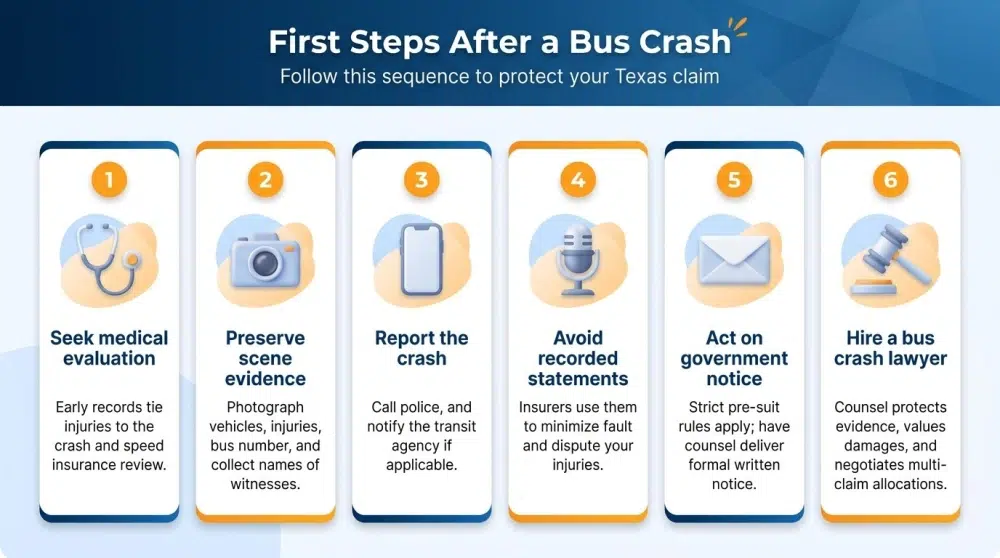
If you or a family member was injured in a Dallas bus or shuttle crash, the following steps can protect your rights and your ability to pursue a claim.
- Seek medical evaluation immediately, even if symptoms seem mild at first. Delayed-onset injuries are common in crash cases, and a gap in treatment can complicate your claim.
- Preserve evidence. If you can do so safely, photograph the scene, the vehicles, and your visible injuries. Note the driver’s information, the bus number, and any witnesses.
- Report the crash. If police have not already been called, request a report. For DART crashes, DART should also be notified.
- Do not give recorded statements to any insurance company without first speaking with legal counsel. Statements made without guidance can be used to minimize your claim.
- If the bus was a government vehicle, be aware of the six-month notice deadline and act immediately.
- Consult personal injury lawyers who handle bus accident claims in Dallas before signing any release or accepting any payment.
A bus crash claim can involve medical evidence, governmental immunity issues, insurance coverage disputes, and competition among multiple claimants for limited policy funds. If you were injured in a Dallas bus or shuttle crash, a GoSuits personal injury attorney can review the circumstances of your case and explain your options. Schedule a free consultation to get started.

Related Texas Personal Injury Resources
- Dallas Personal Injury and Accident Lawyers
- Bus Accident Lawyers in Dallas
- Dallas Wrongful Death Lawyers
- Multi-Vehicle Pileup Fault on Dallas Highways
- Texas Personal Injury Lawyers
Talk With a GoSuits Attorney
Bus and shuttle crash claims in Dallas require prompt action and careful strategy. Whether your claim involves DART, a school district, or a private charter operator, the rules that apply differ significantly from those that govern an ordinary car accident. Understanding those differences early can protect your rights and your recovery.
If you were injured as a passenger on a bus, shuttle, or charter vehicle in Dallas or the surrounding area, a GoSuits personal injury attorney can evaluate your situation and explain what options are available. Contact our Dallas personal injury team for a free, no-obligation consultation.
References and Legal Authorities
- Texas Transportation Code, Chapter 5 – Common Carriers – Texas Legislature Online
- Texas Civil Practice and Remedies Code, Chapter 101 – Texas Tort Claims Act – Texas Legislature Online
- Tex. Civ. Prac. & Rem. Code §101.023 – Damages – Texas Legislature Online
- 49 C.F.R. Parts 390–399 – Federal Motor Carrier Safety Regulations – Electronic Code of Federal Regulations
- 49 C.F.R. Part 387 – Minimum Levels of Financial Responsibility for Motor Carriers – eCFR
- Texas Insurance Code, Chapter 1952 – Uninsured and Underinsured Motorist Coverage – Texas Legislature Online
- Texas Civil Practice and Remedies Code, Chapter 33 – Proportionate Responsibility – Texas Legislature Online
- Common Carrier – Legal Information Institute, Cornell Law School
- Bus and Truck Safety Basics – Federal Motor Carrier Safety Administration, U.S. DOT
- Texas Court Rules – Texas State Law Library Research Guides