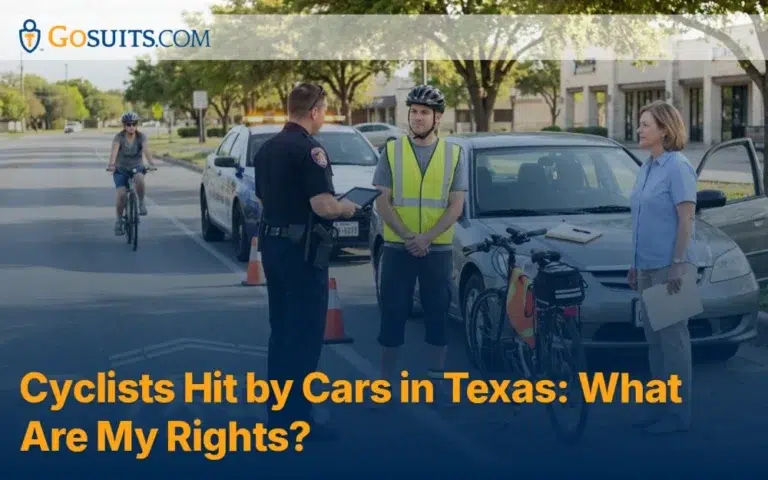
Texas law treats a person riding a bicycle on a public road as a vehicle operator with the same rights and duties as a motor vehicle driver. When a car strikes a cyclist, the cyclist can pursue a personal injury claim if the driver was negligent. The fact that helmets are not legally required for adults in Texas, or that a cyclist was wearing bright versus dark clothing, does not automatically reduce or eliminate recovery. What matters is who violated a legal duty, what evidence captures that failure, and how Texas proportionate responsibility rules apply to the specific facts.
Legal Snapshot
- Legal Topic: Bicycle accident claims cyclist rights and driver duties in Texas
- Jurisdiction: Texas state law (Dallas, TX and statewide)
- Primary Legal Issue: Negligence, proportionate responsibility, insurance coverage for cyclist injuries
- Primary Authority: Texas Transportation Code Chapters 545, 551; Texas Civil Practice and Remedies Code Chapter 33
- Case Stage: Pre-litigation / insurance claim / civil lawsuit
- Date Legal Authority Last Reviewed: 2025
What Rights Do Texas Cyclists Have on Public Roads?
Texas Transportation Code Chapter 551 establishes that a person riding a bicycle on a roadway has all the rights and is subject to all the duties applicable to the driver of a vehicle, except where a specific provision exempts cyclists or applies only to motorized vehicles. [1]
Those rights include the right to occupy a traffic lane, to proceed through intersections on a green signal, to travel on roads that are open to motor vehicle traffic, and to be treated as traffic by other road users. Along I-35E through Dallas and along US-75 (Central Expressway) where cyclists sometimes navigate frontage roads and shared paths, these rights mean that drivers are required to recognize and yield to cyclists just as they would to slower-moving vehicles.
Cyclists also have specific rights related to lane position. Under Transportation Code § 551.103, a cyclist traveling at a speed slower than other traffic may ride as near as practicable to the right curb or edge of the roadway, with statutory exceptions for preparing to turn left, overtaking another vehicle, and where hazardous conditions exist on the right side of the lane. This section does not require cyclists to leave the traveled lane entirely, and a driver who hits a cyclist lawfully in the lane cannot argue the cyclist had no right to be there.
What Does Texas Law Require of Drivers When Passing Cyclists?
Texas Transportation Code § 545.0516 requires a driver overtaking a cyclist proceeding in the same direction to pass at a safe distance of not less than three feet between any part of the vehicle and the bicycle. [2] This three-foot passing rule creates a measurable, codified standard of care. When dashcam footage, tire marks, or witness statements indicate a driver passed within two feet of a cyclist before a collision, that evidence is directly relevant to the question of negligence.
Dallas law enforcement and TxDOT crash investigators have documented numerous rear-end and sideswipe collisions involving cyclists on corridors like the Dallas North Tollway and along surface streets in Oak Cliff, Deep Ellum, and Uptown where cyclists and cars share lanes. In any such case, whether the three-foot rule was observed is one of the first factual questions a personal injury attorney will investigate.
Does Texas Require Cyclists to Wear Helmets?
There is no statewide Texas law requiring adults to wear bicycle helmets. Some municipalities have enacted local ordinances requiring helmets for minors, but none of those applies statewide to adults. [3] This matters significantly in a civil injury case because the absence of a helmet law means that a court cannot treat helmet non-use as a per se violation of any safety statute.
However, a defense attorney or an insurance adjuster may still argue that riding without a helmet was a form of contributory conduct that caused or worsened head injuries. Under Texas’s proportionate responsibility framework, governed by Texas Civil Practice and Remedies Code Chapter 33, a jury can assign a percentage of fault to the plaintiff if it finds that the plaintiff’s own conduct contributed to the harm. [4]
Whether that argument succeeds depends on the facts. A cyclist whose broken arm resulted from a driver running a red light is unlikely to see a helmet-use argument carry much weight. A cyclist with traumatic brain injury who was not wearing a helmet and whose head struck pavement may face a more contested proportionate fault determination. Neither outcome is automatic, and having legal counsel who understands how to present and rebut this evidence makes a meaningful difference.
How Do Clothing and Conspicuity Arguments Affect a Texas Bicycle Claim?
Insurers defending at-fault drivers sometimes argue that a cyclist wearing dark clothing at dusk, or without front and rear lights required by Transportation Code § 551.104, was a contributing cause of the collision because the driver could not see the cyclist in time to stop. [5]
Texas law is pretty specific about nighttime bike gear. Under § 551.104 of the Transportation Code, you need a front lamp throwing white light visible from at least 500 feet, plus a red reflector or red lamp on the back visible from 300 feet. No lights at night? That’s a traffic violation. And here’s the kicker, that violation can get dragged into a civil case as evidence you contributed to the crash, which under proportionate responsibility could shave a chunk off whatever you’d otherwise recover.
The table below summarizes how Texas law structures these proportionate responsibility arguments in bicycle claims.
| Defense Argument | Legal Basis (or Lack Thereof) | Practical Effect on Recovery |
|---|---|---|
| No helmet worn | No adult helmet law in Texas. Argument limited to specific head injury causation. | May reduce damages for head injuries if causation is proven; does not bar recovery entirely |
| Dark clothing at dusk | No statutory clothing requirement. Jury may consider visibility. | May support some percentage of fault; countered by driver’s duty to see and avoid traffic ahead |
| No lights at night | Violation of Tex. Transp. Code § 551.104 if riding after dark without required lamps. | Supports proportionate fault argument; degree depends on other circumstances |
| Riding outside bike lane | Chapter 551 permits riding in the travel lane under several conditions. | Weak argument if cyclist was exercising a statutory right to the lane |
Texas isn’t an all-or-nothing state. Under § 33.001 of the Civil Practice and Remedies Code, a cyclist can still recover as long as their assigned fault stays at or below 50 percent. And a 25 percent finding just trims 25 percent off the recovery, not the whole thing. Getting your head around proportionate responsibility is probably the single most important part of sizing up a Dallas bicycle injury claim. We walk through the whole standard, and how it works in Texas auto cases, in our article on the Texas modified comparative fault and 51% bar rule .
What Insurance Policy Covers a Cyclist Injured by a Driver in Texas?
At-fault state. That’s the starting point for Texas auto insurance. [6] When a driver hits a cyclist, the driver’s liability coverage is typically the primary source of civil recovery for the injuries and any damage to the bike or gear. But here’s the problem, minimums in Texas are $30,000 per person and $60,000 per accident, and serious cycling injuries tend to blow past that pretty quickly. [7]
What if the driver’s underinsured, or has nothing at all? Then your own uninsured/underinsured motorist coverage, the UM/UIM part of your auto policy, can step in, assuming you actually carry it. Texas insurers have to offer UM/UIM, but you can waive it in writing. A lot of people do without really thinking about it. And here’s something people forget, your homeowner’s or renter’s policy might have personal liability coverage that touches certain parts of a crash scenario too.
Then there’s MedPay. It’s the medical payments coverage on an auto policy, and it pays out for medical expenses no matter who caused the crash. A lot of policies extend that MedPay protection to the named insured even when they’re hit as a pedestrian or cyclist, though you kind of have to read the specific policy language to be sure. Figuring out every source of coverage is honestly one of the first things a personal injury lawyer digs into after a Dallas bicycle collision.
What Is a Dooring Accident and Who Is Liable in Texas?
Getting doored is exactly what it sounds like. Someone sitting in a parked or stopped car swings their door open and a cyclist rides right into it. Texas Transportation Code § 545.418 actually makes that illegal, at least when the door opens onto the side facing moving traffic, unless the person can do it safely without messing with the flow of traffic. [8] And the rule doesn’t stop there, leaving that door hanging open longer than you need to load or unload someone is also a violation.
Liability isn’t just on the driver. A passenger who pops the door open is fair game too. Look at Dallas, parts of Bishop Arts District, the Kessler neighborhood, restaurant blocks in Lower Greenville, all of them mix parallel parking with active bike lanes and pretty much beg for dooring incidents. The person who opened the door is usually the one who’s on the hook when a cyclist gets doored, though nothing’s automatic here, every case gets a fact-specific look.

Hypothetical Example
A cyclist is riding in a designated bike lane along a commercial corridor in Dallas near Uptown. A car is parked parallel to the curb. As the cyclist passes, the driver’s side door swings open and strikes the cyclist’s handlebars, throwing the cyclist to the pavement. Under Texas Transportation Code § 545.418, the driver’s act of opening the door into traffic without checking mirrors violates the statute, providing evidence of negligence in a civil claim. If the driver’s liability insurer argues the cyclist was too close to parked cars, the cyclist may respond that the driver had a statutory duty to ensure the door opening was safe before doing so.
This is a hypothetical illustration only. Case outcomes depend on specific facts and applicable law.
What Is a Right-Hook Collision and What Are a Cyclist’s Rights?
A right-hook collision happens when a driver turns right across the path of a cyclist who is traveling in the same direction. The driver cuts across the cyclist’s lane or the adjacent bike lane to complete the turn, and the cyclist either strikes the side of the turning vehicle or swerves and crashes to avoid it. These collisions often occur at intersections where drivers fail to check their mirrors or look for cyclists in the lane to their right before turning.
Here’s the yield rule. Texas Transportation Code § 545.101 and its related provisions basically say a driver making a right turn can’t interfere with traffic in the adjacent lane, and cyclists in that lane are traffic. And if there’s a dedicated bike lane involved? The duty gets even more pointed, the driver crossing that lane to finish the turn has to yield to any cyclist in it before completing the maneuver.
Serious right-hook crashes are a real problem in urban Dallas, and they show up over and over on the same kinds of streets, busy commercial stretches in Carrollton and Plano, service roads along the LBJ Freeway, anywhere cyclists have to share frontage roads with right-turning drivers. So what do you do after one? Move fast. Dashcam footage, intersection cameras, witness statements, all of that stuff needs to be gathered quickly because it’s what actually establishes how the collision went down.
What Evidence Can Matter in a Texas Bicycle Injury Claim?
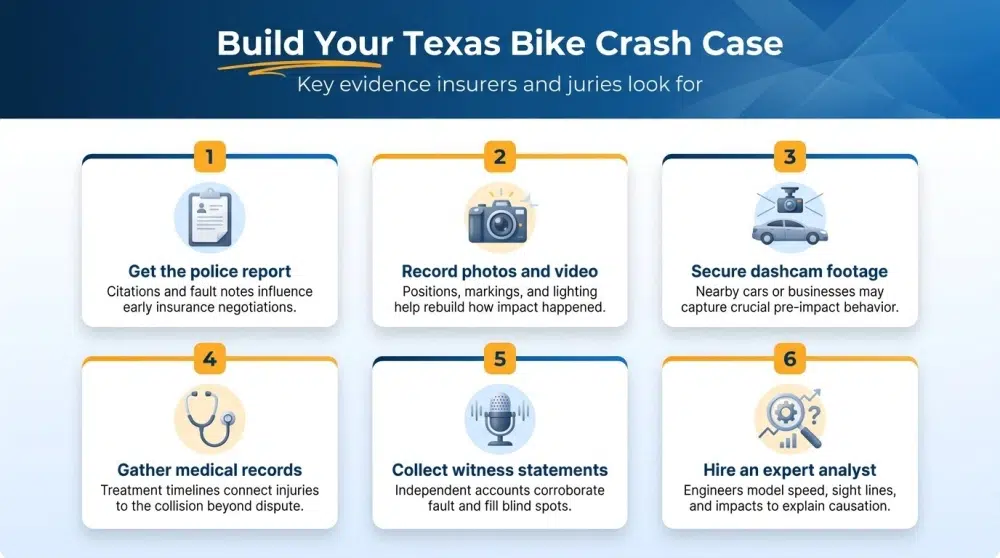
Evidence in a bicycle accident claim involves both proving what the driver did wrong and rebutting the arguments a defense attorney or insurer will raise about the cyclist’s conduct. Key categories of evidence include:
- Police report: Officers document the initial scene, cite any traffic violations, and assess visible fault. While not binding, a police report’s findings are factually significant in insurance negotiations.
- Scene photographs and video: Photographs capturing the position of vehicles, skid marks, bicycle damage, road markings, traffic controls, lighting conditions, and the cyclist’s clothing and equipment provide context no verbal account can fully replace.
- Dashcam footage: The driver’s dashcam, footage from nearby business surveillance cameras along the Dallas North Tollway service road or a commercial strip in Frisco, or transit agency cameras can record the entire sequence leading to impact.
- Bicycle equipment: Whether the bicycle had working lights at the time of a nighttime collision, the condition of brakes, and any impact damage to the frame and components can corroborate or challenge competing accounts.
- Medical records: The nature, location, and severity of injuries provide physical evidence of the mechanics of the collision. Helmet presence or absence matters only if head injury is alleged and causation is disputed.
- Witness statements: Bystanders, adjacent cyclists, and nearby business employees who observed the collision or its immediate aftermath provide independent accounts.
- Expert analysis: An accident reconstruction engineer can analyze vehicle speed, sight lines, reaction time, and impact mechanics to explain how the collision occurred.
- Cell phone records: If distracted driving is suspected, records of driver phone activity at the time of impact can become relevant with proper legal process.
What Damages Are Available to a Cyclist Injured in Texas?
A Texas cyclist who proves a driver’s negligence caused the collision may recover both economic and non-economic damages. Texas Civil Practice and Remedies Code Chapter 41 governs exemplary damages, and Chapter 33 governs the proportionate responsibility framework that can reduce recoverable amounts. [9]
Economic damages include past and future medical expenses, lost income from time off work, reduced earning capacity if the injury affects the cyclist’s ability to work at their prior occupation, property damage to the bicycle and gear, and other quantifiable out-of-pocket costs.
Non-economic damages include physical pain, mental anguish, physical impairment, and disfigurement. Texas law allows recovery for all of these in personal injury cases, though calculating their value requires careful documentation of how the injury has affected the injured person’s daily life, relationships, and activities.
A fatal case is different. If a cyclist doesn’t survive, the family may bring wrongful death and survival claims under Chapter 71 of the Texas Civil Practice and Remedies Code. These aren’t the same as a personal injury claim, and they come with their own filing requirements and deadlines that don’t wait around. Car accident lawyers handling fatal cycling cases know the clock starts from the date of death, usually two years, and getting the investigation moving early is honestly one of the most important things you can do. [10]
How Long Do I Have to File a Bicycle Accident Claim in Texas?
Texas Civil Practice and Remedies Code § 16.003 sets a general two-year statute of limitations for personal injury claims. [11] That period runs from the date of the injury. Missing the deadline ordinarily extinguishes the right to pursue any civil recovery, regardless of the strength of the underlying claim.
Government cases play by different rules. If the at-fault driver was a city employee behind the wheel of a city vehicle, or if a transit bus or government fleet car was involved, the Texas Tort Claims Act requires you to give written notice of the claim within six months of the incident. [12] And some local governments write in even shorter notice windows through their own charters. Miss that notice deadline and your claim can be dead in the water long before the two-year statute of limitations ever runs out.
Acting promptly is always advisable. Evidence deteriorates, witnesses’ recollections fade, and surveillance footage is typically overwritten within days or weeks. Dallas personal injury lawyers can send preservation letters and begin investigation immediately after a bicycle collision, protecting evidence that may otherwise be lost.

What Should I Do After Being Hit by a Car While Cycling in Texas?
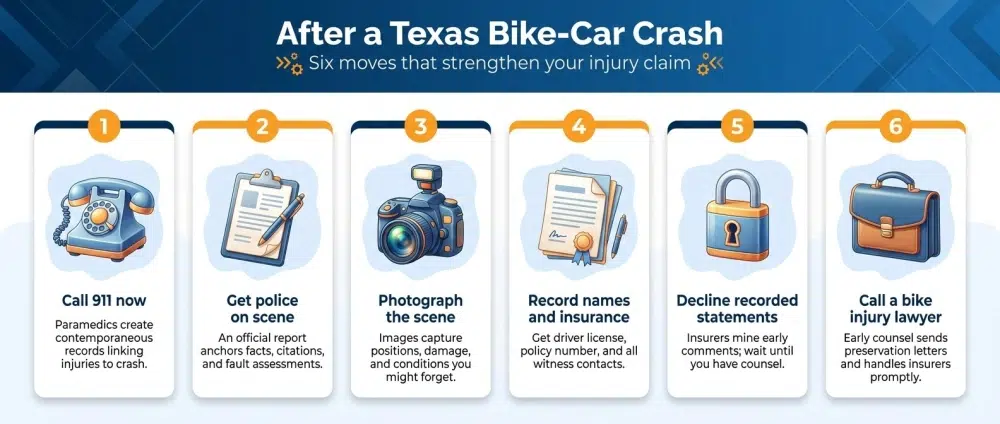
The steps taken in the hours and days after a cycling collision directly affect the strength of any subsequent injury claim. When physically able to do so:
- Call 911 and request medical attention. Even injuries that appear minor at the scene can worsen. A gap between the collision and first medical treatment creates a factual gap that can be exploited later.
- Request law enforcement response. Ask the responding officer to document the crash, note any citations issued, and prepare a crash report. Request the report number before leaving the scene.
- Photograph everything you can. Vehicle positions, road markings, traffic signals, lighting conditions, your bicycle, your clothing, and any visible injuries.
- Collect contact information. Driver name, license number, insurance carrier and policy number, vehicle description, and contact information for any witnesses.
- Do not give a recorded statement to the at-fault driver’s insurer without first consulting with an attorney. Statements made in the immediate aftermath of a collision can be taken out of context.
- Keep your bicycle and gear. Do not repair the bicycle until it has been documented and inspected. The damage pattern can be evidence.
- Follow up with medical care consistently. Consistent treatment creates a medical record that connects your injuries to the collision over time.
- Contact a personal injury attorney. The earlier legal representation begins, the more preservation and investigation options remain available.
An injury claim after a cycling collision involves medical evidence, insurance disputes, liability questions, and legal deadlines. If you were hit by a car while cycling in Dallas or anywhere in Texas, a GoSuits personal injury attorney can review your situation and explain your options.
References and Legal Authorities
- Texas Transportation Code Chapter 551 – Rights and Duties of Cyclists – Texas Legislature Online
- Texas Transportation Code Chapter 545 – Operation and Movement of Vehicles (including § 545.0516 three-foot passing rule) – Texas Legislature Online
- Bicycle Laws in Texas – Texas State Law Library
- Texas Civil Practice and Remedies Code Chapter 33 – Proportionate Responsibility – Texas Legislature Online
- Texas Transportation Code § 551.104 – Bicycle Equipment Requirements – Texas Legislature Online
- Auto Insurance in Texas – Texas Department of Insurance Consumer Guide
- Minimum Coverage Requirements – Texas Department of Insurance
- Texas Transportation Code § 545.418 – Opening Vehicle Door – Texas Legislature Online
- Texas Civil Practice and Remedies Code Chapter 41 – Exemplary Damages – Texas Legislature Online
- Texas Civil Practice and Remedies Code Chapter 71 – Wrongful Death; Survival – Texas Legislature Online
- Texas Civil Practice and Remedies Code § 16.003 – Statute of Limitations – Texas Legislature Online
- Texas Tort Claims Act – Texas Civil Practice and Remedies Code Chapter 101 – Texas Legislature Online
- 23 U.S.C. § 217 – Bicycle Transportation and Pedestrian Walkways – Cornell Law School LII
- National Highway Traffic Safety Administration – Traffic Safety Facts: Bicyclists and Other Cyclists
- Bicycling Safety – Texas Department of Transportation