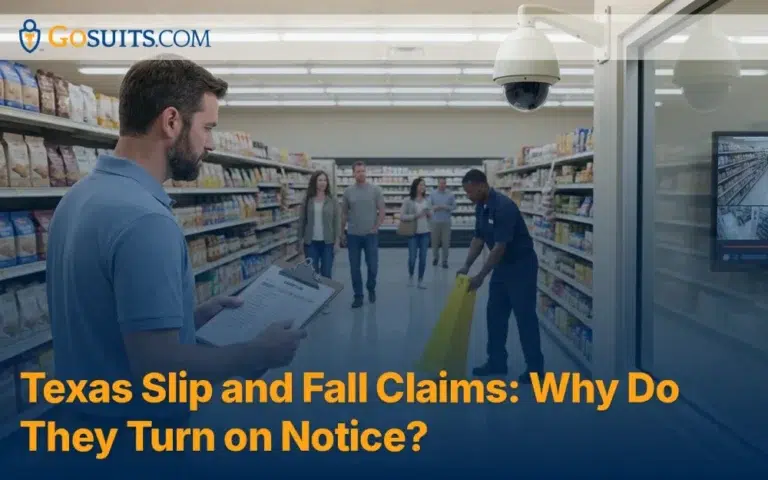
Texas slip and fall claims turn on notice. Almost every single one. The question is pretty much always the same. Did the property owner know about the dangerous condition, or should they have known before someone got hurt? Under Texas premises liability law, the injured invitee has to prove the owner had actual or constructive knowledge of the hazard and then didn’t fix it or warn people about it. No knowledge, no case. I mean, you can have a really serious injury and still watch the whole thing fall apart at trial. So if you got hurt on someone else’s property in Texas, it’s worth spending some time on why notice is the deciding issue, how courts measure this whole constructive knowledge idea, and what kind of evidence actually tends to prove it.
Legal Snapshot
- Legal Topic: Texas Premises Liability / Slip and Fall
- Case Stage: Pre-litigation through trial
- Primary Legal Issue: Actual or constructive knowledge of a dangerous condition
- Primary Authority: Texas common law premises liability; Texas Civil Practice and Remedies Code Ch. 16 (statute of limitations)
- Secondary Authorities: Corbin v. Safeway Stores, Inc., 648 S.W.2d 292 (Tex. 1983) [AUTHORITY TO VERIFY]; Wal-Mart Stores, Inc. v. Reece, 81 S.W.3d 812 (Tex. 2002) [AUTHORITY TO VERIFY]; Texas Pattern Jury Charge PJC 66.3 [AUTHORITY TO VERIFY]
- Jurisdiction: Texas (state law)
- Date Legal Authority Last Reviewed: July 2025
What Is Premises Liability in Texas?
Premises liability. That’s the corner of Texas law that decides when a property owner or occupier is on the hook for injuries that happen on their property. It’s a type of negligence, technically, but Texas courts treat it as its own thing with its own elements. And that matters. A premises liability claim isn’t the same as a plain-vanilla negligence claim, and Texas courts can get pretty strict about keeping the two separate. [1]
The law divides injured visitors into three categories: invitees, licensees, and trespassers. The category determines how much protection the law extends.
| Visitor Type | Who Qualifies | Duty Owed by Owner |
|---|---|---|
| Invitee | Customers, shoppers, restaurant guests, apartment tenants in common areas | Duty to inspect for hazards, repair known conditions, or warn of unreasonably dangerous conditions the visitor would not discover |
| Licensee | Social guests, people with permission but no business purpose | Duty to warn of known dangers; no duty to inspect for unknown dangers |
| Trespasser | People present without permission | Generally, duty not to cause willful injury (with limited exceptions for child trespassers) |
Retail stores, grocery stores, restaurants, apartment common areas, parking lots, and most commercial spaces are open to the public on a business basis, so most fall victims are invitees. Invitees receive the highest level of legal protection, but that protection still requires proving notice.
What Does Texas Law Require an Invitee to Prove?
To recover as an injured invitee under Texas premises liability law, a plaintiff must establish each of the following elements:
- The owner or occupier had actual or constructive knowledge of a condition on the premises;
- The condition posed an unreasonable risk of harm;
- The owner did not exercise reasonable care to reduce or eliminate that risk; and
- The owner’s failure to use reasonable care proximately caused the plaintiff’s injury. [2]
The first element, knowledge, is the one that derails most Texas slip and fall cases. Without proof that the owner knew or should have known about the hazard, even a serious fall on a dangerous surface cannot support a recovery.
Actual Notice Versus Constructive Notice in Texas
Texas courts recognize two types of knowledge that satisfy the notice requirement.
Actual notice basically means the owner or one of their employees knew about the hazard before someone got hurt. Pretty straightforward on paper. An employee spills a drink and wanders off without cleaning it up. That’s actual notice. A manager who hears a customer complain about a busted step and just shrugs? Also actual notice. And yeah, when it’s there, it’s the easier version to prove. But getting proof is the hard part, because businesses almost never fess up to knowing about a problem in advance.
Constructive notice means the condition existed for long enough, or was so obvious, that a property owner exercising reasonable care would have discovered and addressed it. Constructive knowledge is how most Texas fall cases are actually won or lost, because it does not require a smoking-gun admission.
The central question in constructive notice cases is: how long was the hazard present before the injury? Texas courts look to whether the condition existed for a sufficient amount of time that reasonable inspection procedures would have revealed it. [3]
The GoSuits knowledge base article on constructive vs. actual notice in premises liability covers this distinction in detail, including how courts weigh circumstantial evidence of how long a hazard existed.
The Time-on-the-Floor Problem: Why Duration Is the Hardest Element to Prove
For constructive notice to exist, the dangerous condition must have been present for a long enough period that a property owner using ordinary care would have found it. Courts and juries refer to this as the “time-on-the-floor” analysis, though the formal legal standard uses the phrase “temporal element.” [3]
The problem for most fall victims is straightforward: they do not know how long the spill, debris, or defect was there before they fell. A wet floor in a Dallas grocery store aisle could have appeared two minutes before the fall or two hours before. That difference is legally significant. Two minutes generally is not enough time to give rise to constructive notice. Two hours almost certainly is.
Texas courts have held that the mere presence of a substance on the floor, without evidence about how long it was there, is not enough to support constructive notice. [3] This is one reason why Texas slip and fall cases are harder to pursue than many people assume.
Evidence that can speak to duration includes:
- The physical condition of the substance itself (dried edges, cart tracks through a spill, dust accumulation)
- Footprints through the substance suggesting it predated heavy foot traffic
- Employee testimony about when the area was last inspected
- Inspection and sweep logs
- Surveillance footage showing the moment the hazard appeared
Without at least one of these sources, a plaintiff may be unable to satisfy the temporal element even if their injuries are severe. For a person injured at a busy strip mall in Plano or a high-traffic store in the Design District in Dallas, the evidence gathering window is often very short.
Sweep Logs and Inspection Records: What They Are and Why They Matter
Many retail stores, grocery chains, and large property operators maintain written inspection or sweep logs. These records document when employees walked an aisle or area and confirmed it was clean and hazard-free. Sweep logs can be powerful in a Texas slip and fall case, but they cut both ways.
When a sweep log shows that an area was inspected 30 minutes before a fall with no hazard noted, that entry can weaken a constructive notice argument. The owner may argue that the hazard appeared after the last inspection and that reasonable care was exercised.
Conversely, when a sweep log shows that no inspection occurred for several hours in a high-traffic area, or when no log exists at all, that gap becomes evidence of inadequate inspection practices. Courts permit juries to consider whether the inspection intervals were reasonable given the nature of the property and the volume of foot traffic.
Sweep logs also raise authenticity questions. If a log was created or backdated after an incident, that manipulation can become a significant issue in litigation. Preserving the original log, along with any metadata or electronic records tied to it, is a critical early step in these cases.
Personal injury lawyers who handle fall claims often send a written preservation demand to the property owner within days of an incident, specifically identifying inspection logs, maintenance records, and cleaning schedules as documents that must not be destroyed.
Surveillance Footage and Retention Windows: The Race Against Deletion
Surveillance footage is often the single best piece of evidence in a Texas slip and fall case. A camera covering the aisle, walkway, or parking lot where the fall occurred can show exactly when the hazard appeared, whether any employees walked through the area, and the circumstances of the fall itself.
The critical problem is footage retention windows. Most retail stores and commercial properties overwrite surveillance footage automatically, often within 30 to 72 hours. Some larger systems retain footage for 7 to 14 days, while some smaller properties may retain footage for as little as 24 hours.
Once footage is overwritten, it is gone permanently. An injured person who waits a week to consult an attorney and another week for the attorney to send a preservation demand may find that the video no longer exists. This is one of the most common and most damaging delays in Texas slip and fall cases.
The practical implication is that anyone who is seriously injured in a fall on commercial property should move quickly. A prompt preservation demand letter, sent by certified mail or overnight courier, puts the property owner on notice that the footage is relevant to a potential legal claim. If the owner destroys footage after receiving that notice, Texas courts may instruct the jury that the destroyed evidence was unfavorable to the owner, a doctrine called spoliation. [4]
In addition to store cameras, nearby businesses, traffic cameras, and ATM cameras along the same corridor may have captured useful footage. Identifying those supplemental sources quickly is part of the early case development process. Dallas slip and fall lawyers routinely canvass neighboring businesses within the first few days following a serious fall.
The Open and Obvious Defense in Texas
Property owners in Texas frequently assert what is commonly called the open and obvious defense. The argument is that the dangerous condition was so visible and apparent that a reasonable person would have noticed and avoided it, and therefore the owner had no duty to warn of or remedy it. [5]
Texas law does recognize this defense but does not apply it as an absolute bar in every case. The Texas Supreme Court has held that the open and obvious nature of a condition does not automatically negate a property owner’s duty to make the premises safe. Courts instead consider the open and obvious character of a hazard as relevant to comparative fault, not as an automatic elimination of the owner’s duty. [5]
Texas follows a modified comparative fault system under which an injured party can recover only if their percentage of fault is 50 percent or less. If a jury finds the plaintiff more than 50 percent responsible for the injury, the plaintiff recovers nothing. The open and obvious nature of a hazard is typically argued by the defense as evidence that the plaintiff was partly or entirely at fault for not paying attention.
Whether a condition was truly “open and obvious” is usually a factual question for the jury. A wet floor with no warning sign is not self-evidently open and obvious simply because water is wet. Dim lighting, crowded shopping conditions, and the natural direction of a pedestrian’s gaze all affect whether a hazard was actually visible. Courts look at what a reasonable person in that specific situation would have observed, not what a careful and unhurried observer could theoretically have seen.
How These Rules Apply: A Hypothetical Example
The following is a hypothetical example for educational purposes only. It does not describe an actual case.
Suppose a shopper enters a large grocery store off a busy corridor near downtown Dallas on a rainy weekday afternoon. Near the produce section, they slip on a puddle of water. They suffer a fractures wrist and a torn knee ligament.
In this hypothetical scenario, the analysis would proceed as follows:
- Status: The shopper is an invitee. The full duty of inspection and warning applies.
- Actual notice: Unless an employee saw the puddle or caused it, actual notice is unlikely to be established without direct testimony.
- Constructive notice: The plaintiff’s attorney requests all surveillance footage covering the produce section for the 48 hours before the fall. The footage shows the puddle visible on camera for 34 minutes before the fall. Three employees are seen walking past the area during that window without stopping to address it.
- Sweep log: The log shows the aisle was last inspected approximately two and a half hours before the fall, placing the produce section outside the store’s own stated inspection interval.
- Open and obvious: The defense argues the puddle was visible. The plaintiff responds that the lighting was low near the refrigerated display, the puddle was clear and colorless against a light-colored floor, and the plaintiff was momentarily reading a label when the fall occurred.
- Comparative fault: A jury would weigh these factors to assign percentage of responsibility to each party.
This hypothetical illustrates how the notice element, evidence preservation, and comparative fault all intersect in a typical Texas premises case.

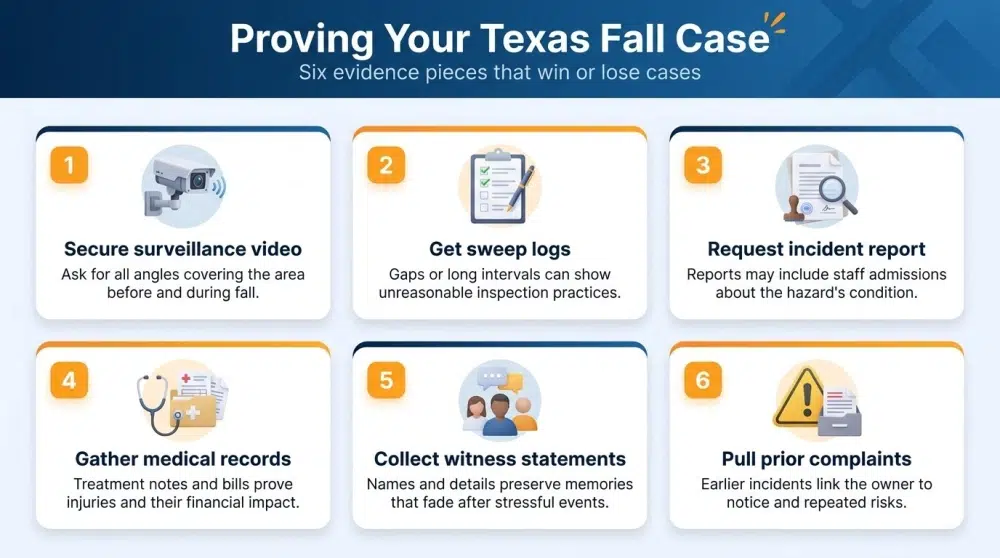
What Evidence Can Matter in a Texas Slip and Fall Case?
Depending on the facts, the following categories of evidence may be relevant to a Texas premises liability claim:
- Surveillance video: Shows when the hazard appeared, who walked past it, and the fall itself. Subject to rapid deletion.
- Inspection and sweep logs: Establish the owner’s actual inspection practices and whether those practices were reasonable.
- Incident reports: Prepared by the property at the time of the fall. May contain admissions about the condition of the property.
- Photographs and video taken at the scene: Document the hazard, the condition of the surface, and any absence of warning signs. Should be taken immediately after the fall if the injured person is physically able.
- Medical records and bills: Document the nature and severity of the injury and connect it causally to the fall.
- Witness statements: Other shoppers or bystanders who saw the hazard or the fall. Contact information should be collected promptly.
- Prior complaints or incidents: Records showing the same condition caused or nearly caused other injuries. Highly relevant to both notice and the owner’s failure to respond.
- Maintenance records: Show whether the property had a history of poor maintenance in the affected area.
- Employee testimony: Depositions of employees on duty at the time may reveal who knew what and when.
Evidence alone does not guarantee liability. It must be assembled into a coherent legal theory under Texas premises law. Slip and fall injury attorneys help evaluate which evidence exists, what additional evidence may be obtained through the discovery process, and how to present it effectively.
What Damages May Be Available in a Texas Slip and Fall Case?
Texas law permits an injured invitee to seek several categories of compensation, subject to proof and the applicable fault rules:
- Medical expenses: Past and future medical bills, including emergency care, surgery, physical therapy, and ongoing treatment.
- Lost income: Wages or salary lost because of the injury, including time spent in recovery and attending medical appointments.
- Loss of earning capacity: If the injury permanently affects the person’s ability to earn at the same level as before.
- Physical pain and suffering: Compensation for the physical pain caused by the injury.
- Mental anguish: Anxiety, depression, fear, and emotional suffering related to the injury.
- Physical impairment: Loss of physical function, including limitations on daily activities.
- Disfigurement: Visible scarring or permanent physical change resulting from the injury.
Texas does not cap compensatory damages in most personal injury cases. Punitive or exemplary damages are available only in narrow circumstances, generally where the defendant’s conduct involved fraud, malice, or gross negligence, and are subject to caps under Texas Civil Practice and Remedies Code Chapter 41. [6]
The recoverable amount depends on the specific facts, the severity of the injury, and how comparative fault is assigned. No outcome can be promised or predicted in advance.
Apartment Common Areas and Residential Property Claims in Texas
Falls do not happen only in retail stores. Apartment common areas, parking garages, leasing office lobbies, stairwells, and pool decks are all premises where an invitee may be injured. The same notice requirement applies.
Apartment landlords and property management companies owe their tenants and invited guests the same duty of reasonable inspection and maintenance in common areas. A broken stair railing in a complex in Oak Cliff, a cracked sidewalk in a Carrollton apartment community, or a poorly lit parking garage in the Uptown Dallas corridor can all give rise to premises liability claims if the owner knew or should have known about the hazard and failed to address it.
Residential property cases often involve longer-standing defects, which can make constructive notice easier to establish. A defective stair that has been in disrepair for months, or a recurring water leak in a common hallway, may be the subject of prior maintenance requests or complaints. Those records become key evidence.
How Long Do I Have to Act Under Texas Law?
Texas imposes a two-year statute of limitations on personal injury claims, including slip and fall cases. Under Texas Civil Practice and Remedies Code Section 16.003, an injured person generally must file suit within two years of the date the injury occurred. [7]
Missing that deadline almost always means losing the legal right to recover, regardless of how strong the case would have been. However, the two-year period can be affected by:
- Discovery rule: In some circumstances, the limitations period may not begin until the injured person knew or should have known of the connection between the injury and the hazard.
- Claims against government entities: Texas law imposes much shorter notice deadlines and additional procedural requirements when the defendant is a government entity, such as a city, county, or state agency. The Texas Tort Claims Act governs these claims and requires prompt written notice to the governmental unit. [8]
- Minors: Special rules may apply when the injured person is a minor.
These exceptions are highly fact-specific and require legal analysis. Consulting an attorney as soon as possible protects the injured person’s legal rights and preserves time-sensitive evidence.
What If the Property Owner Disputes Liability?
Property owners and their insurers routinely dispute liability in fall cases. The most common defenses raised in Texas premises cases include:
- No notice: The owner claims it did not know and had no reason to know about the hazard.
- Open and obvious: The hazard was visible and the plaintiff should have avoided it.
- Contributory negligence: The plaintiff was distracted, wearing improper footwear, or otherwise contributed to the fall.
- No causation: The owner claims the fall did not cause the injuries alleged, or that pre-existing conditions account for the claimed harm.
- Third-party fault: The condition was created by another customer, vendor, or contractor rather than by the owner’s employees.
Even when these defenses are raised, they do not necessarily end the claim. Texas juries weigh all the evidence and assign comparative fault percentages. A plaintiff who is found 30 percent at fault can still recover 70 percent of their damages.
What If Insurance Is Involved?
Most commercial property owners carry general liability insurance that covers premises injury claims. Apartment complexes and residential rental properties also typically carry liability coverage. After a serious fall, the injured person may deal directly with the property owner’s insurer rather than the owner itself.
Insurance adjusters are trained to limit payouts. Early recorded statements, quick settlement offers before the full extent of injuries is known, and requests for medical authorizations are all tactics used by claims professionals to minimize claim value. An injured person is not legally required to give a recorded statement to the other party’s insurer, and doing so without legal guidance can create problems for the claim later.
Slip and fall injury attorneys deal with liability insurers regularly. Representing an injured person in negotiations with an insurer is a core part of the claims process for personal injury lawyers who handle Dallas slip and fall lawyers cases and similar matters across Texas.
What Should I Do After a Slip and Fall Injury in Texas?
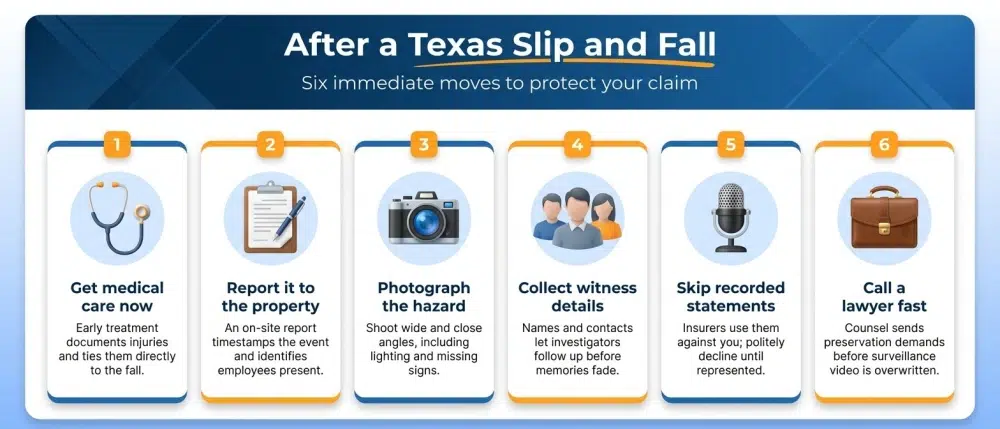
- Get medical care immediately. Your health is the priority, and a prompt medical record creates a contemporaneous connection between the fall and your injuries.
- Report the incident to the property. Ask for an incident report and request a copy.
- Photograph the scene. If you are physically able, photograph the hazard, the surrounding area, the absence of warning signs, and your injuries.
- Collect witness information. Names and contact details for anyone who saw the fall or the hazard.
- Preserve your clothing and footwear. These items may be relevant to a comparative fault argument and should not be discarded.
- Avoid giving recorded statements to the property owner’s insurer without legal guidance.
- Contact an attorney promptly. The sooner a preservation demand reaches the property owner, the better the chance that surveillance footage and inspection logs survive.
A Texas premises injury claim involves medical evidence, notice analysis, insurance negotiations, potential litigation in a Dallas County District Court or the appropriate jurisdiction, and legal deadlines that begin running from the date of injury. Taking the steps above and consulting an attorney early protects your legal rights.
Talk With a GoSuits Attorney
A Texas slip and fall claim involves the notice element, time-sensitive evidence, comparative fault questions, insurance negotiations, and procedural deadlines that begin on the date of injury. If you were injured in a fall on someone else’s property in Dallas or anywhere in Texas, a GoSuits personal injury attorney can review the circumstances of your situation and explain what options may be available.
Schedule a free consultation with our Dallas personal injury team to discuss your case.

Related Texas Personal Injury Resources
- Dallas Personal Injury Lawyers
- Dallas Slip and Fall Accident Lawyers
- Texas Personal Injury Lawyers
- Constructive vs. Actual Notice in Premises Liability
- The Personal Injury Claims Process in Texas Courts
- Statute of Limitations for Personal Injury in Texas
References and Legal Authorities
- Texas Constitution and Statutes – statutes.capitol.texas.gov (Texas Civil Practice and Remedies Code, primary source for Texas civil law)
- Premises Liability Overview – Legal Information Institute, Cornell Law School
- Texas Courts – Rules and Standards – txcourts.gov (Texas Pattern Jury Charges and appellate authority on constructive notice)
- Texas Court Rules Guide – Texas State Law Library (Texas Rules of Civil Procedure governing discovery and spoliation)
- Texas Civil Practice and Remedies Code – statutes.capitol.texas.gov (comparative fault provisions)
- Texas Civil Practice and Remedies Code Chapter 41 – statutes.capitol.texas.gov (exemplary damages cap)
- Texas Civil Practice and Remedies Code Section 16.003 – statutes.capitol.texas.gov (two-year statute of limitations for personal injury)
- Texas Tort Claims Act (Texas Civil Practice and Remedies Code Ch. 101) – statutes.capitol.texas.gov (governmental immunity and notice requirements)
- Texas Courts Online – txcourts.gov (Dallas County District Court and statewide court information)
- Texas Law Research Guide – Texas State Law Library