- Legal Topic: Motorcycle accident fault allocation and the failure-to-see defence
- Case Stage: Pre-litigation, insurance negotiation, and civil trial
- Primary Legal Issue: Comparative negligence and duty to maintain a proper lookout
- Primary Authority: California Civil Code § 1714; Li v. Yellow Cab Co., 13 Cal.3d 804 (1975)
- Date Legal Authority Last Reviewed: 2025
A driver who says “I never saw the motorcycle” is not, under California law, automatically relieved of liability. Every driver has a legal duty to see what is there to be seen. That duty includes actively scanning for motorcycles, checking blind spots, and looking before turning or changing lanes. When that duty is breached, the failure to perceive a lawfully present rider is itself evidence of negligence not a defence against it.
Yet the claim works in practice. Insurers, defence attorneys, and sometimes juries use the excuse of low visibility to argue that the rider was hard to spot, moved unpredictably, or failed to make themselves conspicuous. Those arguments shift a portion of fault onto the injured motorcyclist and in California’s pure comparative negligence system, every percentage point of fault assigned to a rider directly reduces what the rider can recover. If a rider is found 30% at fault for a crash in Irvine or anywhere else in California, the damages award shrinks by exactly 30%.
This article explains the legal weakness of the failure-to-see excuse, the evidence that dismantles it, why rider bias still shapes outcomes, and how the mathematics of fault percentages makes every disputed point genuinely consequential to a real injured person.
What Is the Failure-to-See Defence and Why Is It Legally Weak?
When a driver turns left across traffic and strikes an oncoming motorcycle, or merges into a lane occupied by a rider, the most common opening statement from the driver is simple: “I looked, but I didn’t see them.” Lawyers who handle motorcycle claims call this the failure-to-see defence. It is one of the most frequently raised and most legally fragile arguments in motorcycle accident litigation.
California Civil Code § 1714 requires every person to use ordinary care to avoid injuring others. [1] That statutory duty, confirmed by decades of California case law, imposes an affirmative obligation on drivers to actively look for other road users, not merely to glance in a direction and proceed. The California Supreme Court’s landmark 1975 decision in Li v. Yellow Cab Co., 13 Cal.3d 804, embedded the principle that each party’s failure of reasonable care, including the failure to perceive a hazard, is weighed proportionally in determining fault. [2]
The practical legal implication is straightforward: a driver cannot avoid fault by claiming they did not see what was plainly there to be seen. California courts and jury instructions specifically CACI No. 700 and 701 measure conduct against what a reasonably careful person would have done under the same circumstances. [3] A reasonably careful driver checks mirrors before turning, accounts for the possibility of motorcycles in adjacent lanes, and does not rely on a momentary glance as a substitute for a thorough lookout.
The failure-to-see defence, at its core, attempts to convert the driver’s own breach of the lookout duty into evidence that the motorcycle was somehow at fault for being difficult to see. That inversion is legally questionable but practically effective: insurance adjusters use it routinely in Irvine, along the I-405 corridor and SR-73, and throughout Southern California to reduce settlement offers by assigning a portion of fault to the rider.
Riders who work with motorcycle accident lawyers who understand how to challenge this framing, and who know how to develop the evidence that shows what the driver should have seen and when, are in a substantially better position than those who accept an insurer’s preliminary fault determination.
What Sightline and Lighting Evidence Can Counter the Failure-to-See Claim?
The most effective way to answer a failure-to-see argument is to demonstrate, with physical evidence, that the motorcycle was visible to an attentive driver from a sufficient distance to permit a safe stop or avoidance maneuver. Several categories of evidence accomplish this.
Sightline and Approach-Distance Analysis
An accident reconstructionist can calculate the sight distance available to the driver at the moment the potential hazard became apparent. For a left-turn crash at an intersection, one of the most common motorcycle accident scenarios anywhere in Orange County, this analysis determines how far away the motorcycle was when the driver entered the turn, and whether a driver paying reasonable attention would have seen the bike with enough time to yield.
If the motorcycle was 200 feet away and traveling at the speed limit, and the driver claims not to have seen it, the reconstructionist’s sight-distance calculation can show that a rider at that distance and speed was visible for well over two seconds time that a careful driver would have used. That finding directly contradicts the failure-to-see claim and re-anchors the negligence on the driver where it belongs.
Headlight and Lighting Configuration
Modern motorcycles are required by California Vehicle Code to have their headlights illuminated at all times during operation. [4] Photographs, witness accounts, and vehicle inspection can confirm whether the headlight was functional and lit. Investigators also consider ambient lighting conditions time of day, streetlight placement, and whether glare or shadow from the setting sun along a road like the SR-73 toll road corridor might have affected visibility in specific directions.
Riders who operate with daytime running lights, high-visibility gear, or auxiliary lighting can point to those features as evidence of conspicuity. Conversely, a rider without a functioning headlight may face a contributory-fault argument from the defence. The specifics of the lighting configuration at the time of impact matter, which is why preserving the motorcycle immediately after a crash before it is repaired is critical.
Lane Position of the Motorcycle
Where in the lane a rider was positioned at the time of impact affects both visibility and the allocation of fault. Riders who travel in the portion of the lane most visible to drivers approaching from the side, generally the left third of the lane when passing a row of parked vehicles or when approaching an intersection present a stronger visibility argument than those riding in areas where other vehicles or roadside obstructions could create visual obstruction.
Lane position also determines whether the rider had room to take evasive action and whether failure to do so can be characterized as contributing to the severity of the crash. An accident reconstructionist examines tire marks, final rest positions, and physical evidence to determine where in the lane the motorcycle was traveling before impact.
Approach Speed Reconstruction
Defence attorneys and insurers routinely argue that the motorcycle was traveling too fast for conditions. California Vehicle Code § 22350, the basic speed law, requires all drivers and riders to operate at a speed no greater than is reasonable given weather, visibility, traffic, and road conditions. [5]
Speed reconstruction through event data recorder analysis, skid mark measurement, physical damage patterns, and witness accounts allows investigators to estimate the motorcycle’s speed before impact. If the rider was at or below the posted limit and traveling at a speed appropriate for conditions, that reconstruction directly undermines the excessive-speed argument. If the rider was above the limit, a portion of fault may fairly attach, but that finding does not eliminate the driver’s concurrent duty to look.
Independent Witness Accounts
Bystanders, pedestrians, other drivers who were stopped at the light, and nearby business surveillance cameras can provide accounts that either confirm or refute the driver’s claim. A witness who says “the motorcycle was clearly visible and riding normally” is powerful evidence that the driver’s failure to see the bike was a failure of attention, not a result of any unusual quality of the rider’s visibility.
Surveillance video from businesses along Alton Parkway in Irvine or from intersection cameras operated by the city’s traffic management system can sometimes show the motorcycle’s position and speed leading up to impact, as well as the driver’s behavior in the moments before the turn or lane change. This footage typically overwrites quickly; preserving it through immediate legal action is essential.
What Is Rider Bias and How Does It Affect Fault Determinations?
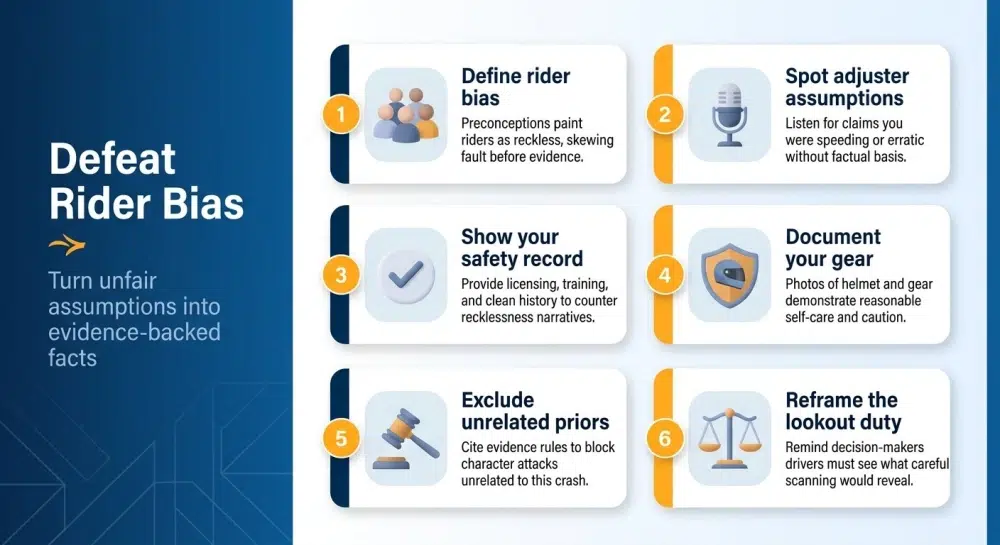
Rider bias is the collection of assumptions, some conscious, many not that decision-makers bring to motorcycle accident claims. Those assumptions include beliefs that motorcyclists are risk-takers, that they routinely speed, that their smaller size means they must have been in the wrong place, and that injuries are the natural consequence of choosing to ride. These assumptions do not reflect the law, but they operate powerfully in the informal stages of a claim and sometimes in the formal stages as well.
How Insurance Adjusters Use Rider Bias
At the claims adjustment stage, the failure-to-see argument combines with rider bias to create an informal presumption that the rider shares responsibility. An adjuster who assumes motorcyclists tend to speed will read a police report differently than one who does not. When a report notes that the driver “did not see” the motorcycle, an adjuster predisposed to rider bias will often interpret that fact as partial evidence against the rider perhaps the rider was in a blind spot because they were moving too fast or too erratically rather than as evidence that the driver failed to look carefully.
The result is that preliminary fault allocations from insurers in Southern California motorcycle claims frequently assign riders percentages of fault 20%, 30%, 40%, that are not grounded in the physical evidence but that reflect this ambient bias. Because the insurance company’s preliminary determination is not binding, and because a challenged determination can be revised through investigation and negotiation, accepting the first number is almost never in the rider’s interest.
Riding History, Gear, and Licensing as Weapons Against the Rider
A defence attorney or insurer may attempt to introduce a rider’s past traffic violations, prior accidents, license status, or choice of protective gear to paint a picture of recklessness. Under California’s rules of evidence, prior acts that are not relevant to the specific conduct in the accident at issue are generally excluded from trial. [6] But in the informal pre-litigation stage, these arguments shape offers.
Gear is particularly loaded. A rider without a helmet required by California law under Vehicle Code § 27803, creates a distinct vulnerability, as the defence will argue that the failure to wear a helmet contributed to the severity of head injuries. [7] A rider who was properly licensed and equipped, wearing a full-face helmet, protective jacket, gloves, and boots, presents a factual picture that contradicts the reckless-rider narrative at the core of rider bias.
Countering these characterizations requires building an affirmative record of the rider’s experience, licensing history, and safety habits and presenting that record to adjusters and, if necessary, to a jury.
How Is a Fault Percentage Argued and Why Does Each Point Matter?
California’s pure comparative negligence system, established by the California Supreme Court in Li v. Yellow Cab Co. allows a partially at-fault plaintiff to recover damages reduced proportionally by their own fault percentage. [2] Unlike the modified comparative negligence systems used in many other states, California imposes no percentage threshold that bars recovery. A rider found 75% at fault can still recover 25% of proven damages. But the math is unforgiving.
For more on how California’s comparative negligence framework applies across different types of vehicle collisions, see this detailed resource on California comparative negligence in car accidents.

The Financial Stakes of Each Fault Percentage Point
Consider a motorcycle accident involving a rider with documented damages, medical expenses, lost wages, future treatment costs, and pain and suffering totaling $500,000. The difference between a 25% and a 35% fault assignment to the rider is $50,000 in reduced recovery. A difference of ten percentage points, which might seem like a rounding error in a complex factual dispute, translates directly into tens of thousands of dollars in the rider’s pocket.
This is why the evidence analysis described above, sightline calculations, speed reconstruction, lighting documentation, lane position is not academic. Each piece of evidence that shifts the fault needle even a few points in the rider’s favor produces a real and significant financial consequence.
How Both Sides Argue the Fault Percentage
The driver’s insurer and defence attorney will typically argue for the highest possible fault allocation to the rider. They do this by characterizing the speed reconstruction as showing excessive speed, pointing to any sightline limitations attributable to the rider’s lane position, and emphasizing any failure to use evasive action. They will present this narrative through the police report, accident reconstruction, and expert testimony.
The rider’s representatives argue the opposite: that the driver had a clear line of sight and sufficient time to react, that the motorcycle’s speed was within legal limits, that the rider’s position was appropriate, and that the driver’s failure to maintain a proper lookout was the dominant cause. Each side’s argument is developed through the same physical evidence, interpreted through different frameworks of what a reasonably careful driver and rider would have done.
At trial, the jury receives California’s standard jury instructions CACI No. 700 and following, that define negligence as the failure to use the care that a reasonably careful person would use in the same situation. [3] The jury then assigns percentages that reflect their assessment of each party’s deviation from that standard.
Hypothetical Example: How the Numbers Work
Quick illustration, not a real case of ours. Rider on the I-405 by the Irvine Spectrum. Driver changes lanes, no signal, impact. The rider’s got $600,000 in documented damages. If the jury says the driver’s 80% at fault and the rider’s 20% at fault, maybe because they think the rider could’ve dodged, the recovery is $480,000. But if the evidence points more at the driver, say a 90% share, suddenly it’s $540,000. That’s sixty thousand bucks on a ten-point shift. Just one case. Just one adjustment. And honestly, that’s exactly why I keep hammering the evidence piece. The fault percentage controls everything, and it starts getting built or lost in the first few days after a crash.
What If Injuries Are Catastrophic or Fatal?
When a motorcycle crash produces catastrophic injuries, traumatic brain injury, spinal cord damage, limb amputation or results in the rider’s death, the damages at stake are correspondingly larger. The fault percentage becomes even more consequential when the underlying damages are substantial.
Wrongful death claims work the same way, basically. When a rider’s family files under California Code of Civil Procedure § 377.60, the same comparative fault math kicks in. If the deceased rider carried some share of the blame, whatever the family can recover gets cut down by that exact percentage. [8] And honestly, the failure-to-see defence and all that rider bias stuff? Shows up in these cases too. Same playbook. The evidence you need to push back on it is pretty much identical to what you’d build in an injury case.
Our Irvine personal injury team also handles cases where motorcycle crashes result in the loss of a loved one. When injuries prove fatal, the accident reconstruction, sightline analysis, and fault-allocation framework described above applies to a wrongful death claim in the same way it applies to an injury claim, but with higher stakes and greater emotional complexity for the families involved.
What Evidence Matters in a Failure-to-See Motorcycle Claim?
Building a case that counters the failure-to-see defence and rider bias requires assembling evidence across several categories, ideally beginning within hours of the crash.
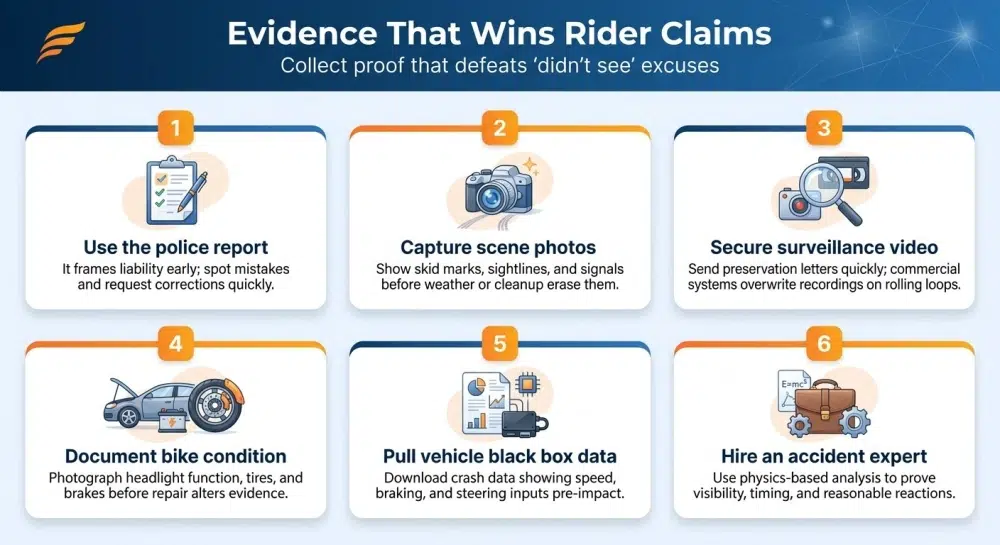
- Police collision report: Documents the officer’s initial impressions, road conditions, weather, any traffic citations issued, and statements from drivers and witnesses. Errors in the report can be challenged, but the report is the starting point for every subsequent investigation.
- Photographs and video at the scene: Capture skid marks, vehicle positions, road markings, sight distances, traffic controls, and lighting conditions. Photographs taken at the same time of day, a week later, can reconstruct ambient lighting conditions.
- Surveillance and dashcam footage: Business cameras near the crash site, city traffic cameras, and dashcams from nearby vehicles often capture the sequence of events before and during impact. This footage overwrites quickly preservation demands must be sent immediately.
- Motorcycle condition documentation: The motorcycle should be photographed and preserved before any repair. Headlight functionality, tire condition, brake wear, and vehicle configuration all bear on fault arguments.
- Event data recorder (EDR) data: Many modern vehicles record speed, braking, and steering inputs in the seconds before impact. The driver’s vehicle may contain EDR data that shows whether they were decelerating or maintaining speed when the crash occurred.
- Witness contact information: Names and phone numbers of all bystanders, pedestrians, and drivers who observed the crash or the conditions leading up to it.
- Medical records: Complete and contemporaneous documentation of all injuries and treatments, beginning with the emergency room visit. Gaps in medical documentation are used by insurers to minimize the severity of the claim.
- Expert accident reconstruction: A qualified reconstructionist can calculate approach speed, sight distances, reaction times, and the positions of vehicles at the moment of impact. Their analysis forms the factual backbone of fault allocation arguments.
How Long Do I Have to Act After a Motorcycle Crash in California?
California’s general statute of limitations for personal injury claims is two years from the date of injury under Code of Civil Procedure § 335.1. [9] Missing this deadline typically eliminates the right to pursue compensation through the courts, regardless of how clear the other driver’s fault may be.
Shorter deadlines apply in certain circumstances. Claims against a public entity including those involving a city-owned vehicle or a government employee driving on duty require a tort claim to be filed with the relevant agency within six months of the incident under the California Government Claims Act. [10] Failure to comply with the claims act deadline bars the lawsuit.
Legal deadlines aren’t the only clock running. There’s a practical one too, and honestly it’s the one that stings more. Surveillance footage? Gets overwritten, often within a week. Witnesses forget what they saw, or they move, or they just stop answering their phones. Physical evidence at the scene gets swept away, repaved, or straight-up lost. The investigation you can run in the first seven days after a crash is miles more productive than whatever you can scrape together six months down the road. So if you or someone in your family got hit on a motorcycle, now’s the time to start locking down evidence and talking to personal injury lawyers. Not next month. Now.
Can a rider still recover damages if they are found partially at fault?
Yes. The short version is that California is a pure comparative negligence state. So if a rider ends up with 40% of the blame, they can still recover 60% of their total proven damages, which honestly makes a huge difference compared to the stricter systems some other states use. Your recovery gets reduced by your fault share, but it’s not wiped out unless you’re carrying 100% of the fault. For context on a serious motorcycle crash in the Huntington Beach area, part of the Irvine cluster, see: Huntington Beach motorcycle fatality on PCH .
How is the motorcycle rider’s speed determined after an accident?
Speed is reconstructed through multiple sources: skid mark analysis, the extent and pattern of vehicle damage, event data recorder (EDR or “black box”) information from the vehicles involved, witness accounts, and comparison with the posted speed limit and road conditions. A qualified accident reconstructionist can calculate a range of probable pre-impact speeds that can be used to support or challenge the claim that excessive speed contributed to the crash.
Does riding without full gear affect fault or recovery in a California motorcycle claim?
California law requires motorcycle riders to wear an approved helmet (Vehicle Code § 27803). Riding without a helmet can result in a finding that the rider contributed to the severity of their own head injuries through comparative fault. Other protective gear, jacket, gloves, boots is not legally required but can become part of the factual narrative about whether the rider was acting with reasonable care for their own safety. Gear documentation should be preserved as evidence. See also: Moreno Valley fatal motorcycle accident for a Southern California example of the stakes involved.
How quickly should evidence be preserved after a motorcycle accident in Irvine?
As quickly as possible ideally within 24 to 48 hours. Surveillance video from nearby businesses and city traffic cameras typically overwrites on a rolling basis, often within three to seven days. Sending preservation letters to camera owners within 24 hours is the standard practice in properly handled motorcycle injury claims. Physical evidence at the scene, including skid marks and debris, can also be lost to street cleaning or weather. Photographs should be taken immediately. Contact with an attorney who can coordinate evidence preservation should happen as early as possible. For context on a fatal Southern California motorcycle crash, see: Bellflower 91 freeway motorcycle SUV crash.

Talk With a GoSuits Motorcycle Accident Attorney
A motorcycle accident claim involving the failure-to-see defence, rider bias, and comparative fault disputes is not a straightforward negotiation. It requires systematic evidence development, an understanding of how California’s proportional fault framework operates, and the ability to challenge inflated fault assignments with physical evidence and expert analysis.
If you or a family member was injured in a motorcycle accident in Irvine or anywhere in Orange County, our Irvine personal injury team handles motorcycle accident claims and works directly with clients from the beginning of the investigation through resolution. You will speak with an attorney, not a case manager and there are no fees unless we recover on your behalf.
Schedule a free consultation to discuss what happened, what evidence is available, and what your options may be under California law.
You can also learn more about how our Irvine motorcycle accident lawyers approach claims involving disputed liability and complex fault allocations.
Related California Personal Injury Resources
- GoSuits Irvine Personal Injury Lawyers: Motorcycle accident claims in Orange County – Irvine motorcycle accident lawyers
- GoSuits Irvine Personal Injury Team – Irvine personal injury and accident lawyers
- Wrongful death claims in Irvine and Orange County – Irvine wrongful death lawyers
- California comparative negligence explained – What is comparative negligence in a California car accident?
- Prior GoSuits case results – Prior Cases
- Our attorneys – Our Attorneys
- About GoSuits – About Us
- Practice areas – Practice Areas
References and Legal Authorities
- California Civil Code § 1714 – Duty of Ordinary Care – California Legislative Information
- Li v. Yellow Cab Co., 13 Cal.3d 804 (1975) – Google Scholar
- California Civil Jury Instructions (CACI), Nos. 700–701 – Judicial Council of California
- California Vehicle Code § 25650 – Motorcycle Headlamp Requirements – California Legislative Information
- California Vehicle Code § 22350 – Basic Speed Law – California Legislative Information
- California Evidence Code § 1101 – Character Evidence and Prior Acts – California Legislative Information
- California Vehicle Code § 27803 – Motorcycle Helmet Requirement – California Legislative Information
- California Code of Civil Procedure § 377.60 – Wrongful Death Standing – California Legislative Information
- California Code of Civil Procedure § 335.1 – Personal Injury Statute of Limitations – California Legislative Information
- California Government Code § 945.6 – Government Claims Act Deadline – California Legislative Information
- Comparative Negligence – Legal Information Institute, Cornell Law School