- What Is Comparative Negligence Under California Law?
- How Does Pure Comparative Negligence Differ From Modified Comparative Negligence?
- How Is Fault Percentage Calculated in a California Car Accident?
- How Does Shared Fault Affect Your Compensation?
- What Is Proposition 51 and How Does It Affect Non-Economic Damages?
- How Do Insurance Companies Use Comparative Fault Against You?
- What Should Injured Plaintiffs Know About Shared Fault Claims?
- What Should Defendants Know When They Are Partially at Fault?
- What Are Common Car Accident Scenarios Involving Shared Fault?
- How Does This Law Apply to Car Accident Victims in Irvine and Los Angeles?
- How GoSuits Helps California Car Accident Victims
- References and Resources
What Is Comparative Negligence Under California Law?
If you were hurt in a car accident in California and someone claims you share some blame, you may be wondering what that means for your right to recover damages. The answer lies in a legal doctrine called comparative negligence, which governs how courts and insurance companies divide financial responsibility when more than one party contributed to a crash.
Comparative negligence is a tort principle that reduces the amount of damages a plaintiff may recover based on the degree of fault attributed to each party involved in an incident. [1] Under this system, the court or jury assigns a percentage of fault to each party, and that percentage directly affects how much compensation the injured person receives.
California follows what is known as pure comparative negligence, which is one of the most plaintiff-friendly systems in the country. Under this rule, an injured person may recover damages even if they were 99% at fault for the accident. Their recovery is simply reduced by their assigned share of fault. This stands in sharp contrast to states that use a modified approach, where reaching a certain fault threshold entirely bars recovery. [2]
The foundational authority for California’s approach comes from the California Supreme Court’s landmark 1975 decision in Li v. Yellow Cab Co., 13 Cal.3d 804, which abolished the older contributory negligence doctrine and formally adopted pure comparative fault. [3] Since that ruling, California courts have consistently applied this framework to personal injury cases, including car accidents.
When you are injured in a crash and seeking help from personal injury lawyers, understanding how comparative negligence shapes your claim can mean the difference between accepting an unfair settlement and pursuing the full recovery you may be entitled to under the law.
How Does Pure Comparative Negligence Differ From Modified Comparative Negligence?
Not all states handle shared fault the same way, and understanding how California’s system compares to others helps frame why the stakes in your claim matter so much.
There are three main approaches used across the United States:
- Pure comparative negligence (California’s rule): A plaintiff can recover damages regardless of their percentage of fault. If you are found 80% responsible for a crash, you may still recover 20% of your total damages.
- Modified comparative negligence (50% bar rule): A plaintiff cannot recover if found 50% or more at fault.
- Modified comparative negligence (51% bar rule): A plaintiff cannot recover if found 51% or more at fault.
A minority of states still use contributory negligence, which bars recovery entirely if the plaintiff contributed in any way to the accident, even by just 1%. Only four states and the District of Columbia use this rule, including Alabama, Maryland, North Carolina, and Virginia. [1]
California’s pure comparative negligence rule means that fault alone does not eliminate your right to recover. However, the greater your assigned fault percentage, the more it reduces your potential recovery. This is precisely why insurance adjusters work hard to assign as much fault as possible to injured claimants, and why having knowledgeable car accident lawyers in your corner matters from the very beginning of your case.
How Is Fault Percentage Calculated in a California Car Accident?
Determining fault in a car accident is rarely straightforward. In California, fault is assessed by examining whether each party exercised the level of care that a reasonably prudent person would use in similar circumstances. This duty of ordinary care is codified in California Civil Code § 1714, which states that every person is responsible for injury caused by their want of ordinary care or skill. [4]
In practice, fault percentages are determined through a combination of the following evidence:
- Police and traffic collision reports, which document the investigating officer’s initial findings and may reference Vehicle Code violations
- Witness statements from bystanders, other drivers, and passengers
- Physical evidence such as skid marks, vehicle damage patterns, road conditions, and debris locations
- Traffic camera and surveillance footage
- Event data recorders (black boxes) in modern vehicles that capture speed, braking, and steering inputs before impact
- Accident reconstruction analysis by qualified professionals
- Cell phone records that may reveal distracted driving
Insurance adjusters conduct their own investigations and assign preliminary fault percentages during the claims process. These initial determinations are not final and can be challenged. If the case proceeds to litigation, the jury ultimately decides the fault percentages after hearing all evidence presented by both sides.
You can learn more about how negligence standards apply to California car accidents in this detailed overview: negligence laws in California a comprehensive guide.
It is worth noting that multiple parties can share fault in a single accident. In a multi-vehicle collision, a jury might assign 40% fault to Driver A, 35% to Driver B, and 25% to the plaintiff. Each defendant’s financial responsibility would reflect their respective share of fault.
How Does Shared Fault Affect Your Compensation?
The financial impact of shared fault on your California car accident claim is direct and proportional. Under the pure comparative negligence rule, the total damages you are awarded at trial are reduced by your percentage of fault.
Here is a straightforward example:
- Total damages proven at trial: $200,000
- Plaintiff’s fault: 30%
- Recoverable damages: $200,000 × (1 – 0.30) = $140,000
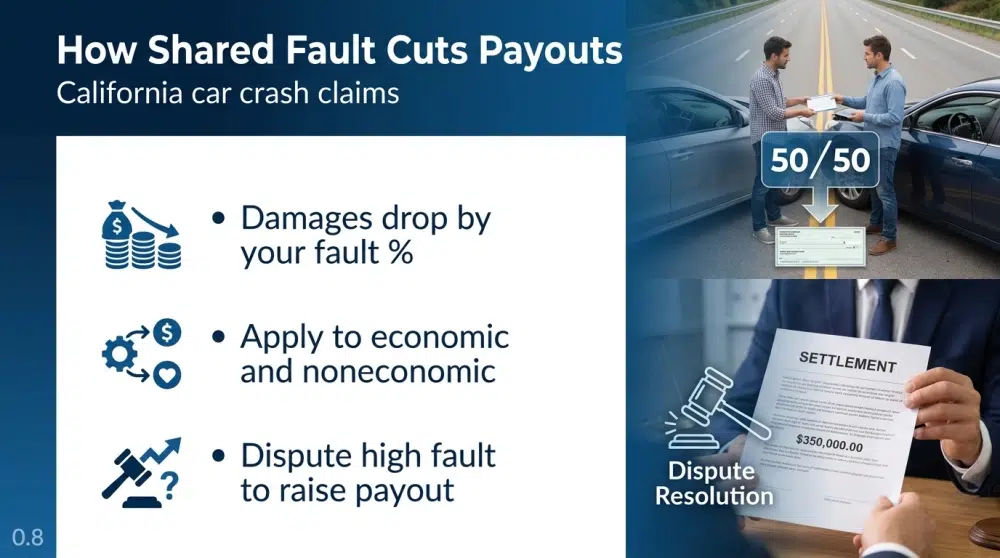
That 30% reduction means $60,000 that the plaintiff cannot recover, even if the defendant’s negligence was the primary cause of the crash. The higher your assigned fault percentage, the larger the financial impact on your recovery.
The types of damages subject to this reduction include:
- Economic damages: Objectively verifiable losses such as medical expenses, lost wages, future medical care costs, vehicle repair or replacement, and loss of earning capacity
- Non-economic damages: Subjective losses such as pain and suffering, emotional distress, loss of consortium, and loss of enjoyment of life
It is also important to understand that California’s pure comparative negligence applies even when the defendant’s insurer disputes liability entirely. The negotiation process often involves back-and-forth arguments about fault percentages, and insurance companies routinely use comparative fault arguments to minimize payouts.
If injuries in the accident are catastrophic or fatal, the damages at stake become far more significant. Families pursuing a wrongful death claim face similar fault allocation questions that can affect the compensation they may recover for their loss.
What Is Proposition 51 and How Does It Affect Non-Economic Damages?
While pure comparative negligence governs how a plaintiff’s own fault reduces their recovery, a separate California law governs how liability is divided among multiple defendants. This is Proposition 51, formally known as the Fair Responsibility Act of 1986, which added California Civil Code § 1431.2. [5]
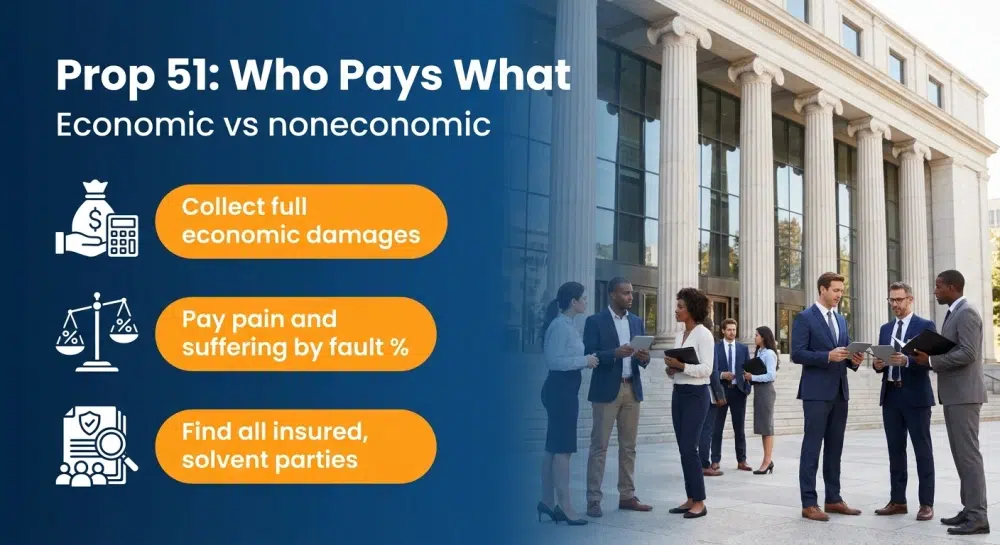
Under Proposition 51, defendants in a personal injury case are jointly and severally liable for economic damages, but only severally liable for non-economic damages.
This distinction has major practical consequences:
- Joint and several liability for economic damages: If multiple defendants are responsible for your medical bills and lost wages, each defendant can be held responsible for the full amount of those economic losses, even if their individual fault percentage was small. If one defendant cannot pay, another can be required to cover the shortfall.
- Several-only liability for non-economic damages: Each defendant is only responsible for the share of non-economic damages that reflects their own percentage of fault. If a defendant is found 20% at fault, they pay only 20% of the pain and suffering award, regardless of whether other defendants can pay their shares.
Civil Code § 1431.2 states: “In any action for personal injury, property damage, or wrongful death, based upon principles of comparative fault, the liability of each defendant for non-economic damages shall be several only and shall not be joint.” [5]
For plaintiffs, this means that if one defendant is judgment-proof or uninsured, you may not be able to fully recover non-economic damages from other defendants to make up the difference. This reality makes it critical to identify all potentially liable parties and adequately insured defendants from the outset of your case.
California’s litigation landscape is complex enough that injured victims in places like Los Angeles and Irvine, CA benefit significantly from working alongside car accident lawyers who can identify all responsible parties, gather persuasive evidence, and counter attempts to unfairly inflate a plaintiff’s comparative fault.
How Do Insurance Companies Use Comparative Fault Against You?
California requires all drivers to carry minimum liability insurance. [6] When a crash occurs, the at-fault driver’s insurer typically handles the claim. However, insurance companies have a financial interest in paying as little as possible, and comparative fault arguments are one of the most common tools they use to reduce payouts.
Here are the strategies insurers commonly employ:
- Inflating plaintiff’s fault: An adjuster may argue that you were speeding, following too closely, distracted, or failed to take evasive action. Even adding 10-20% of fault to a plaintiff’s share can significantly reduce what the insurer must pay.
- Using recorded statements: Insurance adjusters often request recorded statements from claimants shortly after the accident, when emotions are high and details are unclear. Innocent statements about what you were doing before the crash can be used to assign you a higher fault percentage.
- Disputing the severity of injuries: By minimizing injury severity, an insurer reduces the total damage amount before the comparative fault calculation even begins.
- Delaying claims: Extended delays can pressure injured people into accepting low settlements before the full extent of their damages is known.
California’s Department of Insurance oversees insurer conduct and has enforcement authority over unfair claims handling practices. [7] Even so, protecting your rights practically requires understanding that the burden of proof in a negligence claim rests with the plaintiff to demonstrate both the defendant’s fault and the extent of your damages.
Working with car accident lawyers in Irvine or Los Angeles who understand how local insurers operate can help you avoid missteps that increase your assigned fault percentage, and position your claim more accurately from the start.
What Should Injured Plaintiffs Know About Shared Fault Claims?
If you are the injured party in a California car accident and the other driver or their insurer is claiming you share some blame, there are several important points to understand as you pursue your personal injury claim.
Your Right to Recover Is Not Eliminated by Partial Fault
Under California’s pure comparative negligence system, even being predominantly at fault does not bar you from seeking compensation. That said, higher fault assignments produce meaningfully lower recoveries, which is why you should not simply accept an insurer’s fault determination without scrutiny.
Document Everything From the Start
The strength of your claim depends heavily on the evidence available. At and after the scene of the accident, preserving the following is critical:
- Photographs and video of the vehicles, road conditions, traffic controls, and visible injuries
- Names and contact information of all witnesses
- The responding officers’ badge numbers and the traffic collision report number
- Medical records documenting injuries and treatment from the earliest possible date
Avoid Making Premature Statements
What you say to other drivers, bystanders, or insurance representatives immediately following a crash can later be used to assign you a higher fault percentage. You are not required to give a recorded statement to the other driver’s insurer, and doing so without legal guidance can harm your claim.
Be Aware of the Statute of Limitations
California generally allows two years from the date of injury to file a personal injury lawsuit. [8] Missing this deadline typically means losing the right to pursue compensation, regardless of how clear the other driver’s liability may be.
Understand That Fault Determinations Are Negotiable
The initial fault percentage assigned by an insurance company is not binding. Through investigation, evidence gathering, and advocacy, that figure can often be challenged and reduced, potentially increasing your net recovery substantially.
Seeking guidance from injured attorneys is not about gaming the system. It is about leveling the playing field against parties and institutions that are experienced at minimizing payouts.
What Should Defendants Know When They Are Partially at Fault?
Being partially at fault in a California car accident does not mean you bear unlimited financial responsibility. California’s comparative fault system allocates liability in proportion to fault, and several legal protections apply on the defendant’s side as well.
Your Liability Is Proportionate to Your Fault Percentage
For non-economic damages, California Civil Code § 1431.2 limits your liability to your proportional share. You are not required to pay for the non-economic damages that another defendant is responsible for, even if the other party cannot pay. [5]
Economic Damages May Expose You to Greater Liability
Joint and several liability still applies to economic damages under Proposition 51. If you are found even partially at fault for a crash and a co-defendant is uninsured or judgment-proof, you could potentially be required to cover a larger share of the plaintiff’s economic losses. This underscores the importance of adequate liability insurance coverage.
Defendants May Have Their Own Cross-Claims
If a third party’s negligence contributed to the accident, such as a vehicle manufacturer whose defective component caused a brake failure, defendants can bring cross-claims or third-party claims. These actions can redistribute fault percentages and reduce a defendant’s share of liability.

Disputing the Plaintiff’s Account of Events
Defendants are entitled to present evidence challenging the plaintiff’s version of how the accident occurred and the extent of the claimed injuries. Evidence such as surveillance footage, vehicle data, and independent witness accounts can affect how fault is allocated by the jury.
Whether you are a plaintiff or a defendant in a shared-fault car accident, the allocation of fault percentages has profound financial consequences. The case for having skilled legal representation applies equally to both sides of the dispute.
What Are Common Car Accident Scenarios Involving Shared Fault?
In California, certain types of collisions frequently give rise to comparative fault disputes. Knowing the common patterns helps set realistic expectations about how fault may be divided.
Rear-End Collisions
California law generally presumes that a driver who rear-ends another vehicle is at fault. However, shared fault may be argued when the front driver made a sudden, unexpected lane change, stopped abruptly in a non-emergency situation, or had non-functioning brake lights. Statistics from the California Office of Traffic Safety consistently identify rear-end crashes as among the most frequent collision types in the state. [9]
Left-Turn Accidents
Vehicles turning left at intersections are typically expected to yield to oncoming traffic. However, if the oncoming driver was exceeding the speed limit or ran a red light, comparative fault arguments become common. Both sides typically present evidence from traffic cameras and witnesses.
Lane-Change Collisions
Merging or lane-changing without proper signaling or without checking blind spots is a recognized cause of accidents. But if the driver being merged into was also speeding or driving erratically, shared fault may reduce the lane-changing driver’s liability.
Intersection T-Bone Crashes
When two vehicles collide at an intersection, the question of which driver had the right of way becomes central. Disputes often center on whether traffic signals were properly obeyed, and physical evidence such as vehicle damage location is critical to reconstructing the sequence of events.
Pedestrian and Bicycle Accidents Involving a Vehicle
Even in accidents involving pedestrians or cyclists, comparative fault can be raised if the non-motorist entered a crosswalk against the signal or was not using a designated bike lane. However, California’s 2022 Freedom to Walk Act and other pedestrian safety statutes affect how such cases are evaluated. [10]
Distracted Driving Crashes
Cell phone use while driving is one of the most documented causes of fault in California collisions. If both drivers were distracted at the time of impact, a jury may divide fault accordingly. Cell phone records obtained through discovery can be decisive in these cases.
Victims may also face wrongful death claims if injuries from these accidents prove fatal. The comparative fault framework applies in wrongful death cases, and the deceased’s own fault, if any, can reduce the damages survivors recover. California Probate Code and Code of Civil Procedure § 377.60 govern who may bring such claims. [8]
How Does This Law Apply to Car Accident Victims in Irvine and Los Angeles?
Whether you are navigating the 405 Freeway corridor through Irvine or the 10 Freeway through Los Angeles, California comparative negligence law applies uniformly across the state. However, the local context matters when it comes to where cases are filed, which courts have jurisdiction, and how local practices affect litigation strategy.
Irvine, CA sits within Orange County and falls under the jurisdiction of the Orange County Superior Court. Los Angeles, CA cases are handled by the Los Angeles Superior Court, one of the busiest court systems in the nation. Each court has its own local rules, jury pool characteristics, and judicial culture that experienced car accident lawyers navigate regularly.
Traffic volume data in Southern California reflects the elevated frequency of serious collisions. The California Office of Traffic Safety produces annual crash data that highlights the significant number of injury and fatal crashes occurring throughout Los Angeles County and Orange County each year. [9] This data context underlines why comparative fault disputes are so common in the region and why having local legal representation can make a meaningful difference.
Southern California’s freeway and surface street conditions, combined with high vehicle density, often produce multi-vehicle accidents where fault is genuinely divided among several parties. The combination of Proposition 51’s several-only rule for non-economic damages and the state’s pure comparative fault framework means that the specific fault percentages assigned in these multi-party cases have real financial consequences for every party involved.
For residents of Irvine, Costa Mesa, Newport Beach, and surrounding Orange County communities, as well as those throughout greater Los Angeles, the legal framework is the same. What differs is the specific facts of each crash, the evidence available, and the skill with which each side presents its case.
If you or someone you care about was injured in a car accident in this region and shared fault is being raised, connecting with Irvine car accident lawyers or Los Angeles car accident lawyers who practice in the local courts is a step worth taking early.
How GoSuits Helps California Car Accident Victims
Understanding comparative negligence law is important, but applying it effectively in your specific case requires more than legal knowledge. It requires thorough case preparation, strategic evidence gathering, and the kind of direct attorney access that makes a genuine difference when the stakes are high.
GoSuits is a personal injury law firm that serves clients across California, Texas, and Illinois. We handle car accident claims and other personal injury matters in Los Angeles and Irvine, as well as throughout Southern California. Our team brings over 30 years of combined legal experience to every case we take, with courtroom trial experience that strengthens every negotiation.
Technology That Works For You, Not Instead of You
GoSuits uses proprietary case management software built specifically for personal injury litigation. This platform allows our team to move faster, track evidence more precisely, and keep every aspect of your case organized from intake through resolution. Technology handles the administrative work so our attorneys can focus on what matters most: your case.
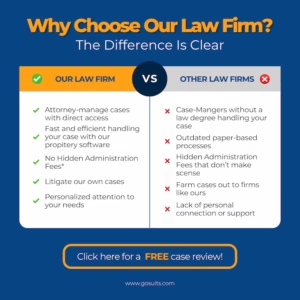
Importantly, our technology augments our legal work but never replaces the attorney-client relationship. Every client at GoSuits is assigned a designated attorney. You have direct, unfettered access to that attorney throughout your case. We do not use case managers or intermediaries to handle client communications. When you have a question, you reach your attorney.
What We Have Achieved for Clients
Our attorneys have secured significant outcomes for injury victims in car accident cases, wrongful death claims, and related personal injury matters. You can review some of our prior cases to see the types of results we have obtained for clients in situations similar to yours.
Past results in individual cases do not guarantee outcomes in future matters. Every case turns on its own facts, evidence, and circumstances.
Our Practice Areas
Beyond car accident cases, GoSuits handles a broad range of personal injury claims. Our practice areas include motorcycle accidents, truck accidents, rideshare accidents, construction accidents, product liability claims, slip and fall injuries, work injuries, and wrongful death cases. We approach every practice area with the same level of preparation and commitment to direct attorney service.
Our Attorneys
The attorneys at GoSuits are the people actually working on your case. We believe that clients deserve to know who is fighting for them, which is why we make it easy to learn about our attorneys before making any decisions about representation.
About GoSuits
GoSuits was founded on the principle that injured people deserve sophisticated legal representation backed by modern technology and delivered with genuine accessibility. We have invested in building a firm where trial readiness is not an exception but a standard. Learn more about who we are and how we work by visiting our about us page.
A Free Consultation With a California Personal Injury Attorney
If you were injured in a car accident in Irvine, Los Angeles, or anywhere in California, and comparative fault is a factor in your case, a free consultation can help you understand your options. You will speak directly with an attorney, not a screening service or case manager. There is no obligation, and there is no fee unless we recover for you.
To connect with our California personal injury team, schedule a free consultation today.
References and Resources
- Comparative Negligence – Legal Information Institute, Cornell Law School
- Pure vs. Modified Comparative Negligence Systems – Legal Information Institute, Cornell Law School
- Li v. Yellow Cab Co., 13 Cal.3d 804 (1975) – Google Scholar
- California Civil Code § 1714 – Duty of Ordinary Care – California Legislative Information
- California Civil Code § 1431.2 – Fair Responsibility Act of 1986 (Proposition 51) – California Legislative Information
- California Auto Insurance Requirements – California DMV
- California Department of Insurance – Official Website
- California Code of Civil Procedure § 335.1 – Statute of Limitations for Personal Injury – California Legislative Information
- California Crash Data Statistics – California Office of Traffic Safety
- AB 2147 – Freedom to Walk Act – California Legislative Information