



















What is it about Irving that shapes an injury case?
A city with this much movement creates injuries in particular places. Part of Dallas/Fort Worth International Airport lies within Irving, and the roads around it fill with taxis, shuttles, rideshare cars, rental vehicles and freight trucks at all hours. Las Colinas has office buildings, restaurants, hotels and a lot of walking, and the corridors along MacArthur Boulevard and Belt Line Road mix commuters with delivery traffic.
Not everything happens on a road. Irving has apartment complexes with security questions, retail centers with parking lot hazards, industrial areas where forklifts and loading docks cause serious injuries, and recreation spots like Campion Trail, where cyclists and pedestrians share space. The right legal theory depends on where you were hurt.
Premises claims: hotels, stores and apartment complexes
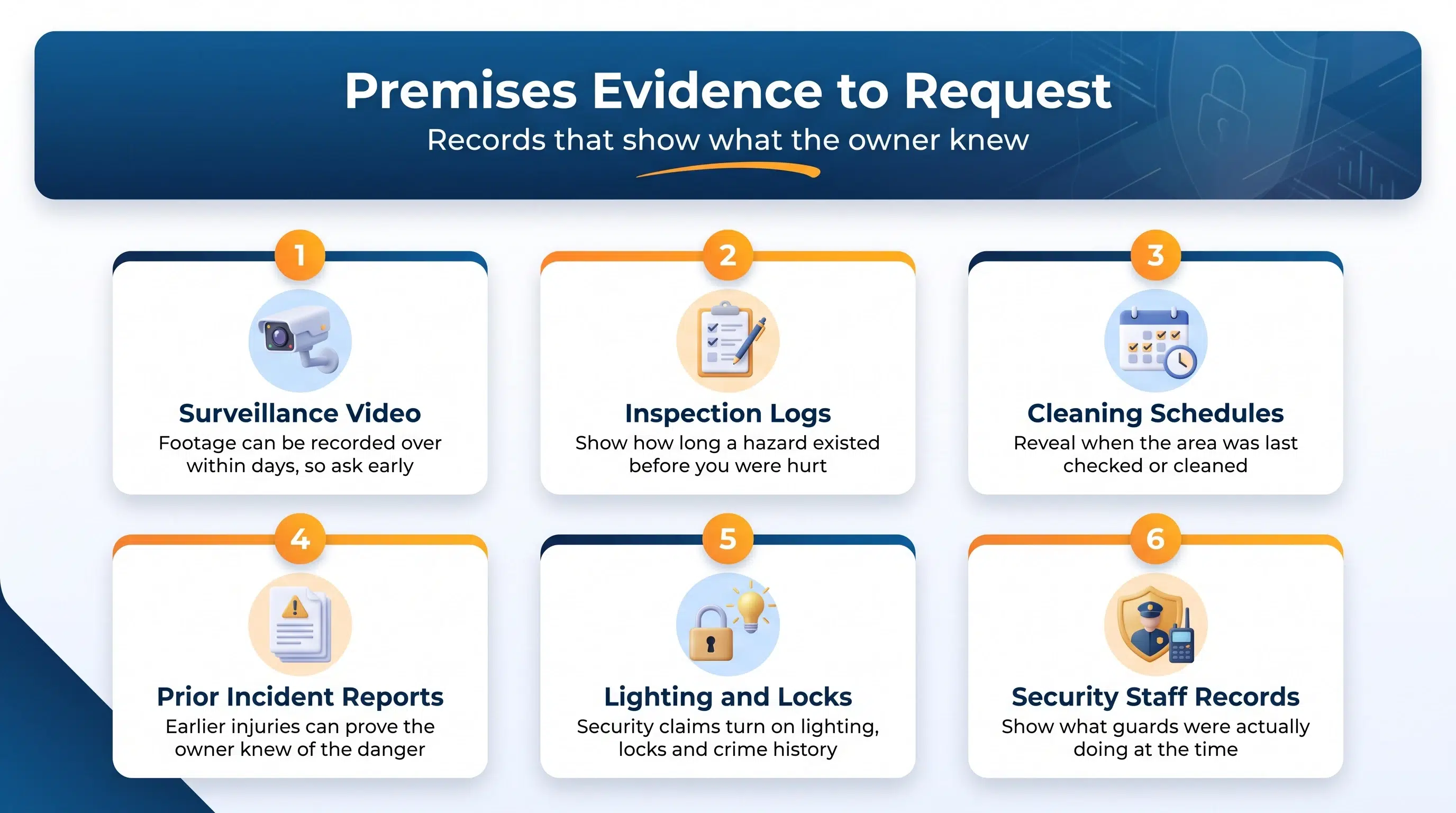
When a person is hurt on someone else’s property, Texas law asks what the owner knew. A customer who slips on a wet floor generally has to show the owner knew or should have known about the hazard and failed to fix or warn. That is why we ask early for surveillance video, inspection logs, cleaning schedules and earlier incident reports, because those records show how long a hazard existed.
Negligent security claims arise when a violent crime on a property could have been foreseen and prevented, such as in a poorly lit parking garage or an apartment complex with a history of break-ins. These cases are fact heavy, and we look at prior reports, lighting, locks and what guards were actually doing.
Large properties are often run by one company, owned by another and cleaned or guarded by a third. Pointing at each other is a standard defense, so we name everyone who may share responsibility.
Crashes on SH 183, SH 114 and I-635
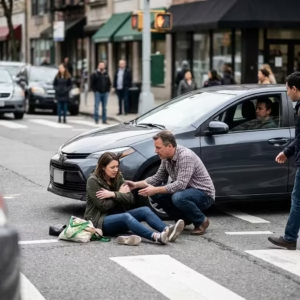
High speeds and merging traffic make these roads dangerous when something goes wrong. Drivers entering or exiting at the airport interchanges have little room to react, and stop-and-go traffic at rush hour produces rear-end collisions that can chain into several vehicles. Trucks and delivery vans add weight to the equation.
In a multi-vehicle crash each driver blames another, and the facts have to be sorted out from physical evidence. We use damage patterns, event data, and nearby camera footage to rebuild the sequence. If a commercial driver was involved, we look into hours of service records, driver qualifications and maintenance logs.
Workers hurt on Irving job sites and loading docks
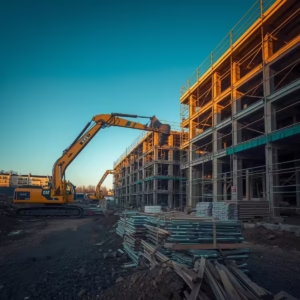
Workers’ compensation covers many job injuries without proof of fault, but it limits what the worker can recover from the employer. A separate claim may exist against a third party, such as the maker of a defective machine, a subcontractor, or a property owner whose negligence caused the injury. Texas also allows employers to opt out of workers’ compensation, and non-subscribing employers can face negligence suits directly.
Warehouse and distribution work near the airport brings hazards like unsecured loads, forklift accidents, falling inventory and heat. Report the injury to your employer promptly, get medical care, and ask us before you sign forms that may waive rights.
How are Irving injury claims valued?
There is no formula. The main drivers are the seriousness and permanence of the injury, the medical cost now and later, the time out of work, and how clearly the other side was at fault. A strong liability case with clear documentation will typically produce better offers than one built on guesswork.
Texas permits recovery of medical expenses, lost earnings, reduced earning ability, physical pain, mental anguish, disfigurement and impairment. What reaches you after a settlement is another matter. Hospitals and insurers may assert liens against it, and how Texas hospital liens work is worth understanding before you sign anything. Beyond pursuing the gross recovery from the at-fault insurer, we negotiate with hospitals, ER groups and medical lien holders at settlement to reduce what you owe out of the award, so more of the money reaches you.
Deadlines and fault rules to know
Most Texas injury lawsuits must be filed within two years of the injury, according to Section 16.003 of the Civil Practice and Remedies Code. Claims against a city or other government body may have much shorter notice windows, so mention it right away if a public road, building or vehicle was involved.
Fault is shared under Chapter 33 of the same code. If you are found more than 50 percent responsible you recover nothing. If you are 50 percent or less responsible, your damages are reduced by your share. That is why we prepare for the argument that you could have avoided the harm.
Where does a lawsuit go?
For most Irving incidents, the case belongs in the Dallas County district courts in Dallas. The defendant’s residence or the place the incident happened usually decides venue, and we confirm it before filing. Many cases settle at mediation or in negotiations well before a trial date, but we prepare as though a jury will decide it.
If you want to talk through your situation with our Dallas-area personal injury team, or simply ask whether you have a claim, you can contact us for a free consultation.
Walking, cycling and rideshare pickups around Irving
Pedestrians and cyclists are hit in the places where roads were built for cars first. Wide arterials like Belt Line Road and MacArthur Boulevard take a long time to cross, and drivers turning right on red or exiting a shopping center often look only for other cars. The trails, including Campion Trail, are safer in some ways, but the street crossings along them can be where trouble starts.
Airport traffic adds another layer. Rideshare drivers stopping at the curb, shuttle buses pulling out and rental cars driven by visitors who do not know the area all create conflict points. If you were hit as a passenger, a pedestrian or a cyclist, several policies may apply, including the driver’s, the platform’s and your own. Texas fault rules apply to a pedestrian or cyclist too, so the other side may argue you crossed in the wrong place or were not visible. We gather camera footage, measure sight lines and track down witnesses who can tell the story differently.
Defective products and equipment
When a tool, vehicle part, appliance or piece of safety equipment fails and causes harm, the claim can reach the manufacturer, a distributor or the retailer. Texas recognizes design defects, manufacturing defects and failures to warn. Proving one usually takes engineering analysis, and the product itself is the most important piece of evidence.
If something broke or caught fire, do not throw it away and do not let anyone repair it. Put it in a safe place, take photographs, keep the packaging and the receipt, and call us before you contact the company. Employers in Irving’s industrial areas may also hold maintenance records for equipment that hurt a worker, and we ask for those at the start.
What to do in the days after you are hurt
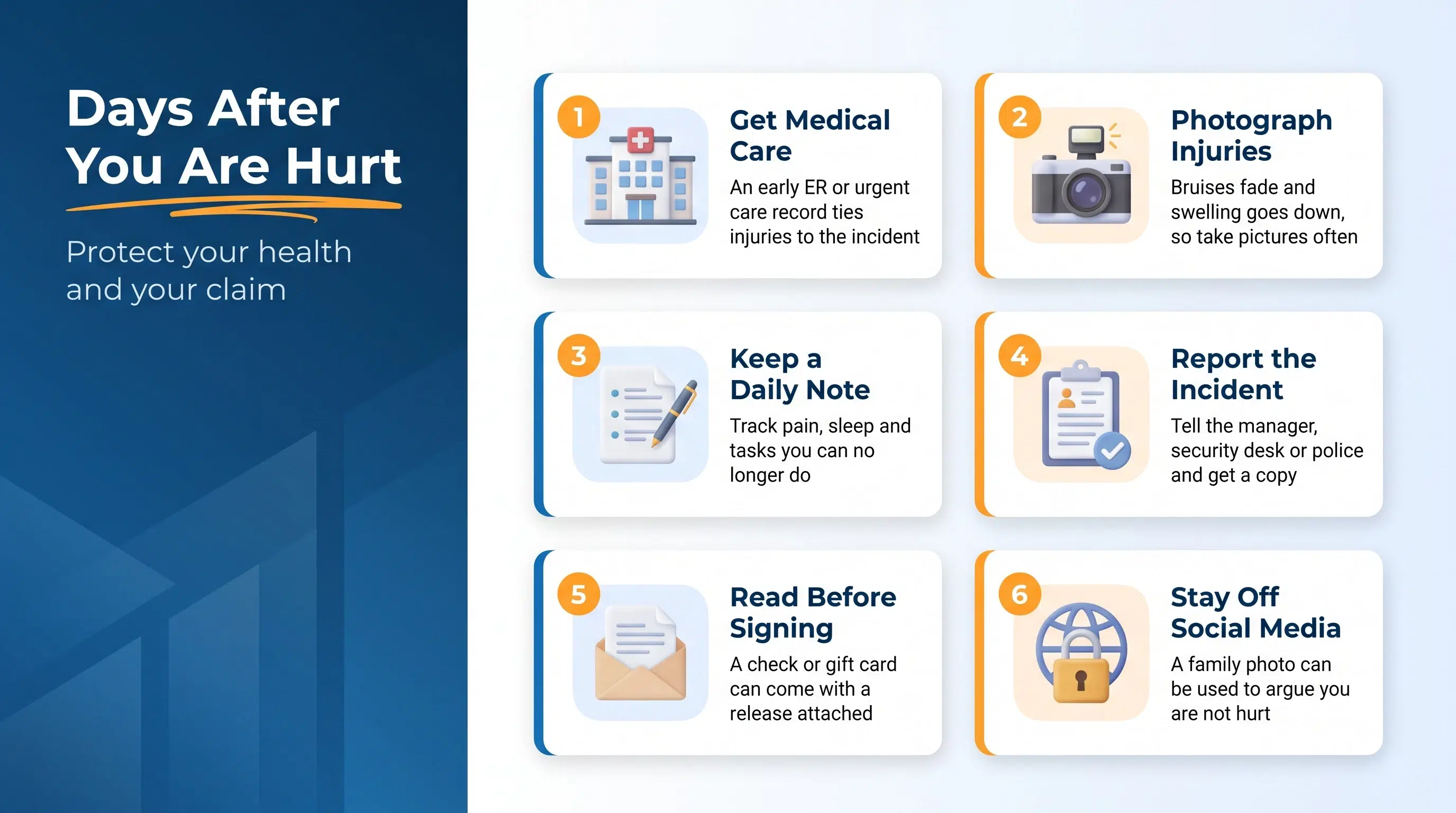
Medical care comes first, and not only for your health. An early record from an ER or urgent care ties your injuries to the incident. Photograph visible injuries as they change, since bruises fade and swelling goes down. Keep a short daily note on pain, sleep and tasks you cannot do.
Report the incident where it happened: to the store manager, the building’s security desk, your supervisor or the police, depending on the setting. Ask for a copy or a report number. Do not sign anything you do not understand, and do not accept a gift card or a check that comes with a release in the fine print.
Be careful with social media. A photo from a family weekend can be used to argue that your injury is not as serious as you say. It is safest to stay off posting about your case, your activities and your recovery until it is over.
Why the paperwork around medical bills matters
People are often surprised that the bill sent to them is not the figure that matters in a Texas injury case. Texas law looks at medical expenses that were actually paid or incurred, which can differ from the amount first billed. That affects both what the claim is worth and what liens must be repaid.
It also means how your treatment is paid for can matter. If you use health insurance, the plan may claim reimbursement from your settlement. If you treat on a letter of protection, the provider is looking to the case for payment. We explain these choices before you make them, and we track every lien so nothing catches you off guard when the case closes.
Treatment close to home
People injured in Irving often go to Baylor Scott & White Medical Center – Irving, which sits in the city. Go to whichever facility is closest and equipped to treat your injury. Make sure the ER staff hear about every symptom, because the first record is the one adjusters read most closely. After the ER, follow up with your primary doctor or a specialist, and keep to the plan they give you.
If you do not have health insurance, tell us. Some providers treat on a letter of protection, and we can explain how that affects the case before you agree to it.
Which Irving cases do we take?
Many of the Irving cases we see start on the road. Crashes on SH 183, SH 114, I-635 and MacArthur Boulevard are handled by our Dallas-area car accident lawyers. Freight trucks serving the airport and warehouses run the same corridors, and a crash with one brings in a carrier, its insurer and federal safety rules, which our Dallas-area truck accident team works from the first week.
When someone is killed, Texas allows the surviving spouse, children and parents to bring a wrongful death claim, and the estate may bring a separate survival claim. Our Dallas-area wrongful death lawyers handle those cases. We also take premises, negligent security, workplace, pedestrian and product injury cases from Irving.