
When a Texas hospital treats an accident victim and a third party may be liable, the hospital can place a legal claim directly against the injured person’s civil recovery before that person collects a dollar. This claim is a hospital lien, and it arises under Texas Property Code Chapter 55. The lien attaches to the injured person’s cause of action and to any settlement, judgment, or insurance proceeds from that claim. [1] Understanding exactly how Chapter 55 works, what requirements the hospital must meet, and where the statute’s limits fall is important for anyone pursuing a personal injury case in Texas after an emergency room visit or hospital admission.
Legal Snapshot
- Legal Topic: Texas Hospital Lien Law – Property Code Chapter 55
- Case Stage: Post-Treatment / Settlement / Pre-Distribution
- Primary Authority: Tex. Prop. Code Ch. 55 (Sections 55.001–55.008)
- Key Secondary Authorities: McAllen Hospitals, L.P. v. State Farm County Mutual Insurance Co., 433 S.W.3d 535 (Tex. 2014); In re North Cypress Medical Center Operating Co., 559 S.W.3d 128 (Tex. 2018); Daughters of Charity Health Services v. Linnstaedter, 226 S.W.3d 409 (Tex. 2007)
- Date Legal Authority Last Reviewed: July 2025
What Is a Hospital Lien and How Does Chapter 55 Create It?
A hospital lien is a statutory right that allows certain Texas hospitals to claim a share of a patient’s tort recovery as security for unpaid hospital bills. Without Chapter 55, a hospital that treated an accident victim could only pursue the patient directly for payment of the bill. Chapter 55 gives the hospital a different path: the lien attaches to the injured person’s cause of action and to the proceeds of any settlement or judgment that flows from the accident. [1]
The Texas Supreme Court described the statute’s purpose as encouraging hospitals to provide prompt and adequate treatment to accident victims by giving hospitals an additional mechanism to secure payment. [2] The theory is that if hospitals know they can recover from an eventual settlement rather than only from the patient, they are more willing to treat people who arrive injured, uninsured, or unable to pay upfront.
The practical consequence is that hospitals with valid Chapter 55 liens sit in the settlement proceeds alongside the injured person’s attorney fees and other expenses. If the lien is not resolved before the settlement funds are disbursed, the injured person and their attorney can face personal liability for the unpaid balance.
Which Providers Can File a Lien Under Chapter 55?
Not every healthcare provider qualifies. Chapter 55 specifies the categories of entities that may assert a statutory hospital lien:
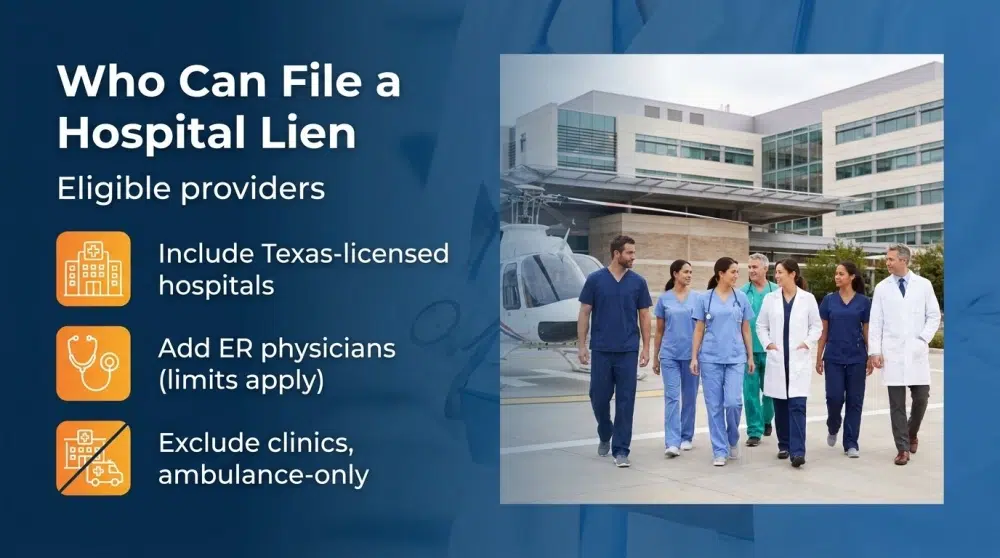
| Provider Type | Eligible Under Ch. 55? | Notes |
|---|---|---|
| Licensed hospital in Texas | Yes | Primary covered entity |
| Hospital district or authority | Yes | Public hospital systems qualify |
| Hospital that provides emergency services | Yes (with conditions) | Must meet admission requirement |
| Physician providing emergency hospital care | Yes (separate provision) | Covered under Sec. 55.004(c); subject to reasonableness cap |
| Non-hospital clinics, urgent care centers | Generally No | Chapter 55 requires “hospital services” |
| Ambulance services alone | Generally No | Unless part of a qualifying hospital system |
The statute applies to a hospital that provides hospital services to a person for an injury caused by an accident attributed to the negligence of another. [1] A physician who provides emergency hospital care services may also have a lien for the physician’s reasonable and necessary charges, subject to a different subsection of the statute.
The 72-Hour Admission Requirement
One of the most important threshold requirements under Chapter 55 is the admission timing rule. To qualify for a statutory lien, the hospital must have admitted the patient within 72 hours of the accident that caused the injury. [1]
This requirement filters out situations where a patient seeks treatment days after the incident and later wishes to assert a lien against a tort recovery. It also creates a specific argument for challenging a hospital lien: if the hospital admitted the patient more than 72 hours after the accident, the foundational condition for the lien may not be satisfied.
Several issues arise in practice:
- Emergency room visits that do not result in formal admission: A patient who receives treatment in the emergency room but is discharged without being formally admitted to the hospital as an inpatient may not satisfy the “admitted” requirement, depending on how courts interpret the term. This is a contested area that requires case-specific analysis.
- Transfer patients: If the patient was initially treated at one hospital and transferred to another, questions arise about which hospital’s admission clock controls and whether the lien of the receiving hospital runs from the original accident time or the transfer time.
- Delayed presentation: A person who drives home after an accident and goes to the hospital the next morning may or may not meet the 72-hour window depending on the precise timing.
Verifying the admission time and date against the accident time and date is a standard step in auditing any Chapter 55 lien.
The 100-Day Filing Deadline and County Filing Requirements
Chapter 55 imposes strict procedural requirements that a hospital must satisfy for its lien to be valid. The two most important procedural rules involve where the lien must be filed and when. [1]
Where to File
The hospital must file the lien with the county clerk of:
- The county in which the hospital is located; and
- The county in which the accident occurred, if different from the hospital’s county.
A Dallas-area hospital must file in Dallas County. If a patient was injured in a rear-end collision in Plano but treated at a hospital in downtown Dallas, the hospital should file in both Collin County (where Plano sits) and Dallas County to be fully protected. Failure to file in the correct counties can make the lien unenforceable against a particular recovery.
When to File: The 100-Day Window
The lien must be filed within 100 days of the patient’s discharge from the hospital. A lien filed outside this window may be challenged as untimely. Verifying the discharge date against the lien filing date is a routine audit step. If a hospital files more than 100 days after discharge, the lien may not be enforceable against a settlement reached with the at-fault party’s insurer. [1]
Contents of the Lien Filing
The lien must be in writing and contain the following information:
- The injured person’s name and address;
- The date of the accident;
- The name and location of the hospital;
- The name of the person alleged to be legally responsible for the injury (if known); and
- The name of the insurer of the person liable (if known).
Defects in the lien’s contents can form the basis of a challenge to its validity or priority.
A driver is injured on the LBJ Freeway in Dallas County after a rear-end collision by a commercial truck. She is taken by ambulance to a hospital in Dallas and admitted within four hours of the crash. She is discharged 14 days later. The hospital must file its lien with the Dallas County Clerk within 100 days of her discharge date. If the hospital files on day 105, the lien’s validity may be challenged on timeliness grounds. Additionally, if the hospital only files in Dallas County without checking whether the accident occurred in a different county, county-specific challenges could arise. Outcomes in actual cases vary based on specific facts and applicable law.
Notice Requirements Under Chapter 55
Filing the lien with the county clerk is only part of what Chapter 55 requires. The hospital must also provide written notice of the lien to the injured person and to any known person who may be liable for the injury or the insurer of that person. [1] The notice requirement exists to ensure that everyone who may be writing a check on a settlement knows about the lien before they distribute funds.
Notice must be sent before the lien is filed and before any settlement or release is signed. Notice sent after a settlement has already been reached may not bind the settling parties, though the lien’s validity as a public record may persist and create complications even in that scenario.
If the hospital knows the name and address of the at-fault driver’s liability insurer, notice must go to that insurer. Practical enforcement of the lien depends heavily on this notice: insurers writing settlement checks need to either include the hospital in the payment or verify that the lien has been resolved before releasing funds.
What the Lien Covers – and What the Statute Caps
Chapter 55 does not allow a hospital to claim an unlimited amount. The statute limits the hospital’s lien to a reasonable and regular rate for the services provided. This phrase is the source of most lien disputes. [1]
The Reasonable and Regular Rate Cap
Courts and practitioners have consistently recognized that a hospital’s published chargemaster rates are not automatically the “reasonable” rate for purposes of a Chapter 55 lien. The Texas Supreme Court’s 2014 decision in McAllen Hospitals, L.P. v. State Farm County Mutual Insurance Co. confirmed that the statute is designed to allow hospitals to secure payment but not to recover an amount beyond the reasonable value of the services. [2]
In In re North Cypress Medical Center Operating Co., 559 S.W.3d 128 (Tex. 2018), the Texas Supreme Court held that evidence of the reimbursement rates a hospital accepts from insurers for the same services is relevant to determining what constitutes a reasonable and regular rate. An injured person or their attorney may demand this information as part of a lien audit and use the gap between billed rates and what insurers actually pay as support for a reduction in the lien amount. [3]

Structure of the Cap Under Section 55.004
Texas Property Code Section 55.004 breaks down what the lien may cover:
| Charge Category | Lien Coverage | Standard Applied |
|---|---|---|
| Hospital services charges | Yes (Sec. 55.004(b)) | Amount of hospital’s charges for services provided |
| Physician emergency care charges | Yes (Sec. 55.004(c)) | Reasonable and necessary charges for emergency hospital care services |
| Other services exceeding reasonable rate | No (Sec. 55.004(d)) | Charges beyond reasonable and regular rate are excluded |
The practical takeaway is that physician bills for emergency care can be included in the lien, subject to a reasonableness requirement, but charges for ancillary services billed at rates that exceed a reasonable and regular rate may not be claimed. Line-by-line auditing of a hospital bill using CPT and ICD-10 codes is standard practice before agreeing to pay any Chapter 55 lien amount. The knowledge base article on reducing medical liens before a Texas settlement covers the auditing process in greater depth.
What Happens When the Patient Had Available Health Insurance That Was Not Billed?
This is one of the most practically significant and contested questions in Texas hospital lien law. The scenario is common: a patient arrives at the emergency room with health insurance, but the hospital elects to treat the patient under a claim of lien rather than billing the health insurer. The hospital then files a Chapter 55 lien for chargemaster rates that are substantially higher than what the health insurer would have paid.
The Texas Supreme Court examined the intersection of hospital liens and available health insurance in Daughters of Charity Health Services v. Linnstaedter, 226 S.W.3d 409 (Tex. 2007). The Court noted that “few patients today ever pay a hospital’s full charges,” and that the existence of significant gaps between billed and paid amounts is a known feature of healthcare billing. [4]
The question of whether a hospital that chose not to bill available insurance can claim the full chargemaster rate through a Chapter 55 lien has not been conclusively resolved in all its dimensions by the Texas Supreme Court. Relevant arguments include:
- The lien cannot exceed what the hospital has a “legal right to be paid.” Under Haygood v. De Escabedo, 356 S.W.3d 390 (Tex. 2012), medical damages in evidence at trial are limited to amounts the provider has a legal right to receive. Courts and litigants have debated whether this principle affects what a hospital can claim through a Chapter 55 lien when available insurance was not billed. [5]
- The “reasonable and regular rate” cap. Evidence of what the hospital would have received from the available health insurer bears on what constitutes a reasonable and regular rate for the same services.
- The fraudulent lien cases. Texas courts have reviewed fact patterns where hospitals systematically chose not to bill available insurance in order to file larger liens, treating this election as potentially giving rise to claims beyond simple lien reduction. [6]
This area requires specific legal analysis based on the facts of each case, including the type of insurance, whether the patient presented the insurance information, what the hospital’s billing practices were, and applicable case law at the time of the dispute.
What Does a Chapter 55 Lien Attach To?
Under Section 55.003 of the Texas Property Code, the hospital lien attaches to:
- The injured person’s cause of action against the person responsible for the injury;
- Any judgment entered in that cause of action; and
- The proceeds of any settlement of the cause of action.
The lien does not attach to workers’ compensation benefits. A patient injured in a workplace accident covered by the Texas workers’ compensation system cannot have a Chapter 55 hospital lien asserted against the workers’ compensation recovery, because the workers’ compensation system operates under its own separate framework that excludes hospital liens under this statute. [1]
Whether the lien reaches uninsured or underinsured motorist (UM/UIM) proceeds is a more complex question. The answer depends on how UM/UIM proceeds are characterized under the specific policy and the theory of recovery, and it has produced different results in different procedural contexts. This is an area where consultation with a Dallas personal injury lawyer is particularly important before resolving any UM/UIM claim where a hospital lien is outstanding.
How Can a Chapter 55 Hospital Lien Be Challenged or Reduced?
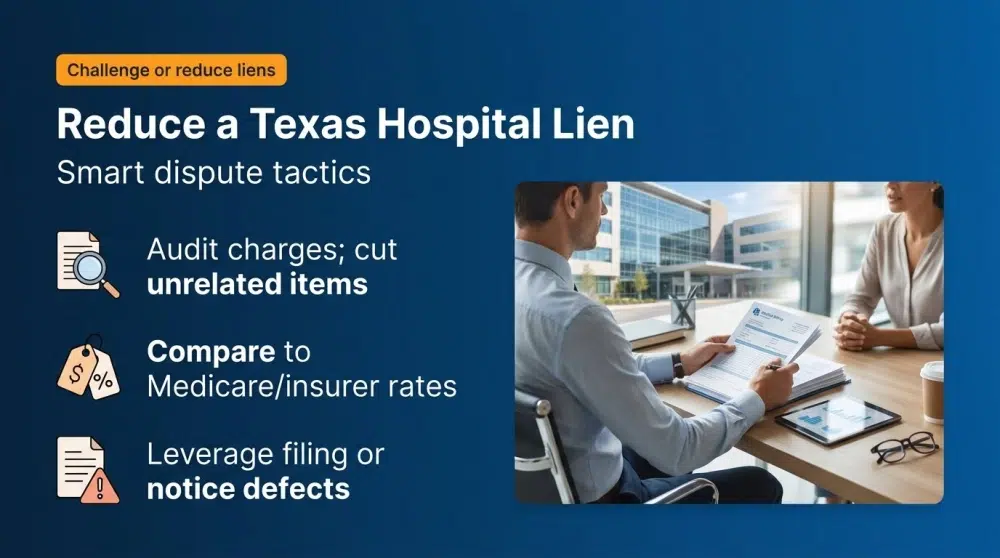
An injured person, their attorney, or a third-party insurer can challenge or seek to reduce a hospital lien on several grounds. In serious cases arising from accidents on I-35E, the Dallas North Tollway, or I-30, where hospital bills can reach hundreds of thousands of dollars, lien reduction is often one of the most financially meaningful steps in a case.
Procedural Challenges
- Patient was not admitted within 72 hours of the accident
- Lien was not filed within 100 days of discharge
- Lien was not filed in the correct county or counties
- Lien filing is defective in required content
- Proper notice was not provided to required parties before filing or before settlement
Substantive Challenges
- Charges exceed a “reasonable and regular rate” for the services
- Lien includes charges for services unrelated to the accident injury
- Lien includes charges for services that were not actually provided
- Available health insurance was not billed, and the lien asserts chargemaster rates that exceed what the insurer would have paid
- The claim is for a cause of action not covered by Chapter 55 (e.g., workers’ compensation injury)
Negotiation
Even where a lien is procedurally and substantively valid, hospitals routinely accept reduced lien amounts when the settlement is constrained by the at-fault driver’s liability policy limits, when liability is contested, or when the audited amount of charges attributable to the covered injury is lower than the face amount of the lien. Requesting an itemized bill and comparing charges to Medicare rates and major commercial insurer rates is the starting point for any negotiation.
A motorcyclist is struck by a distracted driver on the Dallas North Tollway and sustains a fractured femur. He is admitted to a Level I trauma center in Dallas within two hours. The hospital files a Chapter 55 lien for $140,000 in chargemaster rates. An audit reveals that the Medicare rate for the same services in the same geographic area would be approximately $38,000, and the hospital’s contracts with commercial insurers show reimbursement rates averaging $52,000. The at-fault driver carried $100,000 in liability coverage. Given the gap between the lien amount and what the hospital accepts from insurers, and the limited policy, there are strong grounds to negotiate the lien substantially below the $140,000 face amount. Actual negotiated outcomes vary based on the facts, applicable law, and parties involved.
How Long Do You Have to Act? Key Deadlines
Several deadlines matter for hospital liens in Texas:
| Deadline | Party Responsible | Consequence of Missing |
|---|---|---|
| 100 days from patient discharge to file lien | Hospital | Lien may be invalid or unenforceable |
| File before any settlement or judgment | Hospital | Lien may not bind settling parties |
| Send notice before settlement | Hospital | May affect enforceability against insurer |
| Statute of limitations on personal injury claim | Injured person | Two years from date of injury under Tex. Civ. Prac. & Rem. Code § 16.003 [7] |
| Resolve lien before settlement distribution | Attorney/injured person | Personal liability for unpaid lien balance |
The two-year statute of limitations for personal injury claims in Texas is separate from the Chapter 55 filing deadlines. The lien filing timeline operates independently of the underlying personal injury claim deadline. Both must be tracked carefully in any Texas personal injury case involving a hospital admission.

What Should an Injured Person Do After Receiving Notice of a Hospital Lien?
- Do not sign any settlement or release without resolving or accounting for the lien. Settling a case without addressing a valid hospital lien can create personal liability for the injured person and their attorney for the unpaid balance.
- Obtain the lien filing from the county clerk’s records. Verify the filing date, the content of the lien, and whether it was filed in the correct county or counties. The George L. Allen Sr. Courts Building in Dallas is the location where Dallas County civil matters, including lien filings, are handled.
- Request a complete itemized bill with CPT codes and ICD-10 diagnosis codes for every service included in the lien. Remove any charges unrelated to the injuries caused by the accident.
- Compare charges to Medicare and commercial insurer rates for the same services in the same geographic area. The Texas Supreme Court confirmed in North Cypress that this comparison is relevant to the reasonableness of the lien amount. [3]
- Review admission and discharge dates against the accident date to confirm the 72-hour admission window and the 100-day filing deadline were both satisfied.
- Consult a personal injury attorney before distributing any settlement proceeds or agreeing to a lien amount. The interaction between Chapter 55 liens, available health insurance, UM/UIM proceeds, and the ultimate net recovery requires careful legal analysis.
Personal injury lawyers who handle car accident cases and truck accident cases in Dallas regularly navigate Chapter 55 liens as part of the settlement process. Understanding the hospital lien law is part of how attorneys protect their clients’ net recovery.
A hospital lien can significantly reduce what an injured person actually receives from a settlement. If you or a family member received hospital treatment after an accident in Dallas or anywhere in Texas and a lien has been filed, a GoSuits Dallas personal injury attorney can review the lien documents, identify applicable challenges or reductions, and help protect your recovery. This article is for informational purposes and does not constitute legal advice for your specific situation.
Related Texas Personal Injury Resources
- Companion article: Reducing Medical Liens Before a Texas Settlement: How Does It Work?
- Dallas Personal Injury Lawyers
- Dallas Car Accident Lawyers
- Dallas Truck Accident Lawyers
- Dallas Wrongful Death Lawyers
- Types of Damages Available in Texas Personal Injury Cases
- The Personal Injury Claims Process in Texas Courts
- GoSuits Prior Cases
- Our Attorneys
- About GoSuits
- Practice Areas
References and Legal Authorities
- Texas Property Code, Chapter 55 (Hospital Liens) – Texas Legislature Online (statutes.capitol.texas.gov)
- McAllen Hospitals, L.P. v. State Farm County Mutual Insurance Co., 433 S.W.3d 535 (Tex. 2014) – CourtListener
- In re North Cypress Medical Center Operating Co., 559 S.W.3d 128 (Tex. 2018) – CourtListener
- Daughters of Charity Health Services v. Linnstaedter, 226 S.W.3d 409 (Tex. 2007) [related discussion in Nacogdoches County Hospital District] – CourtListener
- 42 U.S.C. § 1395y (Medicare Secondary Payer) – Legal Information Institute, Cornell Law School [related to Haygood analysis context]
- In re Fraudulent Hospital Lien Litigation (Tex. Ct. App. 13th Dist. 2020) – CourtListener
- Texas Civil Practice and Remedies Code, Section 16.003 (Two-Year Statute of Limitations) – Texas Legislature Online
- Texas Civil Practice and Remedies Code, Chapter 140 (Health Benefit Plan Recovery) – Texas Legislature Online
- Texas Court Rules and Legal Research Guides – Texas State Law Library
- Texas Constitution and Statutes – Texas Legislature Online
- 29 U.S.C. § 1132 (ERISA Civil Enforcement) – Cornell Law School Legal Information Institute
- Texas Rules of Civil Procedure and Evidence – Texas Courts Online (txcourts.gov)