
Yes, a health plan may have the legal right to recover part of your California personal injury settlement, but the amount it can take depends almost entirely on what kind of plan you have. California Civil Code section 3040 limits reimbursement rights for California-regulated health plans and health care service plans, including a proportional cap and a mandatory reduction for the attorney fees your lawyer spent creating the recovery. Self-funded ERISA plans operated by private employers, however, are generally governed by federal law and by the plan’s own document rather than by state statutes like Civil Code 3040. That distinction controls how much can be withheld and what defenses may be available. Sorting out which rules apply to your plan before settlement money is distributed is one of the most financially consequential steps in resolving a California personal injury claim.
Legal Snapshot
- Legal Topic: Health Plan Reimbursement and Subrogation in California Personal Injury Settlements
- Case Stage: Pre-settlement and post-settlement lien resolution
- Primary Legal Issue: Whether ERISA federal preemption or California Civil Code section 3040 governs the plan’s reimbursement right
- Primary Authority: California Civil Code § 3040; Employee Retirement Income Security Act of 1974 (ERISA), 29 U.S.C. § 1001 et seq.; 29 U.S.C. § 1132(a)(3); Montanile v. Board of Trustees of the National Elevator Industry Health Benefit Plan, 577 U.S. 136 (2016)
- Jurisdiction: California (state law) and Federal (ERISA preemption)
- Date Legal Authority Last Reviewed: June 2025
Two Completely Different Legal Frameworks: Why It Matters Which Plan You Have
When you are injured in a California accident and your health plan pays your medical bills, that plan often sends a letter asserting a “subrogation” or “reimbursement” right. The letter typically asks to be reimbursed from any settlement or judgment you later receive. What determines how much the plan can actually recover depends on whether the plan is regulated by California law or by federal ERISA law.
A California-regulated plan is a commercial health insurer or health care service plan (such as an HMO) that is licensed and regulated by the California Department of Managed Health Care or the California Department of Insurance. These plans must follow California Civil Code section 3040, which imposes hard limits on reimbursement amounts and requires a proportional reduction for attorney fees.
A self-funded ERISA plan is one where a private employer directly funds benefit payments from its own assets rather than buying an insurance policy. Large employers and many mid-sized companies use this structure. Because ERISA is a federal law, it generally preempts conflicting state laws. Courts have held that California Civil Code section 3040 cannot be applied to self-funded ERISA plans. [1] The self-funded plan’s reimbursement rights are instead controlled by the terms written into its plan document. Those terms frequently favor the plan.
| Feature | California-Regulated Plan | Self-Funded ERISA Plan |
|---|---|---|
| Governing law | California Civil Code § 3040; California Insurance Code | Federal ERISA, 29 U.S.C. § 1001 et seq.; Plan document |
| Reimbursement cap | Yes, limited to proportionate share of recovery | No state-imposed cap; plan language controls |
| Attorney fee reduction required? | Yes, mandatory common fund reduction under § 3040 | Only if plan document provides for it (or court applies equitable principles) |
| Made-whole doctrine applies? | Yes, by default unless waived in plan document | Generally not applicable; federal equitable principles govern |
| Can plan sue to recover after settlement is spent? | State court action; subject to § 3040 limits | Federal ERISA § 502(a)(3); limited by Montanile tracing rule |
How to Identify Whether Your Plan Is Self-Funded or California-Regulated
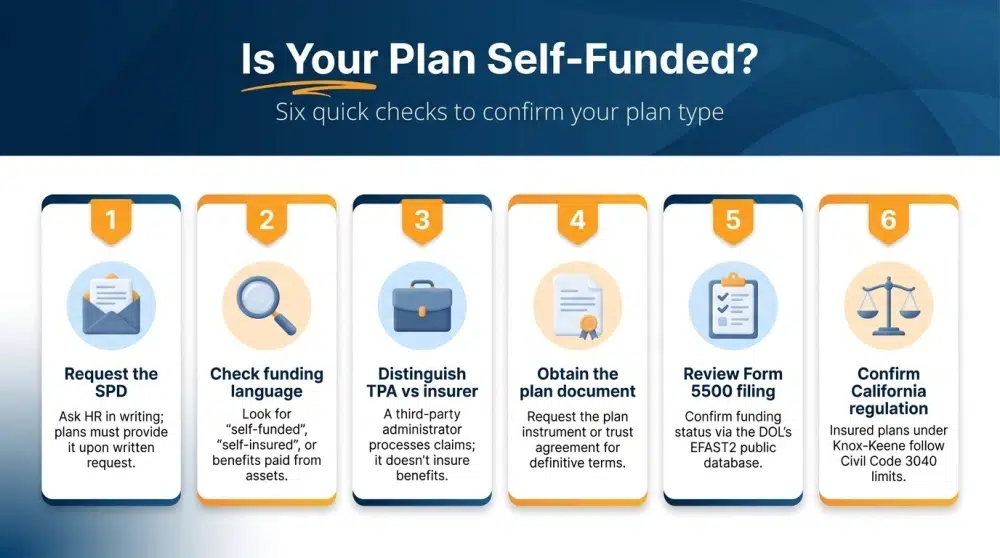
The quickest way to find out is to request the Summary Plan Description (SPD) from your employer’s human resources department. Federal law requires plan administrators to provide the SPD upon written request within 30 days. [2]
Look at the front pages of the SPD for language that says the plan is “self-insured,” “self-funded,” or that benefits are paid from the employer’s general assets. You may also see references to a third-party administrator (TPA), which is a company that processes claims on behalf of a self-funded employer but does not itself insure the benefits. The presence of a TPA does not make a plan a commercial insurance plan.
If the SPD states that the plan is an “insured” plan or that benefits are provided through a licensed insurance company, California Insurance Code provisions and Civil Code section 3040 are more likely to apply. If your coverage came through Covered California or a California Health Care Service Plan licensed under the Knox-Keene Act, Civil Code section 3040 applies directly.
If the language is unclear, the plan can be asked to produce the actual plan instrument (sometimes called the Plan Document or Trust Agreement) along with a copy of the Form 5500 filing. The Form 5500 is filed annually with the U.S. Department of Labor and shows, among other things, whether the plan is funded through insurance or through employer assets. This document is publicly available through the DOL’s EFAST2 database. [3]
What California Civil Code Section 3040 Says About Health Plan Reimbursement
California Civil Code section 3040 governs the reimbursement rights of California-regulated health care service plans and health insurers when their enrollee or insured recovers from a third party for injuries. [4] The statute was enacted to prevent health plans from taking more than a fair share of a limited recovery, particularly when the injured person has not been made whole.
The Proportionality Cap
Under Civil Code section 3040, a health plan’s reimbursement is capped at a proportionate share of the injured person’s total recovery. The statute establishes a formula that takes into account the relationship between the gross recovery and the injured person’s total damages. If you only recovered a fraction of your total losses because of limited insurance coverage or other factors, the health plan is generally not entitled to full reimbursement. The plan’s share is reduced in the same proportion that your total recovery bears to your total economic and non-economic losses. [4]
The Mandatory Attorney Fee Reduction (Common Fund Doctrine)
Section 3040 also requires the health plan to bear a proportionate share of the attorney fees and costs that were spent to obtain the recovery. This is a codification of the common fund doctrine: the plan benefited from the attorney’s work in recovering the money, so it must share in paying for that work. Under the statute, the health plan’s reimbursement amount is reduced by the same percentage as your attorney fee agreement. [4] For example, if your attorney worked on a 33 percent contingency, the health plan’s reimbursement is reduced by 33 percent before any other calculation is applied. This reduction is mandatory and not something the plan can simply refuse.
The Made-Whole Doctrine Under California Law
California recognizes the made-whole doctrine, which holds that a health plan generally may not recover reimbursement unless and until the injured person has been fully compensated for all of their damages. Where the injured person’s total damages significantly exceed the available recovery, the made-whole doctrine can effectively eliminate the health plan’s reimbursement right entirely. California applies this doctrine as a default rule for plans governed by California law, though some plan documents attempt to waive it by explicit language. Whether such a waiver is enforceable depends on the specific plan terms and circumstances. [4]
Self-Funded ERISA Plans Follow Federal Rules Not California’s
If your health coverage comes through a self-funded employer plan, the plan’s subrogation and reimbursement clause is generally interpreted and enforced under federal law. ERISA section 502(a)(3) codified at 29 U.S.C. § 1132(a)(3) allows plan fiduciaries to sue “to obtain other appropriate equitable relief” to enforce the terms of the plan. [1]
Federal courts have held that ERISA preempts California Civil Code section 3040 as applied to self-funded plans. This means the proportionality cap and the mandatory attorney fee reduction that California law imposes on commercial insurers generally do not apply. If the plan document says the plan is entitled to 100 percent reimbursement before the injured participant keeps anything, federal courts have been willing to enforce that language under certain circumstances. See US Airways, Inc. v. McCutchen, 569 U.S. 88 (2013), where the Supreme Court held that clear plan language controls even if the participant has not been made whole, subject to equitable defenses. [5]
When an ERISA Plan Can Recover and When It Cannot
The ERISA plan’s right to recovery under section 502(a)(3) is limited to equitable relief. The plan typically asserts an “equitable lien by agreement”, a lien that attaches to the specific settlement fund because the participant agreed in the plan documents that settlement proceeds would be used to reimburse the plan.
The critical constraint is that the lien can only attach to specifically identifiable funds still in the participant’s possession or control, or to traceable property purchased with those funds. This is the rule established by the Supreme Court in Montanile v. Board of Trustees of the National Elevator Industry Health Benefit Plan, 577 U.S. 136 (2016). [6]
What Montanile v. Board of Trustees Means for Your California Settlement
In Montanile, the Supreme Court addressed an ERISA plan participant who was injured when a drunk driver ran a stop sign and struck his vehicle. The plan paid over $121,000 for his medical care. Montanile later settled his lawsuit for $500,000. After paying attorney fees, approximately $240,000 remained. The plan sought reimbursement, negotiations failed, and Montanile ultimately received the funds. Six months later, the plan sued to recover from his general assets. [6]
The Supreme Court held that when an ERISA plan participant wholly dissipates a third-party settlement on non-traceable items things like food, travel, or services, the plan’s equitable lien is extinguished. The plan fiduciary may not then reach the participant’s general assets because recovery from general assets is a legal remedy, not an equitable one. ERISA section 502(a)(3) authorizes only equitable relief. [6]
The Montanile lesson is a big deal for California claimants. Spent the settlement? Can’t trace it into property? A self-funded ERISA plan may lose its shot at suing for reimbursement entirely. That said, it’s not automatic. Everything turns on the facts, like whether the money was kept separate, how it got spent, and whether any traceable assets are still around. The Supreme Court actually kicked Montanile back down for the lower court to figure that out. [6] And honestly, moving on a settlement while a known ERISA lien is sitting there can expose you to serious liability, so this is one of those situations where getting legal help before distributing funds really isn’t optional.
Why the Plan’s First Reimbursement Letter Almost Always Overstates the Amount Owed
When a health plan learns that you have settled a personal injury claim, it typically sends a reimbursement letter asserting a specific dollar figure. That initial demand is frequently overstated for several reasons.
- It does not account for the attorney fee reduction. Under Civil Code section 3040, California-regulated plans must reduce their demand by your contingency fee percentage. The first letter often omits this reduction entirely. Even for ERISA plans, the Supreme Court in US Airways v. McCutchen recognized that equitable principles may require some attorney fee offset unless the plan document clearly waives it. [5]
- It may include amounts not covered by your injury claim. The plan may list all payments made while you were an enrollee without filtering for charges that were specifically related to the injuries caused by the third party. Pre-existing conditions, unrelated treatments, or charges for other family members may be improperly included.
- It does not apply the proportionality cap. For California-regulated plans, the reimbursement is capped based on the relationship between your total recovery and your total documented damages. A demand sent before your case resolves cannot apply this cap correctly because neither figure is final at that point.
- It may be sent even when the plan lacks a valid subrogation clause. Some plan documents contain subrogation language that is ambiguous, unenforceable, or limited by California law in ways the plan did not account for.
Documents That Can Force a Recalculation
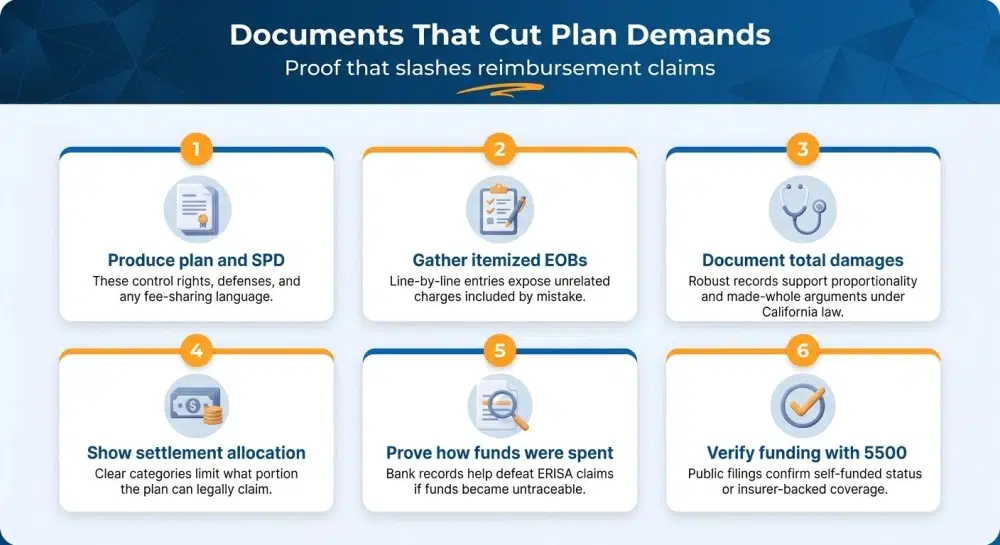
When responding to an overstated reimbursement demand, several categories of supporting documents can require the plan to reduce its claimed amount.
- A complete itemized list of all medical charges the plan paid, identifying which charges are attributable to the injury at issue
- A copy of the Summary Plan Description and the full plan document (to determine the applicable legal framework and the exact language of the subrogation clause)
- The Form 5500 filing (to confirm whether the plan is self-funded or insured)
- Your contingency fee agreement (to calculate the mandatory attorney fee reduction under Civil Code section 3040 for California-regulated plans, or to support equitable arguments for ERISA plans)
- Documentation of your total economic and non-economic damages (medical bills, lost wages, expert reports, and life care plans) compared with your total gross recovery, to support the proportionality calculation or a made-whole defense
- Settlement documentation showing the allocation of proceeds among economic damages, non-economic damages, and other categories, where relevant
How This Applies in Practice
Hypothetical Example, California-Regulated Plan: Suppose a driver is rear-ended on the I-405 near the Irvine Spectrum interchange and sustains a lumbar spine injury requiring surgery. Her health insurer, a California-licensed HMO, pays $90,000 in medical bills. She retains an attorney on a 33 percent contingency and settles the third-party auto claim for $200,000. Her total documented damages, including future medical care and non-economic losses, are estimated at $600,000. Under Civil Code section 3040, the plan’s reimbursement is first reduced by 33 percent for the attorney fee, reducing the plan’s base demand to approximately $60,300. The proportionality cap then limits recovery further because her settlement represents only one-third of her total documented losses. The final reimbursable amount may be substantially lower than the $90,000 originally demanded. This is a hypothetical illustration only; actual calculations depend on specific facts and applicable law.
Hypothetical Example, Self-Funded ERISA Plan: Suppose an employee covered by a large employer’s self-funded health plan is injured in a T-bone collision on SR-73 near Costa Mesa. The plan pays $80,000 in medical bills and the plan document contains explicit language stating the plan is entitled to “full reimbursement from any third-party recovery, without reduction for attorney fees or the made-whole doctrine.” She settles for $300,000. Under federal ERISA law, the plan may attempt to enforce the full $80,000 reimbursement because the plan document’s language is clear, as the Supreme Court allowed in US Airways v. McCutchen. However, the attorney may argue that equitable principles limit recovery or that the common fund doctrine should apply. The outcome depends on the specific plan language and the applicable federal circuit’s interpretation. This example is hypothetical only and does not constitute legal advice for any specific situation.
What Evidence and Documentation Can Matter in Lien Negotiations
Resolving a health plan reimbursement dispute requires gathering specific documentation. The following categories of evidence are typically relevant.
- The plan document and SPD: These are the primary sources for determining whether the plan is self-funded and what the plan’s subrogation clause actually says. Plans are required to provide these documents upon written request under 29 U.S.C. § 1024(b). [2]
- Itemized Explanation of Benefits (EOB): The EOB records every payment the plan made. Comparing the EOB line items against the specific injuries at issue allows for the elimination of charges that are not recoverable from a third party.
- Total damages documentation: Medical records, treating physician opinions, vocational evaluations, and life care plans establish the full extent of your losses. A robust damages record supports proportionality arguments under Civil Code section 3040 and made-whole arguments for California plans.
- Settlement allocation documentation: How the settlement is characterized and allocated among different categories of damages can affect how much of the recovery the plan can properly claim.
- Proof of how settlement funds were distributed or spent: Under Montanile, the traceability of ERISA settlement funds becomes legally significant once the plan asserts its equitable lien after the fact. [6]
- Form 5500 from the DOL EFAST2 database: Confirms plan funding structure. [3]
How Unresolved Health Plan Liens Affect What You Actually Keep
The practical financial stakes are significant. A health plan reimbursement demand that is not challenged or properly negotiated can substantially reduce the net amount an injured person receives. In a California personal injury claim, the amounts at issue typically include:
- Past medical expenses paid by the health plan
- Attorney fees and costs incurred to obtain the recovery (which, for California-regulated plans, must be shared with the plan)
- The injured person’s share of economic damages such as lost wages, future medical costs, and loss of earning capacity
- Non-economic damages for physical pain, mental anguish, and physical impairment
When a large reimbursement claim consumes a disproportionate share of a limited settlement, the injured person may bear the full economic burden of the injury while the health plan recovers its costs without contributing to the expense of obtaining the recovery. Civil Code section 3040 was designed to prevent exactly that outcome for California-regulated plans. For ERISA plans, federal equitable principles and careful negotiation based on plan language may achieve a similar result in some circumstances, but the analysis is plan-specific and fact-intensive.
Timing: When Health Plan Lien Issues Must Be Addressed
California’s personal injury claims carry a two-year statute of limitations for most negligence-based claims, running from the date of injury. See California Code of Civil Procedure section 335.1. [7] However, the health plan reimbursement issue arises not at the filing stage but at the resolution stage when a settlement or judgment is reached. At that point, the plan’s reimbursement right must be resolved before the net proceeds can be distributed.
Here’s the ERISA timing wrinkle. Montanile made it so the plan’s ability to trace settlement money fades once the funds are distributed and spent. In the actual case, the plan waited a full six months after negotiations collapsed before filing suit, and the Court’s ruling leaned pretty heavily on whether those spent funds could still be traced. Bottom line, delay on either side can backfire legally. [6]
If you are already aware that your health plan has asserted a lien or subrogation interest, addressing that interest before distributing settlement proceeds is essential. Distributing funds over a plan’s known objection can expose the distributing attorney or the injured party to liability.
Note on Deadlines: Specific deadlines, notice requirements, and plan-level procedural rules vary by plan and by circumstance. This article does not provide a deadline applicable to any individual claim. An attorney should be consulted to identify the specific deadlines that apply to your situation. [DEADLINE REQUIRES LEGAL VERIFICATION FOR INDIVIDUAL CLAIMS]
What to Do If You Have Received a Health Plan Reimbursement Letter
If you have received a reimbursement or subrogation letter from your health plan in connection with a California personal injury claim, the following steps are generally worth taking before responding or paying any amount.
- Request the full plan document and SPD in writing. You cannot evaluate the plan’s legal rights without the actual plan language. Federal law requires the plan to respond within 30 days. [2]
- Determine whether the plan is self-funded or California-regulated. This single determination changes the entire legal framework that applies.
- Do not voluntarily pay the plan’s initial demand without analysis. The initial letter frequently overstates the amount the plan is legally entitled to recover. Paying without review may result in paying more than required.
- Document your total damages carefully. A complete picture of your total losses is necessary to calculate the proportionality reduction under Civil Code section 3040 and to support any made-whole argument.
- Consult a personal injury attorney before settlement funds are distributed. The interaction between ERISA federal law, California state law, the specific plan document, and your settlement amount is complex. The relevant rules are not easily applied without reviewing the actual plan document and understanding the governing legal framework for your specific plan.
Our Irvine personal injury team has handled claims where health plan reimbursement disputes significantly affected the net outcome for injured clients. Personal injury lawyers who regularly work on California injury claims are familiar with both the Civil Code section 3040 framework and the federal ERISA structure, and can request the plan documents, analyze the applicable law, and negotiate with the plan to address overstated demands.
Related California Personal Injury Resources
- ERISA Liens and Your Personal Injury Settlement
- Medi-Cal and Medicare Lien Reduction in California
- Hospital Lien Act and California Injury Claims
- Lien-Based Medical Treatment in California
- Howell: Billed Versus Paid Medical Damages in California
- 7 Hidden Costs That Can Reduce Irvine Personal Injury Compensation
- What Are the Different Types of Personal Injury Damages?
Talk With a GoSuits Attorney
California injury claims pile up a lot of moving pieces. Medical records, insurance coverage disputes, third-party liability, and sometimes two or three health plan reimbursement demands landing on your desk at the same time. What your plan can grab from your settlement depends on which type of plan it is, the specific plan language, your total documented losses, and how much you actually recovered. Fact-specific stuff. And it really does require pulling the actual plan documents and working through them before any settlement money is distributed.
If you were injured in an accident in the Irvine area, in Orange County, or elsewhere in California, personal injury lawyers at GoSuits can review the circumstances of your claim and explain your options. If you have questions about personal injury lawyers and how they handle health plan liens or any other aspect of an injury claim, schedule a free consultation with GoSuits today.
If you’re hurt and hunting for personal injury lawyers in Irvine, take a look at our Irvine personal injury practice to see how the Irvine team handles California claims. Our California car accident lawyers deal with health plan reimbursement issues pretty regularly, honestly it’s just part of resolving most vehicle accident claims these days. Hurt in a car accident in Irvine or anywhere in the surrounding Orange County area, think Newport Beach, Santa Ana, Fullerton, Costa Mesa, Huntington Beach? Car accident lawyers at GoSuits can handle both the liability side and any health plan lien that comes with it. Standard disclaimer stuff: this is legal information, not legal advice, and reading it doesn’t create an attorney-client relationship. How your claim turns out is going to depend on your specific facts, the law that applies, and the circumstances of your particular case.
References and Legal Authority
- 29 U.S.C. § 1132 (ERISA Civil Enforcement) – Legal Information Institute, Cornell Law School
- Reporting and Disclosure Guide for Employee Benefit Plans – U.S. Department of Labor, Employee Benefits Security Administration
- EFAST2 Form 5500 Filing System – U.S. Department of Labor
- California Civil Code Section 3040 – California Legislative Information
- US Airways, Inc. v. McCutchen, 569 U.S. 88 (2013) – Legal Information Institute, Cornell Law School
- Montanile v. Board of Trustees of the National Elevator Industry Health Benefit Plan, 577 U.S. 136 (2016) – Legal Information Institute, Cornell Law School
- California Code of Civil Procedure Section 335.1 (Two-Year Statute of Limitations) – California Legislative Information
- 29 U.S.C. § 1001 (ERISA – Congressional findings and declaration of policy) – Legal Information Institute, Cornell Law School
- Sereboff v. Mid Atlantic Medical Services, Inc., 547 U.S. 356 (2006) – Legal Information Institute, Cornell Law School
- Great-West Life & Annuity Insurance Co. v. Knudson, 534 U.S. 204 (2002) – Legal Information Institute, Cornell Law School
- California Insurance Code (Knox-Keene Act and Health Care Service Plan Regulation) – California Legislative Information
- Employee Retirement Income Security Act (ERISA) Overview – U.S. Department of Labor