No Illinois law says you must hire a lawyer to make a car accident claim. But deadlines, fault rules, and insurance limits can greatly change how much you can recover, and the other driver’s insurance company has its own lawyers. In Illinois, an injury lawsuit generally must be filed within two years [1], and if you are found more than 50 percent at fault, you cannot recover anything [2]. Because mistakes about fault, insurance, or deadlines can be hard to fix, talking with an Illinois personal injury lawyer early is usually a smart step. This article explains the rules and when legal help matters most. It is general information, not legal advice.
Legal Snapshot
-
Legal Topic: Whether to hire a lawyer for an Illinois car accident injury claim (civil claims only)
-
Case Stage: Early claim, insurance negotiation and pre-suit decision-making
-
Primary Legal Issue: Fault allocation under Illinois modified comparative negligence, plus filing deadlines and insurance limits
-
Primary Authority: 735 ILCS 5/2-1116 (comparative fault); 735 ILCS 5/13-202 (two-year limitations period); 625 ILCS 5/7-203 and 215 ILCS 5/143a (insurance minimums and uninsured motorist coverage)
-
Jurisdiction: Illinois state law; no federal rule changes the core analysis for an ordinary passenger-vehicle crash
-
Date Legal Authority Last Reviewed: November 11, 2026 (attorney review pending)
What Does “Needing a Lawyer” Mean in an Illinois Car Accident Claim?
Needing a lawyer is a practical question, not a legal requirement. Illinois is a fault-based system, so the person who caused a crash, and that person’s liability insurer, is generally responsible for the resulting losses. An injured person can open a claim with the at-fault driver’s insurer without counsel. The risk is that the claim is evaluated by people whose job is to limit what the insurer pays.
Whether legal help is advisable usually depends on injury severity, disputed fault, available insurance, medical liens and how close the filing deadline is. A minor, undisputed fender-bender with no injury looks very different from a multi-vehicle crash on the Kennedy Expressway with hospital treatment and a driver who blames the injured person.
What Does Illinois Law Say?
Illinois law sets the rules in several places, and each one can affect a claim’s value. The Code of Civil Procedure controls fault and filing deadlines. The Illinois Vehicle Code sets minimum liability insurance. The Insurance Code governs uninsured and underinsured motorist coverage. The Illinois Rules of Professional Conduct govern how lawyers may charge for injury cases. These are all state-law sources. This article does not rely on another state’s rules.
What Legal Rules Apply?
|
Issue |
Illinois Rule |
Authority |
Why It Matters |
|---|---|---|---|
|
Filing deadline |
Injury actions generally must be commenced within two years after the cause of action accrued |
735 ILCS 5/13-202 [1] |
Missing it can end the claim regardless of how strong the facts are |
|
Shared fault |
Recovery is barred if the injured person is more than 50 percent at fault; otherwise damages are reduced by that percentage |
735 ILCS 5/2-1116 [2] |
Insurers often work to shift fault onto the injured person |
|
Minimum liability limits |
$25,000 per person, $50,000 per accident for bodily injury, and $20,000 for property damage |
A minimum-limits driver may not carry enough coverage for a serious injury |
|
|
Uninsured and underinsured coverage |
Policies must include uninsured motorist bodily injury coverage; underinsured coverage applies when uninsured limits exceed the statutory minimum |
Your own policy may become a source of recovery |
|
|
Prejudgment interest |
Six percent on most damages in personal injury actions, from the filing date, for up to five years, with exclusions and settlement-offer limits |
735 ILCS 5/2-1303(c) [9] |
Affects settlement strategy for both sides once suit is filed |
|
Contingent fees |
Must be in writing and state how the fee and expenses are determined |
Ill. R. Prof’l Conduct 1.5 [7] |
Explains how many injury lawyers are paid |
How Does This Apply to a Real Case?
The same crash can lead to very different outcomes depending on who is involved. These are hypothetical examples for illustration only. They are not GoSuits cases or results.
Example (hypothetical, not a GoSuits case): A driver is rear-ended in stop-and-go traffic on the Dan Ryan Expressway and feels sore the next day. The at-fault driver’s insurer admits fault and offers to pay the urgent care bill. If the pain turns out to be a longer-term problem, an early settlement and signed release may leave nothing for later treatment. Whether to accept is a decision that benefits from legal review.
Example (hypothetical, not a GoSuits case): Two cars collide at a merge near the Eisenhower Expressway and each driver blames the other. The insurer argues the injured driver was mostly at fault. Under Illinois’s modified comparative rule, the percentages assigned can reduce the recovery or eliminate it, so evidence on fault may decide the case.
Example (hypothetical, not a GoSuits case): A driver with $25,000 in per-person coverage causes serious injuries. The injured person’s medical bills exceed that amount. The injured person’s own uninsured and underinsured coverage, and any other available sources, may need to be reviewed. Reading a policy and its arbitration and notice provisions is difficult without legal help.
When the injuries are serious, the claim often involves more than one source of coverage. Illinois personal injury lawyers can evaluate those sources. Car accident lawyers in Chicago commonly see cases filed in the Circuit Court of Cook County at the Richard J. Daley Center, though venue depends on the facts and where the parties live or the crash occurred.
What Evidence Can Matter?
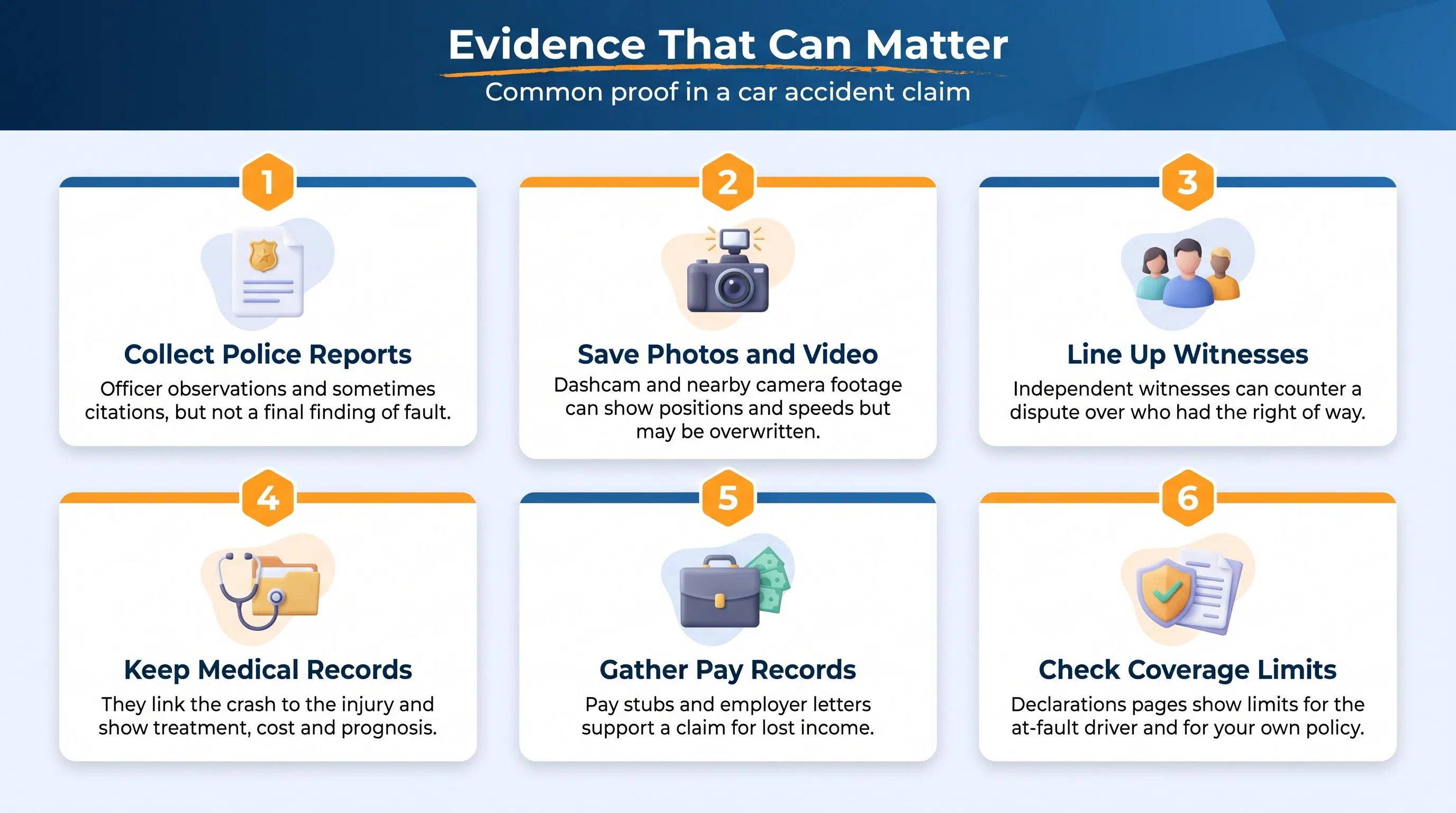
Evidence can support or weaken a claim, but no single item automatically proves liability. The following categories are commonly relevant:
-
Police or crash reports: They record the officer’s observations, parties and sometimes citations. They are a starting point, not a final finding of fault. Illinois Vehicle Code section 11-417 addresses crash reports and crash data [11].
-
Photographs and video: Scene photos, vehicle damage, dashcam footage and nearby business cameras can show positions and speeds. Video may be overwritten quickly.
-
Witness statements: Independent witnesses can counter a dispute over who had the right of way.
-
Medical records and bills: They connect the crash to the injury and document treatment, cost and prognosis.
-
Employment records: Pay stubs and employer letters support lost-income claims.
-
Vehicle data: Event data from modern vehicles can help show braking and speed.
-
Insurance documents: Declarations pages show coverage limits for the at-fault driver and for your own policy.
-
Communications and social media: Messages and public posts can be used by either side, so statements should be made carefully.
What Damages or Remedies May Be Available?
Recoverable damages depend on Illinois law and the facts of the case. Categories commonly claimed in a car accident case include past and future medical expenses, lost wages, loss of earning capacity, physical pain and suffering, emotional distress, disfigurement, and property damage (Illinois Pattern Jury Instructions, Civil, No. 30.00 and following). Punitive damages are available only in limited circumstances and are not typical in ordinary crash cases (735 ILCS 5/2-604.1). Property damage claims follow a separate, longer filing period of five years under 735 ILCS 5/13-205 [1].
If suit is filed and the plaintiff wins a judgment, Illinois law provides for six percent prejudgment interest on most damages, excluding punitive damages, sanctions, statutory attorney’s fees and statutory costs [9]. The statute does not apply that interest against governmental entities [9].

What If the Other Party Disputes Liability?
A disputed-fault case turns on proof. Illinois follows modified comparative negligence: an injured person may recover only if less than or not more than 50 percent at fault, and the recovery is reduced in proportion to the injured person’s share [2]. The Illinois Department of Insurance notes that an insurer may conclude its insured was not at fault and offer nothing [2]. In that situation, evidence preservation, witness interviews and sometimes accident reconstruction testimony may be needed. Giving a recorded statement or accepting blame at the scene can be used against an injured person later.
What If Insurance Is Involved?
Almost every car accident claim runs through insurance, and the dollar limits matter. Illinois requires at least $25,000 per person and $50,000 per accident in bodily injury liability coverage, plus $20,000 for property damage [3]. The Illinois State Bar Association notes that your own policy carries uninsured motorist limits of at least those same bodily injury amounts, and that underinsured coverage must be provided only if uninsured limits exceed the minimums [4]. Illinois law also provides that disputes over uninsured motorist coverage and damages are submitted to arbitration under the policy terms [6].
Medical providers and health insurers may also claim part of a recovery through liens or repayment rights. The Health Care Services Lien Act is found at 770 ILCS 23 [12]. A lawyer’s own fee is protected by the Attorneys Lien Act, which gives attorneys a lien on claims they are hired to pursue [8]. How these rules work together affects what an injured person actually takes home, and the rules are technical.
Illinois ethics rules require a contingent fee agreement to be in writing and to state how the fee is determined and how expenses are handled [7]. Many injury lawyers use that structure, but terms vary, so a client should read the agreement and ask questions before signing.
If You Are the Driver Accused of Causing the Crash
A driver who is blamed for a crash also has legal issues to consider. Illinois’s comparative fault statute allows a defendant to argue that the injured person’s own fault reduces or bars the claim [2]. The prejudgment interest statute can increase a defendant’s exposure once suit is filed, and it contains settlement-offer provisions that can limit that interest [9]. A driver who receives a demand letter or lawsuit papers, or whose policy limits may be exceeded, should promptly notify the insurer and seek legal advice rather than respond alone.
How Long Do I Have to Act?
For most Illinois car accident injury claims, the filing deadline is two years under 735 ILCS 5/13-202 [1]. The clock generally begins when the claim accrues, often the date of the crash. Settlement talks with an insurer do not automatically stop the clock. Other deadlines may be shorter or different:
-
Claims against a local government or public transit agency: Shorter filing periods may apply, generally one year under 745 ILCS 10/8-101(a), or under 70 ILCS 3605/41 for the Chicago Transit Authority.
-
Wrongful death: The Wrongful Death Act generally requires filing within two years after the death (740 ILCS 180/2(d)).
-
Minors and legal disability: The deadline may be paused, and a minor generally has two years after turning 18 to file (735 ILCS 5/13-211(a)).
-
Insurance policy notice and claim deadlines: Policies often require prompt notice, and UM claims have their own procedures. Check the policy language.
A fatal crash raises wrongful death considerations, and our team’s wrongful death lawyers can explain how those claims differ. A collision involving a commercial vehicle can involve additional parties and insurance, which is where truck accident lawyers are often consulted.
What Should I Do Next?
-
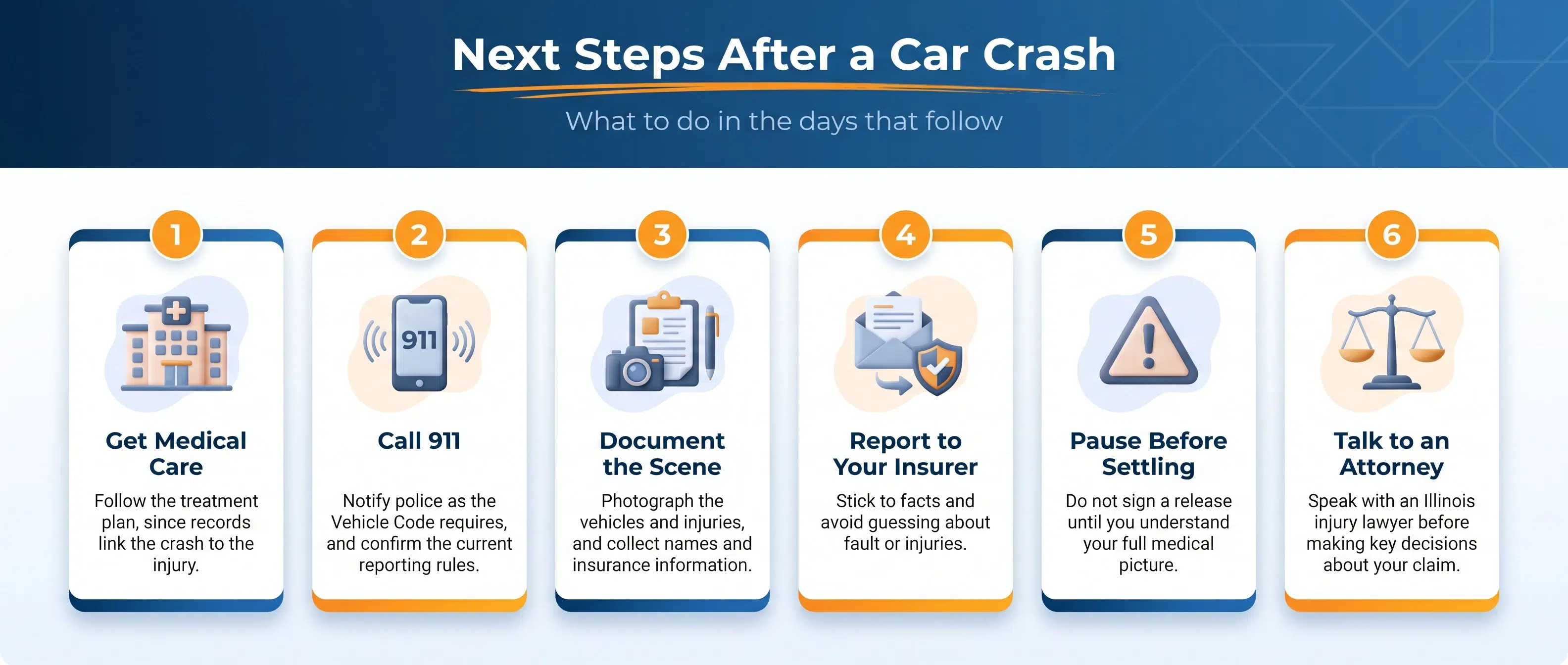
Get medical care and follow the treatment plan. Records link the crash to the injury.
-
Call 911 and notify police, as the Illinois Vehicle Code requires (625 ILCS 5/11-407). Drivers no longer file their own written crash report with the state, since that requirement was repealed in 2021. The investigating officer files the report instead.Photograph the scene, vehicles and injuries, and collect names and insurance information.
-
Report the crash to your own insurer, stick to facts, and avoid guessing about fault or injuries.
-
Do not sign a release or accept a final settlement before understanding your full medical picture.
-
Write down the accident date and calendar the two-year deadline [1].
-
Speak with an Illinois injury attorney about your situation before key decisions are made.
Related Illinois Personal Injury Resources
For broader background, see the GoSuits Illinois injury page. Chicago-area readers may also find information about motorcycle crash claims and pedestrian injury claims. Communities around Chicago, including Naperville, Joliet, Aurora and Cicero, are all part of the same Illinois legal framework discussed here.
Talk With a GoSuits Attorney
An injury claim can involve medical evidence, insurance issues, liability disputes and legal deadlines. If you were injured in an Illinois car accident, a GoSuits personal injury attorney can review the circumstances and explain your options. You can schedule a free consultation to discuss your situation. Past results do not guarantee a similar outcome in any case.
Disclaimer: This article is general legal information about Illinois law and is not legal advice. It does not create an attorney-client relationship. Laws change, and every case depends on its own facts.
References
-
Filing a Claim with Another Driver’s Insurance Company – Illinois Department of Insurance
-
Your Guide to Automobile Insurance and Accidents – Illinois State Bar Association
-
Charging Contingent Fee in Non-Litigation Matters (Rule 1.5) – Illinois State Bar Association
-
735 ILCS 5/2-1303 Interest on Judgment – Illinois General Assembly
-
Fee for Reduction of Lien, Common Fund Doctrine (Opinion 97-08) – Illinois State Bar Association
-
625 ILCS 5 Illinois Vehicle Code – Illinois General Assembly