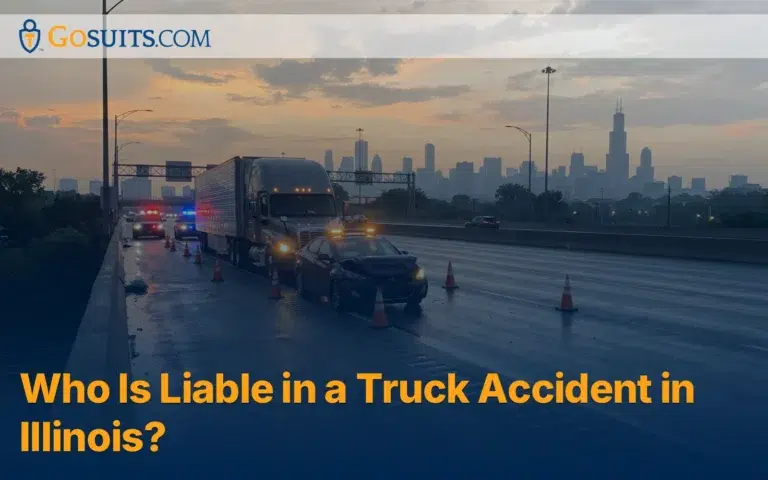
Illinois law does not point to one automatic party in a truck crash. Under Illinois negligence principles, the truck driver, the motor carrier that employs or dispatches the driver, and in some cases a freight broker, maintenance contractor or cargo loader may each be responsible, depending on what caused the collision. A jury or settlement allocates fault by percentage under Illinois statutes, and federal motor carrier safety regulations often help define what careful conduct required. Whether any particular party is liable depends on the facts, the evidence and the law that applies. This article is general legal information for civil claims, not advice about a specific crash.
Legal Snapshot
-
Legal Topic: Civil liability for commercial truck collisions in Illinois
-
Case Stage: Early claim evaluation and pre-suit investigation
-
Primary Legal Issue: Which parties owed a duty of care, breached it, and caused injury, and how fault is divided among them
-
Primary Authority: 735 ILCS 5/2-1116 and 5/2-1117 (Illinois Code of Civil Procedure); 735 ILCS 5/13-202; 49 CFR Parts 387 and 395; McQueen v. Green, 2022 IL 126666; Montgomery v. Caribe Transport II, LLC, No. 24-1238 (U.S. May 14, 2026)
-
Jurisdiction: Illinois state law, plus federal motor carrier regulations and federal preemption law where they apply
-
Date Legal Authority Last Reviewed: November 18, 2026 (attorney review pending)
What Does Liability Mean in an Illinois Truck Accident?
Liability means legal responsibility for harm. In a civil injury claim, an injured person generally must show that a defendant owed a duty of care, breached it, and that the breach caused the injury and damages. A criminal citation or arrest is a separate proceeding and does not by itself settle civil responsibility.
Truck cases are often more layered than ordinary car crashes. A tractor-trailer may be operated by a driver, owned by one company, leased to another, loaded by a third and dispatched through a broker. Each relationship can raise a different liability question.
What Does Illinois Law Say?
Illinois uses a modified comparative fault rule. Under 735 ILCS 5/2-1116, if you are more than 50 percent to blame for your own injury, you cannot recover damages. If you are 50 percent or less to blame, you can still recover, but your damages are reduced by your share of the fault. [1] The Illinois Department of Insurance explains the same rule on its consumer page.
Illinois also uses modified joint and several liability among defendants under 735 ILCS 5/2-1117. All defendants found liable are jointly and severally liable for the plaintiff’s past and future medical and medically related expenses. [2] For other damages, a defendant whose fault is under 25 percent of the total is responsible only for its own share, while a defendant at 25 percent or more may be jointly and severally liable [12]. The statute also treats the plaintiff’s employer differently when fault is totaled. A bill introduced in the 104th General Assembly (HB1464) proposed changing the 25 percent line to 50 percent, but it has not become law.
What Legal Rules Apply?
Several layers of law can apply to one Illinois truck crash. They come from different sources and should not be treated as interchangeable.
|
Source |
What it addresses |
|---|---|
|
Illinois statutes (735 ILCS 5/2-1116, 5/2-1117, 5/13-202) |
Comparative fault, joint liability, filing deadline |
|
Illinois common law |
Negligence, vicarious liability (respondeat superior), negligent hiring, retention, supervision and entrustment |
|
Federal regulations (49 CFR Parts 387 and 395) |
Minimum carrier insurance and driver hours of service |
|
Federal preemption law (FAAAA) |
Whether state-law claims against freight brokers can proceed |
Federal hours-of-service rules limit property-carrying drivers to 11 hours of driving within a 14-hour window after 10 consecutive hours off duty, and a motor carrier may not permit or require a driver to exceed those limits. [6] [7] A violation can be relevant evidence of a breach of care, though it does not automatically establish that the violation caused a particular crash.
Who Can Be Liable in an Illinois Truck Accident?
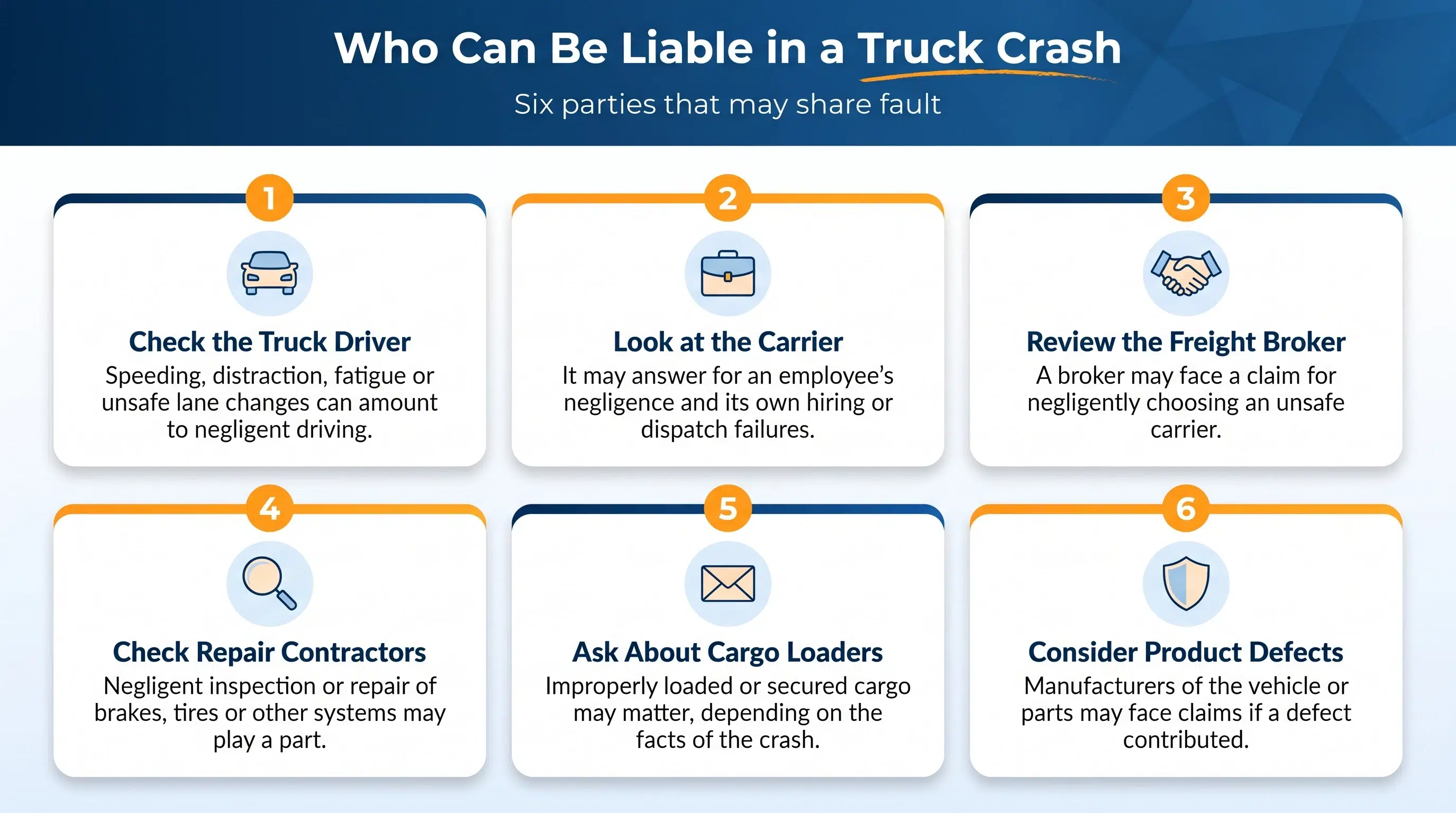
The potentially responsible parties depend on how the crash happened. The table below outlines common theories and does not predict how any case will be resolved.
|
Potential party |
Common liability theory |
||
|---|---|---|---|
|
Truck driver |
Negligent driving, such as speeding, distraction, fatigue, impairment or unsafe lane changes |
||
|
Motor carrier (trucking company) |
Responsible for its driver’s mistakes on the job, and for its own mistakes in hiring, keeping, supervising, training, dispatching, or maintaining trucks |
||
|
Freight broker |
Negligent selection of an unsafe carrier |
||
|
Maintenance or repair contractor |
Negligent inspection or repair of brakes, tires or other systems |
||
|
Shipper or cargo loader |
Improperly loaded or secured cargo, depending on the facts |
||
|
Vehicle or parts manufacturer |
Product liability claims where a defect contributed to the crash |
The driver and the trucking company
An employer can be held responsible for an employee’s mistakes made on the job (Adames v. Sheahan, 233 Ill. 2d 276 (2009)). Many truck drivers are labeled independent contractors, but Illinois courts look past the label and ask who actually controlled the work (Sperl v. C.H. Robinson Worldwide, Inc., 408 Ill. App. 3d 1051 (2011)).
A trucking company can also be sued for its own mistakes. In McQueen v. Green, 2022 IL 126666, the Illinois Supreme Court held that an injured person may sue an employer, such as a trucking company, for careless hiring, supervision, and retention of a driver, even when the company admits it is responsible for the driver’s actions [10]. This matters because it lets a jury hear evidence about the company’s own safety practices.
Freight brokers
On May 14, 2026, the U.S. Supreme Court unanimously held in Montgomery v. Caribe Transport II, LLC that federal law does not shield freight brokers from state-law claims that they negligently hired a dangerous motor carrier [8]. The decision does not make brokers automatically liable. What reasonable care requires in selecting a carrier is expected to be litigated, and the Court left open whether preemption might still apply to purely intrastate loads. [9] [
How Does This Apply to a Real Case?
Hypothetical example (not an actual GoSuits case): A tractor-trailer driver in stop-and-go traffic on I-55 near the Stevenson Expressway fails to slow and rear-ends a passenger car. Electronic logs later suggest the driver had been behind the wheel well past the federal driving limit. The driver, the carrier that dispatched the load and possibly a broker could all become part of the analysis, and a jury could assign each a share of fault.
Hypothetical example (not an actual GoSuits case): A passenger car merges onto the Kennedy Expressway near a tractor-trailer. The truck’s defense is that the car cut in front of it. If a jury found the car driver 20 percent at fault on $200,000 in damages, the recovery would be reduced to $160,000 under the comparative fault rule. Had the car driver been found more than 50 percent at fault, recovery would be barred. These figures are illustrative only.
Disputes like these are why many injured people turn to Chicago truck-crash attorneys early, before key records can be lost or overwritten.

What Evidence Can Matter?
No single piece of evidence proves liability on its own. The following categories commonly matter in Illinois truck cases.
-
Police and crash reports: Initial observations, citations and witness names, though they are not conclusive on fault.
-
Electronic logging device and hours-of-service records: They may show whether the driver complied with 49 CFR 395.3.
-
Engine control module and dashcam data: Speed, braking and following distance in the seconds before impact.
-
Driver qualification and training files: Hiring and supervision records can bear on a direct negligence theory, though a complete file does not prove careful hiring and a missing document does not alone prove causation.
-
Maintenance and inspection records: Brake, tire and repair history.
-
Dispatch records, bills of lading and broker contracts: Who scheduled the trip, what deadlines applied and who selected the carrier.
-
Scene photographs, surveillance video and witness statements: Road conditions, vehicle positions and lane markings.
-
Medical records and bills: The link between the crash and the injuries, and the cost of care.
Trucking companies control much of this evidence. A prompt written preservation request from counsel is one way people try to keep it from being overwritten or discarded.
What Damages or Remedies May Be Available?
Recoverable damages depend on Illinois law and the facts of the case. Categories commonly claimed include:
-
Past and future medical expenses
-
Lost income and loss of earning capacity
-
Pain and suffering and emotional distress
-
Disability, loss of normal life and disfigurement
-
Property damage
If a crash is fatal, family members may have claims under Illinois’s wrongful death statute, and a separate survival claim may exist for the decedent’s own losses. Families facing that situation often consult wrongful death lawyers in Chicago or elsewhere in Illinois to understand which claims apply and who may bring them.
Punitive damages are not available in every case. In Illinois negligence actions, a complaint cannot include a prayer for punitive damages at filing. A plaintiff must instead move to amend after a hearing, and the court allows the amendment only if the plaintiff shows a reasonable likelihood of proving facts at trial sufficient to support an award. The motion must be made no later than 30 days after discovery closes. [3] Illinois courts have described such awards as reserved for conduct beyond ordinary carelessness, such as willful and wanton misconduct.
What If the Other Party Disputes Liability?
Disputes are common. A driver may blame the other motorist, a carrier may argue the driver was an independent contractor, and each defendant may point to another. In a lawsuit, evidence is exchanged through discovery and a judge or jury ultimately allocates fault. The plaintiff’s own conduct is also examined. Because a finding of more than 50 percent fault bars recovery, the way fault is allocated can decide the outcome of the whole case. [1] Settlement offers made before that allocation are negotiated with these risks in mind.
What If Insurance Is Involved?
Federal regulations set a minimum level of financial responsibility. For a for-hire carrier hauling nonhazardous property in interstate or foreign commerce in a vehicle with a gross vehicle weight rating of 10,001 pounds or more, the floor is $750,000. Higher minimums apply to oil and certain hazardous materials.[4] [5] Intrastate carriers may be subject to different requirements.
A carrier’s policy isn’t the only source of recovery. Broker, contractor and personal policies may also matter, and insurers generally evaluate fault before making any offer. Injured people in the Chicago area can ask our Chicago personal injury team to review what coverage may be involved. Anyone dealing with a trucking insurer’s adjuster should be cautious about recorded statements and early settlement releases, and should seek legal guidance before signing anything.
How Long Do I Have to Act?
Illinois generally requires a personal injury lawsuit to be filed within two years after the cause of action accrued under 735 ILCS 5/13-202. [11] Wrongful death claims are commonly described as subject to a two-year period measured from the date of death under 740 ILCS 180/2. [13]
Shorter deadlines can apply when a government body is involved, for example, a municipal or other public vehicle. The Local Governmental and Governmental Employees Tort Immunity Act, 745 ILCS 10/8-101(a), generally requires suit within one year. Tolling for minors or other circumstances may also apply. Because deadlines depend on specific facts, an attorney should confirm them promptly.
In Cook County, civil lawsuits are filed in the Circuit Court of Cook County, including at the Richard J. Daley Center in the Loop. Venue for a truck crash may involve other counties as well, such as Will County for crashes near Joliet. [VERIFICATION FLAG: venue rules depend on where the crash occurred and where defendants reside or do business.]
What Should I Do Next?
-
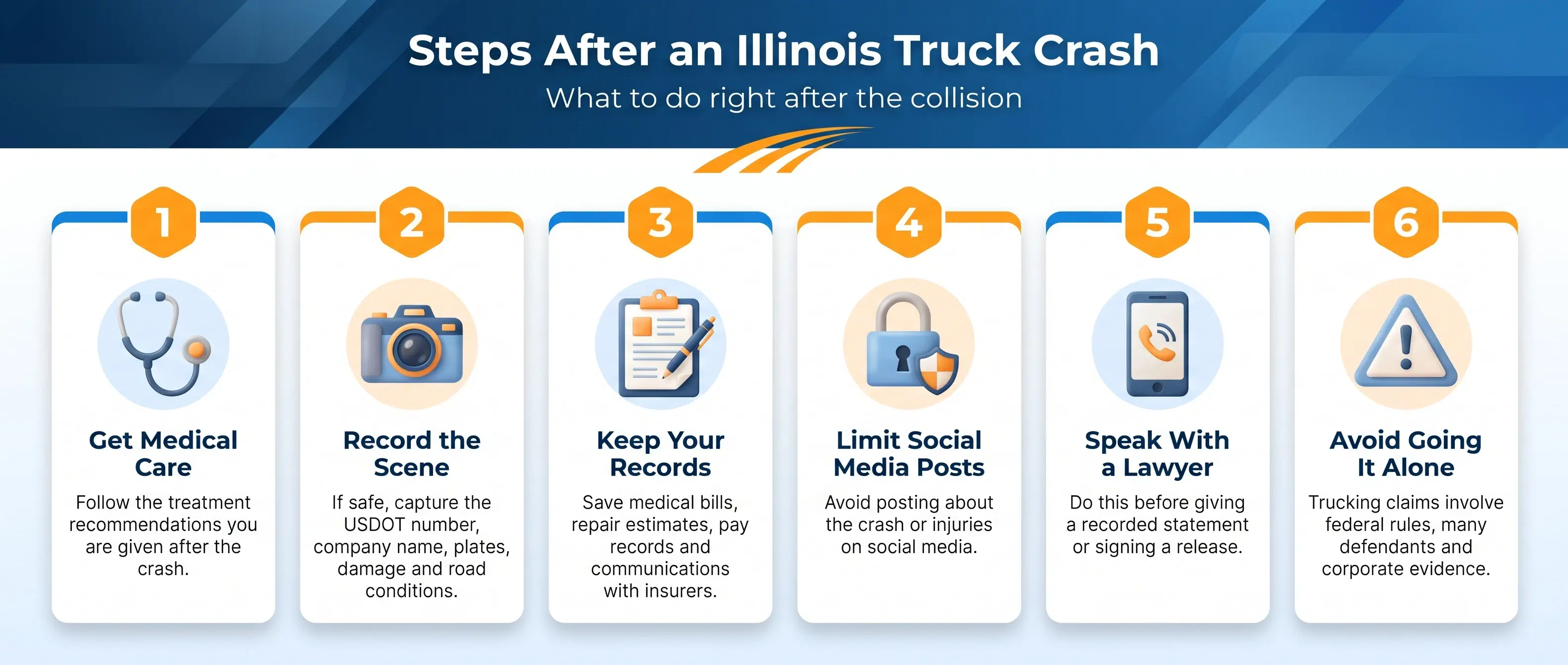
Get medical care and follow treatment recommendations.
-
Record the scene if you safely can, including the truck’s USDOT number and company name, plates, damage and road conditions.
-
Keep medical bills, repair estimates, pay records and communications with insurers.
-
Avoid posting about the crash or injuries on social media.
-
Speak with licensed personal injury lawyers before giving a recorded statement or signing a release, since a carrier’s insurer may begin its own investigation quickly.
Representing yourself in a trucking case is not recommended. These claims involve federal regulations, multiple defendants, corporate evidence and short deadlines.
Related Illinois Personal Injury Resources
For a broader overview of injury claims across the state, see our Illinois personal injury resources. Readers who have lost a family member in a crash can also review information on fatal crash claims in Chicago. Crashes involving large trucks occur on corridors such as I-290, the Eisenhower Expressway and the Dan Ryan Expressway, as well as in suburbs including Aurora and Cicero, but the legal framework described above is a statewide one.
Talk With a GoSuits Attorney
A truck accident claim can involve federal regulations, several possible defendants, preserved electronic data, insurance layers and filing deadlines. If you were injured in an Illinois truck crash, you can schedule a free consultation so a GoSuits attorney can review the circumstances and explain your options. Results depend on the facts of each case, and no outcome is guaranteed.
This article provides general information about Illinois law and is not legal advice. Reading it does not create an attorney-client relationship. Laws change, and outcomes depend on individual facts.
References
-
735 ILCS 5/2-1117 Joint Liability – Illinois General Assembly
-
735 ILCS 5/2-604.1 Pleading of Punitive Damages – Illinois General Assembly
-
49 CFR 387.9 Financial Responsibility, Minimum Levels – eCFR
-
Court Rules Freight Brokers Can Face Negligent Hiring Suits Under State Law – SCOTUSblog
-
Illinois Cheat Sheet for Transportation Claims – Lewis Brisbois
-
How Long Do You Have to File a Personal Injury Claim in Illinois – Paniolaw