No. Texas is not a no-fault state for car accidents. Texas follows an at-fault (fault-based) system, which means an injured person may seek compensation from the driver whose negligence caused the crash, usually through that driver’s liability insurance. [4] Texas does have one no-fault feature: insurers must include personal injury protection (PIP) in an auto liability policy unless a named insured rejects it in writing. [5][7] PIP pays certain benefits regardless of who caused the crash, but it does not replace the right to pursue the at-fault driver. Whether a claim succeeds, and for how much, depends on the facts and the policies involved.
Legal Snapshot
-
Legal Topic: Fault-based (tort) car accident claims versus no-fault insurance benefits in Texas
-
Case Stage: Pre-claim and early claim, including insurance reporting and evidence preservation
-
Primary Legal Issue: Who bears financial responsibility for injuries after a Texas crash, and how fault percentages affect recovery
-
Primary Authority: Texas Civil Practice and Remedies Code Chapters 16 and 33; Texas Transportation Code Chapter 601; Texas Insurance Code Chapter 1952
-
Jurisdiction: Texas state law (no federal statute governs fault in an ordinary private car crash)
-
Date Legal Authority Last Reviewed: November 10, 2026 (research compilation date; attorney review pending)
What Does “No-Fault” Mean for Car Accidents?
A true no-fault system requires each injured person to look first to their own insurance for medical bills and other losses, and it often limits the right to sue the other driver unless injuries meet a threshold. Texas does not work that way. Texas has no general rule that blocks an injured driver, passenger or pedestrian from filing a civil claim against a negligent driver.
The phrase can still cause confusion in Texas because of PIP. PIP is first-party coverage that responds without a fault decision. It is an add-on benefit layered on top of a fault-based system, not a replacement for it.
What Does Texas Law Say?
Texas relies on negligence principles and a statutory proportionate responsibility system. Under Texas Civil Practice and Remedies Code section 33.001, a claimant may not recover damages if the claimant’s percentage of responsibility is greater than 50 percent. [1][2] Under section 33.012(a), a claimant who is not barred has their damages reduced by a percentage equal to their own percentage of responsibility. [3]
Texas also requires drivers to show financial responsibility, which most people satisfy with a liability policy. Transportation Code Section 601.072 sets the minimum limits commonly written as 30/60/25: $30,000 per person for bodily injury or death, $60,000 per accident for bodily injury or death of two or more people, and $25,000 per accident for property damage. [4] Those limits are minimums, and a serious injury can exceed them.
What Legal Rules Apply?
|
Rule |
Authority |
What it means in practice |
|---|---|---|
|
Proportionate responsibility and the 51% bar |
A claimant over 50 percent responsible recovers nothing; a claimant at 50 percent or less has damages reduced by that percentage. |
|
|
Minimum liability insurance |
Tex. Transp. Code § 601.072 [4] |
30/60/25 is the statutory floor for liability coverage. |
|
Personal injury protection (PIP) |
Tex. Ins. Code § 1952.152 [7] |
Insurers must include PIP unless a named insured rejects it in writing; it applies regardless of fault. |
|
Uninsured/underinsured motorist (UM/UIM) |
Tex. Ins. Code § 1952.101 [6] |
Insurers must provide UM/UIM unless a named insured rejects it in writing. |
|
Filing deadline |
Tex. Civ. Prac. & Rem. Code § 16.003 [8] |
Most personal injury suits must be filed within two years after the cause of action accrues. |
|
Officer’s crash report |
Tex. Transp. Code § 550.062 [11] |
Officers who investigate a crash with injury, death, or apparent property damage of $1,000 or more must file a written report. |
Under Texas Insurance Code section 1952.153, an insurer is not required to provide PIP coverage of more than $2,500 per person for all benefits combined.
How Does This Apply to a Real Case?
Hypothetical example, not a GoSuits case: A driver in stop-and-go traffic on I-635 (LBJ Freeway) near Dallas is rear-ended and suffers a back injury. Because Texas is an at-fault state, the injured driver may present a claim to the other driver’s liability insurer. If the injured driver also has PIP, that coverage may pay certain benefits without waiting for the insurers to resolve who was at fault (Tex. Ins. Code § 1952.155). PIP and the fault-based claim are separate tracks, and an attorney should review how they interact.
Hypothetical example, not a GoSuits case: Two drivers merge into the same lane on I-45 in Houston, and each says the other drifted. A jury or the parties may assign each a percentage of responsibility. If the injured driver is assigned 30 percent, Section 33.012 reduces recovery by that 30 percent. If assigned 51 percent, Section 33.001 bars recovery in an action the chapter covers. [1][3]
What Evidence Can Matter?
Evidence does not automatically prove liability, but it shapes how fault percentages are argued. Categories that commonly matter include:
-
Police crash report: Officers must file a written report for qualifying crashes, and TxDOT is the custodian of Texas crash records. [10][11] The report can record the officer’s observations, but it is not the final word on fault.
-
Photographs and video: Scene photos, dashcam footage and nearby surveillance can show vehicle positions, signals and road conditions.
-
Witness statements: Independent witnesses can support or contradict a driver’s version of events.
-
Medical records and bills: These connect the crash to the injury and document treatment and cost.
-
Employment records: Pay records and work restrictions support lost income claims.
-
Insurance documents: Declarations pages and any signed PIP or UM/UIM rejection forms show what coverage exists.
-
Vehicle data and reconstruction: In disputed or serious crashes, onboard data and accident reconstruction engineers may help explain speed, braking and impact.
-
Phone and social media activity: Communications and posts can be relevant to both distraction and injury claims.
What Damages or Remedies May Be Available?
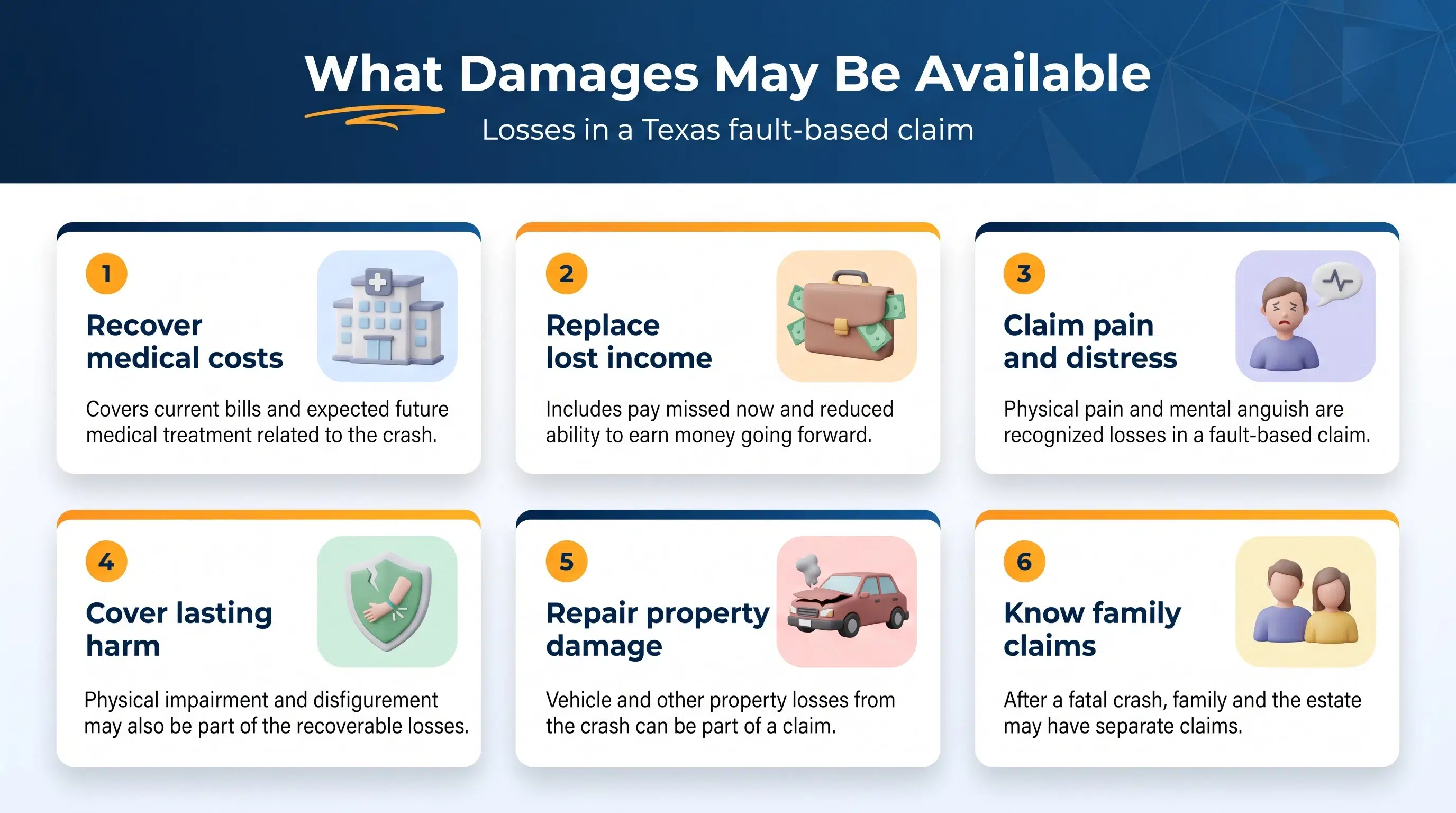
Recoverable losses in a Texas fault-based claim can include medical expenses, future medical expenses, lost income, loss of earning capacity, physical pain, mental anguish, physical impairment, disfigurement and property damage. If a crash is fatal, surviving family members and the estate may have separate wrongful death and survival claims. Punitive (exemplary) damages are possible only in limited circumstances and require specific proof. Recoverability depends on the facts, the available insurance, and applicable Texas law, and no outcome is guaranteed.
PIP is a different kind of remedy. It is a first-party benefit with its own limit, and it is not a measure of what a full injury claim may be worth.

What If the Other Party Disputes Liability?
Disputes over fault are common in Texas crashes, and they matter more here because of the 51 percent bar. An insurer may argue the injured person was partly responsible in order to reduce or eliminate recovery. Under Chapter 33, a defendant may also seek to have a jury consider the responsibility of other persons through the responsible third party procedure in Section 33.004. [1]
In some situations, a defendant found more than 50 percent responsible may be jointly and severally liable for the damages recoverable, meaning it can be responsible for the full amount (Tex. Civ. Prac. & Rem. Code § 33.013(b)). [3] Because defendants and plaintiffs both face real consequences from percentage allocations, evidence gathered early tends to matter. An attorney can evaluate how a dispute is likely to be argued.
What If Insurance Is Involved?
Insurance is usually the center of a Texas car accident claim. Several coverages can come into play:
-
Liability coverage: The at-fault driver’s policy pays claims up to its limits. With 30/60/25 as the statutory minimum, those limits can run out in a serious crash. [4]
-
PIP: Included unless rejected in writing by a named insured, and the rejection can carry forward at renewal with the same or an affiliated insurer unless coverage is requested in writing. [7]
-
UM/UIM: Intended to protect insureds who are legally entitled to recover from owners or operators of uninsured or underinsured vehicles, and also rejectable only in writing. [6]
-
Medical payments (MedPay) and health insurance: Medical payments (MedPay) and health insurance: These may be available depending on the policy. Reimbursement and lien rights can affect net recovery.
A missing PIP or UM/UIM line on a declarations page does not by itself prove the coverage was legally rejected, since Texas requires a written rejection (Tex. Ins. Code §§ 1952.101, 1952.152). The actual rejection record may be worth requesting. Policy deadlines for giving notice or submitting claims may be shorter than the lawsuit deadline.
Car accident lawyers can review which policies apply, whether a rideshare or commercial vehicle changes the coverage picture, and how a PIP claim and a liability claim fit together. For more on how rideshare crashes differ, see our Texas rideshare accident page.
How Long Do I Have to Act?
Most Texas personal injury lawsuits must be filed not later than two years after the day the cause of action accrues under Civil Practice and Remedies Code section 16.003(a) [8]. For a typical car crash, that is generally two years from the date of the crash. Wrongful death claims are also generally governed by a two-year period under section 16.003(b), but the clock generally runs from the date of death.
Exceptions exist, including tolling for minors under section 16.001. Claims against a government entity, such as a city vehicle crash, can carry a much shorter notice requirement. Section 101.101 of the Civil Practice and Remedies Code requires notice within six months after the incident, and city charters may impose their own requirements.
Suits in Dallas County are filed in the district courts located at the George L. Allen Sr. Courts Building, and the same two-year rule applies statewide whether a case is filed in Dallas, Harris or another Texas county.
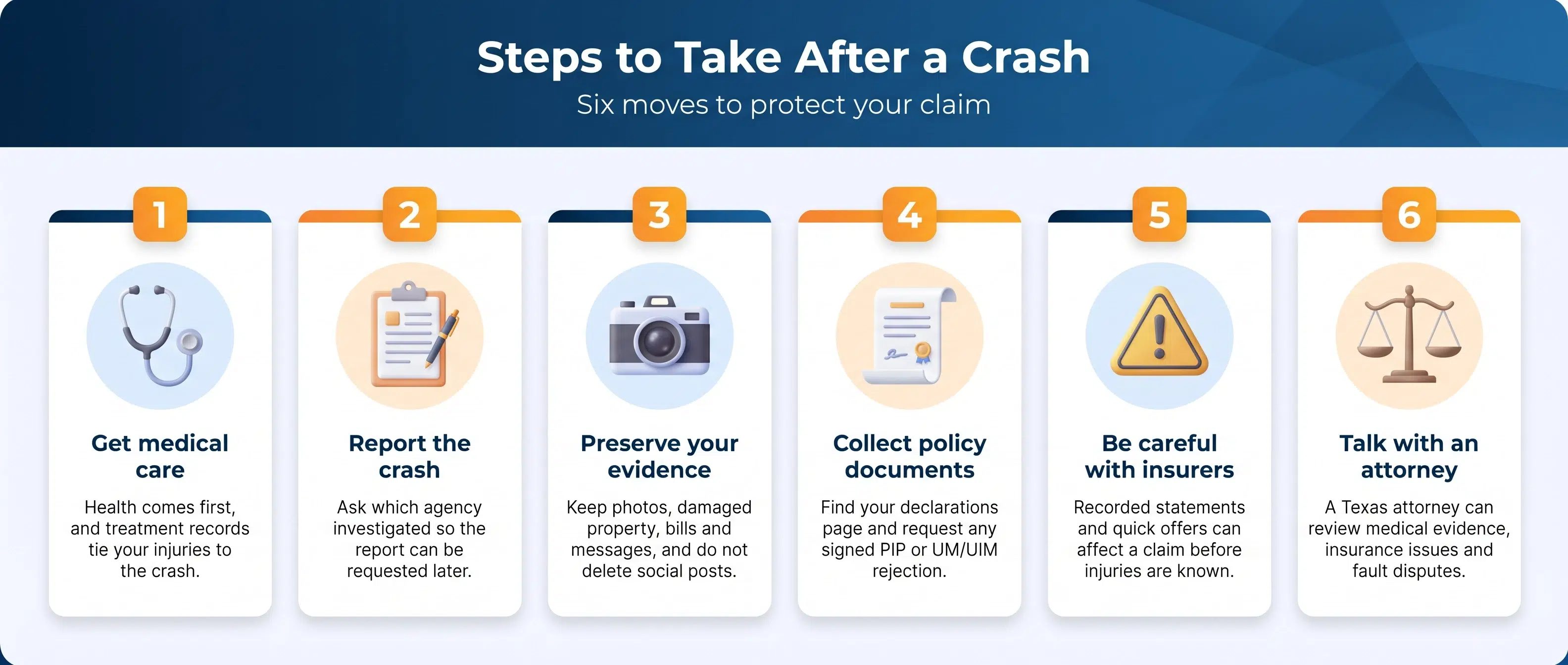
What Should I Do Next?
-
Get medical care and follow treatment advice. Health comes first, and records tie injuries to the crash.
-
Report the crash and get the report number. Ask which agency investigated so the report can be requested later. [10]
-
Preserve evidence. Keep photos, damaged property, medical bills and messages, and avoid deleting social media content.
-
Collect your policy documents. Find your declarations page and ask the insurer for any signed PIP or UM/UIM rejection.
-
Be careful with insurer statements. Recorded statements and quick settlement offers can affect a claim before the full extent of injuries is known.
-
Talk with a Texas attorney before deadlines approach. A personal injury claim involves medical evidence, insurance issues, fault disputes and filing deadlines, and handling it without legal help can put a recovery at risk.
Related Texas Personal Injury Resources
Readers who want a broader overview of how injury claims work across the state can start with our Texas personal injury team’s overview. Those dealing with a crash on foot or on a scooter may also want the Texas pedestrian and scooter pages. Each topic has its own fault and insurance questions that depend on the facts.
Talk With a GoSuits Attorney
An injury claim can involve medical evidence, insurance issues, liability disputes and legal deadlines. If you were hurt in a Texas crash, you can schedule a free consultation and a GoSuits personal injury attorney can review the circumstances and explain your options. This article is general legal information, not legal advice, and reading it does not create an attorney-client relationship. Results depend on the facts of each case, and no outcome is guaranteed.
References
-
Section 33.001, Proportionate Responsibility – Justia Texas Codes
-
Insurance Code, Chapter 1952, Automobile Insurance – Texas Statutes (Texas Legislature)
-
Texas Insurance Code Section 1952.152, Personal Injury Protection Coverage Required – Public.Law
-
Transportation Code, Chapter 550, Accidents and Accident Reports – Texas Legislature
-
Crash Reports and Records – Texas Department of Transportation
-
Texas Transportation Code Section 550.062, Officer’s Collision Report – FindLaw