Yes. Under Illinois law, a person who suffers a traumatic brain injury because of another party’s negligence or wrongful conduct may have a civil claim for damages. Most Illinois injury lawsuits must be filed within two years under 735 ILCS 5/13-202 [1], and claims against local government bodies generally must be filed within one year [3]. Illinois reduces a recovery by the injured person’s share of fault and bars recovery if that share is more than 50 percent [2]. Whether a particular claim succeeds depends on proof of fault, medical causation and the facts of the case. Nothing here guarantees a result.
Legal Snapshot
-
Legal Topic: Civil lawsuit for traumatic brain injury (including concussion) caused by another party’s negligence in Illinois
-
Case Stage: Pre-suit evaluation through filing and litigation
-
Primary Legal Issue: Whether another party’s fault caused the brain injury, and whether the claim is filed on time
-
Primary Authority: 735 ILCS 5/13-202 (two-year limitations period); 735 ILCS 5/2-1116 (modified comparative fault); 745 ILCS 10/8-101 (one-year period for local government defendants)
-
Jurisdiction: Illinois state law; federal law only in limited situations noted below
-
Date Legal Authority Last Reviewed: November 18, 2026 (attorney review pending)
What Does a Brain Injury Lawsuit Mean?
A brain injury lawsuit is a civil action asking a court to hold a person or company financially responsible for harm to the brain. It is separate from any criminal matter or workers’ compensation claim. Medically, the National Institute of Neurological Disorders and Stroke describes a traumatic brain injury as a brain injury caused by an outside force, such as a forceful bump, blow or jolt to the head or body [8].
A concussion is included. The CDC explains that doctors may call concussions “mild” because they are usually not life-threatening, yet the effects can be serious, and some symptoms may not appear until hours or days later [10]. That delay matters legally because it can affect how and when an injury is documented.
What Does Illinois Law Say?
Illinois does not have a separate “brain injury statute.” A brain injury claim is an ordinary personal injury claim, usually based on negligence, and the same rules apply as for other bodily injuries. In general terms, an injured person must show that the defendant owed a duty of care, breached it, and caused injury and damages (Marshall v. Burger King Corp., 222 Ill. 2d 422, 430 (2006)).
Illinois is not described by the Illinois Department of Insurance as a pure comparative fault state. It uses modified comparative negligence under 735 ILCS 5/2-1116, which allows recovery only if the injured person is not more than 50 percent at fault, with damages reduced in proportion to that person’s fault [2].
What Legal Rules Apply?
Several Illinois rules shape a brain injury case. The table below summarizes the main ones, and each should be confirmed against the current statute text [1].
|
Issue |
Rule |
Authority |
|---|---|---|
|
General filing deadline |
Two years after the claim accrues |
735 ILCS 5/13-202 |
|
Injured person was a minor |
Generally two years after turning 18 |
735 ILCS 5/13-211 |
|
Legal disability at accrual |
May allow two years after the disability is removed; fact-specific |
735 ILCS 5/13-211 |
|
Local government defendant |
One year from injury or accrual |
745 ILCS 10/8-101(a) |
|
Shared fault |
Barred if more than 50 percent at fault; otherwise reduced |
735 ILCS 5/2-1116 |
|
Wrongful death after a fatal brain injury |
Generally two years from death |
Illinois Wrongful Death Act |
|
Work injury against employer |
Workers’ compensation is the exclusive remedy |
820 ILCS 305/5(a) |
Illinois also has a rule on how responsibility is divided among several defendants. Under 735 ILCS 5/2-1117, every defendant found liable is jointly responsible for the injured person’s past and future medical expenses. For all other damages, a defendant found less than 25 percent at fault is liable only for its own share, while a defendant found 25 percent or more at fault may be held responsible for the full amount. Section 2-1118 makes exceptions, including for medical malpractice cases, where all liable defendants remain jointly responsible.
Federal law becomes relevant only in particular situations. For example, if a federal employee or agency vehicle caused the injury, the Federal Tort Claims Act requires an administrative claim before suit (28 U.S.C. §§ 2401(b), 2675).
How Does This Apply to a Real Case?
Hypothetical example 1 (not an actual GoSuits matter): Traffic slows suddenly on the Kennedy Expressway during the evening commute, and a driver rear-ends a stopped car. The front-seat driver’s head strikes the window. She feels fine at the scene, but headaches, light sensitivity and trouble concentrating begin over the next several days. Her claim would turn on who was at fault, whether medical records connect her symptoms to the crash, and whether suit is filed within the limitations period. Stop-and-go conditions on the Dan Ryan and Eisenhower Expressways make this kind of collision a common driving scenario, and delayed symptoms are the reason prompt medical care and documentation matter.
Hypothetical example 2 (not an actual GoSuits matter): A pedestrian in the Loop falls on a badly broken public sidewalk and strikes her head. If a local public entity is a defendant, 745 ILCS 10/8-101(a) generally sets a one-year deadline rather than two [3]. Local governments also have statutory immunities and defenses under the Tort Immunity Act, so these cases need early legal review.
Hypothetical example 3 (not an actual GoSuits matter): A worker at a construction site is hit on the head by material dropped by another company’s crew. Workers’ compensation is generally the exclusive remedy against the direct employer under 820 ILCS 305/5(a), but the injured worker may still bring a civil claim against a third party who contributed to the injury [5]. In Munoz v. Bulley & Andrews, LLC, the Illinois Supreme Court addressed whether exclusive remedy protection extends to a general contractor that was not the worker’s immediate employer, and it held that it did not [6]. Whether that decision helps in a given case depends on the contractual and employment relationships.
What Evidence Can Matter?
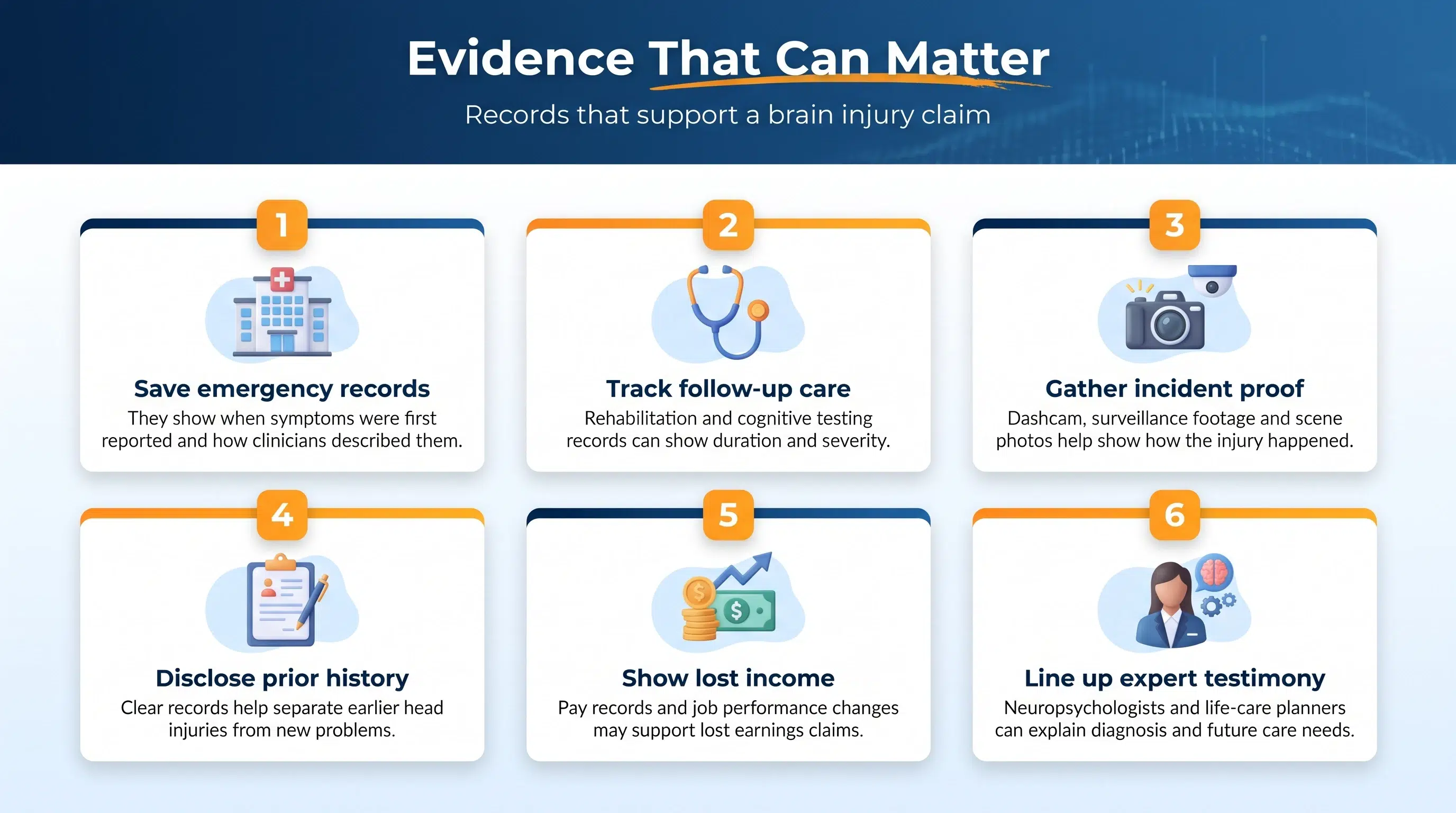
Brain injuries are often invisible, so records carry a great deal of weight. Evidence does not automatically prove liability, but these categories commonly matter:
-
Emergency and treatment records: They show when symptoms were first reported and how clinicians described them. A concussion may produce normal imaging, so symptom documentation can be important.
-
Follow-up care: Neurology, rehabilitation, cognitive testing and counseling records can show duration and severity. Gaps in treatment are often questioned by insurers.
-
Crash or incident reports, photographs and video: Dashcam, surveillance and scene images help show how the head injury occurred and who was responsible.
-
Witness accounts: Bystanders, coworkers, family and friends can describe changes in memory, mood, sleep or personality before and after the event.
-
Employment and income records: Pay records and job-performance changes may support lost earnings and reduced earning capacity.
-
Prior medical history: Earlier head injuries or related conditions will be examined by the defense, so clear records help separate old problems from new ones.
-
Qualified professional testimony: Physicians, neuropsychologists, life-care planners and economists may be used to explain diagnosis, future care needs and financial loss.
What Damages or Remedies May Be Available?
Recoverable damages depend on Illinois law and on what the evidence proves. The Illinois Pattern Jury Instructions list the elements a jury may consider in a bodily injury case [7]. For a brain injury they may include:
-
Past and future medical expenses, including rehabilitation and caretaking costs
-
Past lost earnings and future loss of earning capacity
-
Pain and suffering, including emotional distress
-
Loss of a normal life, which Illinois treats as a recognized element separate from pain and suffering
-
Disability and disfigurement, where supported by the evidence
-
Property damage, such as a vehicle
Illinois does not cap pain and suffering damages in ordinary injury cases. The Illinois Supreme Court struck down a general cap in Best v. Taylor Machine Works, 179 Ill. 2d 367 (1997), and a medical malpractice cap in Lebron v. Gottlieb Memorial Hospital, 237 Ill. 2d 217 (2010). Punitive damages are available only in limited circumstances involving serious misconduct and are not a routine part of a negligence case. Family members may have separate claims, and if a brain injury proves fatal, a wrongful death lawyer can explain what the Illinois Wrongful Death Act may allow.

What If the Other Party Disputes Liability?
Disputes are common in brain injury cases, and they come from both sides. A defendant or insurer may argue that the injured person was partly to blame, which matters because of the 50 percent bar [2]. They may argue that symptoms came from a pre-existing condition, that normal scans mean no injury, or that a gap in treatment shows recovery. They may also dispute whether the defendant’s conduct caused the head trauma at all.
An injured person answers these arguments with consistent medical documentation, objective incident evidence and testimony tied to the specific injury. A person or business facing a brain injury claim should also speak with a lawyer promptly, because deadlines, preservation duties and insurance notice obligations apply to defendants as well. If an insurance company contacts you for a recorded statement, legal advice before responding is wise. Representing yourself in a case this medically complex is not recommended.
What If Insurance Is Involved?
Most brain injury claims are resolved through insurance rather than from personal assets. Depending on the facts, coverage may come from the at-fault party’s liability policy, the injured person’s own uninsured or underinsured motorist coverage (215 ILCS 5/143a and 143a-2), a business’s commercial policy, or workers’ compensation.
Insurers calculate offers based on what they believe their insured’s share of fault was, and the Illinois Department of Insurance notes that it cannot decide comparative negligence disputes, which are resolved through negotiation or the courts [2]. Reimbursement claims from health insurers, government programs or a workers’ compensation carrier can reduce what an injured person keeps. The Workers’ Compensation Act addresses an employer’s reimbursement interest when a third party pays [5]. Early settlements are risky when long-term cognitive effects are not yet known.
How Long Do I Have to Act?
The general rule is two years under 735 ILCS 5/13-202, and the period is commonly counted from the date the claim accrues, which is often the date of injury [1] [12]. Brain injuries can complicate accrual because symptoms may emerge later, and Illinois courts apply a discovery rule in some situations (Golla v. General Motors Corp., 167 Ill. 2d 353 (1995)). Do not assume the clock started later than the incident date.
Shorter deadlines can apply. Claims against local public entities and their employees generally must be filed within one year from the date the injury was received or the cause of action accrued [3] [4]. Claims involving the Chicago Transit Authority or the State of Illinois may follow separate rules, including those of the Court of Claims (70 ILCS 3605/41; 705 ILCS 505/22-1).
For minors, 735 ILCS 5/13-211 generally allows suit within two years after the person turns 18 [12]. That section also addresses persons under a legal disability when the claim accrued. Whether a brain injury amounts to a legal disability is a fact-specific question that requires attorney review, and tolling should never be treated as a reason to wait.
What Should I Do Next?
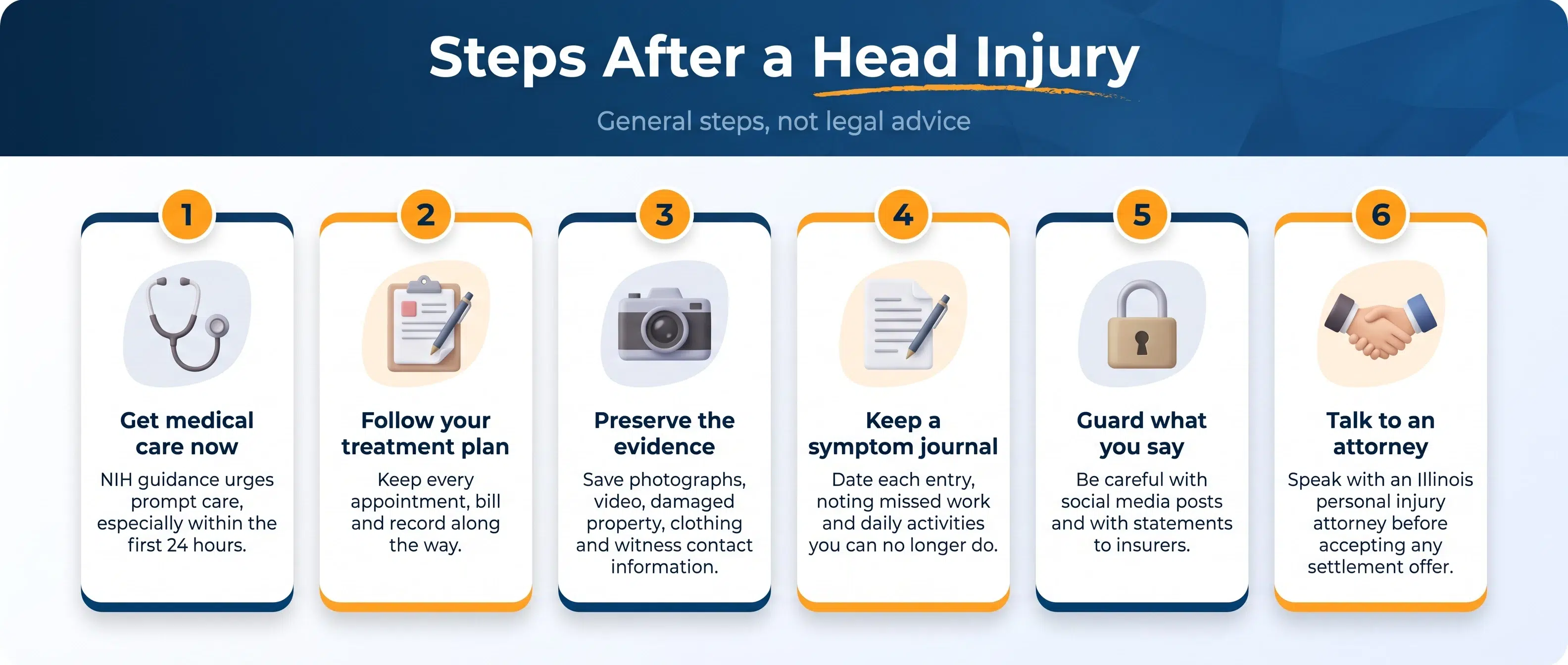
These are general steps, not individualized legal advice:
-
Get medical evaluation right away. NIH guidance urges prompt care after a head injury, especially in the first 24 hours [9].
-
Follow the treatment plan and keep every appointment, bill and record.
-
Preserve evidence: photographs, video, damaged property, clothing and contact information for witnesses.
-
Keep a dated journal of symptoms, missed work and daily activities you can no longer do.
-
Be careful with social media and with statements to insurers.
-
Identify every deadline that may apply, including the shorter ones for government defendants.
-
Speak with an Illinois personal injury attorney before accepting any settlement offer.
Brain injury claims involve medical proof, insurance disputes and strict deadlines. Injured people across the state, including Cook County residents who file in the Circuit Court of Cook County at the Richard J. Daley Center, can speak with brain injury lawyers in Chicago at GoSuits about their options. Injured Illinois residents may also contact our Illinois personal injury team or review our Chicago brain injury practice page. To discuss your situation, schedule a free consultation. GoSuits cannot promise any particular outcome.
Related Illinois Personal Injury Resources
Brain injuries often arise from collisions, falls and workplace events. Readers can learn more about Chicago motor vehicle crash claims or fatal injury claims in Chicago. Whether you are in Naperville, Aurora, Cicero or the South Side, GoSuits personal injury lawyers can review where and how your injury happened. Car accident lawyers can address crash-specific issues, and GoSuits also handles other Illinois injury cases involving falls, trucks and construction sites.
Disclaimer
This article is general legal information about Illinois law, not legal advice, and reading it does not create an attorney-client relationship. Laws and deadlines change and depend on specific facts, so talk with a licensed Illinois attorney about your situation before relying on this information.
References
-
Code of Civil Procedure (735 ILCS 5), Illinois Compiled Statutes – Illinois General Assembly
-
Public Act 093-0011 (amending 745 ILCS 10/8-101) – Illinois General Assembly
-
Illinois Workers’ Compensation Act (820 ILCS 305) – Illinois Workers’ Compensation Commission
-
IPI Civil 30.00 Damage Instructions Introduction – Illinois Courts
-
Traumatic Brain Injury (TBI) – National Institute of Neurological Disorders and Stroke
-
Traumatic Brain Injury (TBI) – National Institutes of Health
-
Illinois Pattern Civil Jury Instructions, Chapter 30 Index – Justia
-
Statute of Limitations for Personal Injury Claims in Illinois – Parker and Parker (secondary source)