They can be. Under California law, a person hurt in a fall on someone else’s property generally has to prove more than that a hazard existed and an injury followed. The injured person usually must show that the owner or occupier knew, or reasonably should have known, about the dangerous condition in time to fix it or warn about it, and that the condition caused the harm [1][2]. Notice is where many fall cases are contested. Defendants may also argue the hazard was obvious, trivial, or partly the injured person’s own fault. Outcomes depend on the evidence, the type of property, and the facts of each case. Nothing here predicts how any particular claim will turn out.
Legal Snapshot
-
Legal Topic: Premises liability (slip, trip and fall injuries) under California law
-
Case Stage: Pre-claim evaluation and early investigation
-
Primary Legal Issue: Whether the property owner or occupier had actual or constructive notice of the dangerous condition
-
Primary Authority: Civil Code section 1714; Ortega v. Kmart Corp. (2001) 26 Cal.4th 1200; CACI Nos. 1000 to 1004 and 1011; for public property, Government Code sections 830.2, 835, 911.2 and 945.6
-
Date Legal Authority Last Reviewed: November 17, 2026 (attorney review recommended before publication)
What Does a “Slip and Fall” Claim Mean in California?
“Slip and fall” is a common label, not a separate legal cause of action. In California, courts treat these cases as premises liability, a form of negligence. The question is whether the person who owned, leased, occupied or controlled the property failed to use reasonable care in keeping it reasonably safe, and whether that failure caused the injury [3][1].
The same framework covers wet floors, torn carpet, uneven sidewalks, broken stairs, poor lighting, and debris in walkways. Slip and fall accident lawyers handling these matters typically spend much of their time on one question: what did the property owner know, and when?
What Does California Law Say?
California’s general duty of care comes from Civil Code section 1714, which holds property owners responsible for injuries caused by a lack of ordinary care in managing their property [3]. In Rowland v. Christian (1968), the California Supreme Court decided that the main question in a property injury case is whether the owner acted reasonably to keep the property safe, not whether the injured person was a customer, a guest, or a trespasser [4].
The Supreme Court explained in Ortega v. Kmart Corp. that owners are not insurers of visitor safety. Liability generally requires actual or constructive notice of the dangerous condition, and the injured person carries the burden of showing that notice [1]. The Judicial Council of California’s jury instruction on unsafe conditions (CACI No. 1003) puts it in plain terms: a property owner is generally not responsible unless they knew about the dangerous condition or should have known about it by using reasonable care.[2].
Ortega also gave injured plaintiffs a practical tool. A plaintiff does not always have to prove exactly how long a hazard sat on the floor. Evidence that the owner failed to inspect the area within a reasonable period can allow a jury to infer the hazard existed long enough to be discovered [1]. The decision arose from a shopper who slipped on spilled milk in a Torrance store [1].
What Legal Rules Apply?
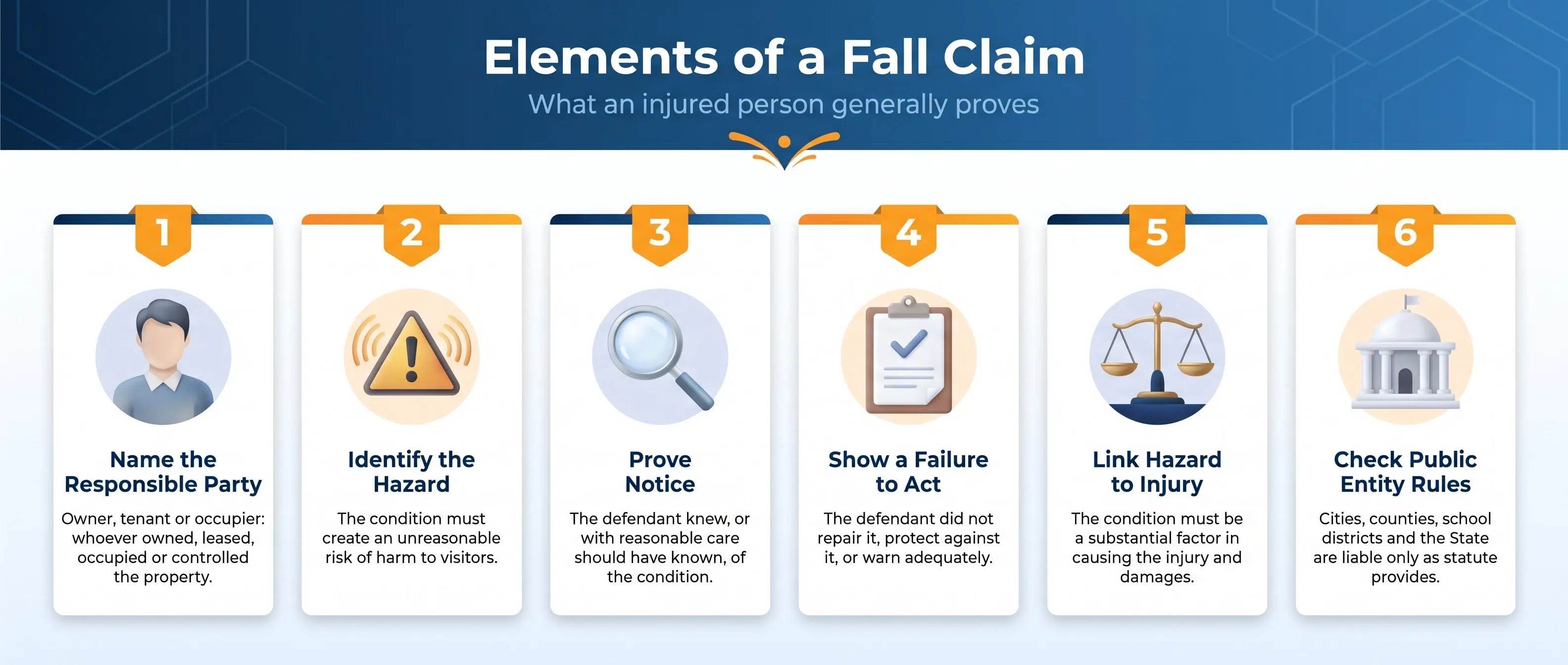
For a private owner or business, an injured person generally needs to establish these points:
-
The defendant owned, leased, occupied or controlled the property.
-
The property had a condition that created an unreasonable risk of harm.
-
The defendant knew, or through reasonable care should have known, about the condition.
-
The defendant failed to repair it, protect against it, or give an adequate warning.
-
The condition was a substantial factor in causing the injury and damages [2].
Public property follows a different statute. A city, county, school district, or the State is liable only as provided by statute. Under Government Code section 835, the injured person must show that the property was in a dangerous condition, that the condition caused the injury, and that it created a foreseeable risk of the kind of injury that happened. They must also show either that an employee’s negligent or wrongful act created the condition, or that the public entity knew or should have known about it in time to fix it or protect against it. [5].
|
Issue |
Private property |
Public property |
|---|---|---|
|
Main legal source |
Civil Code section 1714; CACI 1000 series |
Government Code section 835 and related sections |
|
Notice |
Actual or constructive knowledge |
Employee-created condition, or actual or constructive notice |
|
Minor defect defense |
Argued as part of breach and duty |
Government Code section 830.2 lets a court find a risk trivial as a matter of law |
|
Pre-suit step |
Generally none required |
Written government claim, generally within six months |
How Does This Apply to a Real Case?
Hypothetical example (not a GoSuits case): A shopper slips on a clear liquid in a grocery aisle in the San Fernando Valley. Nobody saw the spill happen. The shopper cannot say how long it was there. The store’s records show no one inspected that aisle for a long stretch before the fall. Under Ortega, that gap in inspection may allow a jury to infer constructive notice, though the store can respond with evidence of a reasonable inspection routine [1].
Hypothetical example (not a GoSuits case): A pedestrian trips on a raised sidewalk slab near downtown Los Angeles. The injured person must present a written claim to the responsible public entity before suing, and the entity may argue the lift was trivial under section 830.2 [6][7]. Whether a defect is trivial depends on the surrounding circumstances, such as size, lighting and visibility, and a court generally cannot decide it as a matter of law when the evidence on those points is genuinely disputed [7].
These examples show why two falls that look similar can have very different legal outcomes.
What Evidence Can Matter?
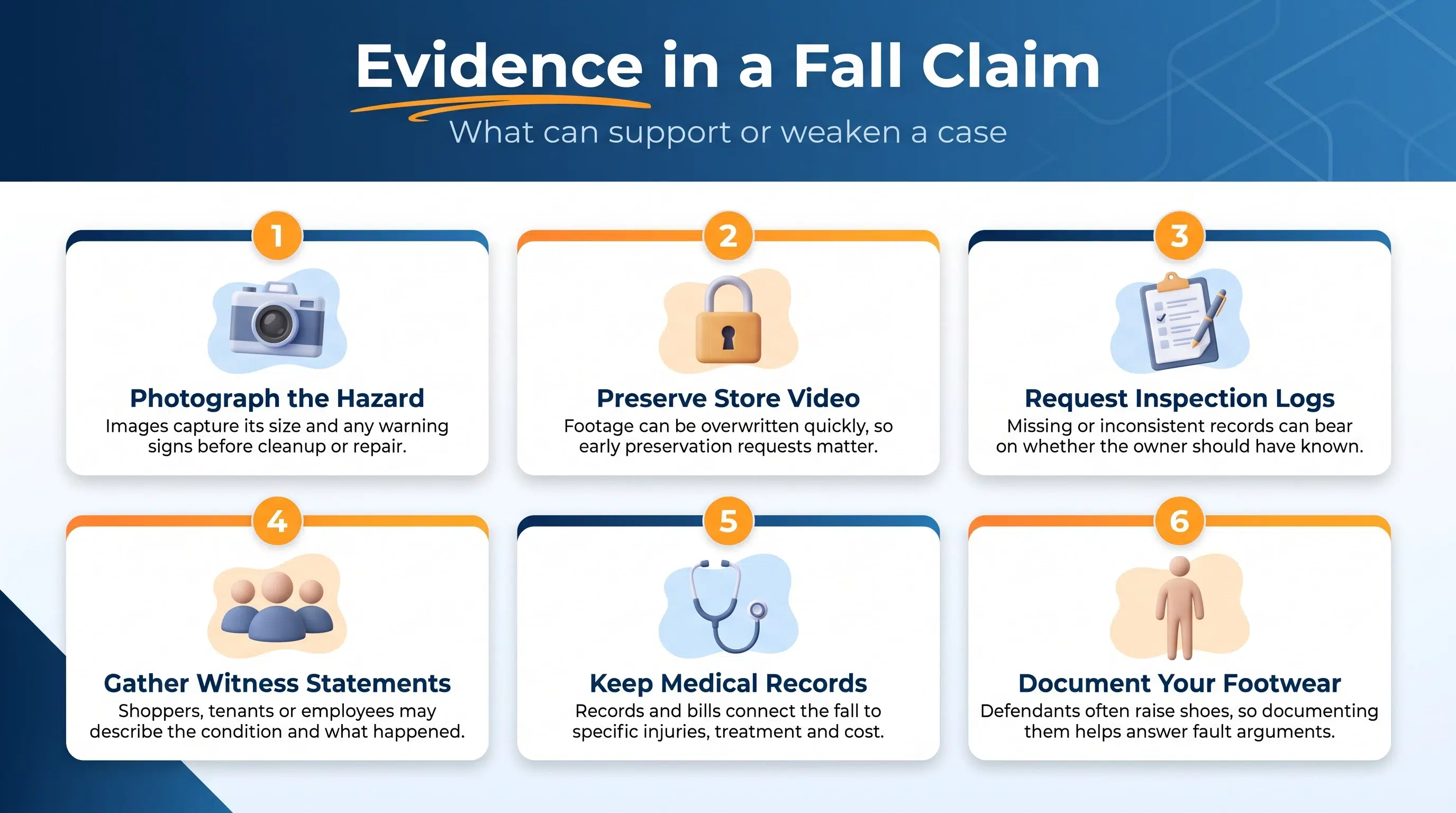
Evidence does not automatically prove liability, but these categories often shape a slip and fall case:
-
Photographs and video of the hazard: They show the condition, its size and any warning signs before it is cleaned or repaired.
-
Surveillance footage: It can show how long a hazard existed, who created it, and whether employees walked past it. Footage can be overwritten quickly, so early preservation requests matter.
-
Inspection logs, sweep schedules and staffing records: Under Ortega, missing or inconsistent inspection records can bear on constructive notice [1].
-
Incident reports and prior complaints: Earlier reports of the same hazard can support actual notice.
-
Witness statements: Other shoppers, tenants or employees may describe the condition and what happened.
-
Footwear and clothing: Defendants often raise these, so documenting them can help address comparative fault arguments.
-
Medical records and bills: They connect the fall to specific injuries and document treatment and cost.
-
Employment records: They help show lost income.
-
Qualified safety or engineering witnesses: In some cases, testimony about walking surfaces, building standards or maintenance practices may be needed.
What Damages or Remedies May Be Available?
If a claim succeeds, recoverable damages may include past and future medical expenses, lost income, loss of earning capacity, physical pain, and emotional distress. Property damage, such as a broken phone or eyeglasses, may also be part of a claim. If a fall proves fatal, surviving family members may have separate rights, and wrongful death lawyers can explain how those claims differ.
Punitive damages are available only in limited circumstances under Civil Code section 3294 and are uncommon in ordinary fall cases. Claims against public entities are subject to additional statutory limits, and punitive damages are generally not available against them under Government Code section 818. What is recoverable always depends on California law and the specific facts.

What If the Other Party Disputes Liability?
Property owners and their insurers commonly raise several defenses. Understanding them helps explain why these cases are not always straightforward, and it applies to injured people and defendants alike.
-
No notice. The defendant argues it did not know about the hazard and that the hazard did not exist long enough for a reasonable inspection to find it. If the owner had a reasonable inspection routine, that can defeat the argument that it should have known about the hazard. [1].
-
Open and obvious condition. If a danger is obvious, the owner may not have a duty to warn about it. However, CACI No. 1004 recognizes that the owner may still have to take reasonable precautions if it is foreseeable that people will encounter the danger anyway, for example because they have no other way to get where they need to go [8]. In Jacobs v. Coldwell Banker Residential Brokerage Co. (2017) 14 Cal.App.5th 438, the court held that an empty swimming pool at a home for sale was an obvious danger, and the defense won, so this argument can succeed in the right facts.
-
Trivial defect. For public property, Government Code section 830.2 allows a court to decide that a risk is too minor to count as a dangerous condition, without sending the question to a jury. [7].
-
Comparative fault. California follows pure comparative negligence, so a person who is partly at fault can still recover, but the award is reduced by that person’s percentage of fault [9]. Defendants may point to distraction, footwear, alcohol or ignoring a warning.
-
Causation. The defendant may argue the fall was caused by something other than the hazard, or that claimed injuries predate the fall.
Defendants face their own challenges too. They must be able to document inspections and maintenance and preserve records once a claim is reasonably anticipated.
What If Insurance Is Involved?
Most claims against businesses and landlords are handled by the property owner’s liability insurer. An adjuster may ask for a recorded statement, medical authorizations or a quick release of a claim. Statements made early can later be used to argue comparative fault or to dispute causation. A person who is hurt should consider speaking with a lawyer before giving a recorded statement or signing a release.
Health insurers, Medi-Cal, and Medicare may seek reimbursement from a recovery. Medicare’s reimbursement rights arise under federal law [10]. Some commercial property policies include medical payments coverage, depending on the policy’s terms. Lien and coverage questions can change what an injured person actually receives, so they deserve early attention.
How Long Do I Have to Act?
For claims against private owners and businesses, California Code of Civil Procedure section 335.1 generally gives you two years from the date of injury to file a lawsuit [11]. Limited exceptions may pause or extend this deadline in some situations.
For claims against a city, county, school district, transit agency or the State, the timeline is much shorter. A written claim generally must be presented to the public entity within six months of the injury under Government Code section 911.2 [6]. If the entity rejects the claim in writing, a lawsuit generally must follow within six months of that notice under section 945.6 [12]. A limited process exists for asking to present a late claim[13], but it is not something to rely on. Because the right deadline depends on who controlled the property, a prompt legal review matters.
What Should I Do Next?
Get medical care first. Then, where it is safe and practical:
-
Photograph the hazard, the surrounding area, and your footwear.
-
Report the fall to the property manager or business and ask that an incident report be made. Keep a copy or note who you spoke with.
-
Collect names and contact information for any witnesses.
-
Keep medical records, bills and a record of missed work.
-
Avoid posting about the fall on social media.
-
Do not sign releases or give recorded statements to an insurer without legal advice.
-
Find out who owns or controls the property. If it may be public, the six-month clock may already be running.
Injury claims involve proof, insurance negotiation and strict deadlines, and they are difficult to manage alone. A personal injury claim is usually stronger when someone with legal training reviews the evidence early. Personal injury lawyers can also identify which property owner, tenant or contractor may have had control of the hazard. If a case is filed, it goes to the Superior Court for the county where it arises, such as Los Angeles County Superior Court, which hears civil matters at the Stanley Mosk Courthouse, or Orange County Superior Court in Santa Ana.
Related California Personal Injury Resources
To learn more about how GoSuits approaches injury matters across the state, visit the GoSuits California personal injury team page.
Talk With a GoSuits Attorney
A fall injury can involve notice disputes, comparative fault arguments, insurance issues and short filing deadlines. If you were hurt in a fall in California, you can schedule a free consultation so a GoSuits attorney can review the circumstances and explain your options. No outcome is guaranteed.
This article provides general legal information about California law, not legal advice for any individual situation. Reading it does not create an attorney-client relationship. Laws and deadlines change, and every case turns on its own facts.
References
-
CACI No. 1003, Unsafe Conditions – Justia (Judicial Council of California)
-
California Civil Code section 1714 – California Legislative Information
-
California Government Code section 835 – California Legislative Information
-
California Government Code section 911.2 – California Legislative Information
-
California Government Code section 830.2 – California Legislative Information
-
CACI No. 1004, Obviously Unsafe Conditions – Justia (Judicial Council of California)
-
42 U.S.C. section 1395y, Medicare Secondary Payer provisions – Cornell Legal Information Institute
-
California Code of Civil Procedure section 335.1 – California Legislative Information
-
California Government Code section 945.6 – California Legislative Information
-
California Government Code section 911.4 – California Legislative Information