Under Texas law, wrongful death compensation goes to the deceased person’s surviving spouse, children, and parents. Siblings, grandparents, and other relatives are not eligible under Chapter 71 of the Texas Civil Practice and Remedies Code [1][2]. If a jury decides the case, it determines each beneficiary’s share. In a settlement, beneficiaries may agree on how the money is divided, with court approval generally required for settlements involving minors. Compensation from a separate survival claim becomes part of the deceased person’s estate and is distributed according to the will or Texas inheritance laws, subject to applicable estate obligations [5]. Recovery depends on the circumstances of the case and is not guaranteed.
Legal Snapshot
-
Legal Topic: Distribution of wrongful death and survival recoveries in Texas civil cases
-
Jurisdiction: Texas state law (no federal law controls who shares in an ordinary Texas wrongful death recovery)
-
Case Stage: Pre-suit evaluation, settlement negotiation, trial and post-settlement approval
-
Primary Legal Issue: Who qualifies as a statutory beneficiary and how damages are apportioned
-
Primary Authority: Tex. Civ. Prac. & Rem. Code ch. 71 (including §§ 71.004, 71.009, 71.010, 71.011, 71.021), Tex. Civ. Prac. & Rem. Code § 16.003, Tex. R. Civ. P. 44 and 173, Tex. Prop. Code ch. 142
-
Date Legal Authority Last Reviewed: November 10, 2026 (attorney verification pending; see verification notes in this article)
What Does “Who Gets the Money” Mean in a Texas Wrongful Death Case?
Texas law recognizes two separate types of claims following a fatal injury. A wrongful death claim compensates eligible family members for losses resulting from the death, while a survival claim allows the deceased person’s existing personal injury claim to continue, including compensation for losses suffered before death. Both claims may arise from the same incident, but they differ in who receives the compensation, what damages can be recovered, and how the funds are distributed.
Texas does not recognize a wrongful death claim under common law. Instead, the right to pursue compensation is established by statute, which determines who is eligible to recover damages [7].
What Does Texas Law Say About Wrongful Death Beneficiaries?
Section 71.004(a) limits the action to the surviving spouse, children and parents of the deceased [2]. Under § 71.004(b), they may bring the action together, or one or more of them may bring it for the benefit of all [2]. The statute text reviewed for this article, the 2025 version, still lists only those three groups [3].
|
Relationship to the deceased |
Statutory wrongful death beneficiary? |
|---|---|
|
Surviving spouse |
Yes |
|
Children, minor or adult |
Yes [7] |
|
Legally adopted children |
Generally treated as children for this purpose [15] |
|
Parents |
Yes |
|
Brothers and sisters |
No [7] |
|
Stepchildren, stepparents and foster family without legal adoption |
Generally no [7] |
Texas lawmakers have proposed expanding wrongful death eligibility to include siblings. House Bill 4327, introduced during the 2025 legislative session, passed the Texas House but did not become law [11]. As of November 2026, Section 71.004 continues to limit wrongful death compensation to surviving spouses, children, and parents [3].
A will does not change the list. The statute, not the will, decides who qualifies for the wrongful death claim.
What Legal Rules Apply to the Split?
Jury apportionment. Under Section 71.010 of the Texas Civil Practice and Remedies Code, a jury may award damages based on the losses resulting from the death [7]. The jury also determines how the award is divided among eligible beneficiaries. Texas law does not require an equal split, as each person’s share may reflect the losses they individually suffered.
Settlement. When a case settles, the beneficiaries and their attorneys negotiate the allocation, and the written agreement should identify each beneficiary and each share. Competing interests can arise. A surviving spouse and an adult child from an earlier marriage, for example, may value their losses differently, which is one reason independent legal advice matters before anyone signs.
Protection from the deceased’s debts. Under Texas Civil Practice and Remedies Code Section 71.011, wrongful death compensation cannot be used to pay the deceased person’s debts [4]. Survival claim proceeds are treated differently because they generally become part of the estate and may be used to satisfy outstanding estate obligations [5].
Who files if the family does not. f no eligible family member files a wrongful death lawsuit within three calendar months of the death, Texas Civil Practice and Remedies Code Section 71.004(c) requires the estate’s executor or administrator to file the claim, unless all eligible beneficiaries request otherwise [7]. This three-month period is separate from the deadline for filing a wrongful death lawsuit.
Criminal case. A civil wrongful death action is not precluded because the death was caused by a felonious act or because a criminal proceeding may exist [1].
How Does the Survival Claim Change Who Gets Paid?
Under Section 71.021 of the Texas Civil Practice and Remedies Code, a personal injury claim does not end when the injured person dies. Instead, the claim continues for the benefit of the deceased person’s heirs, legal representatives, and estate [5]. Any compensation recovered generally becomes part of the estate and is distributed according to the deceased person’s will or, if no will exists, Texas inheritance laws, after applicable estate obligations are addressed [7].
The estate’s personal representative generally has the authority to pursue a survival claim on its behalf [7]. If no representative has been appointed, probate proceedings may be necessary, although heirs can sometimes pursue the claim without an appointment. Delays may also affect the applicable filing deadline.
How Does This Apply to a Real Case?
Hypothetical example (not a GoSuits case): A married driver is killed in a rear-end collision in stop-and-go traffic on I-35E near downtown Dallas. The driver leaves a spouse, a 9-year-old child, an adult child and a living parent. All four are statutory beneficiaries. The spouse files for the benefit of everyone. If the case settles, the four negotiate shares, and the 9-year-old’s share needs court approval. The driver’s estate, through its representative, may separately pursue a survival claim if the driver lived for a period after the crash.
Hypothetical example (not a GoSuits case): An unmarried adult with no children dies in a workplace incident. Both parents are alive, and the person has two siblings. Only the parents have a statutory wrongful death claim. The siblings do not, even though the loss to them is real. If the estate has a survival claim, the siblings may receive money only if they are heirs or beneficiaries of the estate under the will or intestacy rules.
What Evidence Can Matter?
Each beneficiary must prove his or her own loss, so the evidence is personal as well as technical.
-
Proof of relationship: marriage certificates, birth certificates and adoption decrees establish who is a beneficiary.
-
Death certificate and medical records: these show cause of death and, for a survival claim, any period of conscious suffering before death.
-
Crash or incident evidence: police reports, photographs, video, vehicle data and witness statements bear on liability. They do not prove liability on their own.
-
Financial records: tax returns, pay records and benefit statements help show lost support and earning capacity. Economists and other qualified witnesses may be used to project losses.
-
Relationship evidence: testimony from family and friends, messages, photographs and caregiving history can support companionship and mental anguish claims.
-
Estate documents: wills, letters of administration and inventories matter to the survival claim.

What Damages or Remedies May Be Available?
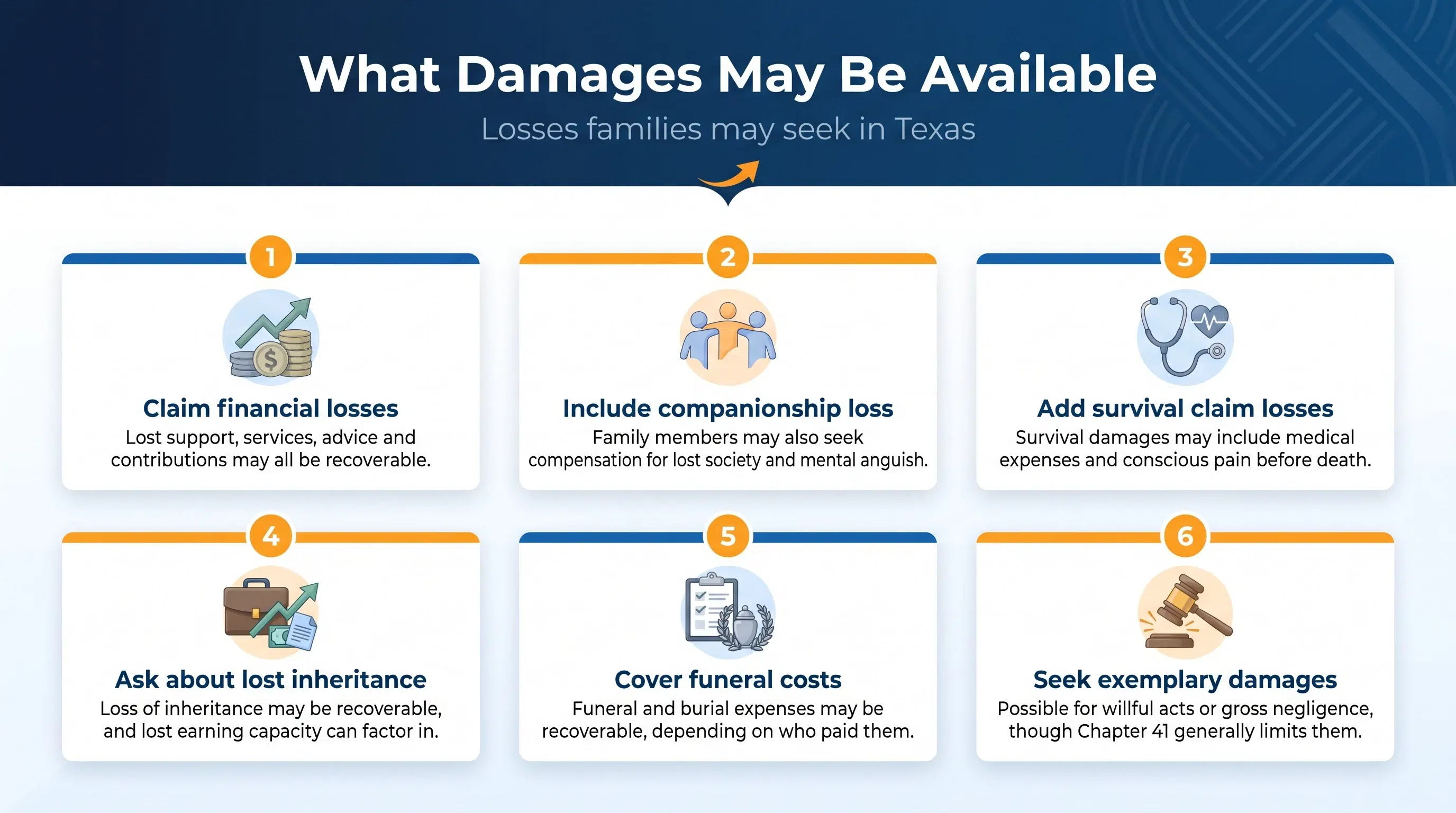
Wrongful death damages may include financial losses, such as lost support, services, advice, and contributions, as well as loss of companionship and society and mental anguish [7]. Loss of inheritance may also be recoverable, while the deceased person’s lost earning capacity can factor into financial losses. Survival damages may include reasonable medical expenses, conscious pain and mental anguish before death, and other supported losses [7]. Funeral and burial expenses may also be recoverable, depending on who incurred them [7].
Section 71.009 permits exemplary damages, also called punitive damages, when a death results from a willful act or omission or gross negligence [14]. Chapter 41 generally limits these awards, subject to statutory exceptions [14]. One commentary states that parents are barred from recovering exemplary damages in a wrongful death action because of the Texas Constitution, article XVI, section 26 [13]. However, Article XVI, Section 26 of the Texas Constitution limits wrongful death exemplary damages to surviving spouses and children. Parents cannot recover these damages through their own wrongful death claims, although exemplary damages may be available through a separate survival claim
The amount a family ultimately receives depends on the applicable law and circumstances of the case. Attorney fees, litigation expenses, valid medical liens, and applicable health insurance reimbursement claims may reduce the final recovery.
What If the Other Side Disputes Liability?
Wrongful death beneficiaries are generally subject to defenses that could have applied to the deceased person’s own injury claim [7]. Texas also applies proportionate responsibility rules under Chapter 33 of the Civil Practice and Remedies Code [12]. If the deceased person was more than 50 percent responsible for the injury, recovery may be barred. A responsibility percentage of 50 percent or less generally reduces recoverable damages accordingly [12].A defendant may also dispute that their conduct caused the death. If the defendant dies, the estate’s executor or administrator may be named in the lawsuit [7].
What If Insurance Is Involved?
Insurance coverage often affects how much compensation is available to distribute. Liability policy limits may be lower than the family’s total losses. Following a fatal vehicle crash, uninsured or underinsured motorist coverage may provide additional compensation if applicable. When multiple beneficiaries must share a limited recovery, determining each person’s share can become more complicated.
Minors raise a further issue. Under Texas Rule of Civil Procedure 44, a next friend’s settlement of a child’s claim needs court approval [8]. Rule 173 addresses when a guardian ad litem is appointed [9]. Chapter 142 of the Property Code provides ways to manage a minor’s recovery, and § 142.008 allows a court to approve a structured settlement with periodic payments in qualifying cases [10]. These steps usually take place in the court where the suit is pending, for example, a Dallas County district court at the George L. Allen Sr. Courts Building if the case was filed there.
How Long Do I Have to Act?
Generally, two years. Under Section 16.003(b) of the Texas Civil Practice and Remedies Code, a wrongful death lawsuit must usually be filed within two years of the person’s death, even if the fatal injury occurred earlier [12]. A survival claim may have a different starting date, generally tied to the original injury. Exceptions and tolling rules may affect these deadlines, while claims involving government entities may require earlier notice.
What Should I Do Next?
-
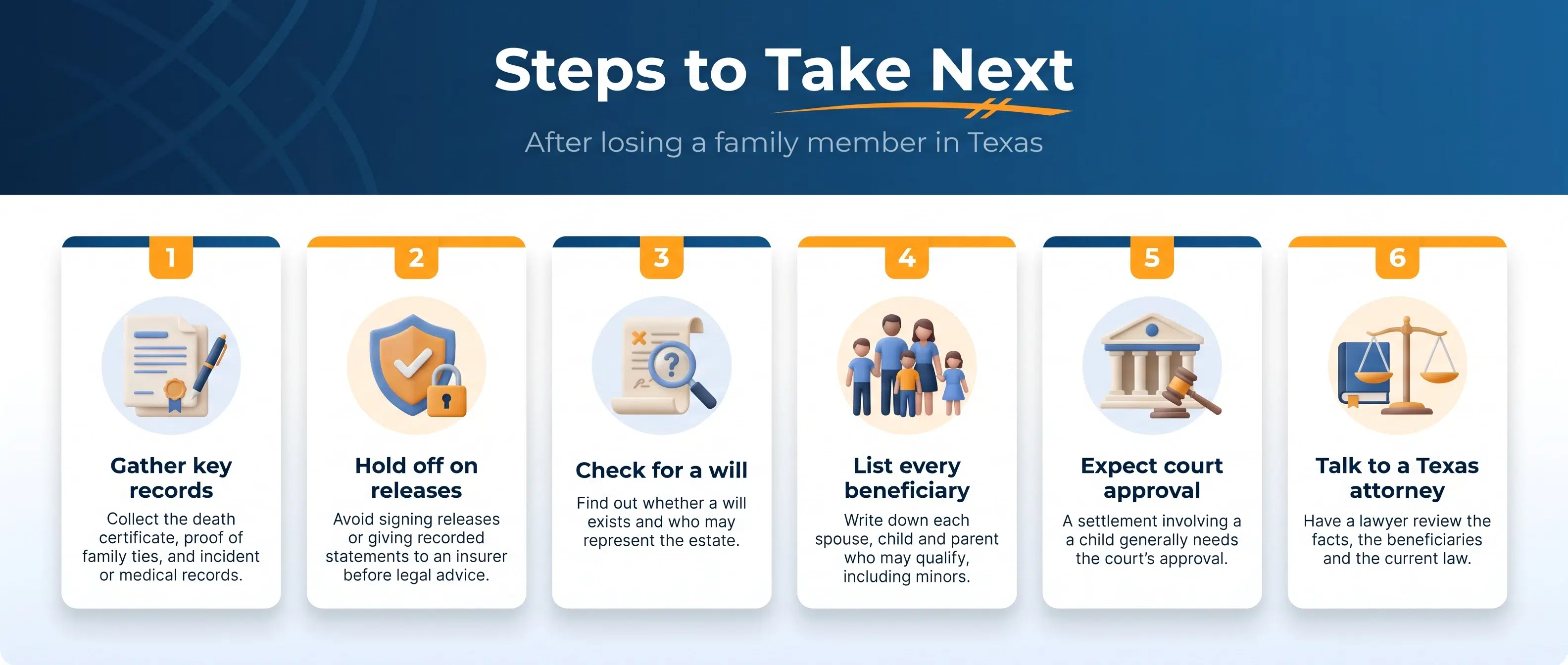
Gather the death certificate, proof of family relationships, and any incident or medical records.
-
Avoid signing releases or recorded statements for an insurer before getting legal advice.
-
Identify whether the deceased left a will, and who may be appointed to represent the estate.
-
Note every person who may be a beneficiary, including minors.
-
Calendar the two-year deadline and speak with a Texas attorney well before it approaches.
This article provides general legal information, not advice for any one family. A Texas attorney should review the facts, the beneficiaries and the current law.
Related Texas Personal Injury Resources
GoSuits publishes our Texas injury practice overview for readers across the state. Families dealing with a fatal crash may also review the Dallas pages for fatal truck-crash claims and fatal workplace incidents. Fatal collisions often involve car accident lawyers, and some deaths arise from workplace or commercial vehicle events. Our Dallas fatal-injury team handles claims connected to those events.

Talk With a GoSuits Attorney
A wrongful death claim can involve statutory beneficiaries, a probate estate, insurance limits, court approval for children and a filing deadline. If you lost a family member in Texas, personal injury lawyers at the GoSuits Dallas office can review the circumstances and explain your options, and wrongful death lawyers can discuss how a recovery might be allocated. You can schedule a consultation to get started.
References
-
Civil Practice and Remedies Code, Chapter 71 – Texas Legislature (tcss.legis.texas.gov)
-
Tex. Civ. Prac. & Rem. Code Section 71.004 – Texas Public Law
-
2025 Texas Civil Practice and Remedies Code Section 71.004 – Justia
-
Tex. Civ. Prac. & Rem. Code Section 71.011 – Texas Public Law
-
Texas Civil Practice and Remedies Code Section 71.021 – FindLaw
-
Civil Practice and Remedies Code 71.021 – Texas Constitution and Statutes
-
Wrongful Death, Survival and Bystander Claims in Texas – Hawley Holman
-
Opinion, No. 12-0946, discussing Rule 44 – Supreme Court of Texas
-
Order discussing Texas Rules 44 and 173 – U.S. District Court, S.D. Tex. (GovInfo)
-
Texas Property Code Section 142.008, Structured Settlement – FindLaw
-
H.B. 4327, 89th Legislature (sibling beneficiaries proposal) – Texas Legislature
-
Texas Wrongful Death Laws, quoting CPRC 16.003 – RecordingLaw
-
Three Key Issues to Consider in Wrongful Death Actions – The Bassett Firm
-
Who Can File a Wrongful Death Claim in Texas – Schiffer Law Firm
-
New Texas PI and Wrongful Death Laws (2025-2026) – Lorfing Law