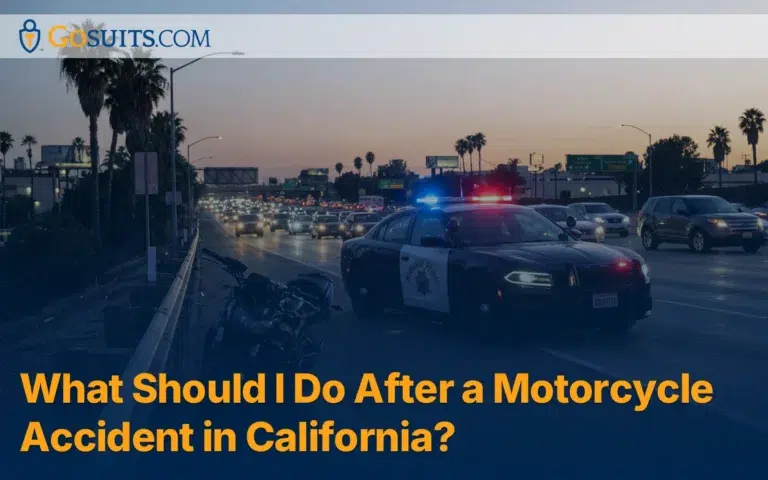
After a motorcycle accident in California, get medical care first, then protect your legal position. Move to safety, call 911, exchange information, photograph the scene, and see a doctor even if injuries seem minor. California law separately requires a written report to law enforcement within 24 hours if anyone was injured or killed, and a DMV report (form SR-1) within 10 days if anyone was hurt or property damage exceeded $1,000 [1][2]. A civil injury lawsuit generally must be filed within two years, and claims involving a public entity can require a written claim in as little as six months [10][12]. This article is general information, not legal advice for your situation.
Legal Snapshot
-
Legal Topic: Steps, reporting duties, and civil claim preservation after a California motorcycle crash
-
Case Stage: Immediate aftermath and early claim preparation
-
Primary Legal Issue: Meeting reporting duties and filing deadlines while preserving evidence of fault and damages
-
Primary Authority: California Vehicle Code sections 16000 and 20008; Code of Civil Procedure section 335.1; Government Code section 911.2; Civil Code section 1714; Li v. Yellow Cab Co. (1975) 13 Cal.3d 804
-
Date Legal Authority Last Reviewed: November 11, 2026 (research date; statutory text should be confirmed against the official California Legislative Information site during attorney review)
What Should I Do at the Scene and in the First 24 Hours?
The first priority is safety and medical evaluation. Motorcyclists have little physical protection, and some injuries, including head, spine, and internal injuries, may not produce obvious symptoms right away. Prompt treatment protects your health and creates a medical record that links your symptoms to the crash.
-
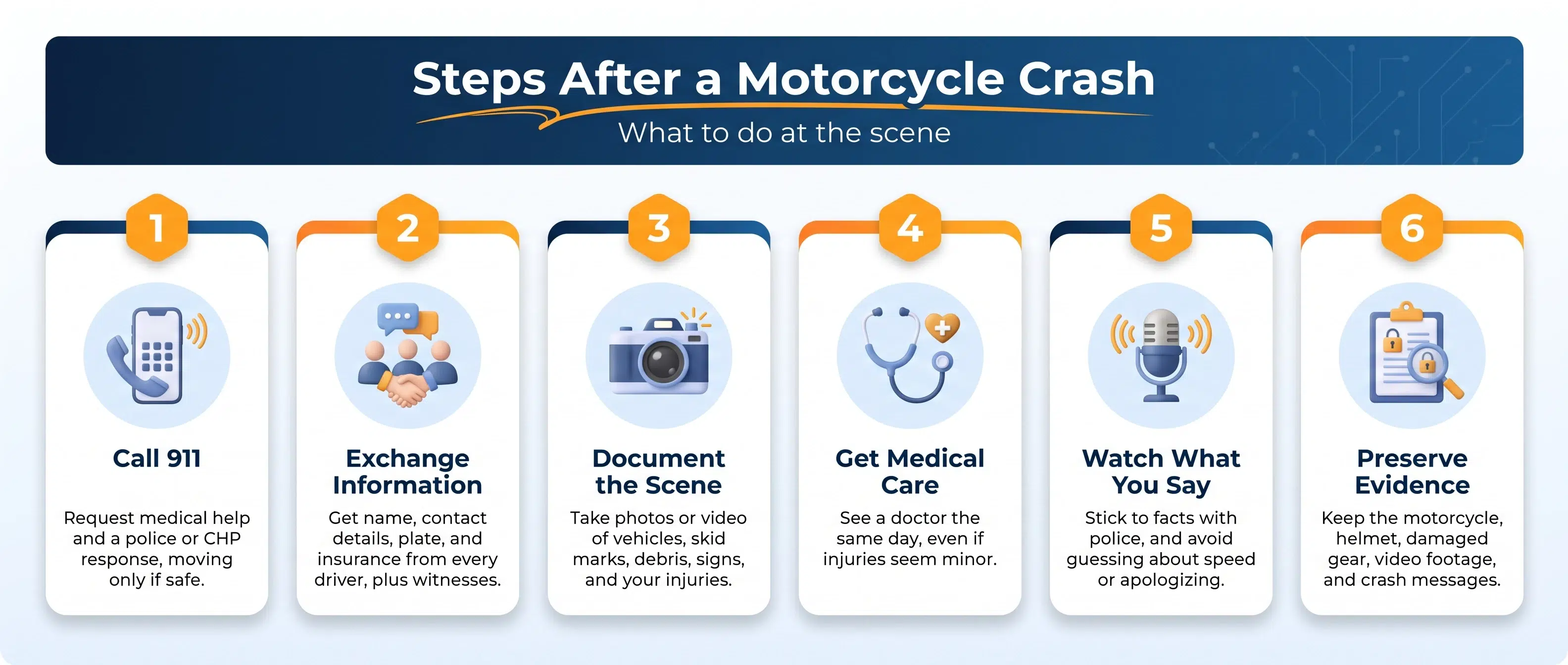
Call 911 and request medical help and a police or California Highway Patrol (CHP) response. Stop-and-go traffic on the 405, the 101, or I-5 can make a downed rider hard to see, so move out of live lanes only if you can do so safely.
-
Exchange information with every driver involved: name, contact details, license plate, and insurance. Identify witnesses and get their contact information.
-
Document the scene with photos or video of vehicles, skid marks, road debris, signage, lighting, and your injuries. Photograph your motorcycle, helmet, and riding gear before anything is repaired or discarded.
-
Get medical care the same day, and follow treatment instructions.
-
Be careful what you say. Stick to facts with police. Avoid guessing about speed or fault, and avoid apologizing.
-
Preserve evidence, including the motorcycle itself, helmet, damaged gear, helmet-camera or phone footage, and any messages about the crash.
-
Talk to a lawyer before giving a recorded statement to any insurance company, including the other driver’s insurer.
What Does California Law Say About Reporting a Motorcycle Accident?
California imposes separate reporting duties that apply regardless of who caused the crash. Missing them does not erase an injury claim, but they are legal obligations in their own right.
|
Report |
Who receives it |
When it is due |
Trigger |
|---|---|---|---|
|
Written report of the accident |
CHP or local police |
Within 24 hours |
Injury to or death of any person (Veh. Code section 20008) |
|
SR-1, Report of Traffic Accident Occurring in California |
California DMV |
Within 10 days |
Injury (however minor), death, or property damage over $1,000 (Veh. Code section 16000) |
|
Notice of the accident |
Your insurer |
Per your policy terms |
Check your policy |
The California DMV says an SR-1 report must be completed and sent within 10 days if anyone is injured, even slightly, or killed, or if property damage is more than $1,000. The SR-1 is required in addition to any report made by police, the CHP, or your insurance company [1]. The SR-1 duty comes from Vehicle Code section 16000[2]. Separately, if anyone was hurt or killed, Vehicle Code section 20008 requires each driver involved to make a written report to the CHP or local police within 24 hours, with some exceptions an attorney can explain.
What Legal Rules Apply to Fault and Lane Splitting?
California decides fault in a motorcycle crash using negligence rules, and a rider who is partly to blame can still recover compensation. Under California Civil Code section 1714(a), people are responsible for injuries caused by their failure to use ordinary care [7]. In Li v. Yellow Cab Co. (1975) 13 Cal.3d 804, the California Supreme Court replaced the old all-or-nothing rule with pure comparative negligence, which means your damages are reduced by your share of the fault [6]. For example, if you are found 30% at fault, you can still recover the other 70% of your damages, though a larger share of fault means a larger reduction.
Lane splitting often comes up when fault is disputed. California Vehicle Code section 21658.1 defines lane splitting as riding a two-wheeled motorcycle between rows of stopped or moving vehicles in the same lane, on both divided and undivided roads. The statute does not set a speed limit for lane splitting. Instead, it allows the California Highway Patrol to develop educational safety guidelines [5], and the CHP presents its lane splitting tips as general safety advice rather than a separate traffic law [4]. Even when lane splitting is legal, a rider can still be accused of riding too fast or weaving unsafely, and a driver can still be accused of changing lanes unsafely.
Other rules can also affect a motorcycle claim. Under California Vehicle Code section 27803, every motorcycle rider and passenger must wear a safety helmet that meets federal safety standards [new ref]. If a rider was not wearing a helmet, the insurer may argue that this made a head or face injury worse and that damages for that injury should be reduced under California’s comparative negligence rules. Not wearing a helmet does not by itself mean the rider caused the crash, so an attorney should review how this argument applies to your claim.
How Does This Apply to a Real Case?
Hypothetical example (not an actual GoSuits case): A rider is moving slowly between rows of stopped cars on the 405 during evening rush hour when a driver changes lanes without signaling and the two collide. The rider fractures a wrist and has road-rash injuries. The driver’s insurer argues the rider was lane splitting and therefore partly at fault.
In that scenario, the legal questions would include whether the driver acted reasonably, whether the rider’s speed and position were reasonable for conditions, and how a jury might divide fault. Because California uses pure comparative negligence, even a finding that the rider was partly responsible would reduce, not eliminate, recoverable damages [6]. Photos, witness accounts, vehicle damage patterns, and any video would likely shape the outcome. Results vary, and nothing here predicts how a particular case will resolve.
What Evidence Can Matter?
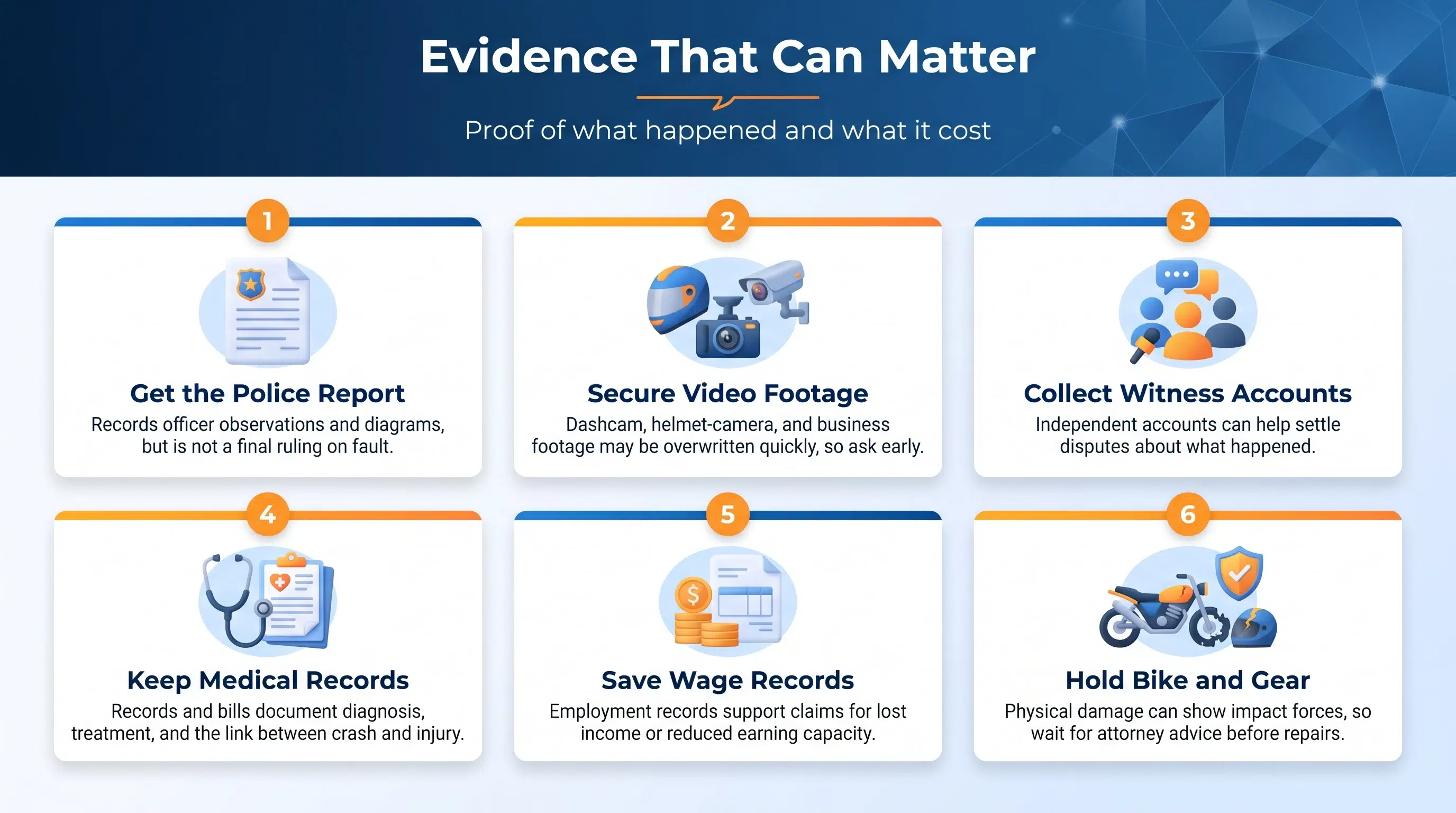
Evidence does not prove liability by itself, but it can show how the crash happened and what it cost. Categories that often matter include:
-
Police or CHP report: records the responding officer’s observations, diagrams, and statements, though it is not a final determination of civil fault.
-
Photos and video: show vehicle positions, road conditions, visibility, and injuries. Nearby businesses and traffic cameras may overwrite footage quickly, so early requests matter.
-
Helmet-camera and dashcam footage: may show speed, signaling, and lane changes.
-
Witness statements: independent accounts can help resolve disputes about what happened.
-
Medical records and bills: document diagnosis, treatment, and the link between the crash and the injury.
-
Employment and wage records: support claims for lost income or reduced earning capacity.
-
The motorcycle and gear: physical damage can help show impact forces. Hold off on repairs or disposal until an attorney advises.
-
Accident reconstruction and vehicle data: in contested or serious cases, engineering analysis and electronic data from vehicles may help explain speed and sequence.
-
Insurance documents and communications: policy declarations, claim letters, and recorded statements.
-
Social media: posts and photos can be used by an opposing party to dispute injury severity.
What Damages or Remedies May Be Available?
Recoverable damages depend on California law and the facts of the case. Common categories include:
-
Economic damages: past and future medical expenses, lost income, loss of earning capacity, and motorcycle or property damage.
-
Non-economic damages: physical pain, mental suffering, inconvenience, physical impairment, and disfigurement.
-
Punitive damages: vailable only in rare cases where the at-fault party is proven, by clear and convincing evidence, to have acted with malice, oppression, or fraud.
-
Wrongful death damages: if a rider dies, a surviving spouse, domestic partner, children, or certain other heirs, or the estate’s personal representative on their behalf, may bring a separate claim.
Uninsured riders face a special limit. Under California Civil Code section 3333.4, which voters adopted through Proposition 213, an uninsured vehicle owner or driver generally cannot recover non-economic losses, such as pain and suffering, in a motor vehicle case. The same bar applies to a rider who was convicted of DUI for the crash, even if the rider was insured. Economic losses, such as medical bills and lost income, may still be recoverable. There is one narrow exception: an uninsured owner can still recover non-economic losses if the driver who caused the crash was convicted of DUI for it. [9].This exception does not cover an uninsured rider who did not own the motorcycle.
What If the Other Party Disputes Liability?
Disputes are common in California motorcycle cases, and the other side may raise several arguments. They may claim you were speeding, lane splitting unsafely, or hard to see, or that you were not wearing a helmet or other protective gear. They may also argue that your injuries existed before the crash, or that gaps in your medical treatment show the injuries were minor. Each of these arguments depends on the facts, and evidence such as photos, witness statements, medical records, and crash reports can often help respond to them.
The same principles apply if you are the driver accused of causing a crash. Preserve your own photos and dashcam footage, report the crash to your insurer, avoid discussing fault with the other side without counsel, and understand that a civil claim, a traffic citation, and a DMV process are separate matters. Both riders and drivers benefit from legal guidance early. Representing yourself in a disputed injury claim carries real risks.
What If Insurance Is Involved?
Insurance is usually how injury claims get paid, so the amount of available coverage matters. For policies issued or renewed on or after January 1, 2025, California requires liability coverage of at least $30,000 for injury or death to one person, $60,000 for injury or death to two or more people, and $15,000 for property damage [8]. A serious motorcycle injury can exceed those limits quickly. If the at-fault driver has little or no coverage, your own policy may include uninsured or underinsured motorist coverage under California Insurance Code section 11580.2.
Insurance adjusters may ask for a recorded statement or push for a quick settlement. Review any offer and release carefully before you sign, because a signed release generally ends your claim. Doctors, hospitals, health insurers, and government programs such as Medi-Cal or Medicare may also claim part of your recovery through liens. Different liens follow different rules, so an attorney should review which ones apply to your claim.
How Long Do I Have to Act?
Several clocks can run at once, and the shortest one controls. The table summarizes general deadlines; your facts may change them.
|
Item |
General deadline |
Authority |
|---|---|---|
|
Written report to CHP or police (injury or death) |
24 hours |
Veh. Code section 20008 |
|
DMV SR-1 report |
10 days |
Veh. Code section 16000 |
|
Written claim against a public entity (injury or death) |
6 months from accrual |
Gov. Code section 911.2 |
|
Lawsuit after written rejection of a government claim |
Generally 6 months from the written notice |
Gov. Code section 945.6 |
|
Personal injury lawsuit |
2 years from the date of injury |
Code Civ. Proc. section 335.1 |
|
Property damage lawsuit |
3 years |
Code Civ. Proc. section 338 |
Most California personal injury lawsuits must be filed within two years under Code of Civil Procedure section 335.1 [10], Property damage claims, such as damage to your motorcycle, generally have three years under section 338 [11]. Property damage claims, such as damage to your motorcycle, generally have three years under section 338
If a public entity may share responsibility, the timeline is much shorter. A crash caused or worsened by a dangerous road condition on a city, county, or Caltrans roadway, or one involving a government vehicle, can trigger the Government Claims Act. Under Government Code section 911.2, a written claim for injury or death generally must be presented within six months after the cause of action accrues, which is usually the date of the crash [12], If the entity sends a written rejection, a lawsuit generally must be filed within six months after that notice [13]. Relief for a late claim is limited, so do not count on it. Special rules may apply to injured minors, but they also come with strict time limits.
What Should I Do Next?
-
Continue medical treatment and keep every record, bill, and prescription.
-
Confirm that the 24-hour police report and the 10-day SR-1 have been handled.
-
Notify your insurer, but decline recorded statements to other insurers until you have legal advice.
-
Write down your own account while it is fresh, and keep a pain and activity journal.
-
Identify any possible government involvement right away, since six months can pass quickly.
-
Do not post about the crash or your recovery on social media.
-
Speak with a California personal injury attorney before accepting any settlement or signing any release.
Related California Personal Injury Resources
Riders and families who want a broader overview of injury claims in the state can review the GoSuits California injury claims overview. Topics that often overlap with motorcycle claims include uninsured and underinsured motorist coverage, Proposition 213, government claim deadlines, and wrongful death claims after fatal crashes.
Talk With a GoSuits Attorney
A motorcycle injury claim can involve medical evidence, comparative fault disputes, insurance limits, and short legal deadlines. If you were hurt in a California crash, one of our personal injury lawyers can review what happened and explain your options. You can schedule a free consultation to discuss your situation. Our motorcycle accident lawyers handle these matters, and no outcome is guaranteed.
This article provides general legal information about California law and is not legal advice or an attorney-client relationship. Laws and deadlines change, and every case depends on its facts.
References
-
Report of Traffic Accident Occurring in California (SR-1) – California DMV
-
Vehicle Code section 20008 – California Legislative Information
-
Vehicle Code section 16000 – California Legislative Information
-
Vehicle Code section 21658.1 – California Legislative Information
-
Civil Code section 1714 – California Legislative Information
-
Vehicle Code section 16056 – California Legislative Information
-
Civil Code section 3333.4 – California Legislative Information
-
Code of Civil Procedure section 335.1 – California Legislative Information
-
Code of Civil Procedure section 338 – California Legislative Information
-
Government Code section 911.2 – California Legislative Information
-
Government Code section 945.6 – California Legislative Information