Illinois car accident settlements can take time because several steps must happen before a claim can be valued and paid. Medical treatment usually needs to reach a stable point, the insurer investigates fault, records and bills are gathered, liens are identified, and both sides negotiate. If talks stall, a lawsuit adds court scheduling under the Illinois Code of Civil Procedure and the Illinois Supreme Court Rules. A delay may be routine or a red flag, depending on the facts, the insurance policy, and the evidence in your claim. Either way, it does not pause the deadline to file a lawsuit.
Legal Snapshot
-
Legal Topic: Delay in resolving an Illinois motor vehicle injury claim
-
Case Stage: Pre-suit negotiation, or pending litigation after a complaint is filed
-
Primary Legal Issue: Why the claim has not settled, and what Illinois law says about timing, fault, liens, interest and deadlines
-
Primary Authority: 735 ILCS 5/2-1303(c) (prejudgment interest) [1]; 735 ILCS 5/2-1116 (comparative fault) [6]; 50 Ill. Adm. Code Part 919 (insurer claims practices) [3]; Illinois Supreme Court Rule 218 [7]; 770 ILCS 23 (Health Care Services Lien Act) [5]
-
Date Legal Authority Last Reviewed: November 11, 2026 (research date; attorney review pending)
What Does a “Slow” Settlement Mean in Illinois?
A settlement is a negotiated agreement that resolves a civil claim without a trial. It is separate from any traffic ticket or criminal matter. In Illinois, a settlement is not triggered by a calendar date. It happens when the injured person and the insurer (or the at-fault driver) agree on a number and sign a release.
That is why two crashes with similar facts can resolve on very different timelines. A claim involving a short recovery and clear fault looks very different from one involving surgery, disputed fault, several vehicles, or limited insurance. Stop-and-go traffic on the Kennedy Expressway or the Dan Ryan Expressway, for example, often produces rear-end and chain-reaction collisions where the question of who was responsible for each impact can take time to sort out.
What Does Illinois Law Say About Settlement Timing?
Illinois has no single statute that sets a deadline for an insurer to settle a bodily injury claim. Instead, insurance claim-handling rules, civil procedure rules, and a prejudgment interest statute affect the pace indirectly.
Insurer claims-handling rules. The Illinois Department of Insurance regulations at 50 Ill. Adm. Code Part 919 set out required and improper claims practices. Section 919.50(a) says an insurer must affirm or deny liability within a reasonable time and must offer payment within 30 days after affirming liability if the amount is determined and not in dispute [4]. Section 919.80(b) sets longer benchmarks of 40 days for automobile collision claims and 60 days for automobile property damage liability claims, measured by median payment periods [3]. These benchmarks cover payment of vehicle and property damage claims, not the negotiation of an injury claim with a disputed value. Illinois courts have held that an insurer’s duty to negotiate in good faith runs to its own insured, not to an injured third-party claimant [Scroggins ref]. An attorney can explain if Part 919 or the Insurance Code’s unfair claims provisions (215 ILCS 5/154.6 and 215 ILCS 5/155) give a particular claimant any remedy.
Prejudgment interest. Since July 1, 2021, Illinois law has added interest to many injury awards. Under 735 ILCS 5/2-1303(c), if you win a personal injury or wrongful death case, the court adds 6% interest per year to most of your damages [1]. This is called prejudgment interest. It starts on the day your lawsuit is filed and can build for up to five years [2]. The law also encourages defendants to make fair offers early. If the defendant makes a written settlement offer within 12 months after the lawsuit is filed, and you reject it or do not accept it within 90 days, the interest depends on how the final judgment compares to that offer [1]. When the judgment is higher than the offer, interest is added only on the difference. When the judgment is equal to or lower than the offer, no interest is added.
This interest does not apply to claims against the State or other governmental entities, such as a city or a school district[2]. Keep in mind that interest only counts from the date a lawsuit is filed, not from the date of the crash. Time spent negotiating before a lawsuit does not earn any interest.
Court scheduling. Court scheduling. Once a case is in court, Illinois Supreme Court Rule 218 requires an initial case management conference within 35 days after the parties are at issue and no more than 182 days after the complaint is filed, unless a local rule provides otherwise [7]. Settlement is one topic the court considers at that conference [7]. A Cook County case is filed at the Richard J. Daley Center in the Circuit Court of Cook County, while suburban cases may be filed in the county circuit courts, such as DuPage County for a crash near Naperville. [7]. At this conference, the judge and lawyers plan the next steps in the case, and settlement is one of the topics the court considers [7]. Where your case is heard depends on where it is filed. In Cook County, most car accident lawsuits are heard in the Law Division at the Richard J. Daley Center in Chicago, though some are heard at suburban courthouses. Crashes outside Cook County go to that county’s circuit court. For example, Naperville sits in both DuPage and Will counties, so a crash there may be heard in either the DuPage County or Will County circuit court.
Why Do Illinois Car Accident Settlements Take So Long?
Most delays come from a handful of recurring causes. The table below lists them with the Illinois or federal rule that is most often involved.
|
Common cause of delay |
Why it slows the claim |
Related authority |
|---|---|---|
|
Ongoing medical treatment |
Future care and permanent effects are hard to value until treatment stabilizes |
Facts of the case; damages rules |
|
Disputed fault |
An insurer may argue the injured driver shares blame, which can reduce or bar recovery |
735 ILCS 5/2-1116 [6] |
|
Medical liens |
Providers may assert liens that must be identified and resolved before funds are paid out |
770 ILCS 23 [5] |
|
Medicare repayment |
If Medicare paid conditionally, its recovery process adds steps |
42 U.S.C. 1395y(b)(2) [9] |
|
Limited insurance or several claimants |
Available coverage may be too small for all claims, which complicates negotiation |
Policy terms; 625 ILCS 5/7-203 |
|
Lawsuit and court schedule |
Discovery, case management conferences and trial settings add months |
Ill. S. Ct. R. 218 [7] |
Other, less obvious causes of delay include slow medical records from doctors and hospitals, a new or overloaded adjuster on your claim, requests for more documents, and the time it takes to prepare and sign a release. A claim can also stall because the insurer is waiting for something from you, such as a form or a record. Keeping track of every letter and email helps you spot these gaps early.
How Does This Apply to a Real Case?
Example (hypothetical, not a GoSuits case): A driver is rear-ended in heavy traffic on the Eisenhower Expressway and begins physical therapy. Her lawyer waits until her doctor says her condition has stabilized before sending a demand, because settling earlier could leave future care unpaid. The insurer then requests records from every provider, which takes weeks. The delay is frustrating but tied to valuation, not to bad faith.
Example (hypothetical, not a GoSuits case): Two drivers collide at an intersection in Cicero, and each says the other ran the light. The insurer assigns part of the blame to the injured driver. Because Illinois bars recovery when a plaintiff is more than 50% at fault [6], the fault dispute drives the whole negotiation, and the case may need to be filed so a court can set discovery deadlines.
These examples illustrate legal concepts only. They do not predict how any real claim will turn out.
What Evidence Can Matter?
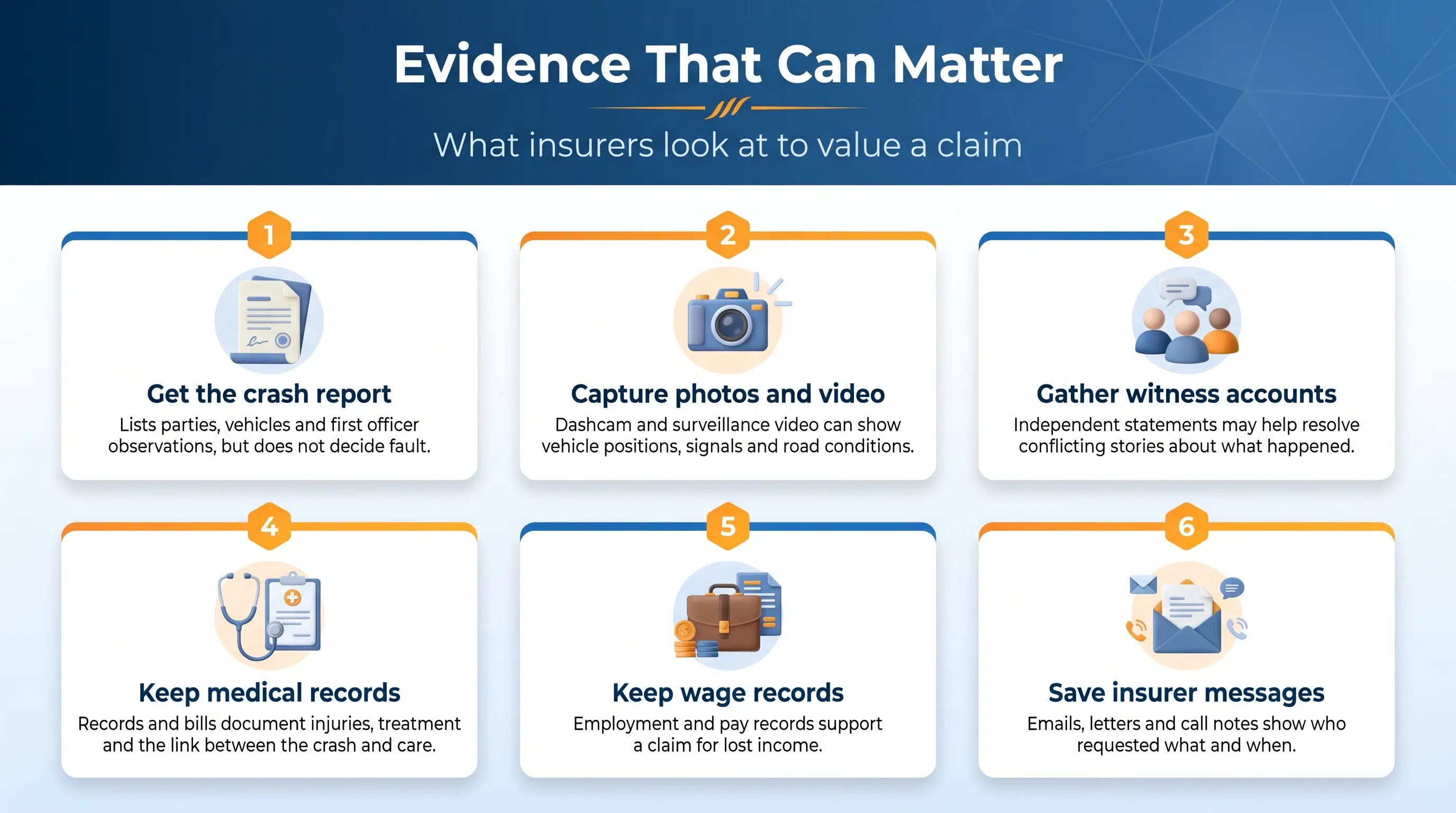
Evidence does not automatically establish fault or value, but it shapes how quickly an insurer can evaluate a claim. Categories that often matter include:
-
Police or crash reports: they record the parties, vehicles and an officer’s initial observations, though they are not conclusive on fault.
-
Photographs, dashcam and surveillance video: they can show vehicle positions, signals and road conditions.
-
Witness statements: independent accounts may help resolve conflicting stories.
-
Medical records and bills: they document injuries, treatment and the connection between the crash and the care.
-
Employment and wage records: they support claims for lost income.
-
Vehicle data and reconstruction analysis: in serious or disputed crashes, these can clarify speed, braking and impact.
-
Insurance documents: declarations pages show the coverage available, which affects negotiation.
-
Communications: saved emails, letters and call notes with the insurer show who requested what and when.
What Damages or Remedies May Be Available?
Recoverable damages depend on Illinois law and the facts of the claim. Categories commonly claimed in an Illinois motor vehicle case include medical expenses, future medical expenses, lost income, loss of earning capacity, pain and suffering, disfigurement, loss of normal life, and property damage. If a lawsuit results in a judgment, prejudgment interest under 735 ILCS 5/2-1303(c) may also be added in qualifying cases [1]. No amount is guaranteed, and settlement offers can be lower or higher than what a court would award.

What If the Other Party Disputes Liability?
Illinois follows a modified comparative negligence rule under 735 ILCS 5/2-1116. This means you can recover damages only if you are 50% or less at fault, and your recovery is reduced by your share of the fault [6]. For example, if you are found 20% at fault, the other driver’s insurer may offer to pay only 80% of your damages [6]. The insurer may also decide its driver was not at fault at all and offer nothing [6].
When fault is contested, the claim often cannot resolve until evidence is exchanged. In litigation, that typically means written discovery and depositions, with the court monitoring progress through case management conferences [7].
How Does the Delay Look From the Insurer or Defense Side?
An insurer or defendant usually needs the same documents the claimant needs: complete medical records, bills, wage proof and details about prior injuries. Until those arrive, it may say it cannot evaluate the claim. Defendants also have a financial reason to act once a suit is filed, because a timely written offer can reduce prejudgment interest exposure under 735 ILCS 5/2-1303(c) [1]. A defendant who believes the claim is overvalued may also decline to negotiate until discovery narrows the dispute. For a defendant or an insured driver, delay does not remove the claim. A lawsuit can still be filed within the limitation period, and prejudgment interest can still accrue after filing.
What If Insurance Is Involved?
Insurance affects both how fast a claim settles and how much it can pay. If the at-fault driver’s policy limits are low compared with your injuries, you may also need to turn to your own coverage, such as underinsured motorist coverage under 215 ILCS 5/143a-2(4). Reviewing each policy and meeting its notice requirements takes time, and some policies set their own deadlines.
Liens are another common reason settlements slow down. Under the Illinois Health Care Services Lien Act, doctors, hospitals, and other providers who treat you generally have a lien on your injury claim for their reasonable charges[5]. A lien is a legal right to be paid from your settlement. The Act also limits how much providers can take. Under 770 ILCS 23/10, all health care liens together are capped at 40% of your recovery, and no single type of provider, such as hospitals, may receive more than one-third [5]. If health care liens reach that 40% cap, attorney liens are limited to 30%. Your settlement money generally cannot be fully paid out until all valid liens are identified and resolved.
If the injured person is a Medicare beneficiary, federal law makes liability insurance primary and Medicare secondary, and Medicare may make conditional payments that must be repaid from a settlement [9]. CMS describes a Final Conditional Payment process that lets parties obtain a final amount before settling, with defined steps that must be completed within set windows [8]. CMS also states that payment of a final demand is due within 60 days, after which interest is charged [10]. Each of these steps adds time even when fault is not in dispute.
When serious injuries are involved, working with Chicago car accident lawyers who handle these insurance and lien questions can help a claimant understand why a case is moving at its current pace. If a crash caused a death, a separate claim may exist, and families may want to talk with wrongful death lawyers about different damages and deadlines.
How Long Do I Have to Act?
Most Illinois personal injury lawsuits must be filed within two years under 735 ILCS 5/13-202. In a car accident case, those two years generally start on the date of the crash. Time spent negotiating with the insurer counts toward that deadline, and only filing a lawsuit stops the clock. Shorter deadlines can apply when a government body is involved. Claims against a city or other local public entity generally must be filed within one year (745 ILCS 10/8-101), and claims against the Chicago Transit Authority have their own one-year deadline (70 ILCS 3605/41). Wrongful death claims have a separate filing period (740 ILCS 180/2). Special rules may apply to injured minors or people with a legal disability, but they depend on the facts. A lawyer can confirm the exact deadline for your situation.
Because the deadline keeps running while the insurer negotiates, a claim that is “almost settled” can still be lost if no lawsuit is filed in time. Property damage claims, such as damage to your vehicle, have a longer deadline. Under 735 ILCS 5/13-205, they generally must be filed within five years, unless a government entity is involved.
What Should I Do Next?
-
Write down the date of the crash and calculate your filing deadline with a lawyer’s help.
-
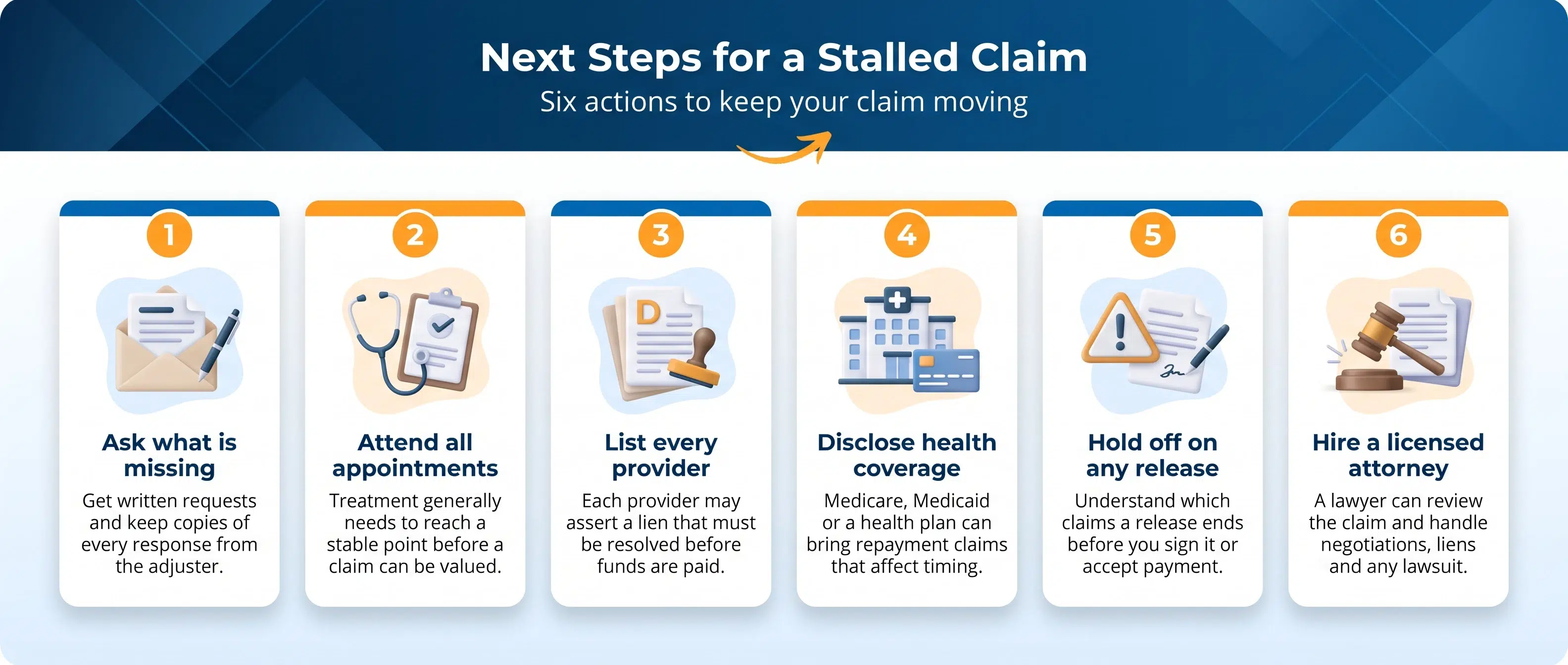
Ask the adjuster in writing what documents are still needed and keep copies of every request and response.
-
Keep attending medical appointments and keep a list of providers, since each may assert a lien.
-
Tell your lawyer if you are on Medicare, Medicaid or a health plan, because repayment claims affect timing.
-
Do not sign a release or accept a final payment before understanding what claims it ends.
-
Retain a licensed Illinois attorney to review the claim. Handling negotiations, liens and a possible lawsuit without legal help can be risky.
Related Illinois Personal Injury Resources
For a broader overview of injury claims across the state, see the GoSuits Illinois personal injury practice page. For Chicago-area claims, including crashes along I-90, I-94 and I-55, see our Chicago personal injury team. Satellite communities such as Naperville, Elgin, Joliet and Waukegan fall within the same Chicagoland service area.
Talk With a GoSuits Attorney
A car accident claim can involve medical evidence, insurance issues, liability disputes, liens and filing deadlines. If you were injured in an Illinois crash and your settlement is stalled, you can schedule a free consultation so a GoSuits personal injury attorney can review the circumstances and explain your options. Past results do not guarantee a similar outcome.
This article provides general legal information about Illinois law. It is not legal advice and does not create an attorney-client relationship. Laws and deadlines change, and every claim depends on its own facts.
References
-
735 ILCS 5/2-1303, Interest on Judgment – Illinois General Assembly
-
Title 50, Part 919, Improper Claims Practice – Illinois Joint Committee on Administrative Rules
-
770 ILCS 23, Health Care Services Lien Act – Illinois General Assembly
-
Demand Calculation Options – Centers for Medicare & Medicaid Services
-
Rights and Responsibilities Letter – Centers for Medicare & Medicaid Services