
Yes, California law allows clients to switch personal injury lawyers at any time, with or without giving a reason. If the previous attorney worked under a contingency fee agreement, they are generally entitled to reasonable payment for the work completed before the change, rather than the full percentage in the original agreement [5][6]. This fee typically becomes payable only if the case results in a financial recovery. The former attorney may also have a claim against the settlement or judgment if a valid attorney’s lien exists. The final amount depends on the fee agreements, the work performed, and the circumstances of the case.
Legal Snapshot
-
Legal Topic: Changing personal injury lawyers and the fee owed to the former lawyer (California)
-
Case Stage: Pre-filing, pending litigation, or settlement negotiations
-
Primary Legal Issue: The client’s right to discharge counsel and the former lawyer’s quantum meruit fee claim
-
Primary Authority: Fracasse v. Brent (1972) 6 Cal.3d 784; California Rules of Professional Conduct 1.15 and 1.16; Business and Professions Code section 6147
-
Date Legal Authority Last Reviewed: November 11, 2026 (research compilation; attorney verification pending)
What Does Switching Personal Injury Lawyers Mean?
Switching personal injury lawyers involves ending the relationship with the current attorney and hiring another to continue handling the case. Most personal injury attorneys work on a contingency fee basis, meaning their payment is based on a percentage of the compensation recovered through a settlement or judgment. Changing attorneys before a case concludes can raise questions about how legal fees are allocated between the former attorney and the lawyer who takes over.
Changing personal injury lawyers is different from an attorney choosing to leave a case. California law distinguishes between a client ending the attorney-client relationship and a lawyer withdrawing from representation. This distinction matters because the circumstances surrounding the change can affect the former attorney’s right to collect legal fees [5].
What Does California Law Say?
The California Supreme Court affirmed a client’s right to end an attorney-client relationship in Fracasse v. Brent (1972) 6 Cal.3d 784. Under Rule 1.16 of the California Rules of Professional Conduct, an attorney must withdraw from representation when the client ends the relationship, subject to any applicable court approval requirements [5].
If a contingency-fee attorney is replaced before the case results in a financial recovery, California law generally limits their compensation to the reasonable value of the services provided before the change, a legal principle known as quantum meruit [6]. Courts determine this amount based on the circumstances of the case, including the work performed and its reasonable value [14].
These rules generally apply to personal injury cases governed by California law. Fee disputes may involve additional considerations depending on the circumstances of the case and the terms of the attorney-client agreement.
What Legal Rules Apply to the Fee?
Several rules work together when a client changes lawyers. The table below summarizes each one in plain English.
|
Rule or Authority |
What It Does |
|---|---|
|
Fracasse v. Brent (1972) 6 Cal.3d 784 |
Confirms the client’s right to discharge a lawyer and limits a discharged contingency lawyer to quantum meruit [5] |
|
Cazares v. Saenz (1989) 208 Cal.App.3d 279 |
Addresses how a contingent fee is divided among discharged and successor attorneys, using a pro rata approach based on time spent [8] |
|
Business and Professions Code section 6147 |
Requires a written contingency fee agreement with a copy to the client and states that the fee is negotiable and not set by law [3][4] |
|
Rule 1.16(e) |
Requires prompt release of the client file and return of unearned fees on termination [1] |
|
Rule 1.15 |
Requires disputed funds to stay in the attorney’s trust account until the dispute is resolved [2] |
|
Mandatory Fee Arbitration (Business and Professions Code section 6200 and following) |
Gives clients a lower-cost forum to resolve fee disputes [11][12] |
Section 6147 also affects the former lawyer’s position. If a contingency agreement does not comply with the statute, the agreement is voidable at the client’s option, and the lawyer is entitled to a reasonable fee [4].
How Is the Former Lawyer’s Fee Calculated?
The former lawyer’s share is generally based on the value of the work completed before the attorney-client relationship ended. In Cazares v. Saenz (1989), the court discussed a proportional approach to dividing contingency fees based on the time each attorney spent working on the case [8]. The State Bar’s arbitration guidance also explains that the agreed contingency fee generally serves as a limit on the former lawyer’s compensation, even if the reasonable value of the work exceeds that amount [7].
The new lawyer’s fee is calculated separately from the former attorney’s claim. In certain cases, the new attorney’s compensation may be limited to the agreed contingency fee minus the reasonable amount owed to the previous lawyer [14]. If the two fee agreements specify different percentages, California State Bar guidance discusses circumstances in which the combined fees may be limited to the higher of the two percentages [7].
An earlier San Francisco Bar ethics opinion explains that, depending on the circumstances, a client may owe the former attorney’s fee in addition to the new lawyer’s fee. It also recognizes that a new attorney may agree to cover the previous lawyer’s fee claim [9]. Because fee agreements vary, clients should request written clarification about how any outstanding attorney’s lien or fee claim will be handled.
California State Bar committee guidance also raises concerns about contingency fee agreements that impose additional charges when a client changes lawyers. Such provisions may be ethically improper if they unfairly restrict the client’s right to change attorneys or result in an excessive fee [5].
How Does This Apply to a Real Case?
Hypothetical example, not a GoSuits case: A driver is hurt in a rear-end collision in stop-and-go traffic on the 405 and hires a firm on a one-third contingency fee. Months later, the driver feels the firm has stopped returning calls and has not moved the claim forward. The driver hires a second firm, signs a substitution, and the second firm settles the claim.
The former law firm may claim a lien against the settlement for the reasonable value of its work, provided it has a valid basis for doing so. Once settlement funds are received, they are generally deposited into a client trust account. Any undisputed funds can be distributed, while the amount subject to a fee dispute must remain in trust until the matter is resolved through an agreement, arbitration, or court decision [2]. The fee dispute is handled separately from the underlying personal injury claim.
Timing matters. Fracasse noted that a discharge shortly before a settlement the lawyer worked hard to obtain may be treated differently than an early discharge [8].
What Happens to the Case File and Costs?
Under Rule 1.16(e), when a representation ends for any reason, the lawyer must promptly release to the client, on request, all client materials and property, subject to protective orders, non-disclosure agreements, statutes, or regulations [1]. The rule also requires a refund of unearned fees paid in advance [1]. A State Bar Association of San Francisco summary notes that client files must be returned even if the client has outstanding bills [15].
The former lawyer may also claim reimbursement of case costs advanced on the client’s behalf. Costs are a separate item from the fee, and how they are paid depends on the fee agreement.
What Evidence and Documents Can Matter?
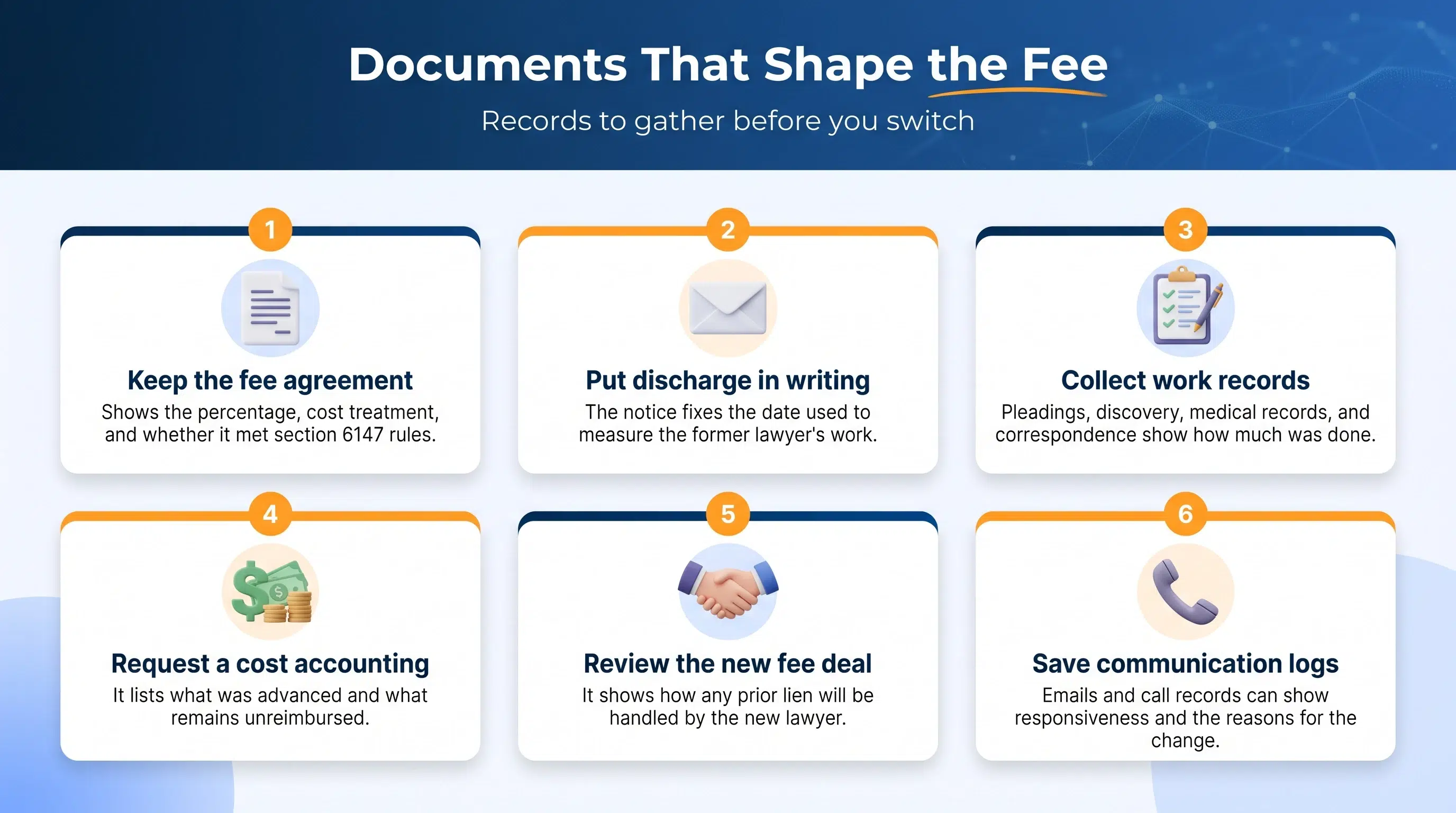
A fee dispute is decided on documents, so records matter. None of these items automatically decides the outcome, but each can shape the fee analysis:
-
The signed contingency fee agreement: It shows the percentage, how costs affect the fee, and whether it met section 6147 [3].
-
A written discharge notice: It fixes the date used to measure the former lawyer’s work.
-
The former lawyer’s work records and case file: Pleadings, discovery, medical records, and correspondence show how much was done.
-
A cost accounting: It shows what was advanced and what remains unreimbursed.
-
The new lawyer’s fee agreement: It shows how any prior lien will be handled.
-
Communication logs: Emails and call records can show responsiveness and the reasons for the change.
A predecessor lawyer asserting a lien may be required to show that the fees claimed were reasonable, and, upon the client’s request, to account for the quantum meruit value claimed [6].

What If the Former Lawyer and I Disagree About the Fee?
California offers a lower-cost forum for these disputes. The State Bar describes its Mandatory Fee Arbitration Program as informal, confidential, and lower cost, and arbitration is required for the attorney if the client requests it [11]. Most fee arbitration runs through local bar association programs, such as the Los Angeles County Bar Association’s attorney-client arbitration service, while the State Bar handles it only when no local program exists [13].
The State Bar’s Mandatory Fee Arbitration Program has certain limitations. It cannot award damages for attorney malpractice or misconduct, nor can it impose disciplinary action against attorneys [12]. Clients may also lose their right to fee arbitration if they file a lawsuit or seek a court ruling on the fee dispute after receiving the required arbitration notice [12].
A different standard applies when an attorney chooses to withdraw from a case rather than being replaced by the client. Under California law, a contingency-fee attorney who voluntarily withdraws generally must show a legally sufficient reason for leaving to recover payment for work already performed [5]. California Rule of Professional Conduct 1.16(d) also requires attorneys ending representation to take reasonable steps to protect their clients from foreseeable harm, including allowing time to find another lawyer and returning relevant case materials [1].
What If Insurance Is Involved?
Insurance does not change the fee rules, but it affects the logistics. When an insurer issues payment, the receiving lawyer must deposit it into a client trust account, and the lawyer’s duties under Rule 1.15 apply, including notice of receipt and prompt distribution of undisputed funds [2]. Rule 1.15 specifically lists prior attorney liens among the disputes that can delay disbursement of the disputed portion [2]. The new lawyer should also give the insurer notice of the change in representation.
How Does the Court Process Work?
If a personal injury lawsuit has already been filed, the change in legal representation must be formally recorded with the court. The California Courts Self-Help Guide explains that a Substitution of Attorney form (MC-050) must be completed, filed with the court, and served on the other parties [10]. If the former attorney refuses to consent to the change, a court order may be necessary under California Code of Civil Procedure Section 284. Switching lawyers close to trial can also create scheduling complications, as courts may deny requests to postpone proceedings without sufficient justification.
How Long Do I Have to Act?
Changing personal injury lawyers does not extend the deadline for filing a lawsuit. Under California Code of Civil Procedure Section 335.1, most personal injury claims must be filed within two years of the injury. However, certain exceptions may apply, including shorter deadlines for filing claims against government entities. Clients should confirm all applicable deadlines before changing attorneys to avoid jeopardizing their right to seek compensation.
Fee arbitration also has a deadline. A client who receives a Notice of Client’s Right to Fee Arbitration from the attorney has 30 days from receipt to submit a request [12]. Because limitation periods and arbitration windows can run while a client searches for a new lawyer, it is wise to arrange the new representation before sending a discharge notice.
What Should I Do Next?
-
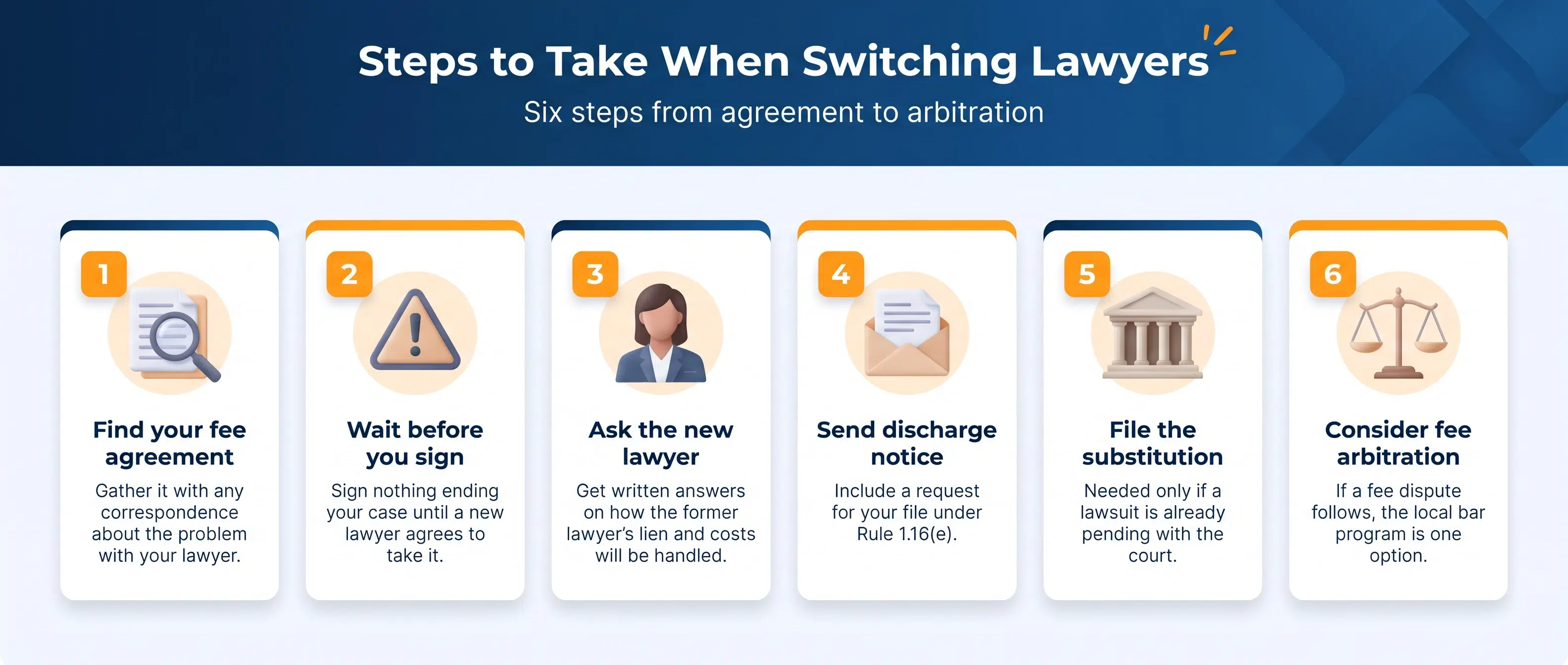
Locate your signed fee agreement and any correspondence about the problem.
-
Do not sign anything that ends your current representation until a new lawyer has agreed to take your case.
-
Speak with a new lawyer and ask in writing how the former lawyer’s lien and costs will be handled.
-
Send a written discharge notice and request your file under Rule 1.16(e).
-
File the substitution of attorney if a case is pending.
-
If a fee dispute follows, consider the local bar’s fee arbitration program.
Fee and lien questions can be technical. Working with a licensed California attorney, rather than handling the transition alone, can help protect your claim and your deadlines.
Related California Personal Injury Resources
Readers who want a broader overview can review the GoSuits California personal injury practice resources. Questions about how a fee works in a particular crash, fall, or workplace claim are best reviewed with a lawyer who can read the agreement and the file.

Talk With a GoSuits Attorney
If you are unhappy with your current representation and want to understand your options, a GoSuits personal injury attorney can review your situation and explain how a change might affect your fee and your claim. You can schedule a free consultation to discuss your case. Every case is different, and no outcome can be guaranteed.
This article provides general legal information about California law and is not legal advice. Reading it does not create an attorney-client relationship. Laws and rules change, so consult a licensed California attorney about your specific situation.
References
-
Rule 1.16 Declining or Terminating Representation – Court Rules
-
Rule 1.15 Safekeeping Funds and Property of Clients and Other Persons – State Bar of California
-
California Business and Professions Code Section 6147 – FindLaw
-
Ethically Speaking: Conversion Clauses in Contingency Fee Agreements – Orange County Bar Association
-
Terminating the Attorney-Client Relationship – Advocate Magazine
-
Remove or Add a Lawyer to Your Case – California Courts Self-Help Guide
-
Frequently Asked Questions: Fee Disputes – State Bar of California
-
Attorney-Client Mediation and Arbitration Services – Los Angeles County Bar Association
-
Duties to Former Clients and Termination of Representation – Bar Association of San Francisco