
Yes, in most situations Texas law does not prohibit an injured person from dealing with an insurer or filing a civil lawsuit without a lawyer. Being allowed to do so is not the same as it being wise. A Texas injury claim is shaped by a two-year filing deadline, a rule that bars recovery if the injured person is found more than 50 percent responsible, limits on recoverable medical expenses, statutory liens, and insurers whose adjusters work for the other side. A mistake in any of these areas can be difficult or impossible to undo, so speaking with licensed Texas personal injury lawyers before signing anything or accepting an offer is strongly recommended. [1] [2]
Legal Snapshot
-
Legal Topic: Pursuing a Texas civil personal injury claim without an attorney
-
Jurisdiction: Texas state law, plus federal Medicare Secondary Payer law where Medicare has paid for injury-related care
-
Case Stage: Pre-claim and early claim decision-making, including settlement and filing a lawsuit
-
Primary Legal Issue: Whether the risks of an unrepresented claim (deadlines, comparative responsibility, damages proof, liens) outweigh the perceived savings
-
Primary Authority: Tex. Civ. Prac. & Rem. Code §§ 16.003, 33.001, 41.0105, 18.001; Tex. Prop. Code ch. 55; Tex. R. Civ. P. 500.3; 42 U.S.C. § 1395y(b)(2)
-
Date Legal Authority Last Reviewed: November 11, 2026 (attorney verification recommended before publication)
What Does Handling a Claim Without a Lawyer Mean?
Handling a claim without a lawyer means you personally gather evidence, communicate with insurers, evaluate your damages, negotiate, sign any release, and, if the claim does not resolve, file and litigate a lawsuit. Lawyers call an unrepresented party “pro se.” Nothing here is individualized legal advice, and this article does not encourage anyone to represent themselves. It explains the Texas rules so you can see what is at stake before you decide.
A personal injury claim is a civil matter. It is separate from any traffic citation, criminal charge, or workers’ compensation process arising from the same event. The civil claim asks whether another person or business failed to use reasonable care and, if so, what compensation the law allows.
What Does Texas Law Say?
Texas law sets the rules for who can recover compensation after an injury and how much. If you are handling a claim without a lawyer, these are the most important rules to know. Each one is a general statement of the law, and exceptions may apply depending on the facts of your case.
|
Issue |
Texas rule |
Authority |
|---|---|---|
|
Filing deadline |
A suit for personal injury generally must be brought no later than two years after the cause of action accrues |
Tex. Civ. Prac. & Rem. Code § 16.003(a) [1] |
|
Shared fault |
A claimant may not recover damages if the claimant’s percentage of responsibility is greater than 50 percent |
Tex. Civ. Prac. & Rem. Code § 33.001 [2] |
|
Medical expenses |
Recovery of medical expenses is limited to the amount actually paid or incurred by or on behalf of the claimant |
Tex. Civ. Prac. & Rem. Code § 41.0105 [3] |
|
Proving medical bills |
An affidavit procedure with strict service deadlines exists for proving the reasonableness and necessity of past medical charges |
Tex. Civ. Prac. & Rem. Code § 18.001 [5] |
|
Hospital liens |
A hospital may hold a lien on an injury claim if the patient was admitted within 72 hours of the accident |
Tex. Prop. Code § 55.002 [6] |
|
Small claims forum |
Justice courts hear money claims of no more than $20,000, including attorney fees but excluding interest and costs |
Tex. R. Civ. P. 500.3(a); Tex. Gov’t Code § 27.031 [9] |
What Legal Rules Apply?
Most Texas injury claims are negligence claims. The claimant must show that the other party owed a duty, breached it, and caused the claimant’s injuries and damages. Texas then applies its proportionate responsibility system. A jury can assign percentages of responsibility to the claimant, the defendant, and in some cases other people. If the claimant is 50 percent or less responsible, damages are reduced by the claimant’s percentage. If the claimant is over 50 percent, recovery is barred. [2]
This is where self-handled claims can go wrong early. Statements made to an adjuster, such as “I didn’t see him until the last second,” may later be used to argue that the claimant bears a larger share of fault. Defendants can also designate other people as responsible third parties under Chapter 33, which can shift percentages. [2]
Federal law enters when Medicare has paid for injury-related treatment. Under the Medicare Secondary Payer statute, liability insurance generally pays before Medicare, and Medicare may make conditional payments that must be repaid from a settlement or judgment. [12] [13] A claimant who ignores that process can face repayment demands after the settlement money is already spent.
How Does This Apply to a Real Case?
Hypothetical example (not a GoSuits case): A driver is rear-ended in stop-and-go traffic on I-45 in Houston. The other driver’s insurer calls within days, asks for a recorded statement, and offers a quick payment for the car and an urgent care visit. The injured driver accepts. Weeks later, an MRI shows a disc injury that requires ongoing treatment. If the driver signed a release, the claim for those later bills may be foreclosed. Whether a particular release has that effect depends on its wording and the facts, which is one reason the paperwork deserves legal review before signing.
Hypothetical example (not a GoSuits case): A shopper slips on a wet floor at a grocery store in San Antonio. The store’s insurer suggests the shopper should have been watching where they were walking. That suggestion is a comparative responsibility argument, and under Texas law it matters whether the shopper’s share ends up above or below 50 percent. [2] In premises cases, such as slip-and-fall injuries, a key question is what the property owner knew about the dangerous condition and when they knew it. These facts are often hard to prove and frequently disputed.
Texas highways such as I-35, I-10, and I-45 carry heavy commercial and commuter traffic, and collisions involving multiple vehicles or commercial carriers can bring several insurers into the picture. The more parties and policies involved, the harder it becomes to evaluate a claim without legal help.
What Evidence Can Matter?
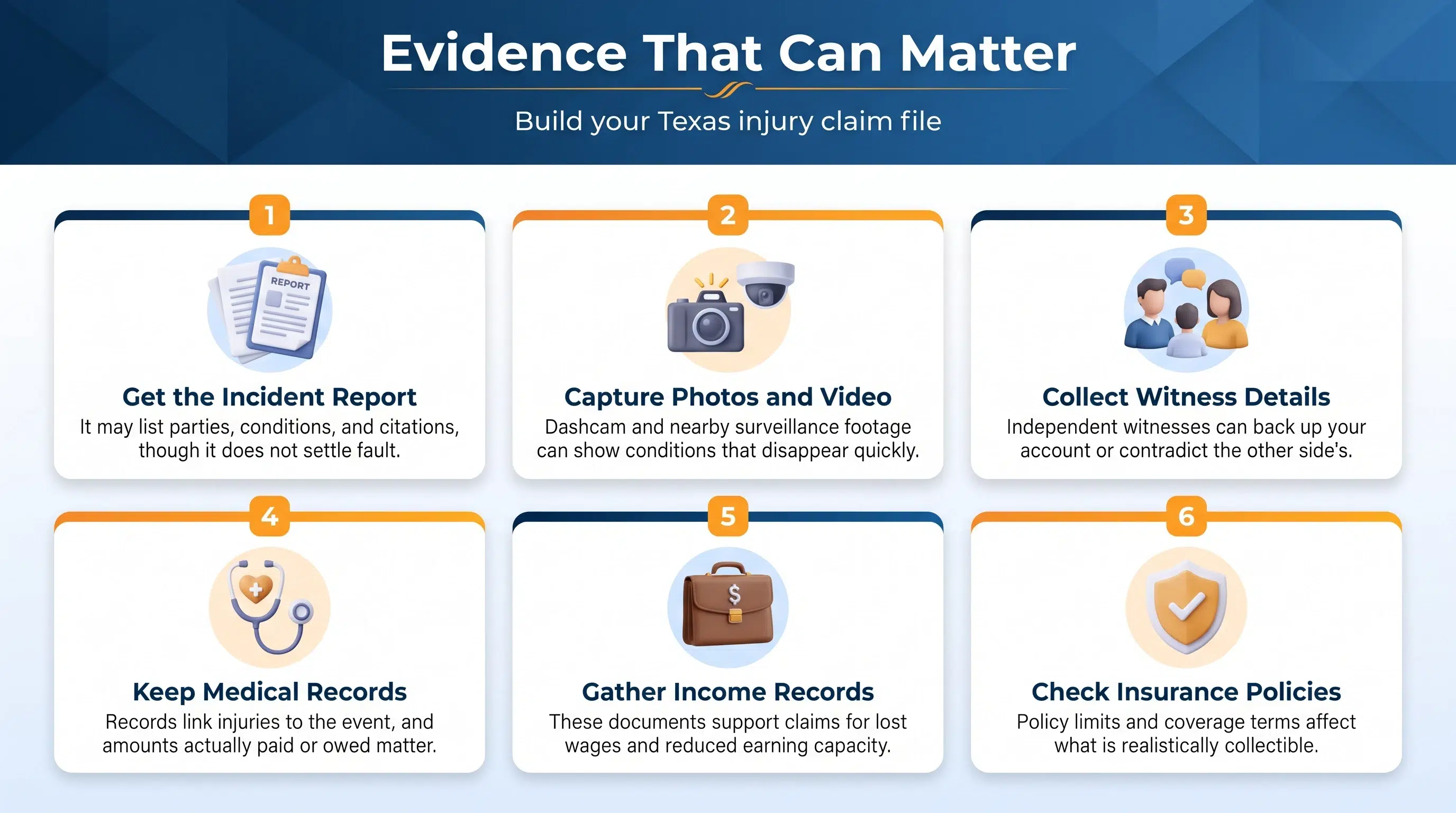
Evidence does not automatically establish liability, but it shapes how an insurer or jury views the case. Categories that commonly matter include:
-
Police or incident reports: They may record the parties, conditions, and citations, though they are not conclusive on fault.
-
Photographs and video: Scene photos, dashcam footage, and nearby surveillance can capture conditions that disappear quickly.
-
Witness information: Independent witnesses can corroborate or contradict competing accounts.
-
Medical records and bills: These link the injuries to the event and document treatment. Because of the paid-or-incurred rule, the amounts actually paid or owed matter, not simply the billed totals. [3] [4]
-
Employment and income records: These support lost wage and earning capacity claims.
-
Vehicle and electronic data: Event data recorders and phone records may bear on speed, braking, or distraction.
-
Insurance documents: Policy limits and coverage terms affect what is realistically collectible.
-
Accident reconstruction testimony: In disputed or serious cases, a qualified reconstruction witness may be needed to explain how the event happened.
Social media posts can also be used by the other side to challenge the extent of an injury, so unrepresented claimants should be careful about what they publish.
What Damages or Remedies May Be Available?
The damages you can recover depend on Texas law and the facts of your case. You may be able to claim past and future medical bills, lost income, loss of earning capacity, physical pain, mental anguish, physical impairment, disfigurement, and property damage. In rare cases, exemplary damages, also called punitive damages, may be available. Under Texas Civil Practice and Remedies Code section 41.003, you must prove by clear and convincing evidence that the harm resulted from fraud, malice, or gross negligence. If an injury proves fatal, family members and the estate may have separate claims, and a wrongful death lawyer can explain how those claims work.
Valuing future medical care and long-term impairment is one of the hardest parts of handling a claim without a lawyer. An early settlement generally ends your right to recover costs that come up later. Texas also limits recovery of past medical expenses to the amount actually paid or incurred under Texas Civil Practice and Remedies Code section 41.0105, and the Texas Supreme Court addressed that rule in Haygood v. De Escobedo, 356 S.W.3d 390 (Tex. 2011). [4] The Texas Legislature has considered changes to sections 41.0105 and 18.001, including a 2025 proposal that did not become law, so check the current statute before relying on any summary.
Texas justice courts can hear small claims cases worth up to $20,000, including attorney fees [9]. The Texas State Law Library notes that you cannot agree to accept less money just to fit within that limit [9]. Injury claims with more serious damages generally belong in a county court at law, which can hear most civil cases up to $250,000 under Texas Government Code section 25.0003, or in a district court, such as the Dallas County or Harris County district courts. These courts follow formal procedure and evidence rules.
What If the Other Party Disputes Liability?
Disputed liability is common, and it is the point where many unrepresented claims stall. The other side may argue the claimant was more than 50 percent responsible, that someone else caused the harm, that the injuries were pre-existing, or that treatment was unnecessary or overpriced.
If you file a lawsuit, your case moves into formal litigation, with written pleadings, discovery, and rules of evidence. Under Texas Civil Practice and Remedies Code section 18.001, you can use affidavits to help prove your medical expenses, and the defendant can serve a counteraffidavit to challenge them. Your affidavits generally must be served within 90 days after the defendant files an answer, or by your expert designation deadline if that comes first. The defendant’s counteraffidavit is generally due within 120 days after its answer, or by its own expert designation deadline if that comes first. Missing a deadline can limit how you prove your medical expenses at trial. Texas courts hold people who represent themselves to the same procedural rules as people with lawyers. [5]

What If Insurance Is Involved?
Insurance is involved in nearly every injury claim, and the adjuster for the at-fault party’s insurer is not your advocate. A liability insurer’s duty runs mainly to its own policyholder, and Texas courts have generally not extended good-faith duties to injured third parties (Allstate Insurance Co. v. Watson, 876 S.W.2d 145 (Tex. 1994))
The Texas Prompt Payment of Claims statute in Insurance Code Chapter 542 sets deadlines for insurers, but courts have described it as applying to first-party claims made by an insured, not to third-party liability claims. [10] [11] That means an injured person claiming against the other driver’s insurer generally cannot count on those statutory deadlines to speed things up.
Your own coverage may also matter, including health insurance, medical payments coverage, and uninsured or underinsured motorist coverage. Reimbursement rights of health plans, hospitals, and Medicare can reduce what the claimant keeps, as discussed below.
What Liens and Reimbursement Claims Can Affect a Settlement?
A hospital that provides services after an accident attributed to another person’s negligence may have a statutory lien on the claim if the patient was admitted within 72 hours. [6] To secure the lien, the hospital must provide notice to the injured person and file written notice with the county clerk before money is paid because of the injury. [7] The lien amount is capped at the lesser of several measures, including 50 percent of the amount recovered and the hospital’s charges for the first 100 days. [8] Under Texas Property Code section 55.007, a release of the underlying claim may not protect the paying party against a valid lien unless the lien is addressed, which can cause problems after a settlement check has been distributed.
Medicare has its own recovery process. The federal Centers for Medicare & Medicaid Services explains that conditional payments are recovered when a settlement, judgment, award, or other payment is made, and that beneficiaries should recognize the reimbursement obligation during settlement negotiations. [12] Health plans may also assert reimbursement rights under their terms and applicable law, including Texas Civil Practice and Remedies Code section 140.005.
What If I Am the One Being Sued?
Defendants face their own risks without a lawyer. If you are served with a Texas civil lawsuit, the deadline to respond is short, and missing it can lead to a default judgment. The deadline depends on the court and the type of case, so review the citation and the Texas Rules of Civil Procedure right away. If you have liability insurance, notify your insurer promptly, because the policy may require it and may include a duty to defend. Do not ignore a citation, and do not assume that a conversation with the plaintiff’s insurer resolves the lawsuit.
How Long Do I Have to Act?
Most Texas personal injury lawsuits must be filed within two years after the cause of action accrues. [1] Wrongful death claims are also generally two years, but the clock typically starts on the date of death rather than the date of the injury. [1] Minors and people of unsound mind may have the deadline paused under Texas Civil Practice and Remedies Code section 16.001.
Claims against a city, county, school district, or other governmental unit can carry a much shorter notice requirement. Section 101.101 of the Civil Practice and Remedies Code requires notice within six months after the incident, and city charters may set their own notice periods [14] These deadlines are strictly applied, and the safest approach is to have a Texas attorney confirm which deadline governs your situation as early as possible.
What Should I Do Next?
-
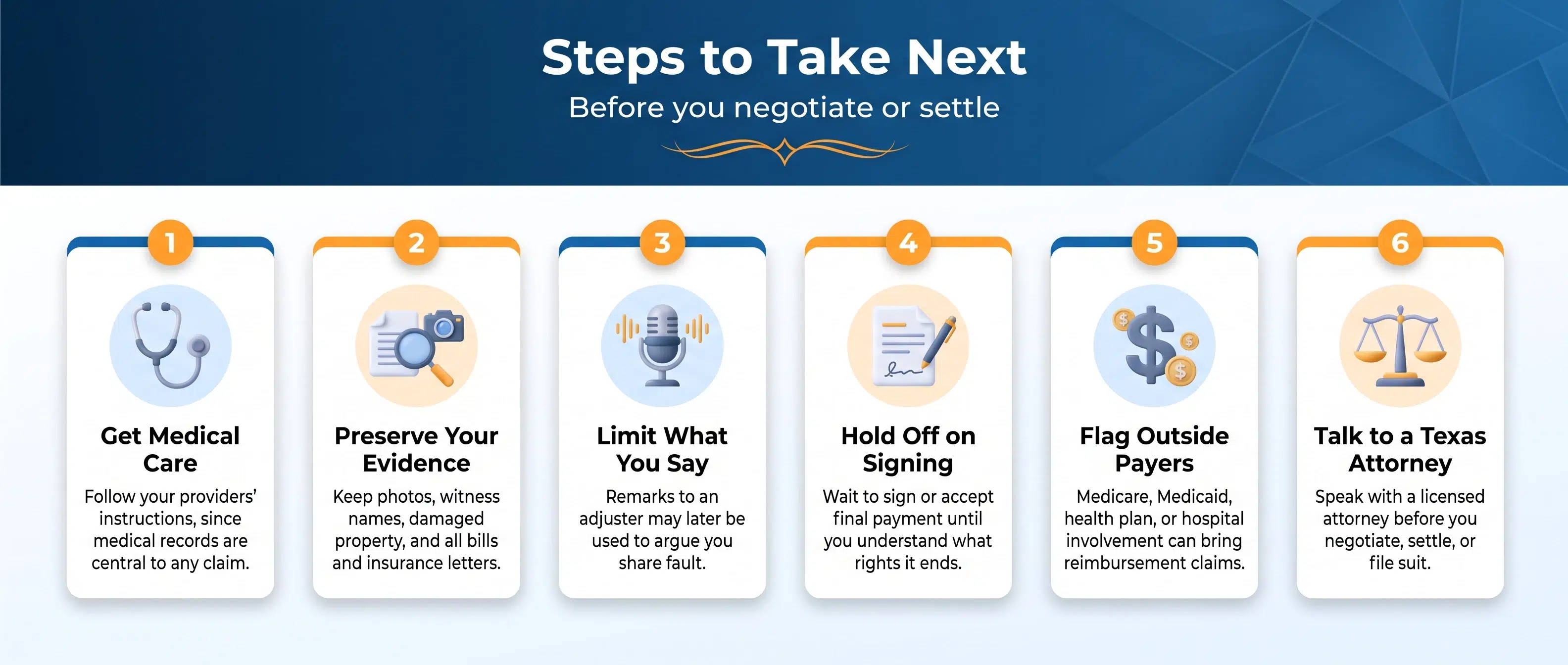
Get medical care and follow your providers’ instructions. Medical records are central to any claim.
-
Preserve evidence, including photos, names of witnesses, damaged property, and all bills and insurance letters.
-
Limit what you say to the other side’s insurer, and do not sign a release or accept a final payment until you understand what rights it ends.
-
Note any Medicare, Medicaid, health plan, or hospital involvement, because reimbursement claims may follow.
-
Calendar the possible deadlines above and have them confirmed for your facts.
-
Speak with a licensed Texas personal injury attorney before you negotiate, settle, or file suit. Many injury lawyers offer an initial review, and the firm can explain fee arrangements before you commit.
Related Texas Personal Injury Resources
Claims differ by incident type. For general information about injury claims in the state, see our Texas personal injury team. GoSuits also maintains Texas pages on pedestrian crash claims and rideshare crash claims. In many vehicle cases, car accident lawyers can explain how fault, insurance, and medical billing rules apply to a specific collision.

Talk With a GoSuits Attorney
An injury claim can involve medical evidence, insurance issues, liability disputes, liens, and legal deadlines. If you were hurt in Texas and are weighing whether to handle a claim on your own, you can schedule a free consultation so a GoSuits attorney can review your circumstances and explain your options. No outcome or amount of recovery can be promised.
This article provides general legal information about Texas law and is not legal advice. Laws change and every case is different. Reading it does not create an attorney-client relationship.
References
-
Medical Expense Challenges, discussing Haygood v. Escobedo, 356 S.W.3d 390 (Tex. 2011) – Hanna Plaut
-
How much can I sue for in a small claims court? – Texas State Law Library
-
Opinion discussing Chapter 542 and third-party claims, S.D. Tex. (Galveston Division) – GovInfo
-
Conditional Payment Information – Centers for Medicare & Medicaid Services