
There is no fixed timeline. A California slip and fall settlement can come together in a matter of months when liability is clear, treatment has finished, and the insurer negotiates in good faith. It can take a year or longer when fault is disputed, the injuries are still developing, or a lawsuit has to be filed. The pace is driven mostly by medical recovery, the strength of the notice evidence, insurer cooperation, and court scheduling. Separate legal deadlines also apply no matter how settlement talks are going, including a two-year filing deadline for most claims and a six-month claim deadline when a public entity owns the property [3][4].
Legal Snapshot
-
Legal Topic: Timing of settlement in California premises liability (slip and fall) claims
-
Case Stage: Pre-claim through trial, with emphasis on treatment, demand, negotiation, and litigation
-
Primary Legal Issue: Whether the property owner or occupier had actual or constructive notice of the hazard, and how long it takes to prove that and value the claim
-
Primary Authority: Ortega v. Kmart Corp. (2001) 26 Cal.4th 1200; Code of Civil Procedure sections 335.1 and 999 to 999.5; Government Code sections 835 and 911.2; Standards of Judicial Administration, standard 2.2
-
Date Legal Authority Last Reviewed: November 10, 2026 (research review only; attorney review pending)
What Does “Settlement Timeline” Mean in a Slip and Fall Case?
A settlement timeline is the period between the fall and the moment the injured person and the liable party (usually through an insurer) agree on payment and sign a release. It is not the same as the filing deadline. The statute of limitations is a legal cutoff for filing a lawsuit. The settlement timeline is simply how long negotiation or litigation takes in practice.
Many people confuse the two. An insurer can keep a claim open for months without ever agreeing to pay, and the filing deadline keeps running during that time. Anyone with an active claim should talk with personal injury lawyers early enough that negotiation never crowds out a deadline.
What Does California Law Say About Timing?
California does not set a required time for an insurer to reach a slip and fall settlement, but once an insurer accepts a claim and receives any required signed release, it generally must pay within 30 calendar days [new reference: 10 CCR § 2695.7. California also sets firm deadlines for filing a lawsuit and, in some cases, for filing a claim before suing. Those deadlines shape the realistic timeline more than any other rule.
|
Situation |
Deadline |
Authority |
|---|---|---|
|
Fall on private property (store, apartment complex, parking lot) |
Generally two years from the date of injury to file suit |
Code Civ. Proc. § 335.1 [3] |
|
Fall on property owned by a city, county, school district, or the State |
Written claim generally due within six months of accrual |
Gov. Code § 911.2 [4] |
|
Public entity responds to the claim |
Entity has 45 days to act, or the claim is deemed rejected |
Gov. Code § 912.4 [4] |
|
Public entity gives written rejection |
Six months from that notice to file suit |
Gov. Code § 945.6 [12] |
|
Missed the six-month claim window |
Application for leave to present a late claim, generally within one year of the injury |
Gov. Code § 911.4 [5] |
These deadlines are summaries. Exceptions, such as extra time for injured minors, and the exact date a claim begins can change the calculation, so a GoSuits attorney can confirm the dates for your case.
What Legal Rules Apply to a California Slip and Fall Claim?
A slip and fall claim is a type of premises liability claim, and the central question is usually notice: did the property owner know, or should it have known, about the hazard? In Ortega v. Kmart Corp. (2001) 26 Cal.4th 1200, the California Supreme Court explained that a property owner is not the insurer of a visitor’s safety, so the owner’s actual or constructive knowledge of the dangerous condition is key to liability [1]. Constructive knowledge can be proven with circumstantial evidence, and if the owner failed to inspect within a reasonable time, a jury can infer that the hazard was there long enough to be found and fixed [1].
That rule affects how long a claim takes, because proving notice often depends on inspection logs, security camera footage, and employee testimony that the property owner controls. Getting those records can take weeks or months, and sometimes it requires formal discovery in a lawsuit.
When the property belongs to a public entity, such as a city or school district, Government Code section 835 applies. A public entity is liable for an injury caused by a dangerous condition of its property only if the injured person proves certain elements, including that the condition was dangerous, that it caused the injury, and either that a public employee created the hazard or that the entity knew or should have known about it in time to fix it [6]. This standard is stricter than ordinary negligence, and it comes with the extra step of filing a claim before you can sue.
Fault can also be shared. California follows pure comparative fault under Li v. Yellow Cab Co. (1975) 13 Cal.3d 804, so an injured person’s own carelessness, such as looking at a phone while walking, may reduce their recovery rather than bar it. The general duty to use ordinary care in managing property comes from Civil Code section 1714.
For damages, Howell v. Hamilton Meats & Provisions, Inc. (2011) 52 Cal.4th 541 holds that an injured person whose medical care was paid through private insurance can recover as past medical expenses no more than the amounts actually paid or still owed, rather than the full amount billed [2]. Insurers rely on that rule when valuing a claim, so it affects how settlement negotiations play out.
What Stages Affect How Long a Settlement Takes?
Most settlement delay comes from a handful of predictable stages. Durations vary widely by case, so the table describes what happens rather than promising a schedule.
|
Stage |
What happens |
Why it can add time |
|---|---|---|
|
Medical treatment |
Injuries are diagnosed and treated until recovery or a stable condition |
Settling before the full extent of injury is known can undervalue future care |
|
Investigation |
Photos, witness names, video, inspection records, and incident reports are collected |
Video may be overwritten and owners may be slow to respond |
|
Demand and negotiation |
A written demand with supporting records goes to the insurer |
Adjusters review records, request more information, and counter |
|
Government claim (if public property) |
A written claim is presented and the entity acts on it |
Entity has up to 45 days before a claim is deemed rejected [4] |
|
Lawsuit and discovery |
Complaint is filed; both sides exchange documents and take depositions |
Court calendars and defense scheduling control the pace |
|
Mediation or trial |
Parties try to resolve the case or present it to a judge or jury |
Trial dates depend on court availability |
Court time goals offer a rough outer limit once a lawsuit is filed. Standard 2.2 of the California Standards of Judicial Administration recommends that 75% of unlimited civil cases be resolved within 12 months, 85% within 18 months, and all within 24 months of filing [9]. These are goals, not guarantees. According to the Judicial Council’s 2026 Court Statistics Report, about 83% of unlimited civil cases resolved in fiscal year 2024–25 ended before trial [10]. [VERIFY against the Judicial Council’s published report.] Those figures cover all unlimited civil cases, not slip and fall claims alone.
How Does This Apply to a Real Case?
Example (hypothetical, not a GoSuits case): A shopper slips on a spill in a grocery store aisle in the San Fernando Valley and fractures a wrist. The store’s camera footage and inspection log are requested early, and the log shows no check of the aisle for a long stretch before the fall. The shopper keeps treating for several months. A demand goes out only after the doctor describes the wrist’s long-term outlook. If the insurer accepts liability and negotiates reasonably, resolution may occur without a lawsuit. If the insurer argues the spill appeared moments before the fall, the dispute over notice can push the case into litigation and discovery, as in Ortega, where the question was how an owner’s inspection gap supports constructive notice [1].
Example (hypothetical, not a GoSuits case): A pedestrian trips on a raised, broken sidewalk slab near downtown Los Angeles. If the sidewalk is city property, the six-month written claim comes first, and the lawsuit clock follows the city’s response [4][12]. Waiting for medical recovery to finish before taking any step could let the claim deadline pass. This is why public-property falls often have a faster front end and a slower back end than private-property falls.
What Evidence Can Matter?
Evidence does not prove liability automatically, but each category can affect how quickly an insurer takes the claim seriously.
-
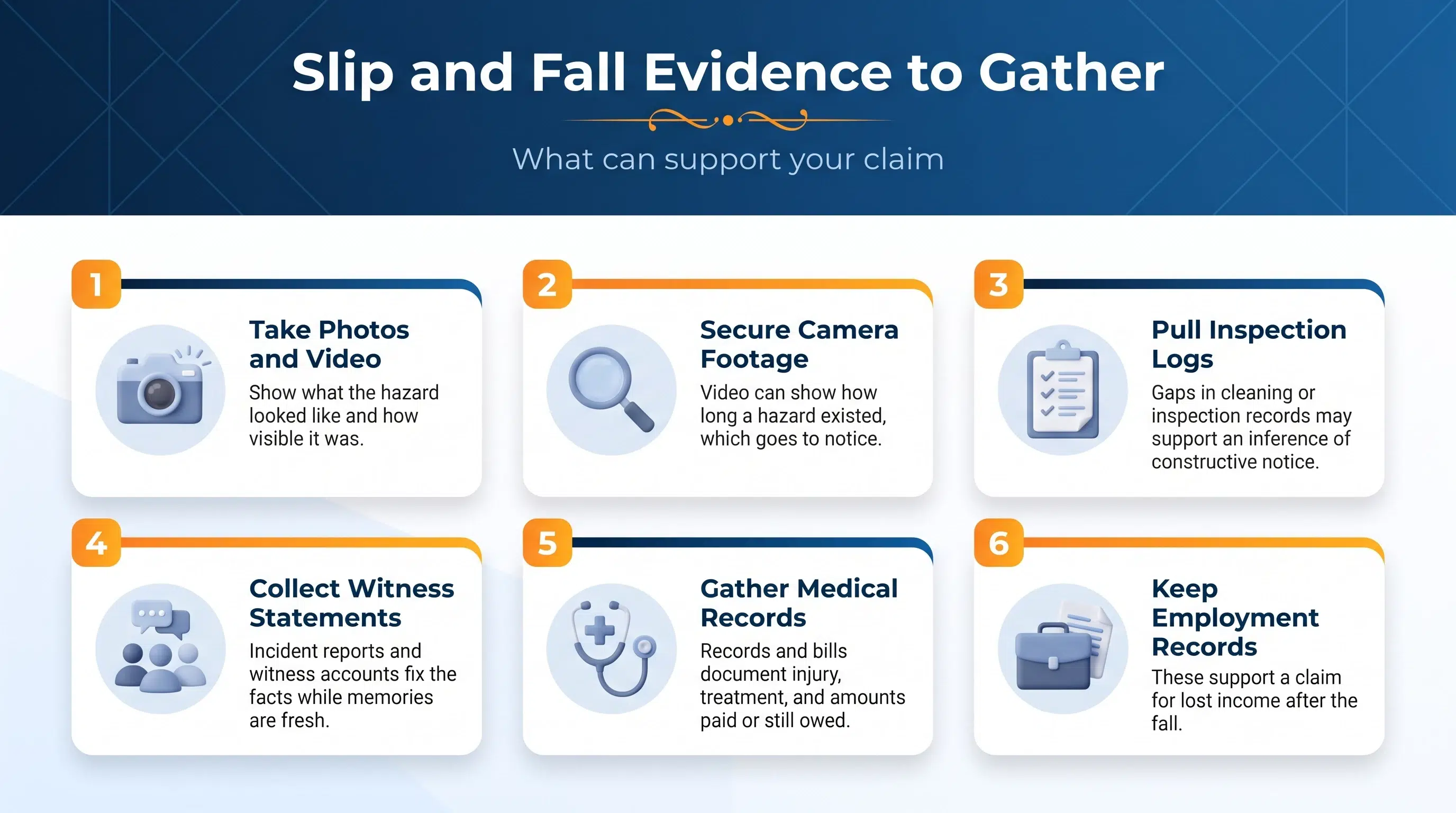
Photographs and video of the hazard and the surrounding area: They show what the condition looked like and how visible it was.
-
Surveillance footage: It can show how long a hazard existed, which goes to constructive notice.
-
Inspection and cleaning logs: Gaps in the logs may support an inference of constructive notice under Ortega [1].
-
Incident reports and witness statements: They fix the facts while memories are fresh.
-
Medical records and bills: They document injury, treatment, and amounts paid or owed, which matter under Howell [2].
-
Employment records: They support claims for lost income.
-
Complaint history and maintenance records (public property): They bear on actual notice under Government Code section 835 [6].
-
Footwear and clothing from the day of the fall: The defense may raise them in a comparative fault argument.

What Damages or Remedies May Be Available?
What you can recover depends on California law and the facts of your case. Damages that may be claimed include past and future medical expenses, lost income, loss of earning capacity, physical pain, and emotional distress. When insurance paid your medical providers, past medical expenses are generally limited to the amounts actually paid or still owed, not the full amount billed [2]. Nothing here predicts or guarantees a particular result.
Damages also affect how long a claim takes, because many injured people wait until they know the full extent of their injuries before settling. A settlement demand sent too early may not account for future medical care, and once you sign a release as part of a settlement, the claim generally ends, even if your injuries turn out to be worse than expected.
What If the Other Party Disputes Liability?
A dispute over liability is one of the most common reasons a slip and fall claim takes longer. Property owners often argue that they didn’t know about the hazard, that it was open and obvious, that it appeared just moments before the fall, or that the injured person wasn’t paying attention. Under Ortega, an owner can’t avoid liability simply by not knowing about a hazard it reasonably should have found, but the injured person still has to produce evidence that the owner knew or should have known about it [1]. If fault is shared, California’s comparative fault rule may reduce the recovery (Li v. Yellow Cab Co. (1975) 13 Cal.3d 804).
If a dispute can’t be resolved through negotiation, the next step is filing a lawsuit in the correct California superior court. A personal injury lawsuit can generally be filed in the county where the injury happened or where the defendant is located. For example, a fall in Los Angeles County would usually be filed in Los Angeles County Superior Court, and a fall in Orange County in Orange County Superior Court, where many civil cases are heard at the Central Justice Center in Santa Ana.
What If Insurance Is Involved?
Most slip and fall settlements are paid by a property owner’s liability insurer, and insurance rules affect timing in three ways.
Time-limited demands. For claims covered by automobile, motor vehicle, homeowner, or commercial premises liability policies, Code of Civil Procedure sections 999 to 999.5 govern pre-lawsuit time-limited demands [8]. A qualifying demand must be in writing, be labeled as a time-limited demand or reference the statute, and give the insurer at least 30 days if sent by email, fax, or certified mail, or at least 33 days if sent by mail [7]. It must also offer to settle all claims within policy limits, including satisfaction of all liens [7]. Because commercial premises policies are covered, these rules can apply to a store or business slip-and-fall.
Liens and reimbursement. Health insurers, Medi-Cal, Medicare, and hospitals may have a right to be repaid from your settlement. Resolving those claims can take weeks after the main negotiation ends. One source of these claims is California’s Hospital Lien Act, Civil Code sections 3045.1 through 3045.6, which lets hospitals that treated you claim part of your recovery.
Statutory offers to compromise. Once a lawsuit is pending, either side can make a formal settlement offer under Code of Civil Procedure section 998. If you, as the injured person, reject the defense’s offer and then don’t get a better result at trial, you can’t recover your own court costs incurred after the offer, and you must pay the defense’s costs from the time of the offer, which can include expert witness fees [11]. That risk often pushes cases toward settlement as trial gets closer.
How Long Do I Have to Act?
For most slip and fall claims on private property, a lawsuit generally must be filed within two years of the injury under Code of Civil Procedure section 335.1 [3]. For falls on public property, a written claim generally must be filed with the government entity within six months under Government Code section 911.2 [4]. Negotiating with an insurer does not pause either deadline, so a GoSuits attorney can confirm the dates that apply to your claim.
What Should I Do Next?
-
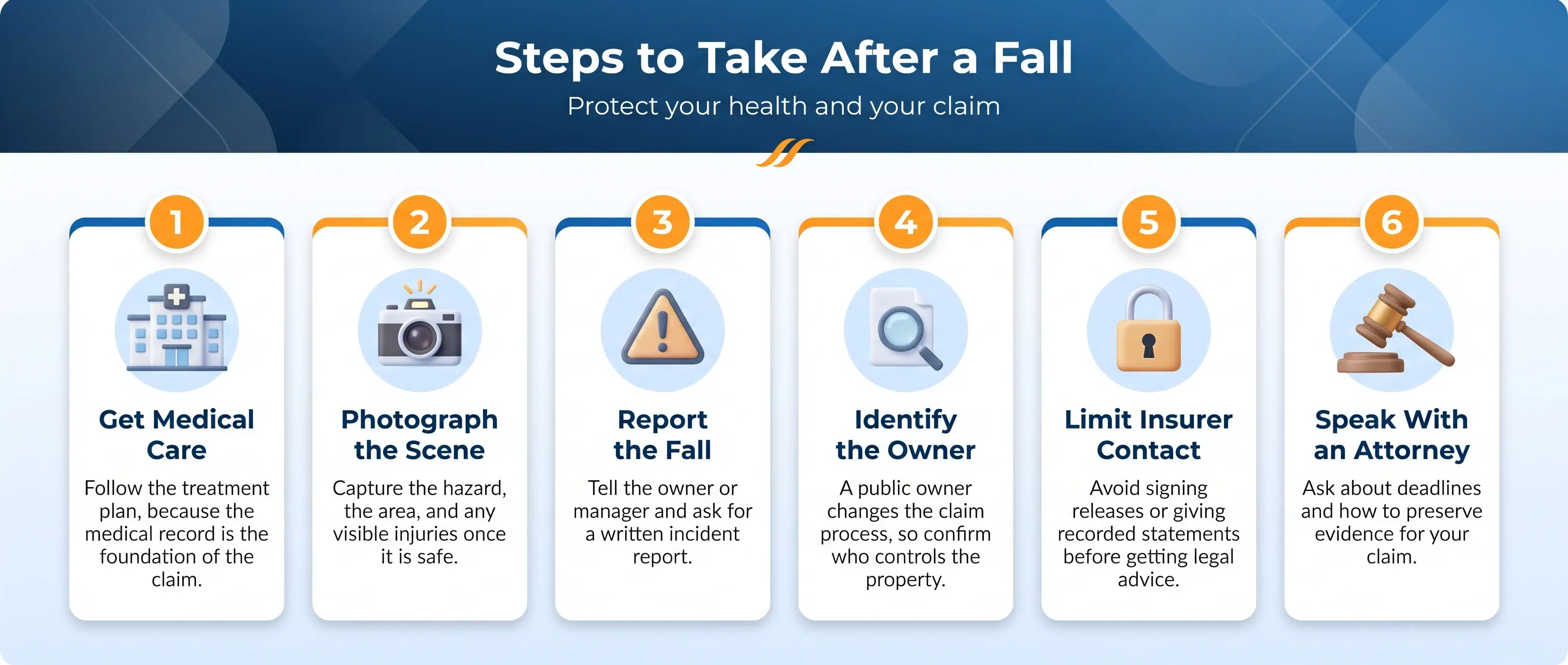
Get medical care and follow the treatment plan, because the medical record is the foundation of the claim.
-
Photograph the hazard, the area, and any visible injuries as soon as it is safe to do so.
-
Report the fall to the property owner or manager and ask that a written incident report be made.
-
Write down witness names and contact details.
-
Find out who owns the property. A public owner triggers the six-month claim rule.
-
Avoid signing releases or giving recorded statements to an insurer before getting legal advice.
-
Speak with a California attorney about deadlines and evidence preservation. Handling a premises claim without a lawyer risks missed deadlines and undervalued damages.
Related California Personal Injury Resources
Readers can find broader information on California personal injury resources from GoSuits. Those looking for local information on falls in the Los Angeles area can see our Los Angeles slip and fall team.
Talk With a GoSuits Attorney
A slip and fall claim can involve notice evidence, insurance issues, liability disputes, and legal deadlines that run while treatment continues. If you were hurt in a fall in California, a GoSuits attorney can review the circumstances and explain your options. You can schedule a free consultation to discuss your situation.
This article provides general legal information about California law and is not legal advice. Every case depends on its own facts, and no outcome or timeline is guaranteed. Consult a licensed California attorney about your situation.