No. Illinois is an at-fault (tort) state, not a no-fault state. A driver who causes a crash through negligence can be legally responsible for the injuries and property damage that result, and the injured person generally pursues compensation from the at-fault driver’s liability insurance [1]. Illinois does not require drivers to carry medical payments coverage, which is the closest feature many policies have to no-fault benefits [4]. Because fault drives the outcome, how responsibility is divided between drivers can change what an injured person may recover. This article explains the Illinois rules in plain English. It is general legal information, not advice about any specific crash.
Legal Snapshot
-
Legal Topic: Illinois fault system for motor vehicle accident claims (at-fault versus no-fault)
-
Case Stage: Early evaluation after a crash, before a claim or lawsuit is filed
-
Primary Legal Issue: Who is legally responsible for the crash, and how shared fault affects recovery
-
Primary Authority: 735 ILCS 5/2-1116 (modified comparative fault); 625 ILCS 5/7-203 and 5/7-601 (liability insurance); 735 ILCS 5/13-202 (two-year deadline for injury suits)
-
Jurisdiction: Illinois state law, with federal law noted only where it applies (for example, Medicare reimbursement rights)
-
Date Legal Authority Last Reviewed: November 10, 2026 (checked against Illinois agency sources and secondary sources; attorney verification of statutory text is pending)
What Does “No-Fault” Mean?
A no-fault system requires each injured person to look first to their own insurance for medical bills and some lost income, usually through personal injury protection (PIP), regardless of who caused the crash. Lawsuits against the other driver are often allowed only for more serious injuries. Illinois does not use that structure.
Under Illinois law, the starting question after a crash is who was negligent. The Illinois Department of Insurance describes liability coverage as the insurance that pays for bodily injury or property damage you cause through the negligent operation of a vehicle [1]. The injured person’s claim is therefore usually directed at the at-fault driver and that driver’s insurer, with the person’s own coverages available in specific situations discussed below.
What Does Illinois Law Say?
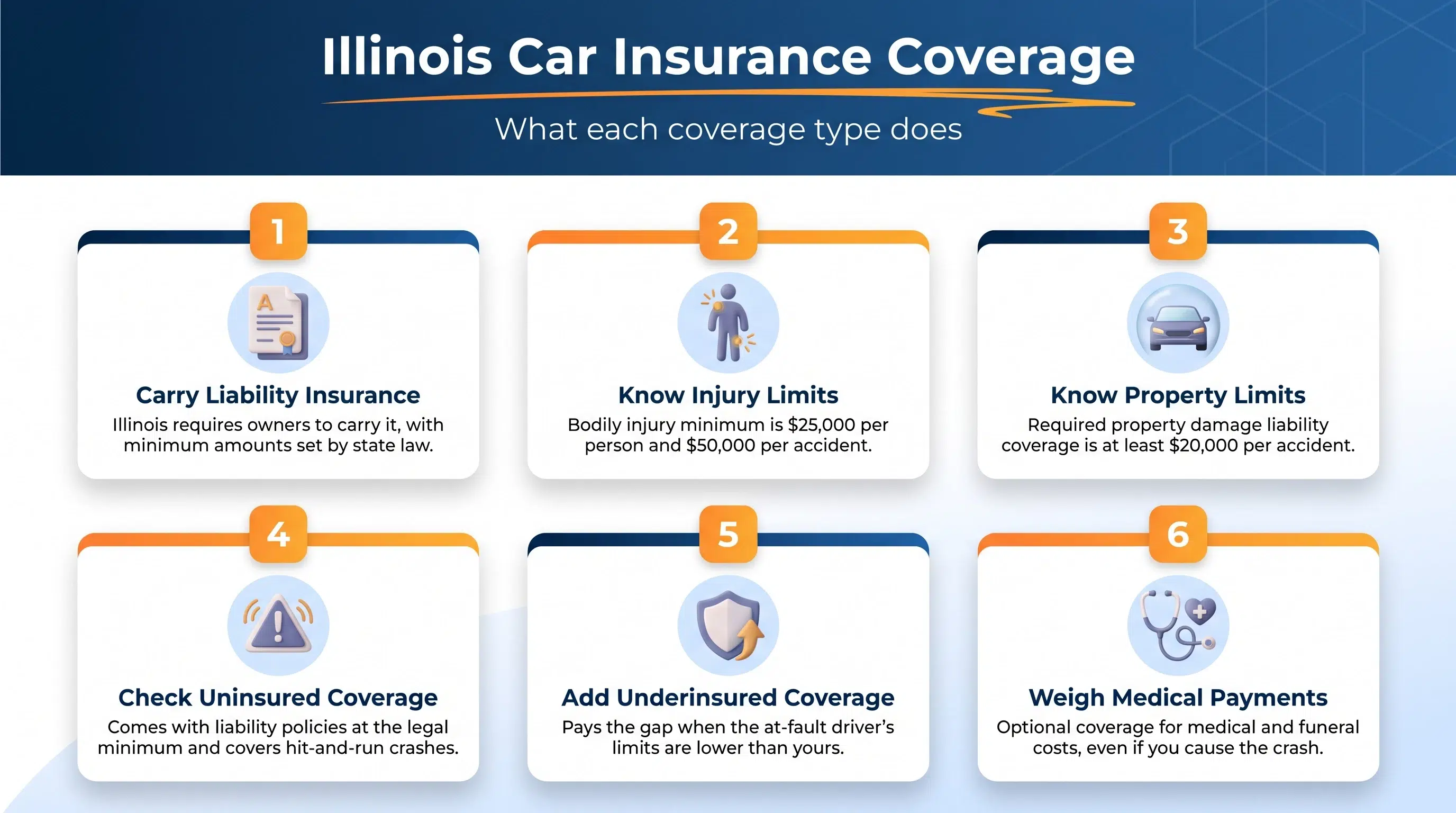
Illinois law requires vehicle owners to carry liability insurance under 625 ILCS 5/7-601, and 625 ILCS 5/7-203 sets the minimum amounts [1][9]. The required minimums are $25,000 per person and $50,000 per accident for bodily injury, and $20,000 for property damage [1].
|
Coverage |
Illinois status |
What it does |
|---|---|---|
|
Bodily injury liability |
Required: at least $25,000 per person / $50,000 per accident |
Pays for injuries the insured driver causes to others [1] |
|
Property damage liability |
Required: at least $20,000 per accident |
Pays for damage the insured driver causes to others’ vehicles or property [1] |
|
Uninsured motorist bodily injury (UM) |
Included on liability policies at the legal minimum |
Covers your injuries from a hit-and-run or uninsured at-fault driver [1][4] |
|
Underinsured motorist (UIM) |
Required when higher UM limits are purchased (215 ILCS 5/143a-2) |
Pays the difference between your UIM limits and the at-fault driver’s lower liability limits [1] |
|
Medical payments |
Optional |
Covers medical and funeral expenses for you and your passengers, even if you cause the crash [1] |
The state does not require collision, comprehensive, medical payments or uninsured property damage coverage [4]. Those are choices each policyholder makes.
What Legal Rules Apply?
Four Illinois rules shape most car accident claims: negligence, modified comparative fault, modified joint and several liability, and the statute of limitations.
Negligence. The injured person generally must show that the other driver owed a duty of care, breached it, and caused the claimed harm. Violating a traffic rule in the Illinois Vehicle Code (625 ILCS 5) may be relevant to that analysis, but it does not by itself decide every element of a civil claim [8].
Modified comparative fault (735 ILCS 5/2-1116). Illinois reduces an injured person’s recovery in proportion to that person’s own share of fault [3]. A plaintiff whose fault is more than 50 percent is barred from recovering damages, while a plaintiff at 50 percent or less recovers a reduced amount.
Modified joint and several liability (735 ILCS 5/2-1117). When more than one defendant is responsible, a defendant whose fault is less than 25 percent of the total is only severally liable for damages other than medical expenses, and defendants found liable are jointly and severally liable for medical expenses [10]. This matters in multi-vehicle crashes and in cases that also involve a vehicle owner, an employer, or a road condition.
Statute of limitations. Discussed below under deadlines.
How Does This Apply to a Real Case?
Hypothetical example, not a GoSuits case: A driver slows in stop-and-go traffic on the Kennedy Expressway and is rear-ended. The other driver carries Illinois minimum limits. In an at-fault state, the injured driver’s claim is generally presented to the rear driver’s liability insurer. If the injuries and bills exceed the available limits, the injured driver may also look to UIM coverage on their own policy, if they have it, and to any other responsible party [1].
Hypothetical example, not a GoSuits case: A driver turning left across oncoming lanes near Lake Shore Drive is struck by a car that may have been speeding. Each driver blames the other. The insurer for the speeding driver may argue the left-turning driver bears most of the fault. If a fact-finder assigned the injured person 20 percent of the fault, the damages would be reduced by that share. If it assigned more than 50 percent, recovery would be barred under 735 ILCS 5/2-1116 [3]. Small differences in how fault is assigned can therefore change the result significantly.
What Evidence Can Matter?
Because fault decides the claim, evidence about how the crash happened is central. Evidence does not automatically prove liability, but these categories often matter:
-
Police and crash reports. They usually record the parties, insurance information, the officer’s observations and any citations. Illinois State Police guidance describes when crash reports can be requeste [5]. Illinois repealed the separate written crash report drivers once had to file with the state, effective August 20, 2021 (Public Act 102-0560).
-
Photographs, video and dashcam footage. They can show vehicle positions, signals, lane markings and road conditions before they change.
-
Witness statements. Independent witnesses may help resolve disputes over who had the right of way.
-
Medical records and bills. They connect the injuries to the crash and document treatment, which supports the damages claim.
-
Employment and wage records. They support lost income and, in serious cases, reduced earning capacity.
-
Vehicle data and reconstruction analysis. Event data and engineering analysis may be used where speed, braking or impact angle is contested.
-
Insurance documents. Declarations pages show liability limits, UM/UIM coverage and medical payments coverage, which determine available sources of recovery.
-
Phone and messaging records. In some cases they bear on distracted driving, subject to discovery rules and privacy limits.
What Damages or Remedies May Be Available?
Recoverable damages in an Illinois negligence claim may include past and future medical expenses, lost income, loss of earning capacity, pain and suffering, loss of normal life, disfigurement and property damage. Recoverability depends on the facts, the evidence and applicable law. Nothing here predicts or guarantees any amount.
Illinois does not currently cap noneconomic damages in an ordinary negligence case. In Best v. Taylor Machine Works, 179 Ill. 2d 367 (1997), the Illinois Supreme Court held that a $500,000 statutory limit on noneconomic damages violated the Illinois Constitution [7]. Punitive damages may be available only in limited circumstances, such as willful and wanton conduct, and carry procedural requirements (Kelsay v. Motorola, Inc., 74 Ill. 2d 172 (1978); 735 ILCS 5/2-604.1).
Health insurers, and Medicare where applicable, may assert reimbursement rights against part of a recovery. The federal Medicare Secondary Payer provisions at 42 U.S.C. 1395y(b)(2) are the starting point for Medicare-related claims [12]. Lien handling often affects the net amount an injured person receives and should be reviewed by a lawyer.

What If the Other Driver Disputes Liability?
Disputed fault is common. The other driver or insurer may argue that the injured person was partly or mostly at fault, that the injuries were not caused by the crash, or that treatment was excessive. The Department of Insurance notes that an insurer may decide its insured was not more than 50 percent at fault and offer nothing [3].
From the defense side, comparative fault is a way to reduce or defeat a claim, and the 25 percent line in 735 ILCS 5/2-1117 can limit a minimally responsible defendant’s exposure for non-medical damages [10]. When a dispute cannot be resolved by negotiation, a lawsuit may be filed in the Circuit Court of Cook County at the Richard J. Daley Center for Cook County cases, or in the circuit court of the appropriate county. Venue and procedure require attorney review.
What If Insurance Is Involved?
Most Illinois claims involve more than one policy. The at-fault driver’s liability coverage is the usual first source. Your own policy may add UM or UIM coverage, and optional medical payments coverage pays regardless of fault [1].
If the at-fault driver is uninsured or leaves the scene, Illinois liability policies automatically include uninsured motorist coverage at the legal minimum for bodily injury or death [4]. If the at-fault driver has insurance but not enough, UIM coverage may help when it was purchased. Because liability minimums are $25,000 per person, a serious injury can exceed the at-fault driver’s limits quickly, so the injured person’s own policy can matter. UM and UIM claims are made against your own insurer, which can raise its own coverage disputes.
Illinois lawmakers recently changed how auto rates are reviewed. Senate Bill 714, signed on August 4, 2026, takes effect July 1, 2027 and concerns insurance rate oversight [11]. Reporting on that law indicates it does not change the minimum liability limits or Illinois’s fault rules. The minimums remain $25,000 per person, $50,000 per accident, and $20,000 for property damage under 625 ILCS 5/7-203.
How Long Do I Have to Act?
Deadlines in Illinois are strict, and missing one can end a claim regardless of its merit.
-
Bodily injury lawsuit: generally two years from the date of the accident under 735 ILCS 5/13-202. The Department of Insurance notes that a person under 18 when injured may have two years from the 18th birthday [2][6].
-
Property damage lawsuit: five years under 735 ILCS 5/13-205 [2][6].
-
Claims against a local public entity or its employees: one year under 745 ILCS 10/8-101, which may apply if, for example, a municipal vehicle or road condition is involved [6].
-
Wrongful death: generally two years after the death under 740 ILCS 180/2. Families dealing with a fatal crash may wish to speak with wrongful death lawyers promptly.
The Illinois Department of Insurance also states that you must either accept a final settlement or file suit within the applicable limitations period [2]. Exceptions, such as tolling or the discovery rule, are fact-specific and need attorney review.
What Should I Do Next?
-
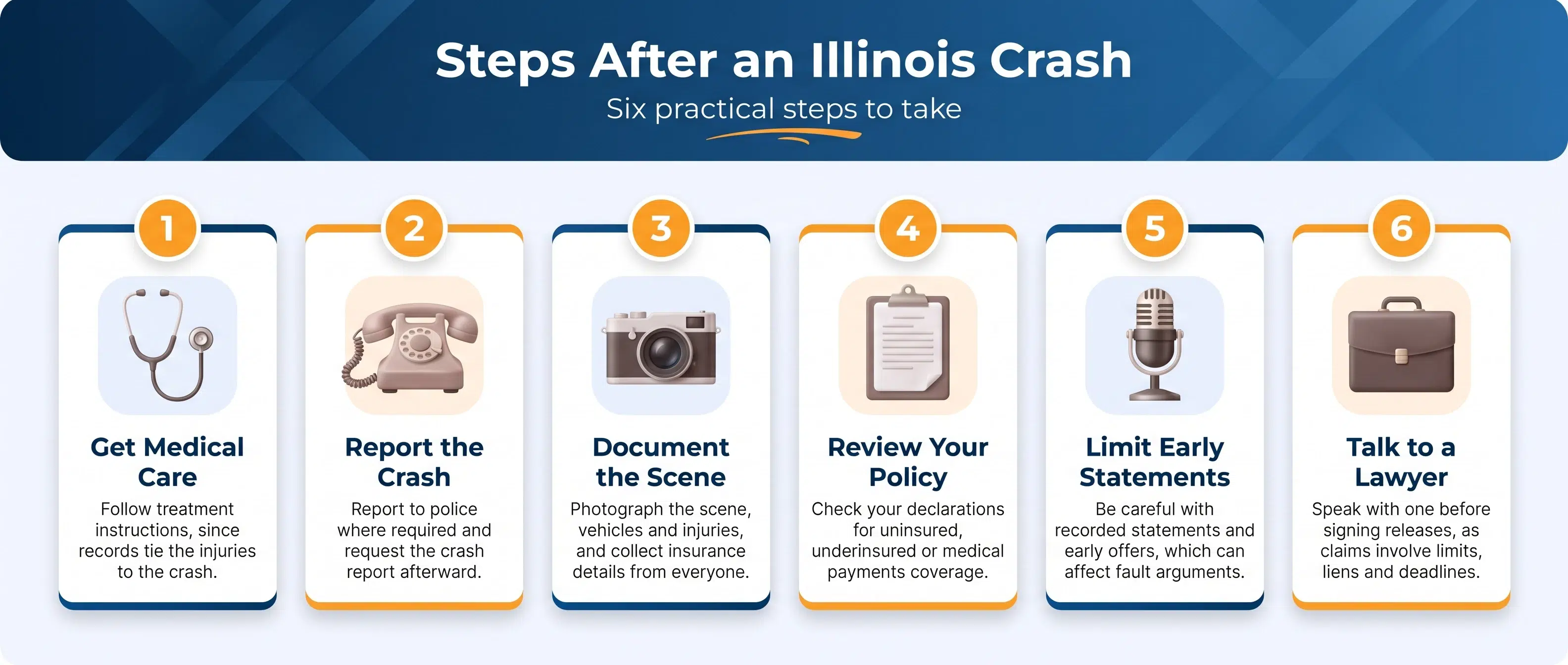
Get medical care and follow treatment instructions. Medical records tie the injuries to the crash.
-
Report the crash to police where required and request the crash report. Reporting thresholds are described by the Illinois State Police [5].
-
Photograph the scene, vehicles and injuries, and collect names and insurance details of everyone involved.
-
Gather your own policy declarations to see whether you have UM, UIM or medical payments coverage.
-
Be careful with recorded statements and early settlement offers. Statements about fault can be used in a comparative fault argument.
-
Speak with a lawyer before signing releases. Injury claims involve liability disputes, insurance limits, liens and deadlines, and handling them without legal help can put recovery at risk.
Related Illinois Personal Injury Resources
Crashes on the Eisenhower, Dan Ryan and Edens expressways, and across Cook, DuPage and Kane counties from Cicero to Naperville and Aurora, can involve more than one kind of claim. For related topics, see the GoSuits pages on truck crashes in the Chicago area, motorcycle crashes in Chicago, and Illinois rideshare accidents.
Talk With a GoSuits Attorney
An Illinois injury claim can involve fault disputes, insurance limits, liens and filing deadlines. If you were hurt in a crash, our Chicago personal injury team can review the circumstances and explain your options. Our Illinois personal injury lawyers handle questions about at-fault claims across the state, and you can schedule a free consultation to discuss your situation. Past results do not guarantee a similar outcome in any other matter.
When the other side is insured, a careful review of both drivers’ coverage often shows the car accident lawyers in Chicago working with the injured person which policies may apply. A conversation is not a promise of any result.
This article provides general information about Illinois law and is not legal advice. Laws change, and each case depends on its own facts. Reading this page does not create an attorney-client relationship.
References
-
Auto Insurance Shopping Guide – Illinois Department of Insurance
-
Filing a Claim with Another Driver’s Insurance Company – Illinois Department of Insurance
-
Mandatory Vehicle Insurance: If You Are Involved in a Crash – Illinois Secretary of State
-
Illinois Vehicle Code, 625 ILCS 5 – Illinois General Assembly
-
735 ILCS 5/2-1117 Joint Liability – FindLaw (secondary source)
-
Insurance Reform Delivers Consumer Protections for Illinois Drivers – Illinois Secretary of State